What is cordyceps? The insect-grown fungus in many mushroom coffees, and what the small human trials do and don't show
Cordyceps is a fungus named for the insects some species grow on, and it appears on many mushroom coffee labels. Human trials are few and small, results are mixed, and none tested a coffee. What to know before you buy.


Cordyceps sits on mushroom coffee labels next to lion’s mane, reishi and chaga, usually with a line about energy or stamina. We went looking for the human research behind it. What we found is a small, uneven pile, much of it in young, healthy people doing exercise tests.
The short answer
- Cordyceps is a fungus, not coffee, tea or a caffeine source.
- Human trials are few and small. The one crossover trial we read had 12 people.
- Results are mixed: a 2025 meta-analysis pooled small gains in endurance measures for one species, while a 2026 review of five studies called the findings inconsistent.
- We found no trial of a mushroom coffee, and we can’t say how much cordyceps any product holds.
What cordyceps actually is
Cordyceps is the common name for several fungi, mainly Ophiocordyceps sinensis (formerly Cordyceps sinensis) and Cordyceps militaris. The name comes from species that grow on insects. The NIH’s LiverTox entry (opens in a new tab) notes that extracts of both have been used in traditional Chinese medicine.
Two species, two sets of studies. The research below splits that way, and a label that says only “cordyceps” doesn’t tell you which one is in the bag. It also doesn’t say whether the fungus is a fruiting body, a mycelium or an extract. Our guide to reading mushroom coffee labels explains those terms.
Because it is a fungus, cordyceps isn’t a caffeine source on its own. The blend is a separate question, and our check of which mushroom coffees are actually caffeine-free found that products differ.
What the human research shows
Most of the cordyceps literature is laboratory work. For people, the questions asked have mostly been about exercise. Here is how big the human sources we read were:
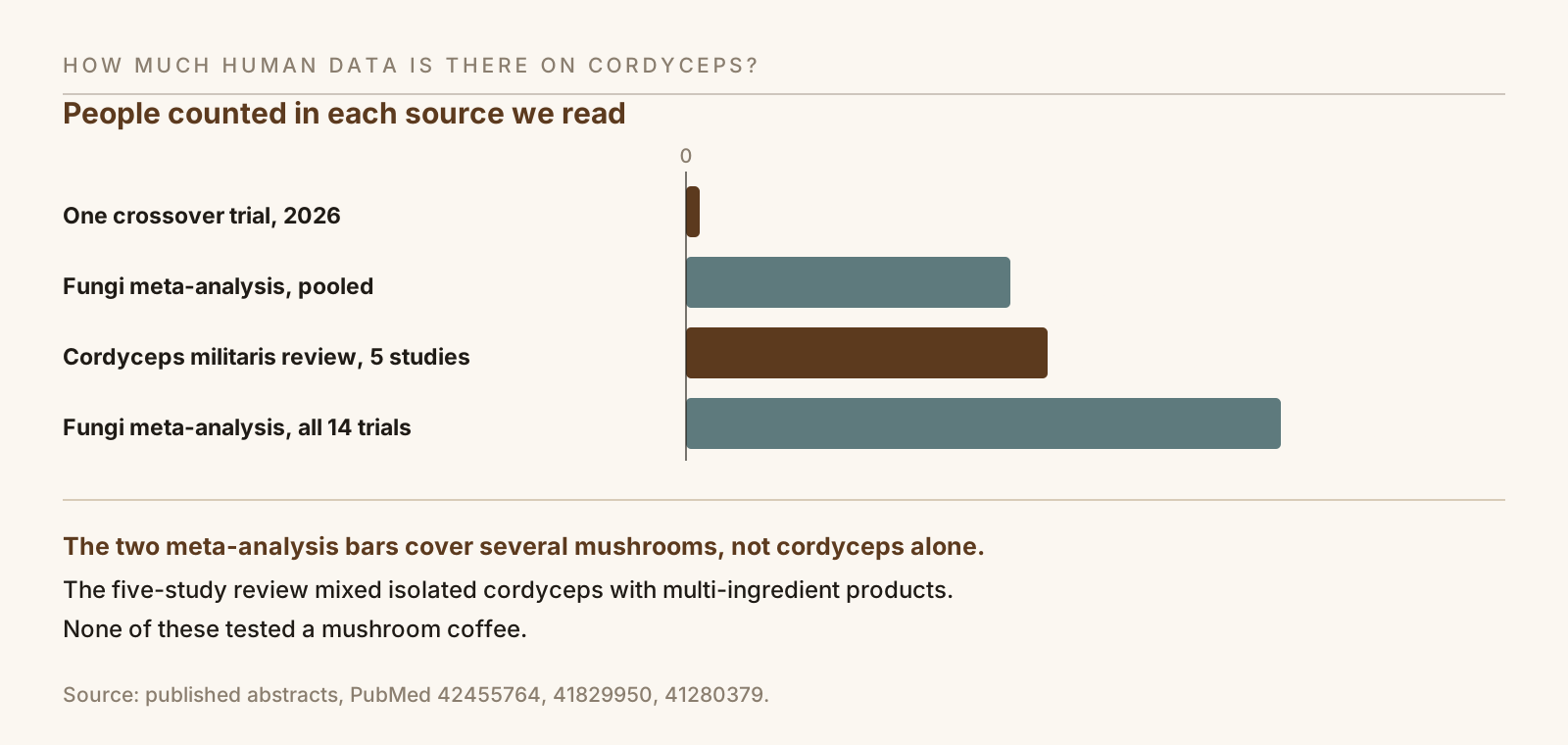
- Five studies of C. militaris, 2026. A narrative review (opens in a new tab) found five intervention studies published from 2017 to 2024, with 321 participants aged 16 to 35. Doses ran from 1 to 12 g a day for 1 to 16 weeks, some as isolated fungus and some inside multi-ingredient products. The authors say some studies reported improvements in selected measures, but the findings were inconsistent. They list small samples, unclear randomization, mixed products and no standardized preparations as limits.
- A meta-analysis across fungi, 2025. A systematic review (opens in a new tab) of 14 randomized trials in 528 athletes pooled eight of them (288 people). For C. sinensis it reported improvements in endurance performance (p = 0.05), ventilatory threshold (p = 0.03) and peak oxygen uptake (p = 0.04). Those p-values sit right at the usual cutoff, and the abstract doesn’t give effect sizes.
- One dose before a cycling test, 2026. A crossover trial (opens in a new tab) gave 12 recreationally active young men 1 g of C. militaris extract or a cornstarch placebo 30 minutes before a test to exhaustion. Reaction times after exercise were faster with the extract (about 964 ms versus 1,034 ms). Peak oxygen uptake, blood glucose, blood pressure and heart rate did not differ. The authors say the benefit was independent of the exercise effect.
Our reading, not the authors’: these studies use different species, forms, doses and tests, in small groups of mostly young, fit people. They can’t be stacked into one answer, and none tell you what a daily cup of a blend does. The honest summary is “interesting and unproven.”
Safety and who should ask first
The LiverTox entry says cordyceps extracts are generally well tolerated and haven’t been associated with serum aminotransferase elevations during use or with clinically apparent acute liver injury. That is a more reassuring line than the case-report concerns we covered for reishi and chaga. It is still a summary of limited data, not a guarantee.
We read abstracts, not the full papers, so anything they don’t state we’ve left out. If you take prescription medicines, are pregnant or nursing, or have a mushroom allergy, it’s worth asking your clinician before you add a mushroom product. We found no safety data for blended coffee.
How to read a mushroom coffee label for cordyceps
The label is where to look:
- Which species, and what form? Look for militaris or sinensis, and for fruiting body, mycelium or extract. A bare “cordyceps” leaves that open.
- Is an amount given? Many blends name a mushroom without its own quantity. That isn’t a mark against one product, but it means the label can’t tell you whether you’re getting anything like the 1 g and up doses used in these trials.
- What else is in the cup? Caffeine, other mushrooms and herbs all change what you’re drinking. Our piece on whether mushroom coffee helps anxiety covers why a single ingredient can’t carry the story.
For the wider picture, see adaptogens versus mushrooms, our look at lion’s mane, and the best mushroom coffee roundup.
The bottom line
Cordyceps is a fungus named for the insects some species grow on. The human research we read is small, centered on exercise tests in young healthy people, and mixed. It doesn’t show what a cup of mushroom coffee does. If you like the idea or the taste, it’s a reasonable ingredient to try, but check the label for species, form and amount, and ask your clinician first if you take regular medicines.
Sources & further reading
- Cordyceps (LiverTox: Clinical and Research Information on Drug-Induced Liver Injury) (opens in a new tab) — NIDDK LiverTox, updated 2026
- Current Evidence of Ergogenic and Post-Exercise Recovery Effects of Dietary Supplementation with Cordyceps militaris in Humans: A Narrative Review (opens in a new tab) — Nutrients, 2026
- Effects of fungal supplementation on endurance, immune function, and hematological profiles in adult athletes: a systematic review and meta-analysis (opens in a new tab) — Frontiers in Nutrition, 2025
- Acute Cordyceps militaris supplementation and elevated resting oxygen uptake with faster reaction times: a randomized crossover trial (opens in a new tab) — PLoS One, 2026
Reader conversation (4)
We read every response. Selected reader notes below.
My blend just says “cordyceps” with no species. Good to know that’s not enough to go on.
I run a few mornings a week and bought it for that. Twelve people in the one-dose trial is a useful reality check.
Thanks, Marcus. Small trials can still be worth reading, they just can’t carry a daily-cup conclusion on their own.
Appreciated that the two species were kept separate. Most articles lump them together.
Wish the meta-analysis had given effect sizes. A p-value of 0.05 doesn’t tell me much about whether it matters.
Read this and have a question or something to add? Send us a note. With your OK, we may publish it here with an editor's follow-up. We only publish notes you've said we can.