What is reishi? The glossy mushroom in many mushroom coffees, and the liver case reports behind its one real warning
Reishi (Ganoderma lucidum) is a woody mushroom with a long folk-medicine history. Case reports describe liver injury after reishi powder, a pooled analysis of 17 trials rated its evidence very low, and no one has tested a mushroom coffee. What to know before you buy.


Reishi turns up on a lot of mushroom coffee labels, usually next to chaga, lion’s mane and cordyceps. The usual write-ups either praise it or skip it. There is one safety finding worth knowing, and it comes from doctors’ case reports, not from marketing.
The short answer
- Reishi is a woody mushroom, not coffee, tea or a caffeine source.
- Published case reports describe liver injury after reishi powder, including one that was fatal.
- Those are single cases. They show a possible risk but can’t tell us how common it is.
- A pooled analysis of 17 trials rated the evidence on its effects as very low certainty.
- We found no report involving a blended mushroom coffee, and we can’t say how much reishi any product holds.
What reishi actually is
Reishi is the Japanese name for Ganoderma lucidum, called lingzhi in Chinese. It is a medicinal mushroom with a long history in traditional Asian medicine (opens in a new tab), sold as powder, extract, tea, capsules and a blend ingredient.
This article isn’t about benefits. The traditional use is real history, and that is as far as we’d go. What the trial evidence says is in a section below, and it is thinner than the marketing.
Because it’s a fungus, reishi on its own isn’t a caffeine source. The blend is a separate question, and our check of which mushroom coffees are actually caffeine-free found that products differ.
The liver case reports
The reports we read describe the same pattern: a person switched to reishi powder and developed liver injury.
- Hong Kong, 2004, and Thailand, 2005. A Thai report (opens in a new tab) describes a fatal case of sudden liver failure linked to reishi powder, and notes that a patient in Hong Kong had been described in 2004. Both patients had taken other therapeutic agents, and both had previously taken traditionally boiled reishi without any toxic effect. The problem appeared after they switched to powder for one to two months. The authors asked for close monitoring, especially alongside other drugs.
- California, 2023. A 47-year-old man (opens in a new tab) arrived at hospital with headache and abdominal pain after taking reishi powder and alcohol. He had acute liver injury, was treated with N-acetylcysteine and fluids, and at a two-week follow-up his symptoms and lab results had resolved.
Two details matter. Reishi was not the only exposure in either report: the earlier patients took other agents, and the 2023 patient drank alcohol. And the earlier patients had tolerated boiled reishi, so the form may matter. We read abstracts, not the full papers, so anything they don’t state we’ve left out.
What the trials show
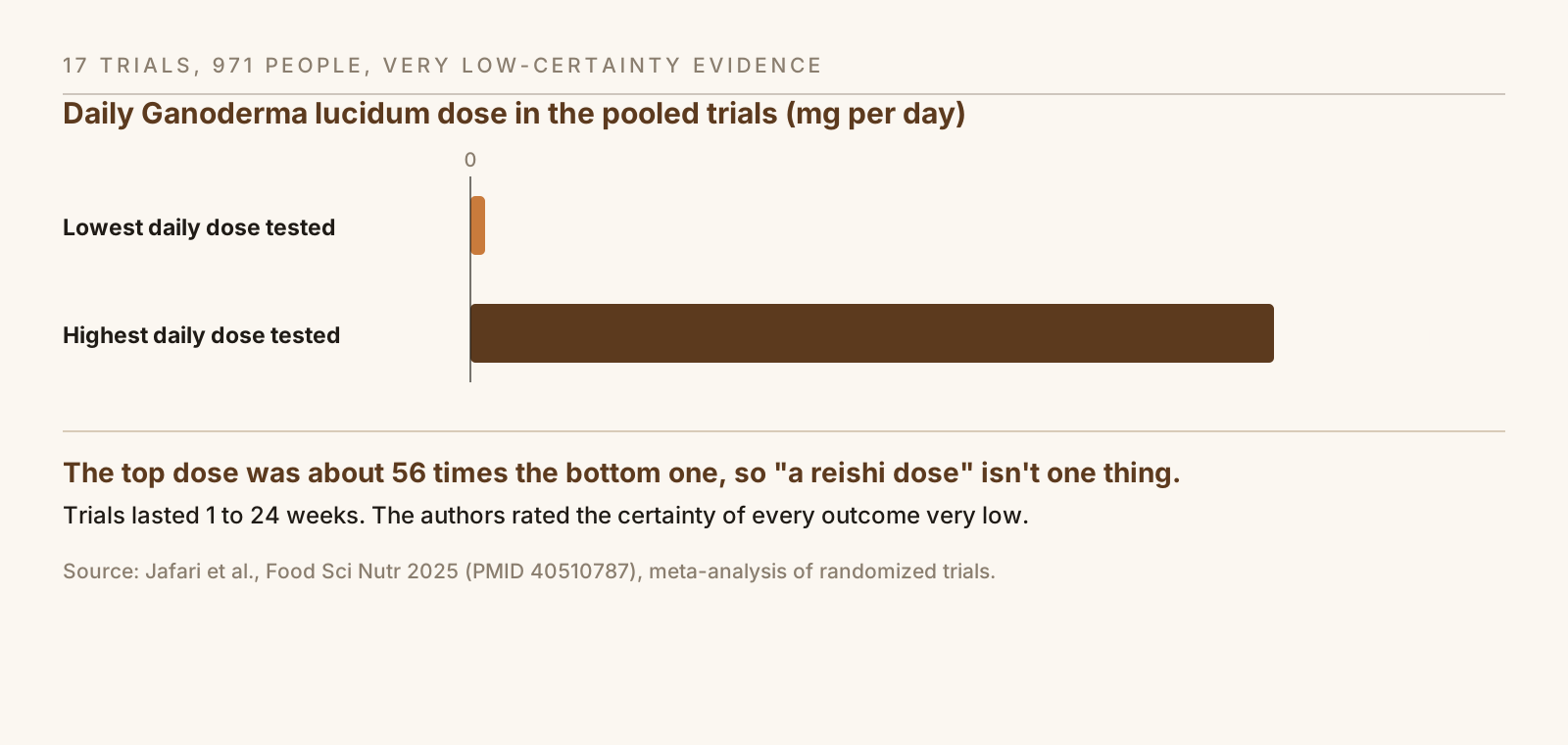
For a sense of the human evidence, we read a 2025 analysis pooling 17 randomized trials with 971 people (opens in a new tab). The trials gave reishi at anything from 200 mg to 11,200 mg a day, for 1 to 24 weeks.
What stands out:
- The changes were small. The authors reported statistically significant differences in body mass index, creatinine, an antioxidant enzyme and heart rate, and no significant effect on blood pressure, fasting glucose, blood lipids, inflammation markers or liver enzymes.
- The certainty was very low. The authors rated the quality of evidence very low for every outcome and concluded that any effects may be modest.
- The doses were all over the map. The top dose was about 56 times the bottom one, which is our arithmetic from their range. A pooled average can’t tell you what a cup of coffee does.
Our reading, not the authors’: a pooled finding of no significant change in liver enzymes is not the same as proof that rare liver injury can’t happen. Trials this size aren’t built to catch rare events, which is the job case reports do.
How to read a mushroom coffee label for reishi
If you have liver problems, drink alcohol regularly, or take prescription medicines, it’s worth a conversation with your clinician before adding reishi. Our pieces on coffee and the liver cover coffee itself, which is a different question.
For everyone else, the label is where to look:
- Is reishi listed, and in what form? Powder, extract and mycelium are different things. Our guide to reading mushroom coffee labels explains the terms.
- Is an amount given? Many blends name reishi without its own quantity. Teeccino’s Miraculous Mushrooms, for example, lists reishi among five mushroom extracts, and Rasa’s Original adaptogenic herbal coffee lists it too. A listing with no separate amount isn’t a mark against one product, but it does mean the label can’t answer how much you’re getting.
- How much else are you taking? The more mushroom products you stack, the less a single label tells you.
For the wider picture on blends, see adaptogens versus mushrooms, our recent look at chaga and our best mushroom coffee roundup.
The bottom line
Reishi is a woody mushroom with a long folk-medicine history. The firm safety signal we found is a small set of liver case reports involving plain powder, and the best pooled trial evidence is rated very low certainty. That’s a reason to be careful with powder and to check labels, not a verdict on a cup of mushroom coffee. If you have liver concerns or take regular medicines, ask first.
Sources & further reading
- Fatal fulminant hepatitis associated with Ganoderma lucidum (Lingzhi) mushroom powder (opens in a new tab) — Journal of the Medical Association of Thailand, 2007
- Ganoderma lingzhi (Reishi mushroom)-induced acute liver injury in the setting of alcohol use: a case report and review of the literature (opens in a new tab) — Cureus, 2023
- The nutritional significance of Ganoderma lucidum on human health: a GRADE-assessed systematic review and meta-analysis of clinical trials (opens in a new tab) — Food Science & Nutrition, 2025
Reader conversation (4)
We read every response. Selected reader notes below.
I take a reishi capsule most evenings and never thought about the powder-versus-boiled difference. Going to mention it to my pharmacist at my next refill.
A pharmacist is a good person to ask, Marian. The reports are few, so this is about being informed rather than alarmed.
Thanks for saying plainly that the trial evidence is rated very low. Most pages I find on this go straight to the benefits list.
Checked my tin. Reishi is listed but there is no amount for it, just a total for the blend. Now I know what to look for.
The note that alcohol was part of the 2023 case is useful. I do not think many people connect the two.
Read this and have a question or something to add? Send us a note. With your OK, we may publish it here with an editor's follow-up. We only publish notes you've said we can.