Which mushroom coffees are actually caffeine-free? We read the labels, and most of them are coffee
We checked what every major mushroom coffee brand publishes about its own caffeine content, on its own pages. Most of these products contain coffee and say so. One contains no coffee and still isn't caffeine-free. One is sold under the words 'Caffeine Free' while its first ingredient is coffee. Here is the whole shelf, with each brand's own figure attached.
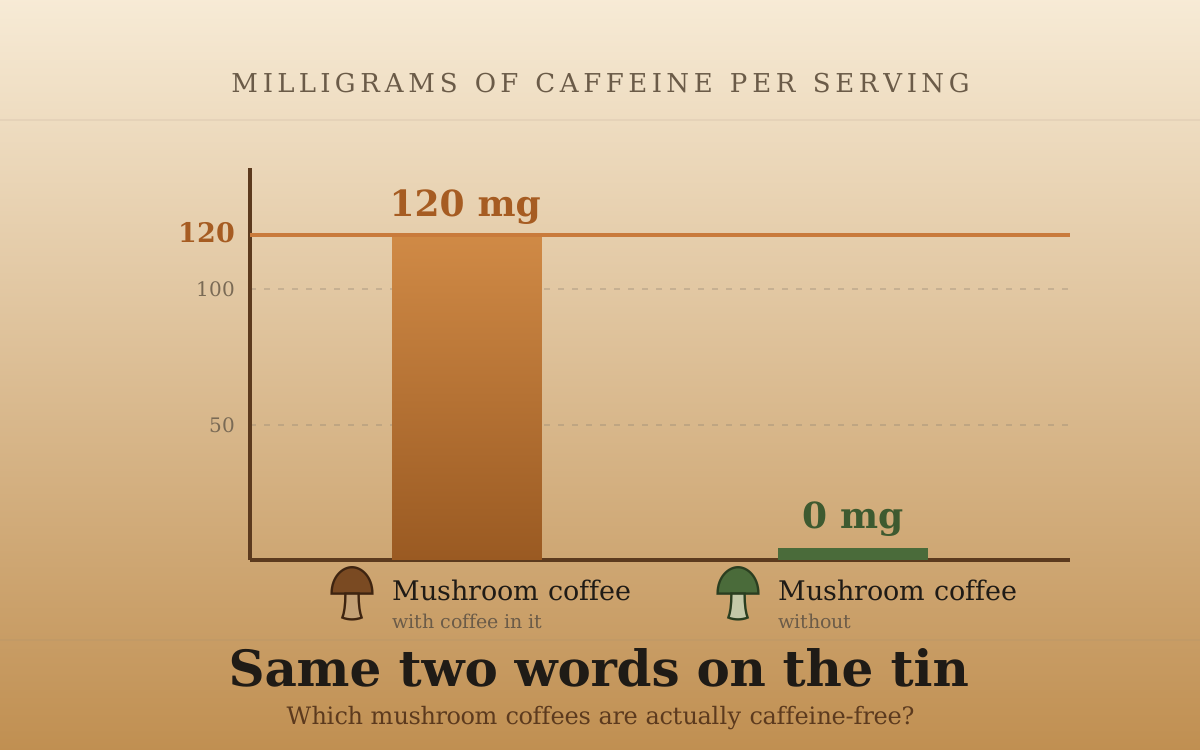
RYZE answers this question on its own ingredients page, in five words, before anyone else gets a chance to spin it:
“Yes, RYZE Mushroom Coffee is coffee.”
That sentence is the honest centre of this whole category, and it is worth sitting with for a second, because a great many people arrive at mushroom coffee having been told it is the thing you drink instead of coffee. Some of it is. Most of it isn’t. And there is no reliable way to tell which is which from the front of the pack.
So we did the boring version of this article: we went to every major brand’s own pages and wrote down what the brand itself says about its own caffeine. No third-party listicles, no retailer copy, no estimates of our own. Where a brand publishes a number, it is below with its name on it. Where a brand publishes nothing, that absence is recorded too, because on this question an absence is information.
The short answer
Across the products we could verify from primary sources, published caffeine content runs from 0 mg to 120 mg per serving.
That is not a spread within a category. That is two different drinks wearing the same name. At the top, Om Mushroom’s coffee blend publishes 120 mg per 8 oz serving — more caffeine than plenty of ordinary brewed coffee. At the bottom, MUD\WTR Rest and Rasa Original both publish a flat zero and have ingredient lists that back it up.
Three things follow, and the rest of this article is the evidence for them:
- “Mushroom coffee” is usually coffee. The mushrooms are an addition, not a replacement. Brands are mostly candid about this; the confusion is in the category name, not in the fine print.
- “Contains no coffee” and “contains no caffeine” are different claims. Tea and cacao are also caffeine sources, and at least one popular blend is caffeine-free of coffee and not caffeine-free of caffeine.
- The ingredient list is more reliable than the front of the pack — not because brands lie, but because US labelling law asks almost nothing of them here.
If you want the mushrooms without the stimulant, you are shopping for a small subset of this category, and you have to shop for it deliberately.
What a US label has to tell you — and what it doesn’t
This is the structural fact that explains everything else, and it comes straight from the FDA:
“All packaged foods are required to list caffeine in the ‘list of ingredients’ when it is added to products as a stand-alone ingredient.”
“When a packaged food contains an ingredient – such as chocolate chips – that inherently contains caffeine, then caffeine will not appear on the list of ingredients. However, the caffeine-containing ingredient (for example, chocolate) will be listed.”
Read that twice. In a mushroom coffee, the caffeine is essentially never added as a stand-alone ingredient — it arrives inside the coffee, the tea or the cacao. Which means the word “caffeine” will usually not appear on the label of a caffeinated mushroom coffee at all. Its absence tells you nothing.
Nor is the amount required. The FDA notes only that many companies choose to publish it:
“Many packaged foods, including beverages and dietary supplements containing caffeine, voluntarily provide information on the label as to how much caffeine they contain.”
Voluntarily. That is the whole regime. A brand that publishes 120 mg and a brand that publishes nothing are both fully compliant, and the one that publishes the big honest number is doing you a favour it is under no obligation to do.
There is a related gap worth knowing if you drink these out of the house: the same FDA page says restaurants and retail food establishments “are not required by law to tell you how much caffeine is in the products they serve.”
The six words to look for
Caffeine is made by a small handful of flowering plants. Fungi are not among them — caffeine is not a fungal metabolite, and no mushroom in any of these products is contributing any. (The one footnote: researchers have measured oyster mushrooms absorbing caffeine when cultivated on spent coffee grounds, at levels that would amount to a milligram or two in a normal dose. Real, published, and not something to shop around.)
So there are six words to scan an ingredient list for. If none of them are present, you are almost certainly at zero:
| Ingredient | Why it’s there | Rough caffeine load |
|---|---|---|
| Coffee (incl. “instant coffee”, “Arabica”) | It’s the base of most of the category | The dominant source, by far |
| Tea — black, green, matcha | Flavour, or a gentler stimulant angle | Moderate, and real |
| Cacao / cocoa | Chocolate flavour and body | Small but not zero |
| Yerba mate | Energy positioning | Substantial |
| Guayusa | Energy positioning | Substantial |
| Kola nut / guarana | Energy positioning | Substantial |
Two traps in that list. “Decaf coffee” is still coffee — more on that below. And rooibos is not tea; despite usually being sold as “rooibos tea”, it comes from a different plant entirely and is genuinely caffeine-free. Seeing it in a list is not a red flag.
Cacao deserves its own note, since it turns up constantly in this category and gets waved through. USDA’s reference figure for unsweetened cocoa powder is 230 mg of caffeine per 100 g — about 2.3 mg per gram. So a couple of grams of cocoa in a drink is a few milligrams of caffeine: worth knowing if you are counting to zero, irrelevant as a stimulant. The compound doing most of the work in cacao is theobromine, which USDA puts at 2,057 mg per 100 g — nine times the caffeine, and a different molecule with different effects.
What each brand publishes about itself
Every figure below is the brand’s own, taken from its own site, checked in August 2026. Blank means the brand publishes no figure that we could find.
| Product | Caffeine source in the ingredient list | Brand’s own figure |
|---|---|---|
| Om Mushroom Coffee Blend | Coffee | 120 mg / 8 oz |
| Om Mushroom Coffee Latte Blend | Coffee | 116 mg / 8 oz |
| Everyday Dose Coffee+ Medium Roast | Coffee | 90 mg |
| RYZE Mushroom Coffee Dark Roast | Coffee | “about 80–90 mg” |
| Four Sigmatic Focus Ground Coffee, Dark | Organic dark roast Arabica coffee | labelled “Regular Caffeine” |
| RYZE Mushroom Coffee (original) | 100% Arabica coffee | “about 48 mg” |
| Everyday Dose Coffee+ Mild Roast | Coffee | 45 mg |
| MUD\WTR Original | Cacao and black tea — no coffee | “around 35 mg” |
| Rasa Dirty | Coffee (first ingredient) | 35 mg |
| La Republica Decaf Mushroom Coffee | Decaffeinated instant Arabica coffee | none published |
| Teeccino Miraculous Mushrooms Adapt & Protect | none, beyond cacao powder last in the list | none published; labelled caffeine free |
| Rasa Original | none | 0 mg |
| MUD\WTR Rest | rooibos only, which is caffeine-free | 0 mg |
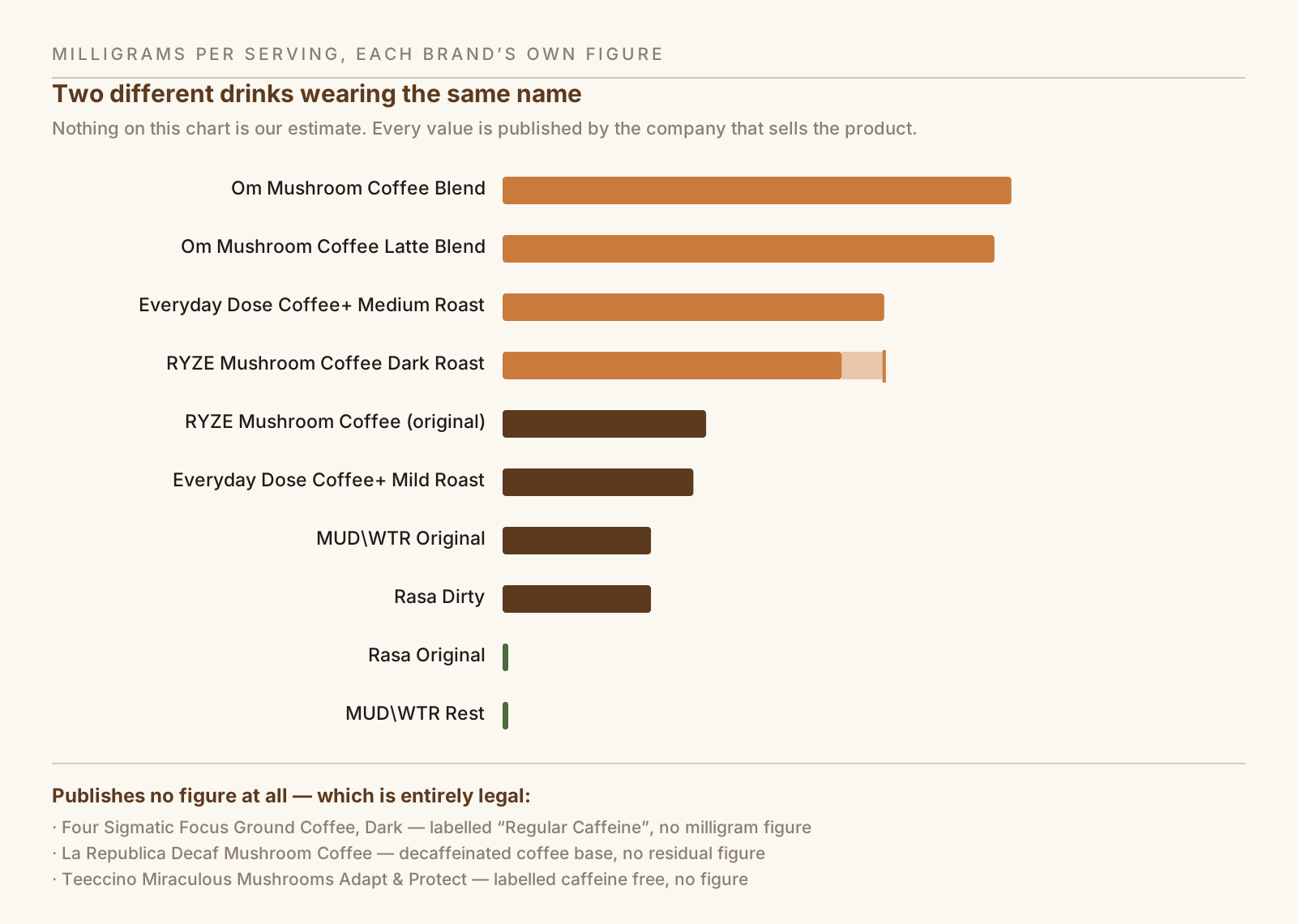
The shape of that chart is the article. There is no clustering, no category norm, no safe assumption. A shopper who reaches for “a mushroom coffee” without checking is picking somewhere on a range from nothing to more than a cup of coffee.
Worth saying plainly: Everyday Dose and Om come out of this well, and for opposite-looking reasons. Everyday Dose puts a caffeine-per-serving table on its ingredients page with 45 mg and 90 mg stated next to its comparison figure for regular coffee. Om publishes 120 mg — the highest number in this article — on its own blog, under a headline asking how much caffeine is in mushroom coffee. Neither had to. Publishing an inconvenient number is the behaviour you want from a brand, and it should not go unremarked just because the number is high.
No coffee in it, still not caffeine-free
MUD\WTR Original — the blend previously sold as :rise, which we reviewed under that name — is the cleanest illustration in the category of why “coffee-free” is the wrong question.
Its ingredient list, verbatim:
“Organic Mushroom Blend (Chaga, Reishi, Lion’s Mane and Cordyceps Mushrooms and Mycelium cultured on Organic Oats and/or Organic Sorghum), Organic Cacao, Organic Spice Blend (Organic Cinnamon, Organic Turmeric, Organic Ginger, Organic Cardamom, Organic Black Pepper, Organic Nutmeg, Organic Cloves), Organic Black Tea Powder, Himalayan Pink Salt”
No coffee anywhere in it. And the brand’s own figure is “around 35 mg of caffeine per serving” — because of the cacao and, mostly, the black tea powder.
Thirty-five milligrams is not much. It is roughly a cup of black tea. But if you are avoiding caffeine because of sleep, anxiety, a pregnancy, or a medication interaction, 35 mg is not zero and you should get to decide that knowingly. A reader who assumed “no coffee beans” meant “no caffeine” would have got this wrong, and it is an entirely reasonable thing to have assumed.
The same brand’s Rest blend is the control case: turkey tail and reishi, lucuma, rooibos extract, spices, valerian, passionflower, ashwagandha, chamomile — and 0 mg. Same company, same shelf, same visual language, two completely different answers.
“Decaf” is not “caffeine-free”, and the FDA says so
The FDA gives this its own heading on the page we have been quoting: “‘Decaffeinated’ Does Not Mean Caffeine-free.” Underneath it:
“Decaffeinated coffees and teas have less caffeine than their regular counterparts, but still contain some caffeine. For example, decaf coffee typically has 2 to 15 milligrams in an 8-fluid-ounce cup.”
We have written about that gap before, and it is normally a small, forgivable imprecision. In this category it becomes something sharper.
La Republica sells a product called Decaf Mushroom Coffee. Its ingredient list is “USDA Organic Fair-Trade Arabica instant coffee, organic mushroom high-extracts.” Its own copy describes it as “water-processed DECAFFEINATED Organic Mushroom Coffee” offering “the full coffee experience — bold taste, zero jitters” and a blend “delivering a satisfying and invigorating experience without the caffeine.”
And the page’s own title — the text that shows in a browser tab and in a Google result — reads: “Caffeine Free Mushroom Coffee – La Republica Superfoods.”
We want to be careful and fair about what that is and isn’t. The product page does not hide the coffee: it is the first ingredient, and the body copy says “decaffeinated” repeatedly. Nobody is being deceived about what is in the tin. But the phrase carrying it into search results is “Caffeine Free,” and no residual figure is published anywhere on the page — so a reader who needs actual zero has no way to satisfy themselves from the label, and the search result they clicked told them the answer was zero before they arrived.
“Caffeine-free” is not a defined nutrient content claim in US food labelling the way “fat free” or “sugar free” are — there is no threshold it has to clear. That is exactly why it needs to be used carefully by the people who use it, and read sceptically by everyone else.
“Half the caffeine of coffee” — half of what?
This is the claim the whole category leans on, and it has a hole in the middle: nobody agrees what a cup of coffee contains.
Here are the denominators, all from the pages we checked:
- Everyday Dose puts “Regular Coffee — 200mg” in its comparison table, and elsewhere on the same page describes a standard 8 oz brewed coffee as “roughly 95–200mg depending on bean, grind, and pour.”
- RYZE says its original blend’s “about 48mg of caffeine” is “less than half the amount that’s in a regular cup of coffee” — which puts their working figure somewhere north of 96 mg.
- RYZE again, on the Dark Roast page, says “about 80-90 mg of caffeine, about the same amount as a regular cup of coffee” — which puts a regular cup at about 85 mg.
- The FDA gives 113 to 247 mg for regular brewed non-specialty coffee, though note that is per 12 fluid ounces, not the 8 oz most brands quote.
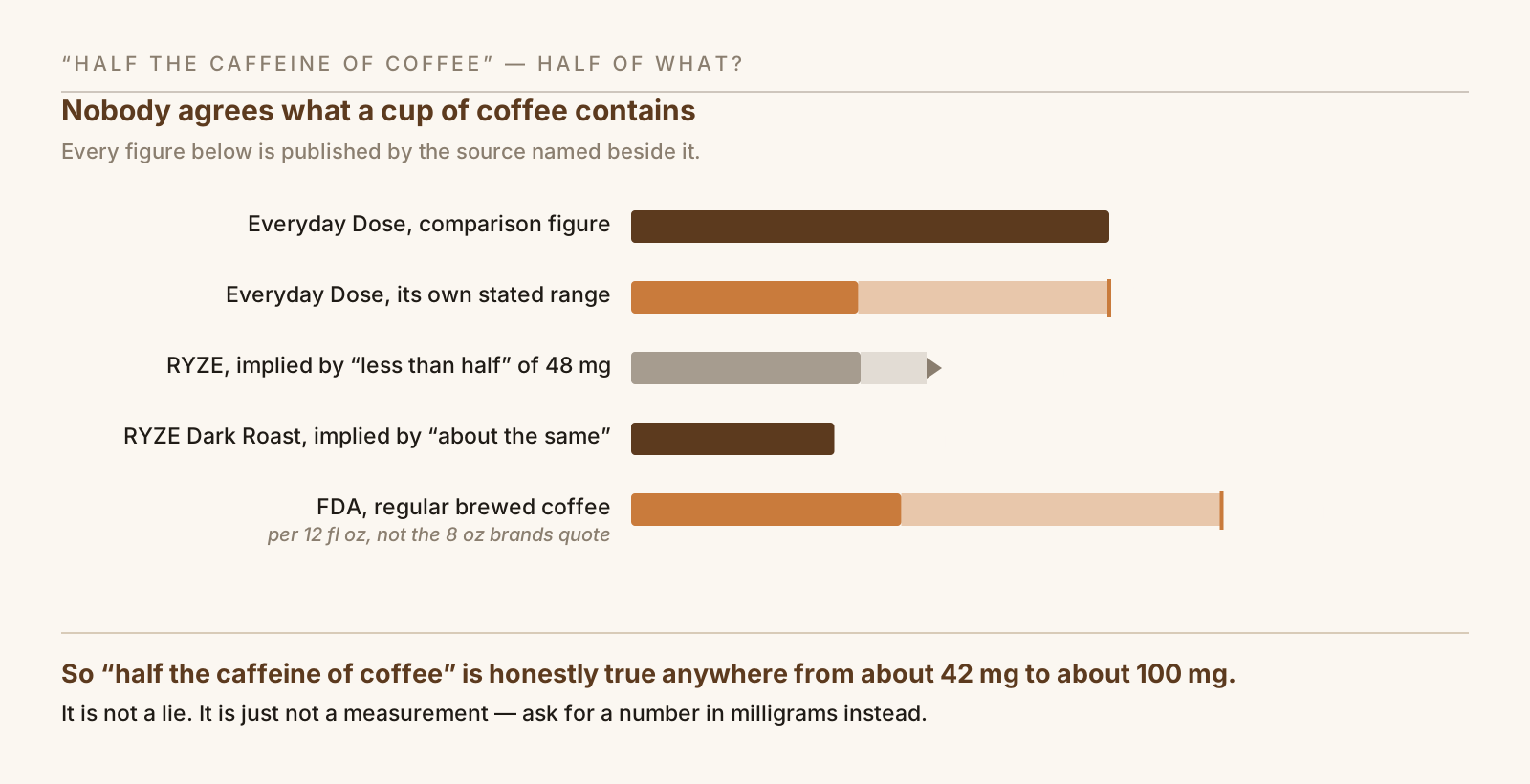
So “half the caffeine of coffee” is a true statement across a range of about 42 mg to 100 mg, depending entirely on a number the brand chooses and does not have to disclose. It is not a lie. It is just not a measurement, and you cannot plan a caffeine intake around it.
There is a smaller wrinkle on the RYZE Dark Roast page worth noting, because it shows how easily this drifts. The FAQ says 80–90 mg, “about the same amount as a regular cup of coffee.” The product description that travels with that same item — the copy that follows a product into carts, feeds and listings — ends with the line “All with less than half the caffeine of regular coffee.” Both are on the same product; they cannot both be right. This looks like category boilerplate that didn’t get updated for a full-strength SKU rather than anything deliberate, and the FAQ number is clearly the one to trust. But it is a good illustration of why the specific figure beats the comparative phrase every time.
The practical rule: ignore any claim shaped like “less than coffee” and look for a number in milligrams. If there isn’t one, treat the product as unquantified.
The ones that really are zero
Short list, and it holds up on both tests — the brand publishes zero (or claims caffeine-free), and the ingredient list contains none of the six words.
Rasa Original — roasted chicory, burdock, shatavari, dandelion, eleuthero, codonopsis, date seed, maca, cinnamon, ashwagandha, rhodiola, chaga mycelium, reishi extract. Published figure: 0 mg. It is a roasted-root blend with mushrooms in it rather than a coffee, and the ingredient list is consistent with the claim. Note that its stablemate Dirty Rasa leads with coffee and publishes 35 mg — same brand, near-identical packaging, one letter of difference in the name.
MUD\WTR Rest — 0 mg, and the only tea-ish thing in it is rooibos, which doesn’t count.
RYZE Mushroom Chicory — described by RYZE as having “zero caffeine,” and positioned on their site with the line “Caffeine free? No problem.” We could not obtain a full ingredient declaration for this one in text form, so it clears the claim test but we could not run the ingredient test ourselves.
Teeccino Miraculous Mushrooms Adapt & Protect — labelled caffeine free, and the ingredient list is “Carob pods, chicory, ramón seed, proprietary blend of organic wellness mushrooms (Chaga extract, Lion’s Mane extract, Reishi extract, Turkey Tail extract, Cordyceps extract), natural flavors, cacao powder.” No coffee, no tea. We reviewed it last week, and the caveat we raised there applies double here: the family name is not the answer. Two other products in the same Miraculous Mushrooms line — the Cacao + 5 instant and the Matcha Latte — are not caffeine-free, and the matcha one is squarely in green-tea territory. If you are buying for zero, buy the SKU, not the range.
That last point generalises to the whole shelf and is probably the single most useful habit to take away. Brands do not have caffeine statuses. Products do. MUD\WTR, RYZE, Rasa and Teeccino each sell both caffeinated and caffeine-free items under one visual identity.
The edge cases, including two we can’t fully resolve
Two products where an honest label read produces a question rather than an answer. We are including them because pretending the method always terminates cleanly would be the dishonest thing.
Teeccino Adapt & Protect lists cacao powder. It is last in the declaration, which under US labelling convention means it is the smallest component by weight. At USDA’s 2.3 mg of caffeine per gram of cocoa powder, a fraction of a gram of cacao contributes a fraction of a milligram — genuinely negligible, and nowhere near enough to matter to anyone. But the brand publishes no residual figure, so we are reasoning from ingredient order rather than from a measurement, and we would rather say that than imply we counted. If you are avoiding caffeine for a medical reason and need a number rather than an inference, ask the manufacturer.
Clevr Blends’ Golden SuperLatte is badged “Caffeine-free” and answers its own FAQ with “This blend is caffeine-free!” — while its ingredient list ends “…Himalayan Pink Salt, Tocopherols, Green Tea Extract, Probiotic.” Green tea extract sitting immediately beside tocopherols, at the very end of a list, is the classic signature of an antioxidant preservative rather than a tea ingredient, and decaffeinated green tea extract is routinely used that way. That is almost certainly what is happening. But the page does not say so, and a caffeine-sensitive reader scanning that panel has no way to reach that conclusion unaided.
Both cases point the same direction: the ingredient-list method gets you a long way and then hands you a phone number. For most people, most of the time, a trace from a flavour or preservative ingredient is not worth a second thought. For a small number of readers — a genuine sensitivity, an arrhythmia, a pregnancy where you have decided on zero rather than “low” — the difference between “negligible” and “measured” is the whole point, and the only way across it is to ask.
How to check any product in about a minute
- Skip the front of the pack. “Clean energy”, “no jitters”, “gentle lift” and “smooth focus” are not caffeine claims and carry no information about caffeine.
- Read the ingredient list for the six words — coffee, tea, cacao, mate, guayusa, kola. Remember rooibos doesn’t count, and “decaf coffee” does.
- If none appear, you are almost certainly at zero.
- If any appear, find a milligram figure. Many brands publish one; it is often on an ingredients or FAQ page rather than the product page itself, which is where several of the numbers in this article were hiding.
- If there is no figure and you need one, email the brand. A company that can tell you within a day is a company that knows its own product; a vague answer is itself an answer.
- Re-check when you reorder. Formulations change, product lines get renamed — MUD\WTR’s
:risebecame Original, Four Sigmatic’s Think became Focus — and a caffeine-free product is frequently one shelf away from a caffeinated sibling with nearly identical packaging.
None of this is an argument against mushroom coffee. If you like the drink and caffeine isn’t your problem, a 45 mg cup with lion’s mane in it is a perfectly reasonable thing to enjoy, and we have covered what the research does and doesn’t support about the mushrooms themselves and how adaptogens and functional mushrooms differ elsewhere. Our broader mushroom coffee roundup is the place to start if flavour is what you’re optimising for.
But if you came to this category specifically to get off caffeine — and a great many people do, because “mushroom coffee” sounds like the answer to that question — then you are shopping in a much smaller aisle than the marketing implies, and the ingredient list is the only tool that reliably works. Twelve seconds on the back of the pack. That is the whole method.
Sources & further reading
- Spilling the Beans: How Much Caffeine is Too Much? — FDA consumer update on caffeine labelling and decaffeinated products (opens in a new tab) — U.S. Food and Drug Administration
- FoodData Central — Cocoa, dry powder, unsweetened (FDC ID 169593), caffeine and theobromine per 100 g (opens in a new tab) — USDA Agricultural Research Service
- RYZE — ingredients page, including the brand's own caffeine figure (opens in a new tab) — RYZE Superfoods
- RYZE — Mushroom Coffee Dark Roast product page (opens in a new tab) — RYZE Superfoods
- MUD\WTR — Original blend, ingredient list and caffeine figure (opens in a new tab) — MUD\WTR
- MUD\WTR — Rest blend, ingredient list and caffeine figure (opens in a new tab) — MUD\WTR
- Om Mushroom Superfood — how much caffeine is in Om's coffee blends (opens in a new tab) — Om Mushroom Superfood
- Everyday Dose — ingredients page, caffeine per serving table (opens in a new tab) — Everyday Dose
- Rasa — Original blend, ingredient list and caffeine figure (opens in a new tab) — Rasa
- Rasa — Dirty blend, ingredient list and caffeine figure (opens in a new tab) — Rasa
- La Republica — Decaf Mushroom Coffee product page (opens in a new tab) — La Republica Superfoods
- Four Sigmatic — Focus Ground Coffee, Dark (opens in a new tab) — Four Sigmatic
- Teeccino — Miraculous Mushrooms Adapt & Protect Herbal Coffee (opens in a new tab) — Teeccino
Reader conversation (5)
We read every response. Selected reader notes below.
I switched to a mushroom coffee eight months ago on the strength of a friend telling me it was “basically caffeine-free,” and I have spent those eight months quietly confused about why my sleep never improved. It’s a coffee. It says so on the brand’s own page, which I have now read for the first time. I feel a bit stupid but mostly I feel annoyed, because at no point did anything I was shown while buying it use the word coffee in a way I registered.
Please don’t feel stupid — the category name is doing the work here, not you. “Mushroom coffee” is read by almost everyone as a thing that replaces coffee, and the brands are mostly not hiding the coffee so much as relying on that reading. The specific thing that would have saved you eight months is a habit rather than knowledge: ingredient list first, front of pack never. It takes twelve seconds and it would have told you on day one.
Worked in food regulatory affairs for a long time and I want to put a slightly less cynical gloss on the “publishes no figure” column. Publishing a caffeine number commits you to it across every batch, every crop year and every supplier change, and for a botanical input that varies naturally you are then either testing every lot or exposed. That is a genuine reason a careful company might decline, and it is not the same as hiding something. Your framing was fair, but I’d add that the brands publishing a number are taking on a real obligation, not just being nice.
That’s a better explanation than the one I had and I’m glad it’s in the thread. It also sharpens the Om point rather than softening it — publishing 120 mg means owning 120 mg, and they did it on a page whose headline invites the comparison. If lot-to-lot variation is the real constraint, then the most useful thing a brand could publish is a range with a method attached, which nobody in this category currently does.
Small note from this side of the Atlantic: the labelling situation isn’t the same here. My understanding — and I’m going from packs in my own cupboard rather than from the regulation — is that drinks above a certain caffeine concentration have to carry an explicit warning naming pregnancy and children, which means some of these products would arrive in a UK shop looking quite different from how they look in yours. Might be worth a look, because “read the ingredient list” is good advice everywhere but the amount of help you get from the label clearly isn’t constant.
This is a real gap in the piece and I’d rather say so than paper over it — everything above is US labelling, and I wrote it as though that were the whole world. I’m not going to repeat your recollection as fact until I’ve read the actual rule, but if it holds up then a straight comparison of what the same tin has to tell you in three jurisdictions is a genuinely useful article that nobody has written. It’s going on the list with your name on it.
Devil’s advocate: is 35 mg actually worth this much scrutiny? That’s a cup of tea. Half the people reading this have a square of dark chocolate after dinner and don’t think about it. I take the point about the products at 120 mg, which are genuinely mislabelled by implication, but the middle of your table feels like a lot of alarm about a trivial dose.
Fair challenge, and for most readers you’re right — 35 mg is not a health event and we deliberately didn’t call it one. The reason it still matters is that the people who arrive at this category are disproportionately not most readers. Someone tapering, someone with an arrhythmia, someone who has decided on zero during a pregnancy rather than on “low” — for them the difference between 0 and 35 is the entire decision, and they currently can’t make it from the front of the pack. The scrutiny is about who gets to choose, not about the size of the number.
The line that landed hardest was that brands don’t have caffeine statuses, products do. I bought the wrong one out of a range I’d already checked, because I checked it once a year ago and then trusted the packaging shorthand ever after. Same colours, same logo, one word different in the name. That’s not a labelling failure exactly, but it is a design decision somebody made.
Have something to add? Email us and we may include it in a future update.