What is lion's mane? The shaggy mushroom in many mushroom coffees, and why four small trials can't yet tell you what a cup does
Lion's mane (Hericium erinaceus) is an edible shaggy mushroom with a long culinary history. Human trials are few and small, some are tied to companies that sell it, and no one has tested a mushroom coffee. What to know before you buy.


Lion’s mane is one of the names you’ll see on almost every mushroom coffee label, usually next to reishi, chaga and cordyceps. Most write-ups lean on memory-and-focus language. We went looking for the human trials behind it, and what we found is a small, uneven pile.
The short answer
- Lion’s mane is a shaggy edible mushroom, not coffee, tea or a caffeine source.
- We found only a handful of randomized human trials, and the largest we read had 41 people.
- Results were mixed: one trial in older adults reported higher cognitive scores, while a one-dose trial in healthy young adults found no significant overall effect.
- Some of the research comes from teams tied to companies that make or sell lion’s mane products.
- We found no trial of a mushroom coffee, and we can’t say how much lion’s mane any product holds.
What lion’s mane actually is
Lion’s mane is the common name for Hericium erinaceus, called yamabushitake in Japan. It grows as a cluster of long, soft white spines, and it is eaten as food in parts of East Asia. A 2025 systematic review (opens in a new tab) describes it as an edible, medicinal fungus used both as food and as a supplement.
That matters for reading studies. One of the 2025 trial papers notes that the fruiting body is the part usually eaten as food, in portions of up to 300 g fresh. The trials, by contrast, used dried powder, extract, cookies or capsules of mycelium, the root-like growth of the fungus. A coffee blend adds one more form, and we can’t tell which one from the front of a bag.
Because it is a fungus, lion’s mane isn’t a caffeine source on its own. The blend is a separate question, and our check of which mushroom coffees are actually caffeine-free found that products differ.
What the human trials show
The 2025 systematic review counted five randomized trials and three pilot trials of lion’s mane, plus laboratory studies. We read the abstracts of the trials below. They are small:
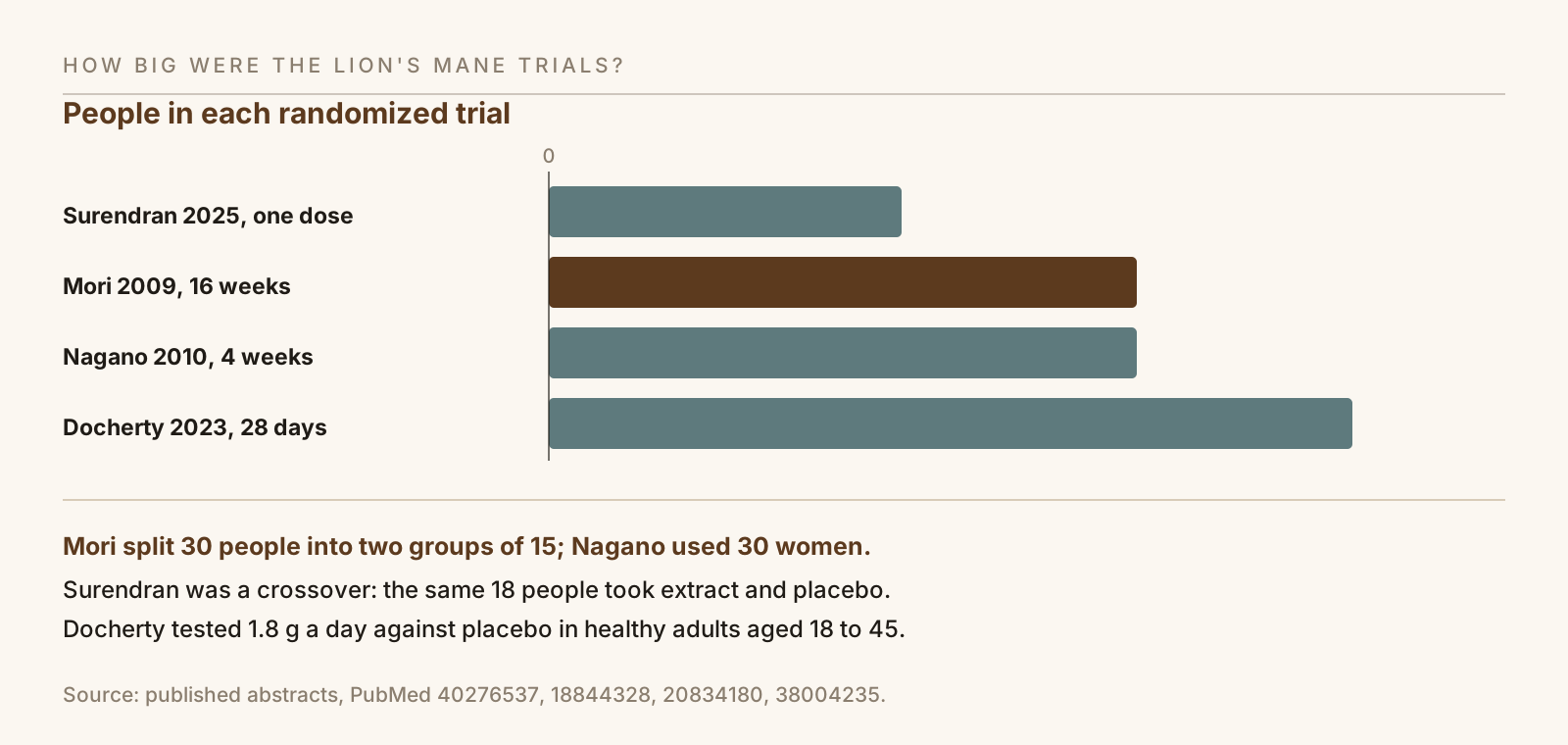
- Older adults, 2009. A Japanese trial (opens in a new tab) randomized 30 people aged 50 to 80 with mild cognitive decline into two groups of 15. The lion’s mane group took 250 mg tablets, four at a time, three times a day for 16 weeks. They scored higher on a cognitive scale at weeks 8, 12 and 16 than the placebo group, and the scores fell again four weeks after they stopped. The listed author address is a mushroom company’s laboratory.
- Healthy young adults, one dose, 2025. A crossover trial (opens in a new tab) gave 18 healthy 18-to-35-year-olds 3 g of extract. There was no significant effect on the overall thinking or mood measures. One individual task, a pegboard test, did improve at 90 minutes. Two authors work for a company that uses lion’s mane in its drinks, which the paper declares.
- Healthy adults, 28 days, 2023. A pilot trial (opens in a new tab) of 41 healthy adults aged 18 to 45 found faster Stroop-task performance an hour after a single 1.8 g dose. A trend toward lower stress after 28 days did not reach statistical significance (p = 0.051). The authors called it a pilot and asked for caution given the small size.
A 2010 trial in 30 women (opens in a new tab) who ate lion’s mane cookies for four weeks reported lower scores on some mood and general-complaint questionnaires. We’d treat it the same way: small, short and self-reported.
Our reading, not the authors’: these studies use different forms, doses, ages and tests, so they can’t be stacked into one answer. The honest summary is “interesting and unproven.”
Side effects and who should ask first
The same systematic review says potential side effects, though commonly unreported, include stomach discomfort, headache and allergic reactions. In a 49-week trial of lion’s mane mycelium capsules in people with early memory problems, four people dropped out (opens in a new tab) because of abdominal discomfort, nausea or skin rash, and the authors reported no other adverse events. The authors list a company, Grape King Bio, among their affiliations.
We read abstracts, not the full papers, so anything they don’t state we’ve left out. If you have a mushroom allergy, take prescription medicines, or are pregnant or nursing, it’s worth asking your clinician before you add a mushroom product. We found no safety data for blended coffee.
How to read a mushroom coffee label for lion’s mane
The label is where to look:
- Is lion’s mane listed, and in what form? Fruiting body, extract and mycelium are different things. Our guide to reading mushroom coffee labels explains the terms.
- Is an amount given? Many blends name a mushroom without its own quantity. A listing with no separate amount isn’t a mark against one product, but it does mean the label can’t tell you whether you’re getting anything like the the 1.8 g to 3 g doses used in these trials.
- What else is in the cup? Caffeine, other mushrooms and herbs all change what you’re drinking. Our piece on whether mushroom coffee helps anxiety covers why a single ingredient can’t carry the story.
For the wider picture, see adaptogens versus mushrooms, our looks at reishi and chaga, and the best mushroom coffee roundup.
The bottom line
Lion’s mane is a shaggy edible mushroom with a long culinary history. The human trials we read are small, use different forms and doses, and in several cases involve people tied to companies that sell it. They don’t show what a cup of mushroom coffee does. If you like the taste or the idea, it’s a reasonable ingredient to try, but check the label for form and amount, and ask your clinician first if you have allergies or take regular medicines.
Sources & further reading
- Benefits, side effects, and uses of Hericium erinaceus as a supplement: a systematic review (opens in a new tab) — Frontiers in Nutrition, 2025
- Improving effects of the mushroom Yamabushitake (Hericium erinaceus) on mild cognitive impairment: a double-blind placebo-controlled clinical trial (opens in a new tab) — Phytotherapy Research, 2009
- Acute effects of a standardised extract of Hericium erinaceus (Lion's Mane mushroom) on cognition and mood in healthy younger adults (opens in a new tab) — Frontiers in Nutrition, 2025
- The acute and chronic effects of Lion's Mane mushroom supplementation on cognitive function, stress and mood in young adults: a pilot study (opens in a new tab) — Nutrients, 2023
Reader conversation (4)
We read every response. Selected reader notes below.
I bought a lion’s mane blend because of the focus talk. Reading that the biggest trial had 41 people is a useful reality check.
Thanks for pointing out which studies had company ties. I would never have looked at the author affiliations.
Thank you, Devon. It doesn’t make the results wrong, but it’s worth knowing when you weigh them.
Good reminder that fruiting body, extract and mycelium aren’t the same. My label just says “mushroom blend.”
I grill lion’s mane in butter now and then. Funny that the 300 g steak is what nobody studies.
Read this and have a question or something to add? Send us a note. With your OK, we may publish it here with an editor's follow-up. We only publish notes you've said we can.