What is chaga? The black fungus in many mushroom coffees, and the kidney case reports behind its one real warning
Chaga is a fungus that grows on birch trees, not a coffee or tea plant. Three published case reports link large daily doses of the powder to oxalate kidney damage. What we know, what we don't, and what to check on a label.


If you’ve looked at mushroom coffee, you’ve seen chaga on the label. It sounds like a trendy wellness ingredient, and the usual write-ups either rave about it or skip it. There is one safety finding worth knowing about, and it comes from doctors’ case reports, not from marketing.
The short answer
- Chaga is a fungus that grows on birch trees. It is not coffee, tea or a caffeine source.
- Three published case reports describe kidney damage in people who took large daily amounts of chaga powder for months to years.
- Those are single cases. They show a possible risk but can’t tell us how common it is.
- None of the three involved a blended mushroom coffee, and we can’t say how much chaga any product holds.
What chaga actually is
Chaga, Inonotus obliquus, is a fungus that parasitizes birch and other trees (opens in a new tab). The black, crusty growth is dried and ground into powder, or extracted, and then sold as powder, tea, capsules or a blend ingredient.
It has a long history in folk medicine. The case reports below describe it as a traditional remedy, and that is the most we’d say. This article isn’t about benefits, and we haven’t evaluated trial evidence on what it does in people.
Because it’s a fungus, chaga on its own isn’t a caffeine source. The blend is a separate question, and our check of which mushroom coffees are actually caffeine-free found that products differ.
The three kidney case reports
All three reports come from kidney specialists in Asia, and all describe oxalate nephropathy, where oxalate crystals build up in the kidney’s tubules.
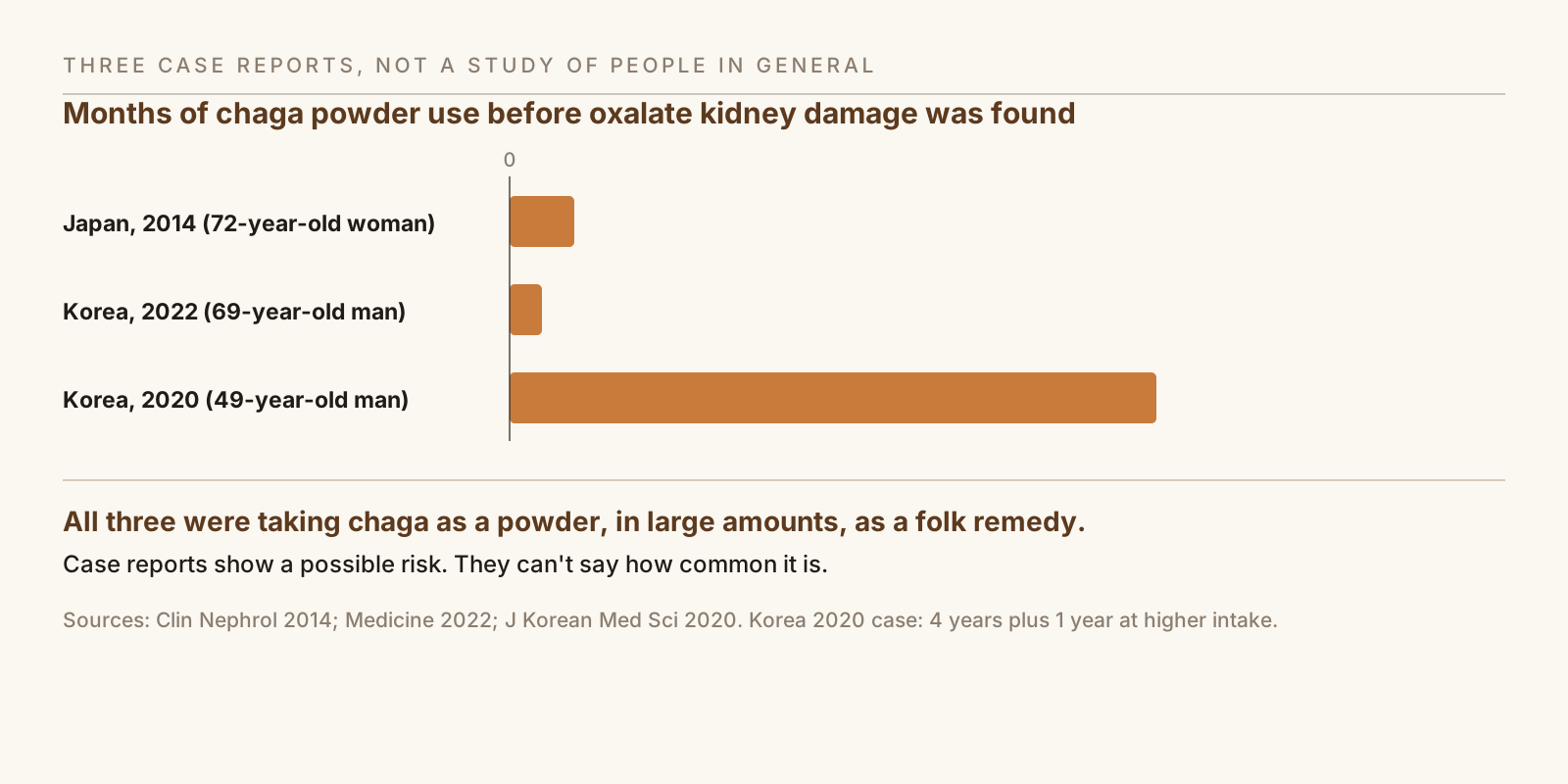
- Japan, 2014. A 72-year-old woman (opens in a new tab) had taken 4 to 5 teaspoons of chaga powder a day for about 6 months, as a remedy for liver cancer. Her kidney function fell, she began hemodialysis, and a biopsy showed oxalate crystals. The authors called it the first reported case linked to chaga.
- Korea, 2020. A 49-year-old man (opens in a new tab) reached end-stage kidney disease after long-term chaga powder use for a skin condition. The authors measured the oxalate in his leftover powder and described it as extremely high. They estimated his daily oxalate intake at about twice a usual diet for four years and five times for a further year.
- Korea, 2022. A 69-year-old man (opens in a new tab) had taken 10 to 15 grams of chaga powder and 500 mg of vitamin C daily for 3 months. He developed acute kidney injury, was treated with dialysis and steroids, and his kidney function recovered within a month.
What the reports can’t tell us
A case report is one person’s story, told carefully by their doctors. It’s a good way to spot a possible problem and a poor way to measure it.
- We don’t know how common this is. Three cases don’t give a rate. Many people may take chaga without trouble.
- The doses were large and the form was powder. Teaspoons or grams daily, for months. A serving of a blend is a different exposure, though we can’t put a number on it.
- Other factors were in play. The 2022 patient was also taking vitamin C, and the Japanese patient had a serious illness and recent surgery. The authors point to chaga, but a single case can’t isolate one cause.
- We read abstracts, not the full papers. The details above come from the published abstracts, so we’ve left out anything they don’t state.
How to read a mushroom coffee label for chaga
If you have kidney disease, a history of kidney stones, or you take supplements regularly, it’s worth a conversation with your clinician before adding chaga. Our piece on coffee and kidney stones covers coffee itself, which is a different question.
For everyone else, the label is where to look:
- Is chaga listed, and in what form? Powder, extract and mycelium are different things. Our guide to reading mushroom coffee labels explains the terms.
- Is an amount given? Many blends name chaga without a quantity. Teeccino’s Miraculous Mushrooms, for example, names chaga as an extract alongside other mushrooms and doesn’t state an amount, as we noted in that guide. Several other brands we checked are the same, so it isn’t a mark against one product.
- How much else are you taking? The more chaga products you stack, the less a single label tells you.
For the wider picture on blends, see adaptogens versus mushrooms and our best mushroom coffee roundup.
The bottom line
Chaga is a birch fungus with a folk-remedy history, and the one firm safety signal we found is a handful of kidney case reports involving large amounts of plain powder. That’s a reason to be careful with powder and to check labels, not a verdict on a cup of mushroom coffee. If you have kidney concerns, ask first.
Sources & further reading
- Chaga mushroom-induced oxalate nephropathy (opens in a new tab) — Clinical Nephrology, 2014
- Development of end stage renal disease after long-term ingestion of Chaga mushroom: case report and review of literature (opens in a new tab) — Journal of Korean Medical Science, 2020
- Chaga mushroom-induced oxalate nephropathy that clinically manifested as nephrotic syndrome: a case report (opens in a new tab) — Medicine (Baltimore), 2022
Reader conversation (4)
We read every response. Selected reader notes below.
I had no idea chaga was an oxalate issue. I get kidney stones, so I am glad I read this before buying a tin of mushroom coffee. Off to ask my urologist.
Asking is the right move, Helen. With a stone history, the oxalate point is the part worth raising with your clinician.
Appreciate that you said the case reports involved big daily doses of plain powder and did not scare people off every blend. That is the honest framing.
Checked my own label after reading this. Chaga is listed with no amount at all, so I cannot tell what I am getting. Useful nudge to look.
Did the reports say anything about chaga tea versus powder? My mother drinks it as a tea.
Good question, Raj. The abstracts we read describe powder, so we cannot say anything about tea. If she has kidney concerns, her clinician is the right person to ask.
Have something to add? Email us and we may include it in a future update.