What is date seed coffee? The caffeine-free grounds roasted from what most people throw away
Date seed coffee is a roasted, ground drink made from the pit inside a date — the part that gets spat out or binned every time someone eats the fruit. It has a real desert history that predates the European wartime chicory story, it's naturally caffeine-free, and it turns a byproduct that's normally feed or trash into something you can brew. Here's the honest version: what it is, what it tastes like, how it's made, and where it fits.

Every time someone eats a date, or a factory pits one for paste or packaged fruit, a hard little seed comes out and almost always gets thrown away. It happens billions of times a year, across every date-growing region from the Gulf to California’s Coachella Valley, and almost none of it gets a second look. Roast that seed, grind it, and brew it, and you get a genuinely drinkable, caffeine-free cup — one of the more literal “someone’s trash” stories in the whole coffee-alternative category.
Date seed coffee isn’t new, and it isn’t a wellness-brand invention either. It has a documented history as a desert-region substitute, it’s had real food-science attention paid to it in the last decade, and a small handful of companies now sell it as a packaged product. Here’s the honest version: what it is, where it comes from, what it tastes like, and whether it’s worth trying.
What date seed coffee is
Date seed coffee is a brewed drink made from the roasted, ground pit found inside a date — the fruit of the date palm, Phoenix dactylifera. Every date has one seed, a hard, elongated, deeply grooved pit that most people either spit out or discard when the fruit is pitted for cooking, paste, or packaging. Dried, roasted dark, and ground, that pit produces a powder you brew much like ground coffee or roasted chicory.
It belongs in the same broad family as chicory, ramón seed, and roasted barley: things you roast hard enough to develop coffee-like flavor compounds, then grind and brew, with no bean and no caffeine involved anywhere in the process. What sets date seed coffee apart from most of that family is where the raw material comes from — not a root grown to be a coffee substitute, and not a grain grown as a staple crop, but the discarded core of a fruit that was already being eaten for something else entirely.
A desert tradition, not a wartime invention
Most of the roasted coffee substitutes on this site trace back to European wartime rationing — chicory, acorn, and soybean coffee all have some version of that blockade-and-shortage story. Date seed coffee’s history runs through a different region and a different reason.
An FAO technical monograph on date palm byproducts (opens in a new tab) describes it plainly: “In remote parts of the desert a coffee like beverage is sometimes prepared from date pits by roasting and grinding in a similar way as for coffee beans.” That’s a practical, local adaptation — in places where real coffee wasn’t readily available but dates, and their seeds, always were — rather than a crisis substitute manufactured at wartime scale. The same document adds a less flattering historical footnote: roasted, ground date pits have also reportedly been used to adulterate commercial coffee powder, stretching real coffee with something cheaper and darker. Both uses come from the same basic fact — roasted date seed looks and behaves enough like ground coffee to pass for it, for better or worse.
That desert-adaptation lineage is worth naming because it’s genuinely different from the story behind most of the other roasted substitutes in this category, and it’s part of why date seed coffee deserves its own entry rather than a footnote in someone else’s article.
The byproduct math
The food-waste framing that shows up on nearly every date-seed-coffee product page is one of the rare cases where the sustainability pitch actually checks out, once you’re specific about what it’s claiming.
That same FAO monograph puts the pit at roughly 6 to 12% of a date’s total weight at the fully ripe (tamr) stage, depending on variety and grade — a genuinely substantial fraction of the fruit that isn’t the part anyone eats. The document is candid about where those pits mostly go: ground or whole animal feed is the primary use, limited by how hard and poorly digestible the pit is, with various charcoal, tar, and even jewelry uses explored on the side. Roasting them into a drink for people is a comparatively small, recent use case next to feed and disposal, not the default.
We couldn’t verify a precise global tonnage figure for discarded date pits from a source we could actually load and check — several aggregated search summaries cited one, but none of the underlying pages loaded for us to confirm the number, so we’re leaving it out rather than repeating a figure we can’t stand behind. What we can say plainly, on FAO’s own figures: pits are a real, sizeable fraction of the fruit’s weight, they’re mostly treated as feed or waste, and turning some portion of them into a beverage people actually want is a genuine, if modest, upgrade from either of those defaults.
What it actually tastes like
This is the part best described by people who’ve actually made and drunk it, rather than by a lab.
Recipe writers who’ve tested it at home describe the brewed cup as landing somewhere between coffee and tea, with mild chocolatey undertones and a flavor that’s noticeably lighter and more refreshing than regular coffee. Another home cook described roasted date seeds as carrying “a similar, albeit sweeter, flavor profile to coffee beans” — which tracks with what you’d expect: you’re roasting the core of a naturally sweet fruit, not a bean cultivated and processed specifically to be bitter and acidic.
In the caffeine-free lineup, that puts date seed coffee in the mild, low-bitterness end of the roasted-and-brewed tier — closer to a gentle chicory or ramón seed cup than to anything chasing the sharp, acidic edge of a dark espresso roast. If what you miss about coffee is the ritual of a warm roasted cup rather than a jolt or an intense bitterness, it’s a reasonable, low-stakes thing to try. If you’re chasing an exact stand-in for a strong dark roast, it won’t fully get you there — nothing in this mild-roasted-seed family really does.
How it’s roasted and brewed
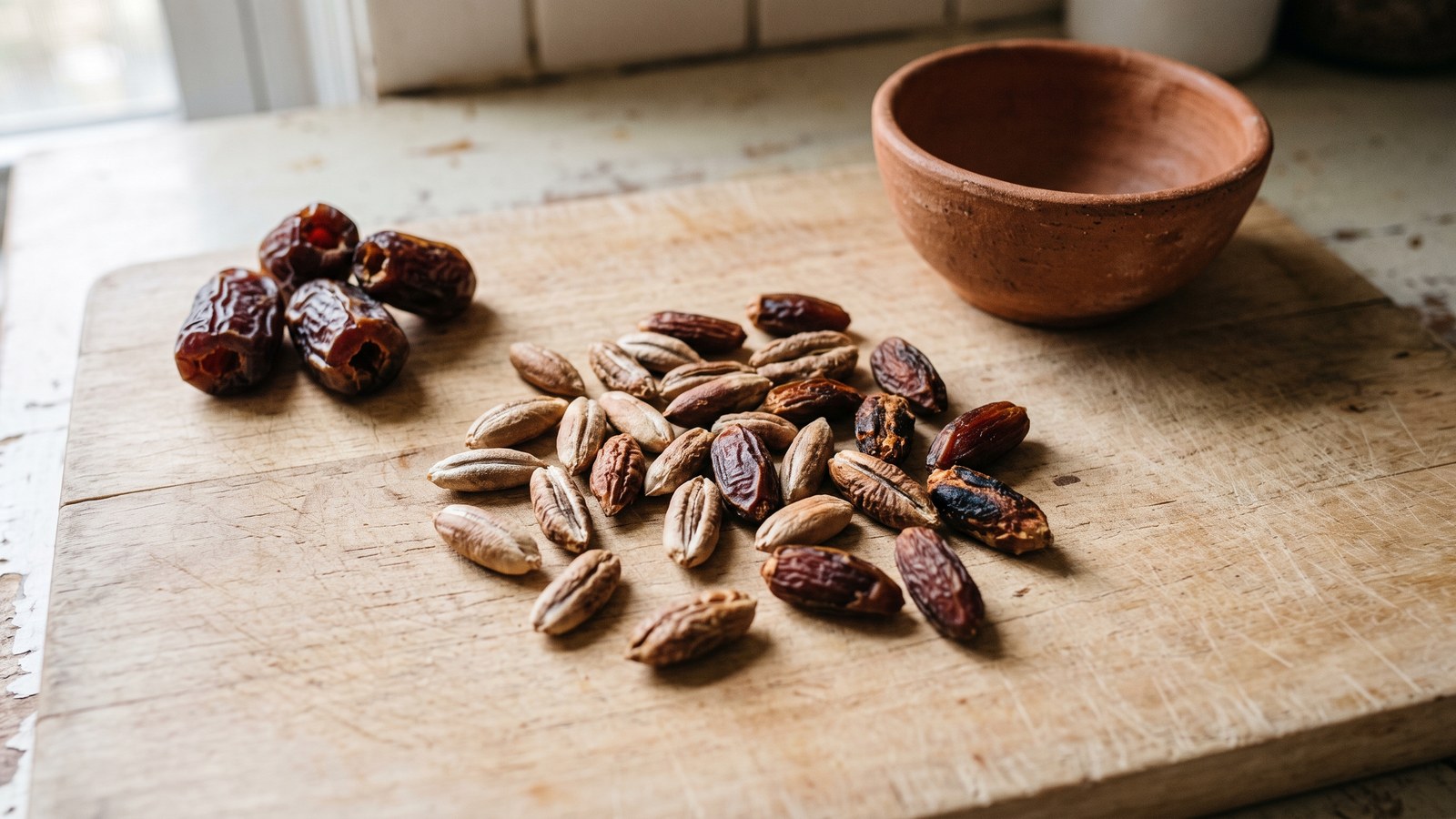
Making date seed coffee at home is genuinely simple, and it’s almost entirely a byproduct of eating dates you were going to eat anyway. The process, pieced together from a couple of home cooks who’ve actually walked through it start to finish (opens in a new tab), including one built around the zero-waste angle specifically (opens in a new tab):
- Save the pits from dates you eat, rinsing off any clinging fruit.
- Dry them for several days until they’re hard and fully moisture-free — a damp pit won’t roast evenly.
- Roast them dark. Recipe writers land on slightly different specifics here — one describes roasting at 350°F (175°C) for 30 to 45 minutes, another at 400°F (about 205°C) for 25 to 30 minutes, both until the pits are visibly dark and fragrant. That spread is normal for a home method with no shared standard rather than a sign either one is wrong; start toward the lower end and adjust based on how dark and aromatic your batch comes out.
- Cool, then grind the roasted pits in a coffee or spice grinder into a coarse-to-fine powder, sieving out any larger pieces and re-grinding them.
- Brew it like ground coffee — a French press or pour-over both work, the same way you’d approach brewing roasted chicory root, since both are coarse roasted grinds rather than tea leaves.
Ground powder keeps for a couple of weeks refrigerated, or about a month frozen, according to the home cooks who’ve written it up. It’s a genuinely low-cost, low-waste project if you already eat dates regularly and don’t mind saving pits in the freezer until you’ve collected enough for a batch — one recipe calls for around 25 to 30 pits per two servings, so it takes some accumulating.
Caffeine, and what we can honestly say about nutrition
Caffeine: none, structurally. A date seed doesn’t produce caffeine — it’s a fruit pit, not a coffee bean — so there’s nothing to remove and nothing to trace. Every account we could verify, from home-cooking writers to the FAO’s own description of the desert tradition, treats it as caffeine-free without qualification. That’s the whole reason it shows up on lists of coffee alternatives at all: a genuinely zero-caffeine cup that still delivers a warm roasted drink to hold.
Nutrition: a harder claim to pin down responsibly. Date seeds have real, published food-science attention — several peer-reviewed papers exist on their fiber, phenolic, and mineral content, and on how roasting temperature affects them. We went looking for the actual figures rather than repeating a number a search engine surfaced, and ran into a wall worth being honest about: every academic paper we tried to load directly — through PubMed, MDPI, ScienceDirect, and a couple of university-hosted PDFs — was blocked by a login wall, a paywall, or a bot-check page that never resolved to the actual article. That means specific numbers like a phenolic-content figure or an antioxidant percentage exist in the literature, but we couldn’t verify them ourselves by reading the source, so we’re not printing them here as fact. A retailer’s own page for a packaged date-seed product lists vitamins and minerals including magnesium, calcium, iron, zinc, and potassium, and describes the pits as fiber-rich — reasonable claims for a plant seed in general, but attributed to that seller’s marketing copy rather than to a study we checked ourselves, so treat it as a plausible sales description rather than a verified nutrition panel.
The one number we’re comfortable stating plainly, because a government agricultural source states it directly: the seed itself makes up roughly 6 to 12% of a date’s weight, which at least tells you it’s not a trivial fraction of the fruit — just not, on the evidence we could actually verify, a nutrition claim we’re willing to quantify further.
Who it’s for, and a few practical cautions
Date seed coffee is a low-risk, low-stakes thing to try for most people who are curious about it:
- Caffeine-free, so it suits anyone quitting or cutting caffeine, slow caffeine metabolizers, and people avoiding stimulants generally. As always in pregnancy, run any new regular drink past your provider — the caffeine question is settled here, but that’s a general good habit, not a specific concern with this ingredient.
- A byproduct, not a supplement. Nothing about roasting a date pit turns it into a treatment for anything, and we haven’t found — nor would we repeat — a specific health claim attached to drinking it beyond “it’s a caffeine-free roasted beverage.”
- Home-roasting is the main practical hurdle, not a safety one. A whole, unroasted date pit is hard and should never be chewed or swallowed on its own — it’s roasted and ground specifically so it becomes a fine powder you brew, the same as you’d never eat whole roasted coffee beans by the handful. If you’re saving pits from dates over time, keep them somewhere clean and dry until you have enough for a batch.
- If you have a known allergy to dates specifically, there’s no reason to assume the seed is safer than the fruit — treat it with the same caution.
Where to find it
Date seed coffee sits somewhere between a DIY kitchen project and a small specialty category:
- Home-roasting is the most accessible route, and arguably the most honest one given the food-waste story — you’re using pits from dates you were already eating, at essentially no extra cost.
- A small number of dedicated brands sell it packaged and pre-roasted. Products describing themselves as roasted date-seed coffee, positioned around prebiotic fiber and being caffeine- and acid-free, are available through general online retailers, and at least one company sells a “date coffee” line built specifically around this ingredient, sometimes blended with chicory root. We’re naming that these products exist rather than endorsing their specific marketing claims — several of the health and blood-sugar claims on smaller brands’ own pages go further than we’d repeat without a study behind them, which is worth knowing if you go looking.
- Broader herbal-coffee brands sometimes use dates as one ingredient in a blend, rather than the whole product. Teeccino’s French Roast (opens in a new tab), for instance, lists roasted chicory, carob, barley, dates, and almonds among its ingredients — dates there for natural sweetness within a chicory-based blend, not as a standalone roasted-pit product the way the dedicated date-seed brands work. It’s a genuinely different technique from what this article describes, but it’s an honest example of a familiar brand already putting date material into a coffee-alternative cup, worth knowing if you’re curious about the ingredient without committing to a whole new category.
Prices on packaged date-seed products tend to sit in specialty territory rather than supermarket-grain territory, since this is a small niche rather than a commodity crop — home-roasting your own is the cheaper route if you’re already buying dates.
Does it work as a coffee alternative?
As a genuine “tastes exactly like my dark roast” replacement, no — nothing in this mild, sweet, low-bitterness family really claims that, and date seed coffee doesn’t either. As a caffeine-free, roasted, coffee-adjacent drink with a real desert history and an unusually literal food-waste story behind it, yes, and it’s one of the more interesting entries in the category precisely because almost nobody has heard of it.
The honest trade-offs: it’s mild rather than intense, sweet rather than sharp, and — unless you’re roasting your own from dates you already eat — harder to find on a shelf than chicory or barley. What it offers that most of its peers don’t is the byproduct story itself: you’re not growing anything new to make this drink, you’re using the part of an existing fruit that almost always goes to feed or the bin. For a reader who likes that kind of “nothing wasted” angle as much as the cup itself, it’s worth seeking out or, better, worth trying to roast a small batch from dates already in the pantry.
The bottom line
Date seed coffee is a caffeine-free, roasted drink made from the pit inside a date — a genuine byproduct of eating the fruit that mostly ends up as animal feed or waste. It has a documented desert-region history as a coffee substitute that predates and differs from Europe’s wartime chicory story, a mild, sweet, low-bitterness flavor that lands closer to a gentle chicory cup than a dark roast, and a food-waste angle that holds up on the numbers we could actually verify, even where we deliberately left out figures we couldn’t. It’s easy enough to roast at home from dates you’re already eating, harder to find pre-packaged, and worth trying with modest expectations: not a coffee replacement, but a genuinely pleasant, zero-waste-minded cup with a history most people have never heard.
This article describes what date seed coffee is and how it’s made, not a health treatment. Nothing here is medical advice, and if you have a specific dietary concern or allergy, that’s a conversation for a clinician, not a website.
Sources & further reading
- Date Palm Products — Chapter 4: By-products of the date palm (opens in a new tab) — Food and Agriculture Organization of the United Nations
- Date Seed Coffee (Caffeine-Free Coffee Alternative) (opens in a new tab) — Alphafoodie
- Caffeine-free date seed 'coffee' (opens in a new tab) — Closed Loop Cooking
- Date Seed Coffee (Caffeine-Free) (opens in a new tab) — Coachella's Best Dates
Reader conversation (5)
We read every response. Selected reader notes below.
My grandmother used to roast date pits when coffee was hard to get, and I genuinely thought that was just a family thing she invented out of necessity. Seeing it written up with an actual FAO reference behind it is oddly validating — it was never just her, it was a whole regional habit nobody ever wrote down where I could find it.
I work near the Central Valley date groves and we throw out an unbelievable amount of pits every season, mostly to feed mix. Roasting a batch this weekend just to see — appreciate that this didn’t oversell it as some miracle superfood, because every date-adjacent product page I’ve seen makes claims that made me skeptical of the whole category.
That skepticism is well earned — a few of the retailer pages we looked at for this piece made claims well past what we’d repeat without a study behind them. Would genuinely love to hear how your batch turns out; the roasting-time spread in the piece is really just two home cooks’ word against each other.
Tried the closedloopcooking method a few months ago after saving pits in the freezer for weeks. The chocolatey note is real and it surprised me — expected something closer to plain roasted grain and got something closer to a mild carob drink. Worth doing once even just for the novelty.
Appreciate the paragraph admitting the antioxidant numbers couldn’t be verified instead of just repeating whatever came up first in a search. That’s rarer than it should be on food sites and it’s the reason I keep reading this one over the ones that just copy each other’s stats.
Small correction from someone who grew up around this: it’s not only “remote desert” preparation historically, it shows up in ordinary households too when coffee prices spike, not just in places without access to it at all. Otherwise a fair and accurate summary of something I rarely see covered outside Arabic-language sources.
Thank you for that — the FAO document we cited frames it narrowly around remote areas, but a price-driven household habit makes just as much sense and probably explains more of the actual history than the document alone captures. Noted for the record here since we can’t rewrite an FAO monograph.
Have something to add? Email us and we may include it in a future update.