What is maca? The Andean root in some adaptogen coffee blends, and why most of its evidence comes from animals
Maca is an Andean root in the mustard family, listed in some adaptogen coffee blends. Recent meta-analyses lean on animal studies, and the human trials we found are small. What to check on a label.


Maca sits in the ingredient lists of a number of adaptogen coffee blends, usually between a few other roots and a mushroom or two. It rarely gets its own explainer. We read the abstracts of five recent papers to see what a label is leaning on when it lists it. The short version: the headline numbers come largely from animal experiments, and the human trials we found are small.
The short answer
- Maca is a root from the Andes, not coffee, tea or a caffeine source.
- A 2024 meta-analysis reported large effects on performance, but it pooled animal and human studies, and several of the tests it names are animal tests.
- A 2026 meta-analysis of 14 animal studies found no significant change in three muscle-damage markers.
- The one human performance trial we found, in 10 trained basketball players, showed no significant difference from placebo.
- We found no trial of a coffee blend, and a label rarely says how much maca is in the cup.
What maca actually is
Lepidium meyenii is an Andean plant in the brassica (mustard) family, grown for its root. A 2011 review describes it as used for centuries in the Andes as an adaptogenic plant. The root is dried and powdered or turned into an extract, and sold as powder, extract or capsules.
If “adaptogen” is a word you keep seeing on bags, our explainer on adaptogens versus mushrooms covers where it came from, and our look at adaptogen cortisol claims covers what the marketing can and can’t support.
One adaptogen blend we’ve covered, Rasa, lists maca in its published ingredient list alongside rhodiola, ashwagandha and several others, with no separate amount given for it. That is typical of how the ingredient appears.
What the pooled studies say
Here is how many studies each pooled analysis counted, and what kind they were:
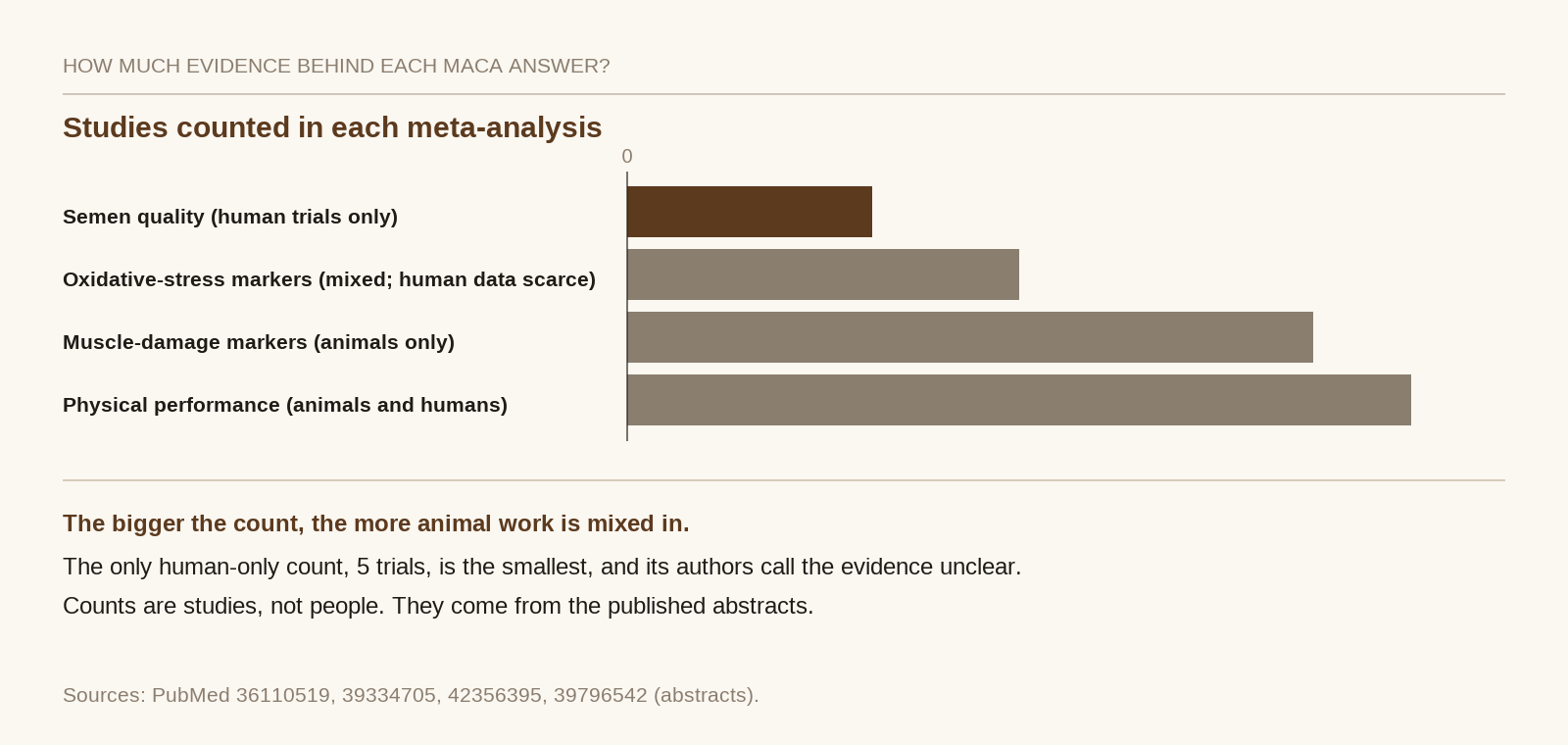
- Physical performance. A 2024 meta-analysis in Nutrients included 21 studies in its review and 16 in the pooled analysis, covering animals and humans. It reported large effects on forced-swimming, rota-rod and grip-strength tests and on blood lactate, and a bigger effect at higher doses. Forced swimming and rota-rod are animal tests, and the abstract doesn’t say how many of the 16 studies were human. Its authors credit compounds called macamides.
- Oxidative-stress markers. A 2024 meta-analysis in Antioxidants pooled 8 studies on lab markers such as glutathione peroxidase and reported small to large effects, again larger at higher doses. Its authors say information on humans is scarce.
- Muscle-damage markers. A 2026 meta-analysis in Nutrients pooled 14 animal studies and found no statistically significant change in three blood markers. Its confidence intervals were wide, the heterogeneity (how much the studies disagreed with each other) was very high, and its authors say the evidence does not support a robust overall effect and call the findings exploratory.
Our reading, not the authors’: the two 2024 papers report large effects and the 2026 paper reports none, on different outcomes drawn from different sets of studies, so “unsettled” is a fairer word than either “works” or “doesn’t.” A “large effect” in a rodent swimming test is also a long way from what one scoop in a morning mug would do. None of the three tested a drink.
The human trials
Human evidence is thinner and, where we found it, mixed:
- Trained athletes. A 2025 crossover trial (opens in a new tab) gave 10 well-trained male basketball players either 2,000 mg a day of maca or placebo for two weeks. There were no significant differences in jump height, shooting accuracy, repeated sprints, fatigue index or blood lactate clearance. The authors concluded that two weeks of supplementation gave no benefit for performance or fatigue. Ten people, two weeks, one population.
- Semen quality. A 2022 meta-analysis in Frontiers in Pharmacology found five randomized trials. The pooled change in sperm concentration was 2.22, with a 95% interval of -2.94 to 7.37, which spans zero. Its authors describe the effects as unclear and the number of trials and participants as too small for firm conclusions.
Our searches also turned up other small human trials and an older review, on health questions that are best taken to a doctor, and we haven’t built anything on them. If you’re thinking about maca for a specific health reason, that is a conversation for your clinician, not a coffee blend label.
We found nothing in these abstracts on side effects or drug interactions, so we can’t say what a safe amount is. If you take regular medicines, or are pregnant or nursing, ask your clinician or pharmacist before adding a maca product.
How to read a label for maca
- Is it listed at all? It shows up in adaptogen and “root” blends more than in plain chicory-and-grain coffees, so scan the full ingredient list rather than the front of the bag.
- Is an amount given? Many blends name maca without its own quantity. The basketball trial used 2,000 mg a day in a supplement, so a bare name can’t tell you whether you’re anywhere near that. Our guide to reading mushroom coffee labels explains the terms.
- What form is it? Powder, extract and capsule forms all exist, and the abstracts we read don’t compare them, so we can’t say whether the form matters in a cup.
- What else is in the cup? Caffeine, other roots and mushrooms all change the picture. If caffeine-free matters to you, our check of which mushroom coffees are caffeine-free goes brand by brand.
The bottom line
Maca is an Andean root with a long traditional history and a research record that leans heavily on animals. Pooled analyses report large effects in some places and nothing significant in others, and the only human performance trial we found was small and null. None of this means it’s harmful or useless. It means a blend that lists maca with no amount is offering a name more than a dose, and that’s worth knowing before you pay extra for it. For a sibling ingredient with a similar story, see our piece on rhodiola.

Sources & further reading
- Effects of Maca (Lepidium meyenii Walp.) on Physical Performance in Animals and Humans: A Systematic Review and Meta-Analysis (opens in a new tab) — Nutrients, 2024
- The Effects of Maca (Lepidium meyenii Walp) on Cellular Oxidative Stress: A Systematic Review and Meta-Analysis (opens in a new tab) — Antioxidants, 2024
- Lepidium Meyenii Walp. (Maca) and Blood Biomarkers of Muscle Damage and Post-Exertion Protein Degradation: A Systematic Review and Meta-Analysis of Preclinical Studies (opens in a new tab) — Nutrients, 2026
- The Impact of Lepidium meyenii (MACA) Supplementation on Basketball-related Performance and Antifatigue Ability: A Double-blind Crossover Study (opens in a new tab) — Journal of Physiological Investigation, 2025
- Maca (Lepidium meyenii Walp.) on semen quality parameters: A systematic review and meta-analysis (opens in a new tab) — Frontiers in Pharmacology, 2022