What is eleuthero? The "Siberian ginseng" root in some adaptogen coffee blends, and why its best evidence is decades old
Eleuthero is a woody Asian shrub root listed in some adaptogen coffee blends. Much of its human research is Soviet-era and hard to check, and recent reviews call the evidence uneven. What to check on a label.


Eleuthero turns up in the ingredient lists of a few adaptogen coffee blends, usually between a mushroom and a couple of other roots. It rarely gets its own explainer. We read the abstracts of five papers to see what a label is leaning on when it lists it. The short version: there is a large old body of human research that almost nobody can read, and recent reviewers say the evidence is uneven.
The short answer
- Eleuthero is a root from a shrub native to northeast Asia. It is not coffee, tea or a caffeine source.
- A 2021 review gathered 46 Soviet-era human studies, 29 of them reported as placebo-controlled. The original papers were never translated, so the review’s summary is what we have.
- A 2025 review of the root says the clinical trials are too varied and too low in quality to judge whether it works.
- The one modern placebo-controlled trial we found tested eleuthero leaf extract combined with another herb, so it can’t isolate eleuthero.
- We found no trial of a coffee blend, and a label rarely says how much eleuthero is in the cup.
What eleuthero actually is
Eleutherococcus senticosus is a thorny shrub from the Russian Far East and East Asia. The root is dried and sold as powder, extract or tincture. It is called “Siberian ginseng” in a lot of shops, but it is a different plant from true ginseng, and the nickname is marketing more than botany.
A 2025 review says the root has been used in traditional medicine for about twenty centuries, and that European regulators list it for traditional use against symptoms like fatigue and weakness. That is a statement about tradition and regulation, not proof from trials.
If “adaptogen” is a word you keep seeing on bags, our explainer on adaptogens versus mushrooms covers where it came from, and our look at adaptogen cortisol claims covers what the marketing can and can’t support.
One blend we’ve covered, Rasa, lists eleuthero in its published ingredient list alongside maca, rhodiola, ashwagandha and several others, with no separate amount given for it. That is typical of how the ingredient appears.
The Soviet-era trials
Much of the human work on eleuthero was done in the USSR. A 2021 narrative review (opens in a new tab) went to three libraries in St. Petersburg and located 46 human studies published between 1962 and 1986, saying they had never been translated or made public. This is how those studies were described:
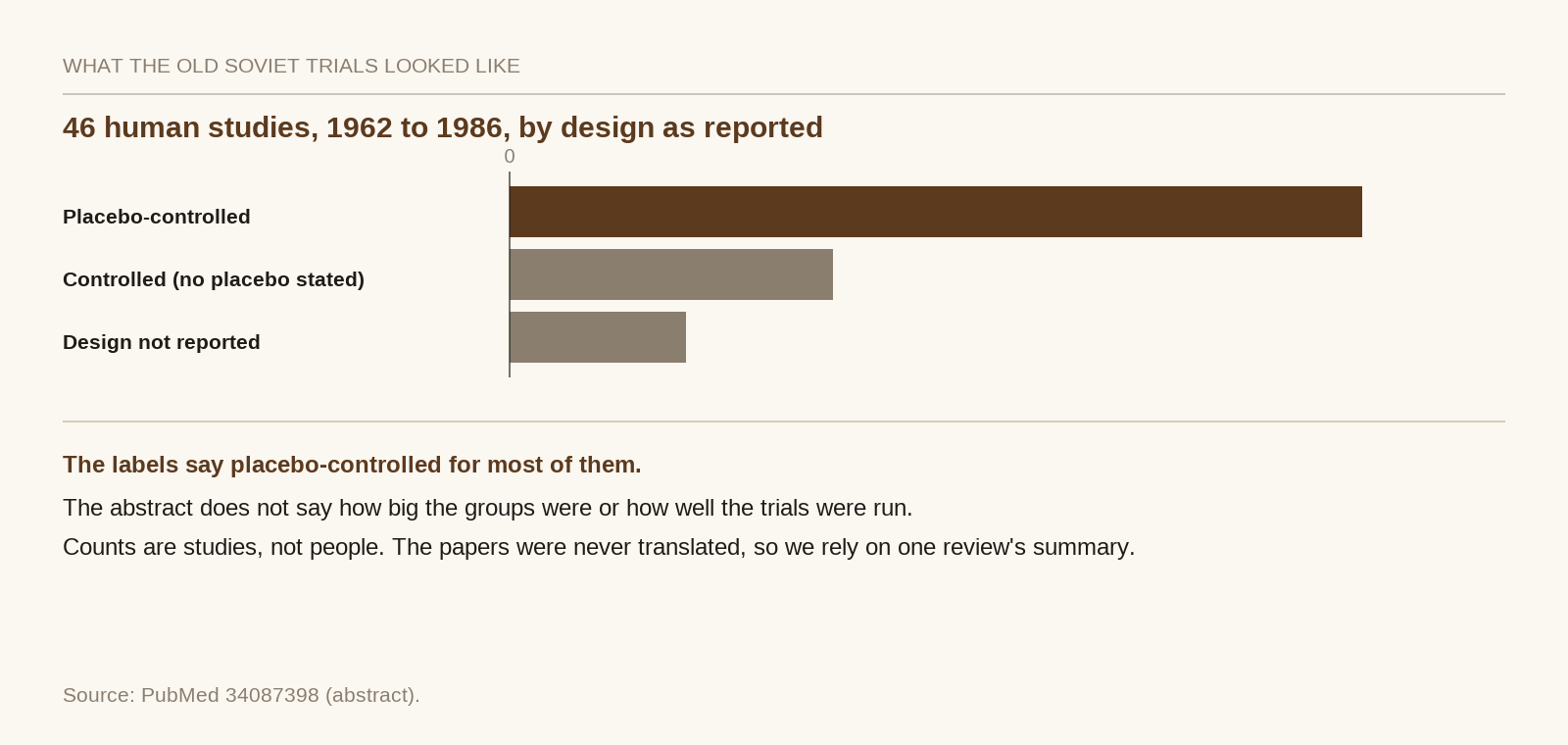
- Who was studied. The largest group, 21 studies, enrolled healthy volunteers. The most common dose was 2 ml of liquid extract a day, used in 14 studies.
- What they measured. Outcomes included physical and mental stamina under different conditions, including heat and high altitude, plus how often people came down with respiratory infections (5 studies), and a handful on vision and blood counts.
- What the review concluded. Its authors judged that eleuthero “appears to exhibit benefits” for cognitive function and physical and mental endurance, called the respiratory findings promising, and added that the data have to be read within their limitations.
Our reading, not the authors’: a pile of 46 studies sounds substantial, but the abstract doesn’t give group sizes, doses beyond the common one, or how the trials were run. Papers from that era were not held to modern reporting standards, and readers can’t open them to check. That’s a reason to hold the headline loosely rather than a reason to dismiss it.
What recent reviews say
The newer summaries are cooler.
- The 2025 root review. A review in Frontiers in Pharmacology catalogued the plant’s chemistry, noting two marker compounds, eleutheroside B and E, used to standardize products. It says preclinical work points to anti-inflammatory and nerve-protective activity. Then it says the main issue is a lack of robust clinical evidence, that the trials are highly varied and of low quality, and that poor standardization of products makes it impossible to assess effectiveness.
- The 2026 comparative review. A vote-counting analysis of 275 clinical studies (opens in a new tab) covered seven adaptogens, eleuthero among them, across seven outcome areas. Its authors report that individual adaptogens show different effect profiles. The abstract doesn’t give eleuthero’s own results, so we can’t say where it landed.
- One modern placebo-controlled trial. A 2020 study in Nutrients gave healthy adults a combination of eleuthero leaf extract and a second herb for 12 weeks. The combination significantly improved one memory subscore, figure recall (p = 0.045), against placebo, and no adverse effects were seen. A p-value that close to the usual cutoff, on one subscore, from a two-herb mix, is a hint and not a finding.
Our reading: the older literature is large and positive but hard to check, and the newer literature is small, mixed and cautious. A blend that lists eleuthero is borrowing from the first without having tested the second.
Safety and medicines
The abstracts we read say little about safety in everyday use, so we can’t give a safe amount. One piece of caution does show up. A 2023 retrospective review (opens in a new tab) of 1,816 adverse-event reports found 30 with a likely causal link between an adaptogen and an antidepressant, and for eleuthero it listed bleeding events with several of the drugs, such as upper stomach bleeding and nosebleeds. Reports can’t show how common this is, and they can’t prove cause. But if you take any regular prescription, especially an antidepressant, ask your pharmacist before adding an eleuthero product. The same goes if you are pregnant or nursing.
How to read a label for eleuthero
- Is it listed at all? It shows up in adaptogen blends more than in plain chicory-and-grain coffees, so scan the full ingredient list rather than the front of the bag.
- Is an amount given? Many blends name eleuthero without its own quantity. The common Soviet-era dose was a liquid extract, so a bare name can’t tell you whether you’re anywhere near what was studied. Our guide to reading mushroom coffee labels explains the terms.
- What form is it? Powder, extract and tincture all exist, and the 2025 review blames poor standardization for much of the confusion. Look for a blend that says which part of the plant and what form.
- What else is in the cup? Caffeine, other roots and mushrooms all change the picture. If caffeine-free matters to you, our check of which mushroom coffees are caffeine-free goes brand by brand.
The bottom line
Eleuthero is a thorny Asian root with a long traditional history and a big, old and mostly unreadable body of human research. Recent reviewers say the trials are too uneven to judge it, and the one modern placebo trial we found tested a two-herb mix. None of this means it is harmful or useless. It means a blend that lists eleuthero with no amount is offering a name more than a dose. For two neighbors in the same aisle, see our pieces on rhodiola and maca.
Sources & further reading
- Eleutherococcus root: a comprehensive review of its phytochemistry and pharmacological potential in the context of its adaptogenic effect (opens in a new tab) — Frontiers in Pharmacology, 2025
- Findings of Russian literature on the clinical application of Eleutherococcus senticosus: A narrative review (opens in a new tab) — Journal of Ethnopharmacology, 2021
- Are all adaptogens created equal? A comparative review and trend analysis of clinical data (opens in a new tab) — Frontiers in Pharmacology, 2026
- Combined Treatment with Two Water Extracts of Eleutherococcus senticosus Leaf and Rhizome of Drynaria fortunei Enhances Cognitive Function: A Placebo-Controlled, Randomized, Double-Blind Study in Healthy Adults (opens in a new tab) — Nutrients, 2020
- Harder, better, faster, stronger? Retrospective chart review of adverse events of interactions between adaptogens and antidepressant drugs (opens in a new tab) — Frontiers in Pharmacology, 2023
Reader conversation (4)
We read every response. Selected reader notes below.
I had no idea the “Siberian ginseng” name was basically a sales label. Good to know it is not the same plant as ginseng.
Thanks, Gordon. The shared name comes from a loose resemblance in how the root was used, and the plants are only distant relatives. It is worth checking the Latin name on a bag.
The point about papers nobody can open is the part that stuck with me. A lot of old research gets quoted as if everyone has read it.
I take a prescription every morning and had never thought to ask the pharmacist about a coffee blend. Doing that this week.
Appreciate that you said the abstract did not give eleuthero’s own results in the big review instead of guessing.
Read this and have a question or something to add? Send us a note. With your OK, we may publish it here with an editor's follow-up. We only publish notes you've said we can.