What is okra seed coffee? The Civil War coffee substitute Confederate soldiers called "Lincoln Coffee"
Roasted okra seeds brewed as coffee are a real, documented Civil War-era substitute — not a wellness-blog invention — with a surviving 1863 firsthand account, a genuinely different nutrition profile from any root or grain on this site, and a modern homesteading following. Here's the honest version.

Most of the ingredients on this site earn their “coffee substitute” label from a root or a grain — chicory, dandelion, barley. Okra seed coffee earns it from a vegetable pod’s leftover seeds, and it comes with something rarer than most of this cluster: a surviving firsthand account, written in 1863 by a man who actually drank it every day for a year and a half.
The short answer
Okra seed coffee is a hot drink brewed from the roasted, ground seeds found inside mature, dried okra pods. Okra (Abelmoschus esculentus) is a flowering plant in the mallow family — related to cotton and hibiscus, not to the coffee plant — so the seeds contain no caffeine at all. It has a documented history as an American Civil War-era coffee substitute, when the Union naval blockade of Southern ports made real coffee scarce and expensive, and it has a small but real modern following among home gardeners and homesteaders who roast their own.
A Confederate surgeon’s own account
Most wartime coffee-substitute stories get passed down secondhand — a general reference to “parched acorns and chicory” in a history book, with no name attached. Okra seed coffee has something better: a signed, dated, firsthand account.
In February 1863, Dr. N. B. Cloud, a surgeon with the Confederate Army stationed near Savannah, Georgia, wrote a letter describing what his own household had been drinking. It ran in The Daily Journal of Wilmington, North Carolina that April. Cloud explained that his family had already tried rye, ground peas, cornmeal, and potatoes as coffee substitutes before settling on something better: okra seed, washed, dried, and parched (roasted) before grinding and brewing “in the usual way.” His verdict, in his own words, was that it came out “almost exactly like coffee in color, very pleasantly tasted and entirely agreeable” — and his family had been drinking it successfully for eighteen months by the time he wrote the letter. He even worked out the economics of it: okra grows well anywhere cotton does, he noted, and an acre of good garden land could produce roughly 500 pounds of seed.
Cloud’s account sat alongside a long list of substitutes Southern households turned to once the Union blockade cut off real coffee almost entirely — rye, sweet potato, acorns, persimmon seed, malted barley, dandelion root, roasted corn, beans, beets, and carrots all show up in the historical record from the same few years. Confederate soldiers had a name for the whole category of homemade brews: “Lincoln Coffee,” a wry nod to the president whose blockade had made the real thing unavailable in the first place. We’ve covered that broader wartime-substitute story, including chicory’s own role in it, in ersatz coffee’s wartime history.
How it’s made, then and now
Cloud’s 1860s method and the home method people still use today are recognizably the same process, three steps apart.
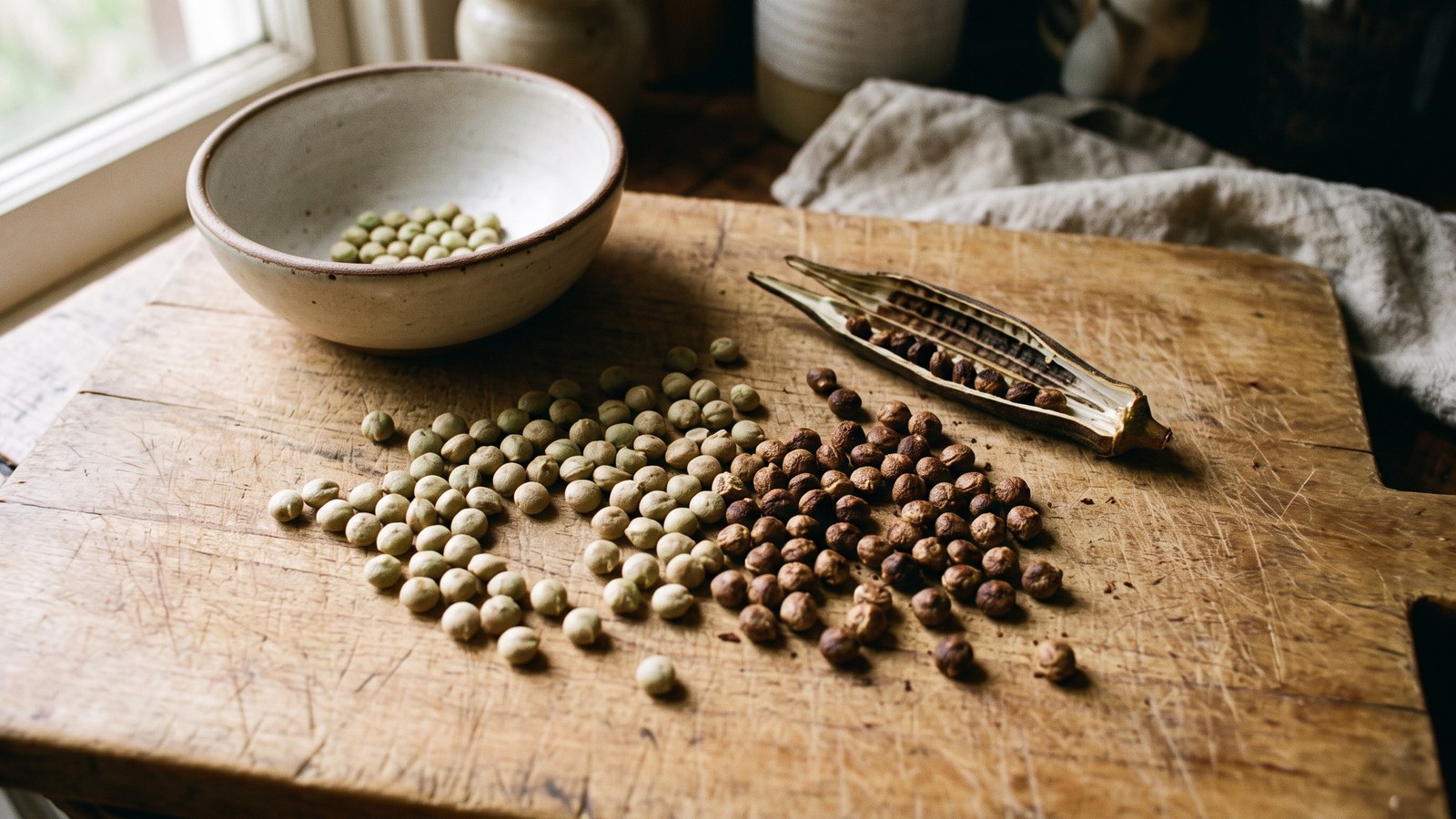
Harvest and dry. Let okra pods mature and dry out on the plant well past the point you’d pick them to eat — the pods turn brown and start to split open on their own. Split them the rest of the way by hand to remove the seeds inside.
Roast. Modern home cooks land on a couple of workable methods: a dry pan over medium heat, shaking or stirring until the seeds pop and darken to a rich brown, or a 350°F (175°C) oven for about 20 to 30 minutes, stirring occasionally until they darken and take on a coffee-like aroma. Cloud’s own account adds a detail that still matters if you try this yourself: grind the roasted seeds soon after roasting, because they become noticeably harder if left to sit for a day or two first.
Grind and brew. Grind the roasted seeds in a coffee grinder or with a mortar and pestle, then brew exactly as you would ground coffee — French press, pour-over, or a simple steep-and-strain, roughly a tablespoon or two of grounds per cup of hot water.
Does it taste like slimy okra?
This is the question everyone who’s ever cooked with fresh okra asks first, and the honest answer is no. Okra’s famous sliminess comes from mucilage — a soluble fiber in the pod’s flesh — not from the small, hard seeds sealed inside it. By the time a mature pod has dried on the plant and its seeds have been roasted, there’s essentially no mucilage left in the seed itself to carry into the cup. Multiple people who’ve actually made and tasted it independently describe something in the same neighborhood: nutty and toasty, milder and less bitter than real coffee, with one description landing on “a cross between toasted popcorn, toasted nuts, and black tea.” It reads as its own drink, not as a disguised vegetable.
What’s actually in a roasted okra seed
Here’s where okra seed genuinely parts ways with the rest of this ingredient cluster. Chicory and dandelion root are prized mainly for inulin, a soluble fiber, because roots are the plant’s storage organ for starch and fiber, not for protein or oil. A seed is a different kind of storage organ entirely — built to fuel a new plant — and okra seed’s composition reflects that.
A 2009 food-science study out of Nigeria roasted okra seeds at 160°C for 10 to 60 minutes and measured the resulting flour’s composition directly:
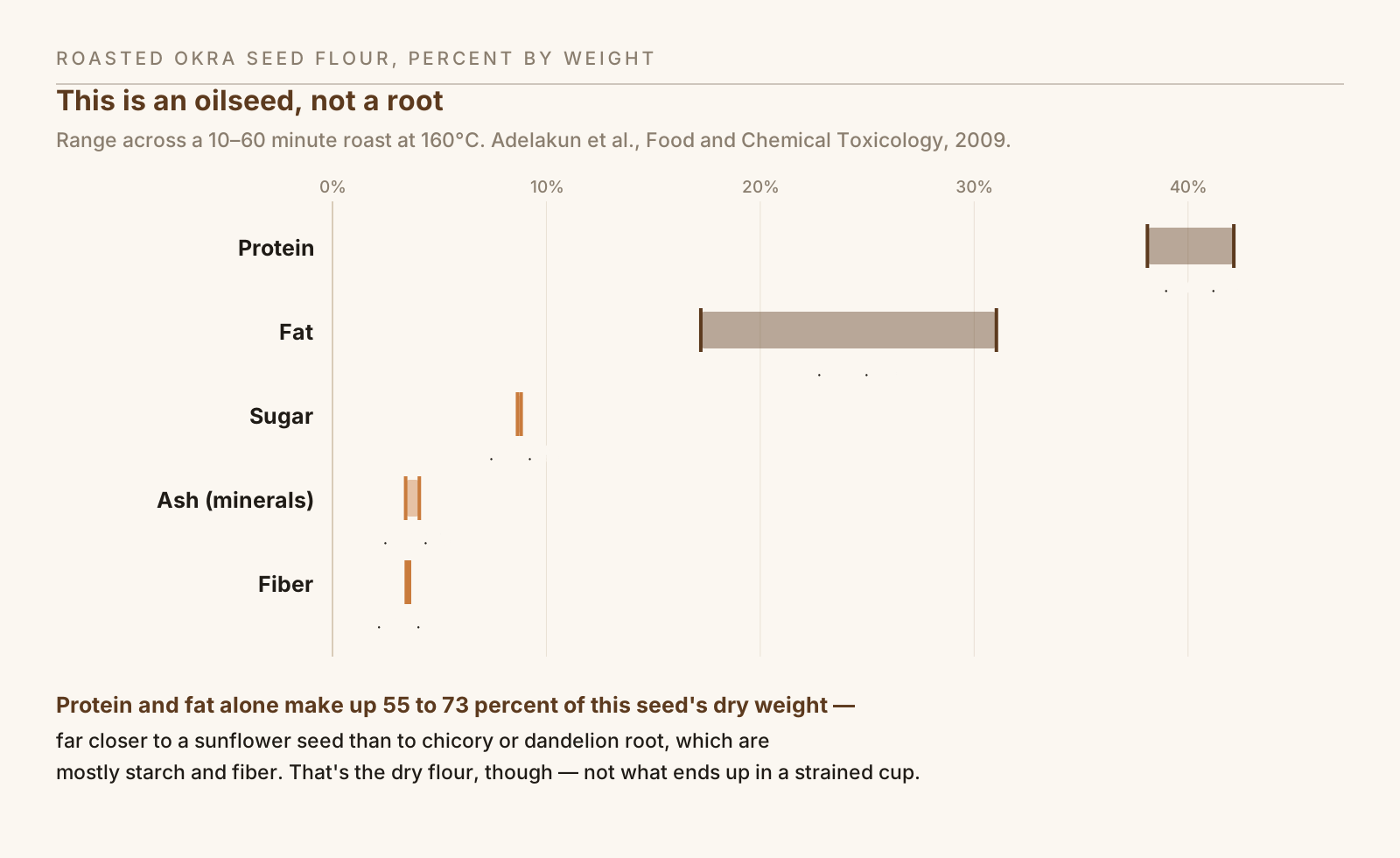
Protein ran 38 to 42 percent and fat ran 17 to 31 percent depending on roasting time — together, more than half the dry seed’s weight. That’s a genuinely different macronutrient shape than chicory, dandelion, or barley, and it puts roasted okra seed closer in spirit to a sunflower or pumpkin seed than to anything else covered on this site. The same study also found that roasting measurably increased the seed’s antioxidant activity, which tracks with what roasting does to plenty of plant material generally — it isn’t a claim specific to okra, and it isn’t a health claim either way.
One honest caveat worth stating plainly: this describes the roasted dry flour the researchers analyzed, not what actually ends up in a brewed, strained cup. A lot of that protein and fat stays behind in the spent grounds rather than dissolving into the liquid — the same basic limitation that applies to reading a coffee bean’s nutrition panel and assuming it all transfers to your mug.
Allergies and other honest caveats
Okra belongs to the mallow family (Malvaceae), alongside cotton, hibiscus, durian, and cacao. The World Health Organization doesn’t formally recognize okra as a food allergen, largely because it hasn’t been the subject of much dedicated allergy research one way or the other. That’s not the same as a clean bill of health: a documented body of research exists on occupational contact dermatitis and IgE-mediated skin reactions among people who handle raw okra for a living, and okra has occasionally been named as a trigger for Food Protein-Induced Enterocolitis Syndrome (FPIES) in specific individuals — a real but uncommon reaction, distinct from a classic allergy.
None of that makes okra seed coffee an unusually risky choice. It makes it exactly as risky as the vegetable itself already is for you: if you have no history of reacting to okra, there’s no specific reason a roasted-seed drink made from the same plant would be different. If you do have a known reaction, treat the seed coffee with the same caution, and this article isn’t a substitute for a conversation with your own clinician about a diagnosed food reaction.
Where it fits today
Unlike chicory or barley coffee, okra seed coffee never became a shelf category. It’s stayed almost entirely a homesteading and heirloom-seed-saving project: seed-keeping collectives and Etsy sellers list okra varieties specifically bred or selected for seed coffee, and the recipe itself circulates mostly through gardening and home-cooking blogs rather than a packaged-goods aisle. At least one small overseas brand currently sells a packaged version, but it’s the exception rather than a sign the category has gone mainstream.
That’s a real difference from the herbal-coffee blends most of this site covers, which lean on chicory, carob, roasted barley, and dates instead. Teeccino (opens in a new tab)’s French Roast, for instance, blends roasted chicory with carob, barley, dates, and almonds — worth flagging that recipe contains both barley (not gluten-free) and almonds (a tree-nut allergen) — while Dandy Blend and Pero occupy the same roasted-root-and-grain format. None of them use okra seed at all. If what you actually want is an off-the-shelf, repeatable cup rather than a garden project, that’s the practical trade-off: the mainstream herbal-coffee brands have done the blending and roasting for you, and okra seed coffee, at least for now, mostly hasn’t found its way into that aisle.
The bottom line
Okra seed coffee earned its place in American history honestly — a real wartime substitute with a name, a face, and a surviving firsthand account, not a modern wellness-blog rediscovery dressed up as folklore. What makes it worth a second look today isn’t nostalgia: it’s a genuinely different composition than the roots and grains that dominate this category, a taste that has nothing to do with the vegetable’s reputation for sliminess, and a home-garden project that’s stayed exactly that — a project — rather than becoming a brand on a shelf. If you grow okra already and let a few pods go to seed, it’s one of the more literal “why did nobody tell me this” ingredients on this entire site.
This article is educational, not medical advice. If you have a known food allergy or a diagnosed reaction to okra, talk to your own clinician before trying any homemade coffee substitute.
Sources & further reading
- 21 April 1863: "Okra the best Substitute for Coffee" (opens in a new tab) — Civil War Day by Day, UNC Libraries
- Coffee alternatives that were used during the Civil War (opens in a new tab) — We Are The Mighty
- Did you know you can make coffee using okra? Here's how to (opens in a new tab) — Onmanorama
- Roasted Okra Seed Coffee (opens in a new tab) — Sweet Miscellany
- Chemical composition and the antioxidative properties of Nigerian Okra Seed (Abelmoschus esculentus Moench) Flour (opens in a new tab) — Food and Chemical Toxicology, 2009 (PMID 19425185)
- Okra allergen profile (opens in a new tab) — Allergy Resources UK
Reader conversation (5)
We read every response. Selected reader notes below.
My great-aunt used to talk about “poor man’s coffee” from the garden and I always assumed she meant chicory. Turns out it might have been this the whole time — nobody in the family ever wrote down which seeds she actually used.
Let a row of okra go to seed every year just to save for next season’s planting and had no idea the seeds themselves had a whole second life. Roasting a batch this weekend.
Report back on how it turns out. The one thing I’d watch for is grinding it soon after roasting — the 1863 account was specific that the seeds get noticeably harder if you let them sit a day or two first, and that tracked with the modern write-ups too.
Okra shows up in so much West African cooking that it’s funny to see it framed here as an American Civil War discovery. Wouldn’t surprise me at all if roasting the seeds for a hot drink has an even older, unwritten history somewhere in that direction too.
Was fully expecting this to taste slimy just from reading the title, so the mucilage explanation actually changed my mind about trying it. Ordering a small bag of seeds to test before I bother growing my own.
The protein and fat numbers surprised me more than the history did, honestly. Assumed anything called a “coffee substitute” would be mostly fiber like chicory, not something closer to a sunflower seed.
Have something to add? Email us and we may include it in a future update.