Do adaptogens actually lower cortisol? What the trials show — and why the number is the easy part
Ashwagandha really does move cortisol in randomized trials. Whether that makes your day feel different is a separate question, and the research is much less settled about it. A dietitian's honest read on cortisol claims in the functional-drink aisle.

Walk down the functional-drink aisle and count how many packages say the word cortisol. Mushroom coffees, evening blends, “stress support” lattes, adaptogen creamers. The pitch is remarkably consistent: modern life has your cortisol stuck high, coffee is making it worse, and this powder will bring it back down.
Two of those three claims have real research behind them. The third — the part that actually matters to you — is the one nobody wants to talk about.
I want to walk through what the trials actually found, because the honest version is more interesting than either the marketing or the backlash. Ashwagandha genuinely does move cortisol. That’s not the weak link. The weak link is the assumption sitting underneath the whole category: that a lower number on a lab report is the same thing as a better day.
The short answer
Ashwagandha reliably lowers measured cortisol in randomized trials. Whether it reliably makes people feel better is contested, with two 2025 meta-analyses of overlapping evidence reaching opposite conclusions. Rhodiola’s evidence base is considerably weaker. “Adaptogen” is a marketing word with no regulatory meaning. And for most people reading this, the things that move cortisol most are sleep, light, alcohol, and training load — not a scoop of anything.
None of which means the powders are useless. It means the claim on the front of the bag is answering an easier question than the one you’re asking.
What cortisol actually is
Cortisol has been cast as the villain hormone, and it’s worth resetting that before we look at numbers.
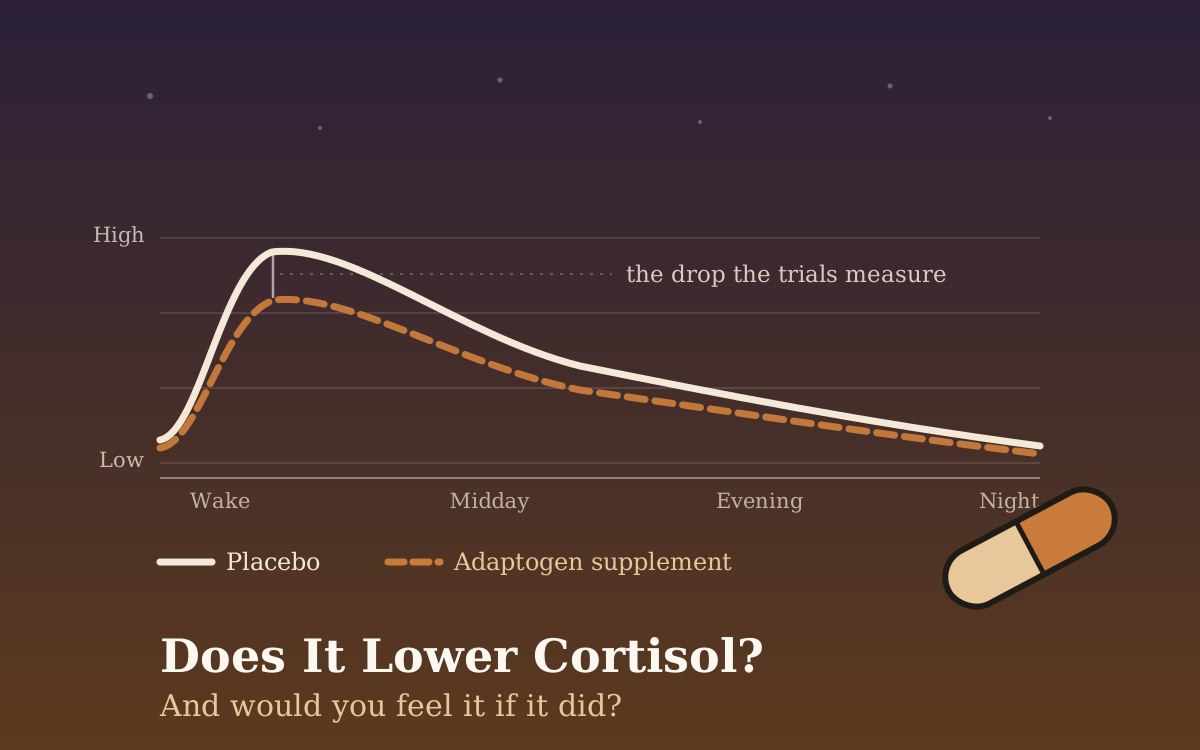
Cortisol is your primary glucocorticoid. It mobilizes glucose, modulates immune activity, and — critically — it is supposed to be high in the morning. Levels rise sharply in the 30 to 45 minutes after you wake up, a pattern called the cortisol awakening response, then decline across the day to a trough around midnight. That morning surge is the mechanism that gets you vertical. We wrote about it in how to wake up without coffee, because it’s the single most useful piece of physiology for anyone trying to get through a morning without caffeine.
So “lower cortisol” is not automatically good. Flattened cortisol curves — a blunted morning rise — are associated in the literature with fatigue and burnout, not with wellness. What you generally want is a steep, well-timed curve: high on waking, low at night. Not a low one.
This matters for reading supplement claims, because a product advertising that it lowers cortisol is not telling you when, and when is most of the story.
Does coffee raise cortisol?
Yes — but less than the marketing implies, and the interesting part is a different finding entirely.
The foundational study here is a 1996–2005 line of work from Lovallo’s group (opens in a new tab), and one crossover trial in particular: 96 healthy adults, double-blind, caffeine given as capsules after a washout. After five days off caffeine, a challenge dose produced a robust cortisol rise. But after five days of daily intake at 300 or 600 mg, the cortisol response to the morning dose was abolished — gone. The afternoon dose still produced a rise.
Read that carefully, because it cuts against the usual pitch. If you are a daily coffee drinker, your body has largely stopped mounting a cortisol response to your first cup. The tolerance is partial, not complete, but it’s real. “Your morning coffee is spiking your cortisol” is describing what happens to someone who doesn’t drink coffee daily.
The newer and more provocative finding runs the other way. A 2024 study in Psychoneuroendocrinology looked not at baseline cortisol but at cortisol reactivity — how hard the system swings when you’re put under laboratory stress. Across two separate samples, habitual caffeine users showed heightened cortisol reactivity to stress compared with non-users.
That’s a much better description of what people actually report when they quit. Not “my mornings got calmer” so much as “bad news stopped landing like a physical blow.” It’s the same territory as the best coffee alternative for anxiety — the change shows up in the size of the reaction, not the resting state.
What ashwagandha actually does to the number
Here the supplement industry has a better hand than skeptics usually give it credit for.
Withania somnifera has been studied in enough randomized placebo-controlled trials to support meta-analysis, and the cortisol finding replicates. A 2025 meta-analysis in Nutrition and Health pooled the trials and reported a reduction in circulating cortisol of roughly 1.16 µg/dL versus placebo (95% CI −1.64 to −0.69). A separate 2025 systematic review in BJPsych Open covering 15 randomized trials in 873 participants also found a significant cortisol reduction at eight weeks.
Two independent teams, same direction, statistically significant. By supplement-literature standards that is a strong showing.
The caveats are the usual ones and they are not trivial. These trials are small — a median arm of a few dozen people. They are short, typically eight weeks. Outcome measurement is inconsistent across studies. And a large share of them are funded by extract manufacturers, which in nutrition research is consistently associated with more favorable results. I’d treat the existence of the effect as reasonably established and the magnitude as soft.
The gap between the number and the day
Now the part that decides whether any of this is worth your money.
The two 2025 meta-analyses agree that cortisol falls. They disagree about whether anything else does.
The Nutrition and Health review found the cortisol reduction was not accompanied by a significant change in perceived stress. Its authors called this a dual impact — a real biochemical effect with no corresponding shift in the outcome participants could actually feel. The BJPsych Open review, pooling an overlapping but not identical set of trials, did report improvement on perceived-stress and anxiety scales at eight weeks, while finding no significant improvement in quality of life.
Two competent teams, largely the same underlying studies, different answers on the question that matters. That is not a scandal; it’s what a literature of small heterogeneous trials produces. But it should absolutely change how you read a package that says “clinically shown to reduce cortisol.” That sentence can be entirely true while the sentence you assumed it meant — clinically shown to make you feel less stressed — remains unresolved.
This is the same structural problem we ran into with mushroom coffee and anxiety: the biomarker research runs well ahead of the experience research, and the marketing quietly borrows the credibility of the former for claims about the latter.
Rhodiola, and the rest of the shelf
Ashwagandha is the strongest case on the shelf. Everything else is weaker, and it’s worth being specific about how much weaker.
Rhodiola rosea, the second-most-common adaptogen in coffee-alternative blends, is usually sold for fatigue and mental stamina. The most-cited systematic review (opens in a new tab) screened 206 articles and found 11 that qualified. Two of six trials on physical fatigue found an effect. Three of five on mental fatigue did. And the reviewers’ verdict on the whole set was blunt: all included studies showed either high risk of bias or reporting flaws serious enough to prevent assessment of validity, and no two studies measured the same outcomes — which made pooling them impossible.
That’s not evidence of absence. It’s an absence of usable evidence, which is a different and more common situation. If a product’s rhodiola content is doing something for you, the honest position is that we can’t currently tell whether it’s the rhodiola.
Holy basil, schisandra, eleuthero, reishi, cordyceps — the picture gets thinner from there. I went through the category boundaries in adaptogens vs mushrooms, and the short version is that “adaptogen” is a bucket assembled by marketers, not a pharmacological class with shared mechanisms.
“Adaptogen” is not a regulated word
Worth stating plainly, because it explains a lot of the label language you’re reading.
The term originated in mid-20th-century Soviet research, describing a substance that non-specifically increases resistance to stressors. It has no legal definition in US or EU food law. It is not an authorised health claim: the EU Register of nutrition and health claims (opens in a new tab) contains no entry permitting it, and in the US it survives in the structure/function-claim space where nobody has to prove anything before printing it.
Practically: the word on the front of the bag tells you what the brand hopes, not what has been demonstrated. Which is exactly why the hedged phrasing on better packaging — “traditionally used to” — is doing legal work rather than scientific work.
The safety conversation nobody leads with
If a product is pharmacologically active enough to shift a hormone in a randomized trial, it is active enough to have a downside. Both things are true at once, and the adaptogen category is unusually bad at holding the second one.
The NIH’s LiverTox database (opens in a new tab) documents cases of clinically apparent liver injury associated with ashwagandha, ranging from asymptomatic enzyme elevations through prolonged jaundice, with a growing published case series. It’s an uncommon outcome relative to how widely the herb is used, and the picture is complicated by the fact that many products mix root and leaf material and by the general unreliability of supplement labeling. But it is a documented signal, not a rumor.
Beyond the liver: ashwagandha is generally advised against in pregnancy, may raise thyroid hormone levels (a problem if you’re already treated for thyroid disease), and can compound sedatives. Rhodiola is more often reported to cause activation and jitteriness than sedation, which is worth knowing if you came to it looking for calm.
I’d add one dietitian’s note. If you’re in the first weeks off caffeine, that is a bad time to add a new active compound — you’ll have no way to attribute what you’re feeling. Let the withdrawal timeline resolve first, then change one variable.
What actually moves cortisol
If your goal is a healthier cortisol rhythm rather than a lower number, the levers with the strongest evidence behind them are unglamorous and free.
Sleep duration and regularity. Short and fragmented sleep is among the most reliable ways to disturb next-day cortisol. This is also the lever caffeine interferes with most, often invisibly — see what a daytime cup does to sleep architecture.
Morning light. Bright light shortly after waking sharpens the awakening response, which is the direction you want.
Alcohol. Reliably raises cortisol and degrades sleep quality in the same night. For most people who drink regularly, this is a larger lever than any supplement.
Training load. Exercise acutely raises cortisol, which is normal and adaptive; chronic under-recovery keeps it elevated in a way that isn’t.
Caffeine timing. Given that afternoon doses still produced a cortisol rise even in habituated drinkers, moving your last caffeine earlier is a real intervention. The half-life math makes the case better than I can here.
None of that is as satisfying as buying something. It is, however, where the effect sizes are.
What this means for your mug
Here’s the practical translation, and it may be the most useful thing in this article.
A naturally caffeine-free brew — roasted chicory, barley, carob, dandelion root, rooibos — contains no adaptogens and makes no cortisol claim. Herbal and grain-based coffee blends — Teeccino (opens in a new tab), Dandy Blend, Pero and the rest of that shelf — all sit in this group: roasted plant material, no caffeine, no active stress-axis compound. What they do is remove caffeine from your day, which — per the 2024 reactivity finding — is plausibly the more consequential change anyway.
Mushroom-and-adaptogen coffees are a different product doing a different thing, and many of them still contain caffeine from coffee or green tea. That’s not a knock; it’s just worth knowing which problem you’re solving. If you want to be off caffeine, read the ingredient panel rather than the claim on the front.
And if you want to try ashwagandha, take it as a discrete supplement at a known dose rather than as an unspecified fraction of a beverage blend. Powders in drink mixes are routinely dosed well below trial levels, and you have no way to know from the label. Isolating the variable is the only way you’ll learn anything about whether it works for you.
The bottom line
Adaptogens are not snake oil and they are not the answer. Ashwagandha lowers a hormone in randomized trials, which is more than most of the wellness aisle can say. What remains genuinely unsettled is whether that translates into a day that feels different — and two 2025 meta-analyses of the same small studies landed on opposite sides of it.
Meanwhile the biggest cortisol lever available to most people is the one already in their mug, and it works by subtraction rather than addition.
If you’re switching to a caffeine-free cup, do it because you want the caffeine gone. That effect is real, well-characterized, and doesn’t depend on anyone’s meta-analysis coming out the right way.
This article is educational and isn’t medical advice. If you’re pregnant, managing thyroid or liver disease, or taking prescription medication, talk to your own clinician before starting any herbal supplement.
Sources & further reading
- Dual impact of Ashwagandha: significant cortisol reduction but no effects on perceived stress — a systematic review and meta-analysis (Albalawi et al.) (opens in a new tab) — Nutrition and Health, 2025
- Effects of Ashwagandha Supplements on Cortisol, Stress, and Anxiety Levels in Adults: A Systematic Review and Meta-Analysis (opens in a new tab) — BJPsych Open, 2025
- Rhodiola rosea for physical and mental fatigue: a systematic review (Ishaque et al.) (opens in a new tab) — BMC Complementary and Alternative Medicine, 2012
- Ashwagandha — LiverTox: Clinical and Research Information on Drug-Induced Liver Injury (opens in a new tab) — National Institute of Diabetes and Digestive and Kidney Diseases (NIH)
- Caffeine stimulation of cortisol secretion across the waking hours in relation to caffeine intake levels (Lovallo et al.) (opens in a new tab) — Psychosomatic Medicine, 2005
- Habitual caffeine use is associated with heightened cortisol reactivity to lab-based stress in two samples (opens in a new tab) — Psychoneuroendocrinology, 2024
- EU Register of nutrition and health claims made on foods (opens in a new tab) — European Commission
Reader conversation (5)
We read every response. Selected reader notes below.
This is the first thing I’ve read on cortisol that didn’t either sell me something or tell me the whole category is a scam. The bit that actually landed was that a flattened curve isn’t the goal — I’ve spent a year trying to get a number DOWN without once asking whether down was the right direction. My morning has been dragging and I’d been reading that as “still too much stress.” Genuinely rethinking things.
That reframe is the one I most wanted to land, so thank you for saying it back. The shape of the curve is the useful variable and almost nothing on a label is describing shape. Worth saying plainly: a dragging morning has a long list of possible causes and cortisol is only one, so please don’t self-diagnose off an article — but “is down actually what I want here” is a good question to walk into a clinician’s office holding.
Six weeks of ashwagandha, no change I could point to, felt like I was the one doing it wrong. Seeing that one of the 2025 reviews found the cortisol drop with no matching change in perceived stress is weirdly consoling. The blood work presumably did what it does and I just didn’t notice, which turns out to be a documented outcome rather than a personal failure.
Thank you for the liver paragraph. I take levothyroxine and had no idea about the thyroid interaction either — that would have been a genuinely bad surprise. Every other article I found treats these as food. They’re plainly not food if they can shift a hormone in a trial, and I appreciate you making that exact argument instead of just bolting a disclaimer on the end.
That’s the logic I keep coming back to: potent enough to work is potent enough to interact. The thyroid one is under-discussed relative to how many people are on replacement therapy. Please do run it past your own GP or pharmacist before starting anything — with levothyroxine specifically that’s a conversation worth having rather than a thing to work out from the internet.
The reactivity study explains something I could never put into words. Eight months off coffee and my resting state honestly feels about the same as it always did. What changed is that a bad email doesn’t put my hands shaking anymore. I’d assumed I was imagining it because nothing about my baseline felt different. “The size of the reaction, not the resting state” is exactly it.
Small practical note for anyone else reading labels: I went and checked my “stress support” mushroom blend after this and it has 60mg of caffeine per serving from green tea extract, listed in the fine print under the adaptogen list. I’d been drinking it in the afternoon for six months thinking it was the caffeine-free option. The advice to read the panel and not the front of the bag is not theoretical.
Have something to add? Email us and we may include it in a future update.