What is rhodiola? The arctic root in some adaptogen coffee blends, and why two meta-analyses disagree about what it does
Rhodiola is a cold-climate root used in traditional medicine and listed in some adaptogen coffee blends. Two recent meta-analyses disagree on endurance, and two small trials tested it with caffeine. What to check on a label.


Rhodiola shows up in the ingredient lists of a handful of adaptogen coffee blends, usually next to ashwagandha and a mushroom or two. It gets less attention than its neighbors, which is a little odd, because it has something most of them lack: a pair of recent trials that tested it alongside caffeine. We read the abstracts. The short version is small studies, and two pooled analyses that point in different directions.
The short answer
- Rhodiola is a plant root, not coffee, tea or a caffeine source.
- A 2025 meta-analysis of 26 trials reported small endurance gains. A 2026 meta-analysis of 9 trials found no significant effect on VO2max. Both pool small, varied studies.
- Two 2026 trials tested rhodiola with caffeine, in 10 and 48 young male athletes. Neither established that the pair beats caffeine alone.
- We found no trial of a coffee blend, and a label rarely tells you how much rhodiola is in the cup.
What rhodiola actually is
Rhodiola rosea is a low-growing plant from cold, high-altitude regions. The root is dried and powdered or turned into an extract, and it has a long history of use in traditional medicine. Our explainer on adaptogens versus mushrooms covers where the “adaptogen” label came from, and our look at adaptogen cortisol claims covers what the stress marketing can support.
A 2026 chemistry review in Frontiers in Pharmacology adds a practical wrinkle. It says adulteration is widespread in the global Rhodiola product market, and that species are hard to tell apart once a raw material has been processed, because the usual identification methods stop working. The authors say reliable chemical markers are still lacking. We read that as a reason to treat “rhodiola” on a label as a name, not a specification. We can’t say how common mix-ups are in coffee blends, and the paper doesn’t either.
One adaptogen blend we’ve covered, Rasa, lists rhodiola in its published ingredient list with no separate amount for it. That is typical of how the ingredient appears.
Two meta-analyses, two answers
Here is how many people each source we read counted:
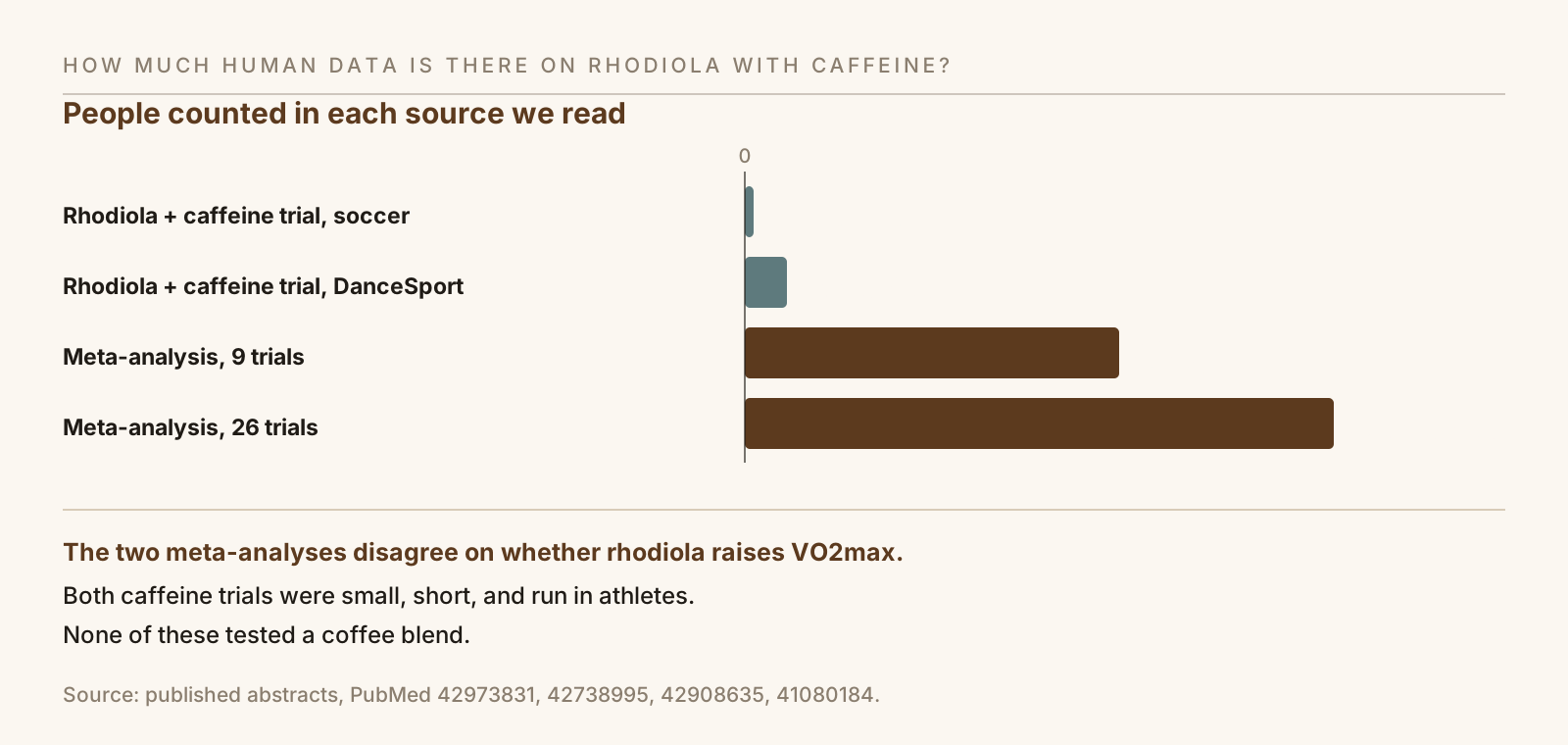
- The 2025 analysis. A meta-analysis in Frontiers in Nutrition pooled 26 randomized trials in 668 healthy people, average age about 22, with supplementation averaging 33 days. It reported small gains in VO2max (11 studies) and time to exhaustion (7 studies), and its authors call rhodiola an effective endurance aid while noting that differences between studies warrant cautious reading. It found no effect on two inflammation markers.
- The 2026 analysis. A meta-analysis in Frontiers in Physiology pooled 9 trials in 424 healthy adults. Its interval for VO2max ran from about -0.9 to 3.0, which spans zero, so it found no significant effect. It did report higher total antioxidant capacity. Its authors say the evidence doesn’t support rhodiola for improving VO2max or preventing altitude-related problems, and they blame varied designs, doses and durations.
Our reading, not the authors’: the two papers searched at different times with different trial sets, and both say the underlying studies are inconsistent. Taken together, “unsettled” is a fairer word than either “works” or “doesn’t.” The people in these trials were healthy, mostly young, and taking standardized extracts, which is a long way from a scoop of coffee blend with an unstated amount.
Rhodiola with caffeine
This is the part that makes rhodiola worth a post on a coffee site. Two 2026 trials gave athletes rhodiola, caffeine, both, or placebo:
- Soccer players. A crossover trial (opens in a new tab) in 10 young men gave single doses of rhodiola and caffeine (3 mg per kilogram of body weight each) an hour before a short, all-out sprint test. The combined condition showed higher peak power than placebo, and some salivary stress markers differed between conditions. The authors themselves say the small sample and one-time dose mean the findings should be read cautiously, and they call for proper interaction analyses.
- DanceSport athletes. A four-week trial (opens in a new tab) split 48 young men into four groups of 12: placebo, caffeine, rhodiola, or both. Group differences were outcome-specific. The caffeine groups, with or without rhodiola, scored higher than placebo and rhodiola alone on kick success rate, but the test for an interaction wasn’t significant, and the authors say the data did not establish a synergistic effect. The trial was registered retrospectively.
Our reading, not the authors’: in the larger trial the caffeine groups did better and rhodiola alone looked much like placebo on that measure, so it’s hard to argue from this that rhodiola earns its place in a caffeinated cup. Both trials used capsules and measured athletic performance, not how anyone feels over a morning. If you’re easing off caffeine, our piece on L-theanine and caffeine covers a pairing that has had more study.
One more practical point. We found nothing in these abstracts on side effects or drug interactions, so we can’t say what a safe amount is. If you take regular medicines, or are pregnant or nursing, ask your clinician or pharmacist before adding a rhodiola product.
How to read a label for rhodiola
- Is it listed at all? It appears in adaptogen blends more than in plain chicory-and-grain coffees, so scan the full ingredient list rather than the front of the bag.
- Is an amount given? Many blends name rhodiola without its own quantity. The trials we read used capsules in set doses, so a bare name can’t tell you whether you’re near them. Our guide to reading mushroom coffee labels explains the terms.
- Which species, which part? “Rhodiola” can cover more than R. rosea. A label that says Rhodiola rosea root extract gives you more to go on than one that doesn’t.
- What else is in the cup? Caffeine, other herbs and mushrooms all change the picture.
The bottom line
Rhodiola is a cold-climate root with a long traditional history and a modest, inconsistent research record. Two meta-analyses published a year apart reach different conclusions on endurance, and the only two trials we found pairing it with caffeine were small and didn’t show the pair beating caffeine alone. None of this means it’s harmful or useless. It means a coffee blend that lists rhodiola with no amount is offering a name more than a dose, and that’s worth knowing before you pay extra for it.
Sources & further reading
- The effect of Rhodiola rosea supplementation on endurance performance and related biomarkers: a systematic review and meta-analysis (opens in a new tab) — Frontiers in Nutrition, 2025
- Antioxidant but not ergogenic or altitude-protective: a meta-analysis of Rhodiola species in healthy adults (opens in a new tab) — Frontiers in Physiology, 2026
- Effects of Rhodiola rosea and caffeine, alone and in combination, on Wingate performance and physiological stress responses in soccer players (opens in a new tab) — Frontiers in Physiology, 2026
- Effects of Caffeine and Rhodiola rosea, Alone and Combined, on DanceSport-Specific Jive Performance (opens in a new tab) — Nutrients, 2026
- Adulteration prevention-oriented systematic review of chemical constituents in the genus Rhodiola (opens in a new tab) — Frontiers in Pharmacology, 2026
Reader conversation (4)
We read every response. Selected reader notes below.
I bought an adaptogen blend because rhodiola was on the front of the bag. Reading this, I went and checked and there’s no amount listed anywhere. Good to know before I rebuy.
That’s the most common pattern we see, Dana. A name without a quantity is hard to judge either way.
Appreciated that you set the two meta-analyses side by side instead of picking one. I’d have just quoted the more positive one.
The chart starting at zero helps. Ten people in the soccer trial really puts the “alone or combined” headline in perspective.
I take a couple of regular medicines, so the line about asking a pharmacist first is the one I’m acting on.
Read this and have a question or something to add? Send us a note. With your OK, we may publish it here with an editor's follow-up. We only publish notes you've said we can.