What the same tin has to tell you in three countries: caffeine labelling in the US, UK and EU
The ingredient-list method we published for reading a US mushroom-coffee label is universal. The label itself is not. The EU and UK mandate a quantified high-caffeine warning that the US does not require at all — but a name-based exemption means it doesn't catch what you'd expect. We read the actual regulations and ran the mushroom-coffee shelf through them.

A reader in Leeds, Priyanka Sundaram, left a comment on our mushroom-coffee caffeine piece that we couldn’t shake. We had written that US labelling asks almost nothing of a brand on this question — no requirement to state a milligram figure, ever, for any product. Priyanka pointed out that she recalled something different: a mandatory warning, naming pregnancy and children by name, on a caffeinated drink she’d bought in the UK. She was right to push. The method we published — read the ingredient list, because the label won’t give you a number — is universal. The label itself is not, and the reason it isn’t is more interesting than “Europe regulates more.”

So we went and read the actual instruments — the US Code of Federal Regulations, the FDA’s own guidance, and the retained UK text of the EU’s food information regulation — rather than working from memory or from summaries. Here is what each one actually says, and what happens when you run the mushroom-coffee shelf we already surveyed through the stricter of the two systems.
The short answer
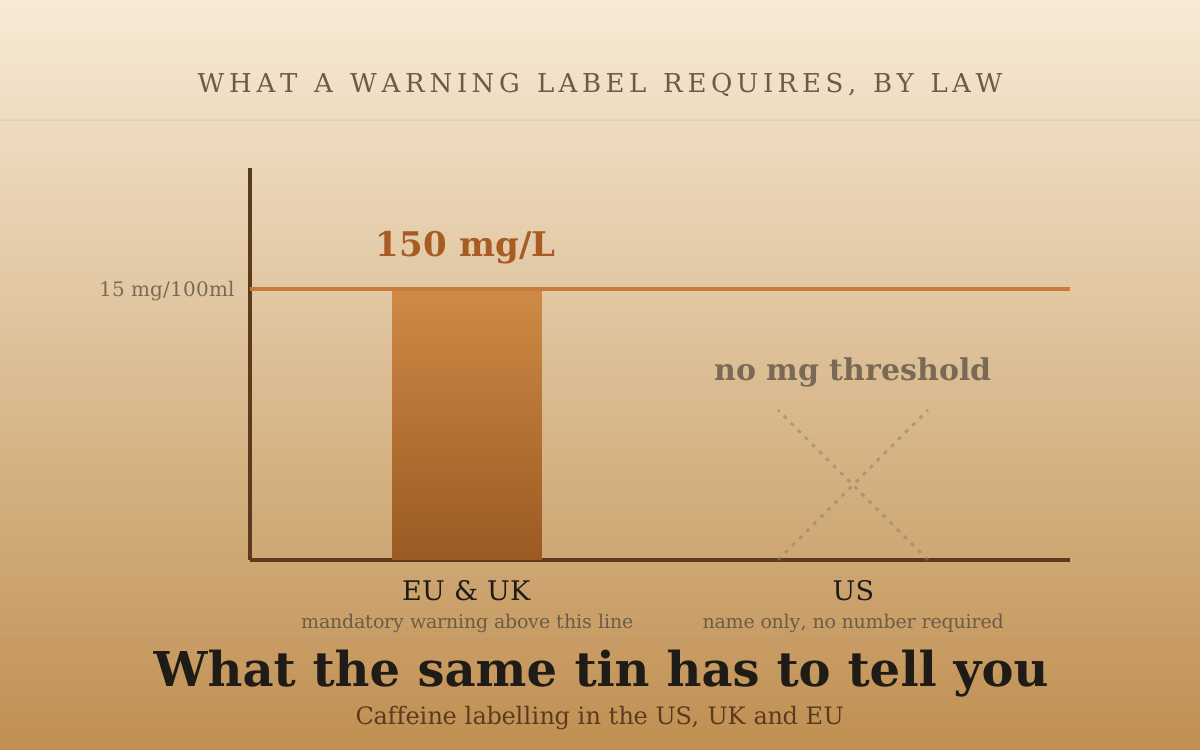
The US requires a caffeine-containing ingredient to be named. It does not require a number, for any product, at any concentration. The EU and UK go further: above 150 mg of caffeine per litre (15 mg per 100 ml), a beverage must carry a mandatory warning statement and a quantified mg-per-100ml figure — and that rule reaches powders meant to be mixed with water, not just ready-to-drink cans.
But there’s a catch that matters directly to the mushroom-coffee category we already surveyed: the EU/UK warning doesn’t apply to anything “based on coffee, tea or coffee or tea extract” if the product’s name includes the word “coffee” or “tea.” That exemption is about the name on the front of the pack, not the number in the cup. When we ran our previously published brand-by-brand caffeine figures through the 150 mg/L threshold, every single product that would cross it also had “coffee” in its name — so every one of them would be exempt from the very rule that would otherwise apply to it.
Three things follow:
- A US reader gets less structural help than they might assume, because there is no quantity requirement here at all, in any market segment we could find, outside a narrow 2018 safety guidance for bulk pure caffeine powder.
- An EU/UK reader gets more help, but with a hole shaped exactly like the mushroom-coffee category. The rule that would flag a high-caffeine drink is switched off by the one word most of these products already use to describe themselves.
- The ingredient-list method from our earlier piece still works everywhere, because it doesn’t rely on any of this. It’s the one tool none of these three regulatory regimes can take away from you.
What US law actually requires
The baseline is 21 CFR 101.4, the FDA’s general ingredient-declaration rule. It says ingredients “shall be listed by common or usual name” in “descending order of predominance by weight,” with an allowance to group anything at 2% or less under a catch-all statement. That’s the whole structural requirement. The regulation itself never mentions caffeine, kola nut, guarana or green tea extract by name — they’re just ingredients, declared like any other.
The FDA’s own consumer-facing guidance spells out what that means in practice, on the page we already cited in our mushroom-coffee piece:
“All packaged foods are required to list caffeine in the ‘list of ingredients’ when it is added to products as a stand-alone ingredient.”
“When a packaged food contains an ingredient – such as chocolate chips – that inherently contains caffeine, then caffeine will not appear on the list of ingredients. However, the caffeine-containing ingredient (for example, chocolate) will be listed.”
In a mushroom coffee, a chai latte mix, or an energy-positioned herbal blend, caffeine is essentially never added as a stand-alone ingredient — it arrives inside the coffee, the tea, the cacao or the guarana. Which means the word “caffeine” routinely doesn’t appear on these labels at all, compliantly. As for the amount:
“Many packaged foods, including beverages and dietary supplements containing caffeine, voluntarily provide information on the label as to how much caffeine they contain.”
Voluntarily. A brand that publishes 120 mg per serving and a brand that publishes nothing are equally compliant with US law. And if you’re drinking one of these away from home, the gap widens further — the same FDA page notes that restaurants and retail food establishments “are not required by law to tell you how much caffeine is in the products they serve” at all.
The one US exception, and why it doesn’t help you here
There is a US regulatory document that specifically targets caffeine quantity: FDA’s April 2018 Guidance for Industry on Highly Concentrated Caffeine in Dietary Supplements. It’s worth knowing about, and worth being precise about what it isn’t.
It exists because pure or highly concentrated caffeine — bulk powder or liquid, sold directly to consumers, meant to be measured out at home — had been linked to at least two deaths, because a genuinely safe dose and a genuinely dangerous one differ by an amount no kitchen teaspoon can reliably tell apart. FDA’s position is that such products can be adulterated under the Federal Food, Drug, and Cosmetic Act if they present “a significant or unreasonable risk of illness or injury” under ordinary use — a safety finding, not a labelling mandate for the category of products this article is actually about.
That guidance targets bulk pure caffeine products specifically. It says nothing about a blended finished product — a jar of instant mushroom coffee, an herbal latte mix, a chicory blend — where caffeine (if present at all) arrives diluted inside another ingredient at a normal food-serving dose. None of the products in our mushroom-coffee survey fall inside the category this guidance is aimed at. So for the actual shelf a reader is choosing from, the general rule from the section above stands: name it, don’t quantify it.
What EU and UK law actually require
This is the part Priyanka’s comment sent us to check directly, reading Annex III of Regulation (EU) No 1169/2011 as retained in UK law rather than relying on a secondary description of it. The relevant entry requires, for beverages other than those based on coffee or tea (see the exemption below):
- A threshold of 150 mg of caffeine per litre, measured in the beverage as intended for consumption.
- A mandatory statement — “High caffeine content. Not recommended for children or pregnant or breast-feeding women” — that must appear “in the same field of vision as the name of the beverage.”
- A quantified figure: the caffeine content expressed in mg per 100 ml, stated next to that warning.
- Coverage of reconstituted products. The rule explicitly reaches concentrated or dried beverages that will exceed 150 mg/L once prepared with water — so a tin of instant powder doesn’t get a pass just because it isn’t sold pre-mixed. This is the single biggest structural difference from the US baseline: in the EU and UK, the prepared drink is what’s being regulated, not just the physical product as packaged.
Compare that to the US picture above: no threshold, no mandatory statement, no required number, at any concentration, for a conventional food or beverage. On paper, this is a meaningfully more protective regime — closer to what Priyanka remembered.
The loophole built into the exemption
Here’s the qualifier that changes the practical effect of all of it: the threshold and warning don’t apply to beverages “based on coffee, tea or coffee or tea extract where the name of the food includes the term ‘coffee’ or ‘tea.’”
Read that narrowly, and it sounds sensible — nobody needs a special warning telling them a cup of coffee has caffeine in it; that’s the whole point of coffee. But the exemption is triggered by the word in the name, not by whether the product is a normal cup of drip coffee. A drink that is mostly cacao, mushroom extract and only a modest amount of actual coffee, sold under a name that includes the word “coffee,” gets the same pass as a plain black coffee — even if its caffeine content, per litre, is nowhere near what “coffee” usually implies, or is in fact higher.
That is precisely the shape of the mushroom-coffee category we already surveyed.
Running the mushroom-coffee shelf through it
Our earlier piece tabulated each brand’s own published caffeine figure per roughly 8 fl oz (237 ml) serving — the serving size several of these brands use themselves when comparing to “a regular cup of coffee.” Converting those to mg per 100 ml lets us check every one against the 150 mg/L (15 mg/100ml) EU/UK line directly.
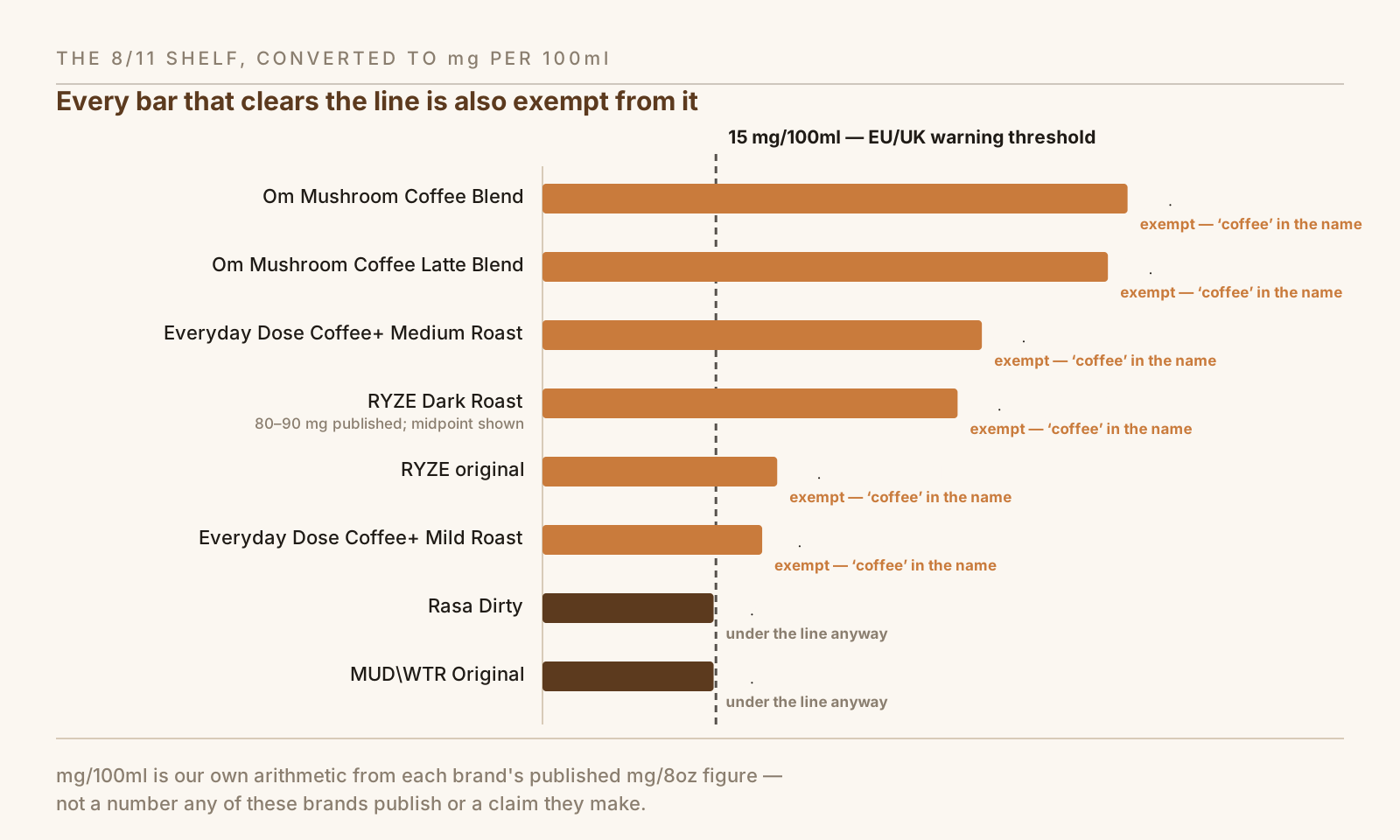
Six products clear the 15 mg/100ml line once converted: Om Mushroom Coffee Blend, Om Mushroom Coffee Latte Blend, Everyday Dose Coffee+ (both roasts), and RYZE (both roasts). Every one of those six has some form of the word “coffee” in its product name — which means every one of them would be exempt from the EU/UK warning regardless of how far above the threshold it sits. Om’s own figure of 120 mg per 8 oz works out to roughly 50.6 mg/100ml — more than three times the threshold — and the exemption would still apply, purely on the name.
The two products that land under the line — Rasa Dirty and MUD\WTR Original, both around 14.8 mg/100ml on this conversion — don’t need the warning anyway, so the exemption is moot for them either way. But it’s worth noting they arrived at “under the line” for opposite reasons with respect to naming: Rasa Dirty’s first ingredient is real coffee, yet its product name doesn’t include the word, so it would get no name exemption if it did cross the line; MUD\WTR Original contains no coffee, but does contain black tea, and its name contains neither word either.
The products that were already at zero in our earlier survey — Rasa Original, MUD\WTR Rest, and Teeccino’s Adapt & Protect — don’t appear on this chart at all, because there’s nothing to convert. None of the six caffeine-source ingredients from that piece (coffee, tea, cacao, yerba mate, guayusa, kola) show up anywhere in their ingredient lists in a caffeine-bearing amount, so no threshold in any of the three jurisdictions in this article is a live question for them.
One caveat worth stating plainly, since the sourcing rule for this piece was primary documents only: we converted brand-published figures using an 8 fl oz assumption these brands themselves invoke elsewhere on their own pages, but that is our arithmetic, not theirs, and we have no evidence any of these US-market products are actually sold in the EU or UK under these labels. This section is a demonstration of how the rule would apply to already-published numbers, not a claim about any brand’s actual compliance status abroad.
Why Brexit didn’t change any of this
Because “EU” and “UK” rules on caffeine are, right now, the same rule. When the UK left the EU, it converted the body of EU food law then in force — including Regulation (EU) No 1169/2011 in full — into domestic “retained” (now “assimilated”) law, rather than rewriting it. We checked the UK’s own retained-law text of Annex III against the current EU consolidated text and found the caffeine provisions unchanged and unamended on either side since. If that changes, it’s the kind of divergence worth its own follow-up — for now, a US reader comparing a UK-sold product to an EU-sold one is looking at the identical threshold, the identical warning wording, and the identical name-based exemption.
What this means for your cabinet
Not much changes about what you should actually do, and that’s the honest headline. Whether you’re shopping in Leeds, London or Ohio, the label in front of you might carry a mandated number, might carry a voluntary one, or might carry neither — and in the one case that seems like it should be most protective, a single word in the product’s own name can switch the whole requirement off. The ingredient-list method from our mushroom-coffee piece works regardless of which of these you’re holding, because it never depended on any regulator requiring anything: scan for coffee, tea, cacao, yerba mate, guayusa and kola, and treat the absence of all six as your best available signal, in any of these three markets.
If you want a product where that scan resolves quickly, look for one whose ingredient list settles the question outright rather than one you have to convert and cross-check against a threshold. Teeccino’s French Roast (opens in a new tab) — roasted chicory, carob, barley, dates, almonds — has none of the six caffeine-bearing ingredients in it at any concentration, in any country’s list, which is a different and simpler kind of certainty than “under the warning line this week.” That’s not a claim that herbal coffee is regulated more strictly anywhere; it’s the same point this whole article has been making from the other direction — a label regime is only ever a backstop, and the ingredient list is the thing that doesn’t change when you cross a border.
We’ll be looking next at how far that “same label, different country” gap extends beyond caffeine — starting with whether the same rule applies to a beverage sold as a powder in a country you’re merely visiting. If you’ve navigated ordering something caffeine-free abroad and found the local rules or menu conventions surprising, we’d like to hear about it in the comments.
Sources & further reading
- 21 CFR 101.4 — Food; designation of ingredients (opens in a new tab) — Cornell Law School, Legal Information Institute (mirroring the Code of Federal Regulations)
- Spilling the Beans: How Much Caffeine is Too Much? — FDA consumer update on caffeine labelling (opens in a new tab) — U.S. Food and Drug Administration
- Guidance for Industry: Highly Concentrated Caffeine in Dietary Supplements (opens in a new tab) — U.S. Food and Drug Administration, April 2018
- Regulation (EU) No 1169/2011, Annex III — foods for which labelling must include one or more additional particulars, as retained in UK law (opens in a new tab) — legislation.gov.uk, UK National Archives
- Regulation (EU) No 1169/2011 on the provision of food information to consumers — consolidated text (opens in a new tab) — EUR-Lex, Publications Office of the European Union
- Which mushroom coffees are actually caffeine-free? — our own brand-by-brand caffeine survey — CoffeeAlternatives.com
Reader conversation (4)
We read every response. Selected reader notes below.
This is more thorough than I expected from a comment I left half-remembering my own cupboard. The bit that actually surprised me is the exemption — I assumed the warning just tracked the number, and finding out it tracks the word “coffee” instead is a genuinely different fact than the one I thought I was reporting. Glad you read the regulation itself rather than taking my word for the recollection.
We nearly didn’t get past your recollection, honestly — it would have been easy to write “the UK requires a warning” as a one-line addition to the old piece and move on. The name exemption only turned up because we went and read Annex III directly instead of summarising it secondhand, which is exactly the standard your original comment held us to. Thank you for the push twice over.
Can confirm the warning label from this end — I have an energy drink in the fridge right now with that exact sentence on it in bold, pregnancy and children named outright. Never once considered that a “coffee” branded product would sidestep the same rule at a higher dose. That’s a strange thing for a regulation to turn on.
American reader, and the FDA guidance on bulk pure caffeine powder was new to me — I’d never have guessed that was the one place US law actually gets specific, and only because people died. Puts the rest of the “voluntary disclosure” framing in a harsher light: it took fatalities to get a number required anywhere, and only for the most extreme product form.
That’s the right way to read it. The 2018 guidance is a safety backstop for one narrow, genuinely dangerous product category, not evidence that the FDA considers quantity disclosure important generally — if it did, the ordinary ingredient-declaration rule would ask for a number too, and it doesn’t. Worth remembering next time someone assumes “the FDA regulates this” means the same thing for every caffeinated product on a shelf.
Small addition from an EU country: the “same field of vision as the name” requirement matters more than it sounds like on a small package. I’ve seen the warning printed at a size that technically satisfies the letter of the rule and is still nearly impossible to read without the exact magnifying glass in your photo. Compliant and legible are not the same test.
That’s a real gap between what the regulation requires and what it guarantees a shopper actually notices, and it’s outside what we checked here — Annex III specifies placement and content, not a minimum type size. Worth its own look at some point, because “technically on the label” and “actually legible” is a version of the same problem this whole article is about.
Have something to add? Email us and we may include it in a future update.