Coffee before donating blood: a drink helps, and one small trial suggests caffeine might too
Should you have coffee before you give blood? Research on faint and dizzy reactions says water matters most, and the caffeine evidence is thin. What the studies found and how to plan around it.


The short answer
If you’re giving blood and wondering about your morning coffee, the research points to a different question: have you had something to drink? Studies of donors suggest water or an isotonic drink beforehand may mean fewer faint or dizzy reactions. The caffeine evidence is thin, and the people running your donation session decide what’s right for you.
I’m not a clinician, and this isn’t medical advice. Your blood service’s instructions come first. What follows is what the studies found, so you can plan the morning.
What goes wrong when donors feel faint
Researchers call the problem a vasovagal reaction: dizziness, lightheadedness or fainting around the time of donation. These reactions are associated with a drop in blood pressure, and they can put donors off coming back.
That blood pressure link is why caffeine gets studied here at all. Caffeine has pressor effects, meaning it can raise blood pressure, so a researcher in the late 1990s wondered whether it might cushion the dip. We’ll get to that trial below, but first the better-supported finding.
What the reviews found
A 2024 systematic review from the Belgian Red Cross and colleagues looked at eating and drinking interventions around donation. Its main results:
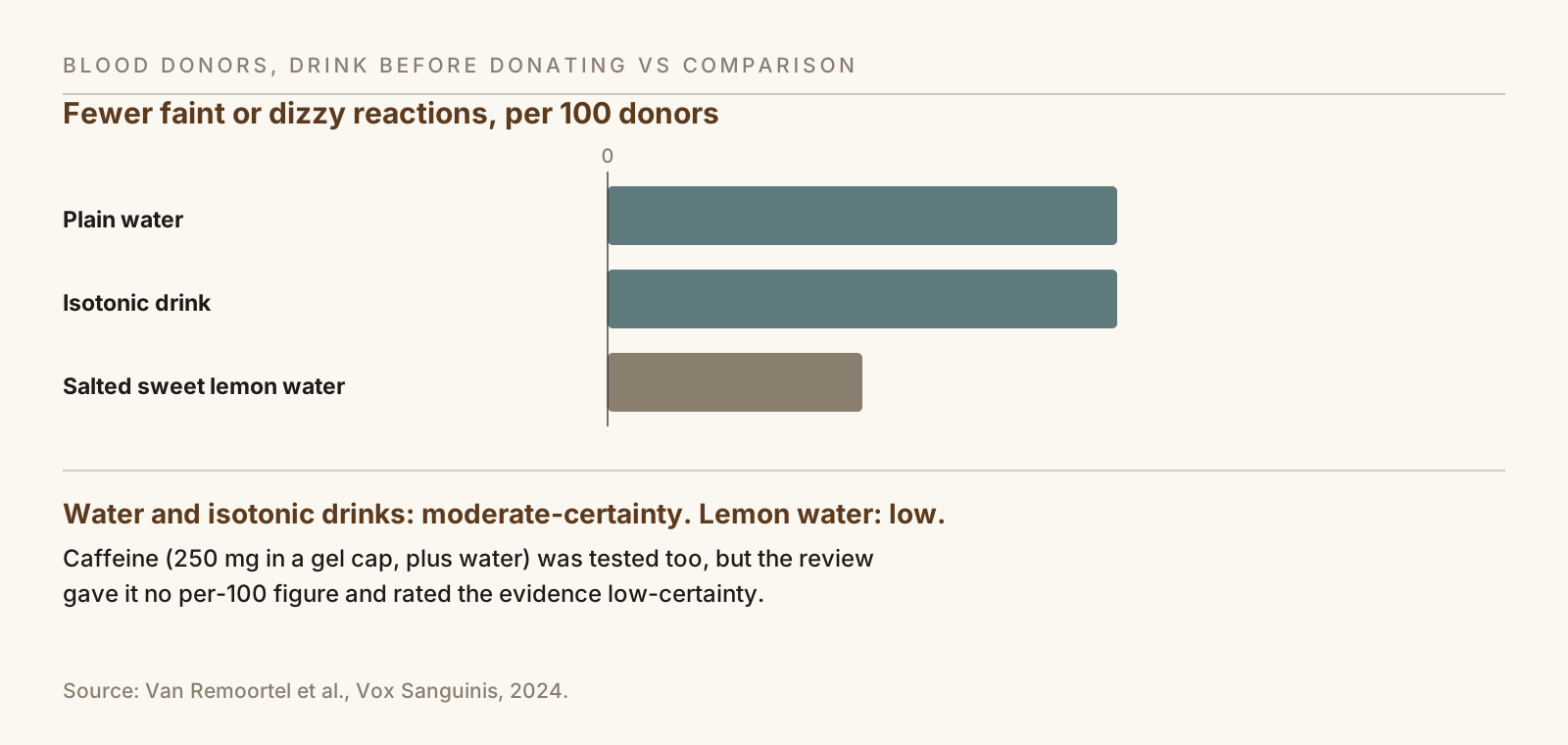
- Plain water beforehand likely meant about 2 fewer reactions per 100 donors, rated moderate-certainty evidence.
- An isotonic drink likely meant about 2 fewer per 100 compared with usual practice, also moderate-certainty.
- Salt-loaded sweetened lemon water may have meant about 1 fewer off-site reaction per 100 than sweetened lemon water alone, rated low-certainty.
An earlier review from NHS Blood and Transplant was more cautious. Pooling five trials of pre-donation water, with more than 12,000 participants, it found a relative risk of 0.79 for reactions. When trials at high risk of selection bias were excluded, the estimate was 0.70 with a confidence interval of 0.45 to 1.11, which crosses 1. The authors said current evidence didn’t strongly support water and called for larger trials.
So the sensible reading is that water probably helps a little, and nobody has proved it beyond doubt. It’s a low-cost habit with a reasonable case behind it.
The one caffeine trial
In 1999, Sauer and France ran a randomized, double-blind trial with 62 female undergraduates giving blood for the first time. They received 0, 125 or 250 mg of caffeine beforehand. Those who got 250 mg scored lower on a reactions inventory, needed fewer interventions from the phlebotomists, and said they were more likely to donate again than those on placebo.
That’s an interesting result, but keep it in proportion. It was one small trial, in first-time female donors. The 2024 review also covered a trial of a 250 mg caffeine gel cap taken with water, and said it may reduce reaction ratings compared with water alone, but it rated that evidence low-certainty and asked for larger studies. Nobody has shown that your regular cup of coffee will make a difference.
For scale, 250 mg is a large dose of caffeine, and our piece on caffeine’s half-life explains how long a dose stays active, which matters if you’re sensitive to it.
If you’d rather skip it
Nothing in this research says you must drink coffee, and if caffeine makes you shaky or jittery, a cup before a needle may not appeal. Here’s how I’d plan it:
- Drink water first. That’s the best-supported step, so start there.
- Don’t change everything on donation day. If coffee is your normal morning habit, going without it can bring a headache within hours. Our guide to how long caffeine withdrawal lasts covers the typical range.
- Book a later slot if the habit worries you. Then you can have your usual cup, with water alongside.
- Taper beforehand if you’re changing anyway. Our guide to quitting caffeine without the headache has a schedule, and donation day isn’t the best day to start one.
Regular donors may also wonder about iron, which is a different question from fainting. Our article on caffeine and iron absorption covers how coffee with meals interacts with it.
A caffeine-free herbal coffee, such as one made from roasted chicory, has no caffeine and counts as fluid, but the studies tested water and isotonic drinks, so those are the safer plan. If you want to know what’s in these brews, start with what is chicory coffee.
Blood donation sits on the same short list as other appointments where the instruction sheet and the daily habit meet. We’ve covered a fasting blood test, a cardiac stress test and surgery, and the rules differ for each.
What to check with your blood service
- Is there anything I should or shouldn’t eat or drink beforehand?
- Do you recommend water, and how much?
- Does caffeine matter for my first donation, or if I’ve felt faint before?
- Is there a quiet time of day to book?
- What should I do if I start feeling lightheaded during or after?
If you do feel dizzy at any point, tell the staff straight away. They’d rather hear it early.
This article is general information, not medical advice. Follow the instructions from your blood service and your clinician.
Sources & further reading
- The efficacy and effectiveness of drinking interventions to reduce vasovagal reactions in blood donors: a systematic review and meta-analysis (opens in a new tab) — Vox Sanguinis, 2024 (Van Remoortel et al.)
- Interventions to reduce vasovagal reactions in blood donors: a systematic review and meta-analysis (opens in a new tab) — Transfusion Medicine, 2016 (Fisher et al.)
- Caffeine attenuates vasovagal reactions in female first-time blood donors (opens in a new tab) — Health Psychology, 1999 (Sauer and France)
Reader conversation (4)
We read every response. Selected reader notes below.
I nearly fainted on my first donation and never connected it to skipping breakfast and drinking only coffee. Water first, I will try that next time.
Appreciate that you pointed out the caffeine trial was one small study. Most articles would have just said coffee prevents fainting.
Thank you, Beth Ann. A small trial is worth mentioning, but it is not enough to build a rule on.
I donate every eight weeks and always get a headache if the appointment is early. A later slot is a simple idea I had not tried.
The staff at my center gave me a cup of water and a snack before I even sat down. Nice to learn there is research behind it.
Have something to add? Email us and we may include it in a future update.