What is chicory coffee? The one root that shows up in almost everything on this site
Chicory is the single most common ingredient across coffee alternatives — and one of the most misunderstood. Here's what the plant actually is, the two totally different industries built on its root, and why 'chicory coffee' sometimes has caffeine and sometimes has none at all.

If you’ve spent any time on this site, you’ve already met chicory. It’s the backbone of our herbal coffee roundup, the subject of a blood-sugar deep dive, an IBS deep dive, a pregnancy-safety deep dive, a price comparison, and a head-to-head against dandelion root. What we haven’t done, in nearly 130 articles, is just stop and explain what the thing actually is — the plant, the root, the two industries that process it in completely different ways, and the single most common misunderstanding about it, which is whether the drink in front of you has caffeine.
As a dietitian, that last question is the one I get asked most about this ingredient, and it doesn’t have a one-word answer. Here’s the fuller version.
The short answer
Chicory coffee is a hot beverage made from the roasted, ground root of Cichorium intybus, a flowering plant in the daisy family related to dandelion, endive, and radicchio. It contains no coffee bean and no caffeine when brewed on its own or as the base of an herbal-coffee blend. But “chicory coffee” is also used, especially in New Orleans and South India, to describe real coffee blended with roasted chicory to extend or flavor it — and that version contains caffeine, because it’s mostly coffee. Same two words, two genuinely different drinks, and the label is the only reliable way to tell them apart.
What chicory actually is, botanically
Cichorium intybus is a perennial herb in the Asteraceae, or daisy, family — the same family that includes dandelion, artichoke, lettuce, sunflower, and endive. It grows to roughly a meter tall, with a long, fleshy taproot that can reach two feet down, small pale-blue flowers, and a milky sap that seeps out when the root or stem is cut. It’s native to Europe, western Asia, and North Africa, and has naturalized widely across North America, where it’s a common roadside wildflower most people walk past without knowing it’s the same plant in their pantry.
The root is the part that matters for this article. By dry weight, raw chicory root is roughly 35 to 40 percent inulin — a storage fiber the plant uses the way animals use fat, banking energy across a growing season rather than burning it immediately. Once the root is roasted, the composition shifts further toward inulin and its shorter cousin, oligofructose, which is part of why our blood-sugar and IBS pieces both cite a roasted-chicory range of roughly 40 to 70 percent inulin and oligofructose by dry weight — a higher figure than the raw root, because roasting drives off water and concentrates what’s left.
Botanically, none of this has anything to do with coffee. Coffea is a tropical evergreen shrub in an entirely different plant family; chicory is a temperate-climate daisy-family herb. The connection is entirely a matter of what roasting does to the two plants’ chemistry — both develop dark, bitter, aromatic compounds under heat — not a shared ancestry.
Two very different industries, one root
Here’s the part that surprised me most while researching this piece, and it isn’t something we’ve laid out clearly elsewhere on the site: the chicory root grown in Europe today mostly isn’t headed for a coffee substitute at all.
Belgium, the Netherlands, and northern France are the heartland of an industrial chicory economy built around inulin extraction, not roasting. Companies like Cosucra and BENEO grow chicory specifically to produce food-industry fiber — the “chicory root fiber” or “inulin” you’ll see listed in yogurt, protein bars, and fiber supplements. Cosucra describes pulling that fiber out through “a gentle hot water diffusion process, similar to the process used to extract sugar from beets” — no roasting, no browning, no coffee-like flavor development at all. The goal is a nearly flavorless fiber additive, and the process is built to protect that, not to darken it.
Roasted chicory — the kind that ends up in a mug — is a completely separate product stream, even though it starts from the same root. Instead of gentle water diffusion, the root is dried and roasted hard, which caramelizes much of that same inulin and develops the dark, bitter compounds — lactucin and lactucopicrin among them — that give roasted chicory its coffee-like edge. One root, two industries, two finished products that taste and function nothing alike. If you’ve ever wondered why “chicory” can mean both a bland invisible fiber additive and a dark bitter coffee substitute, that’s the whole explanation: it’s a processing fork, not two different plants.
How roasted chicory becomes “coffee”
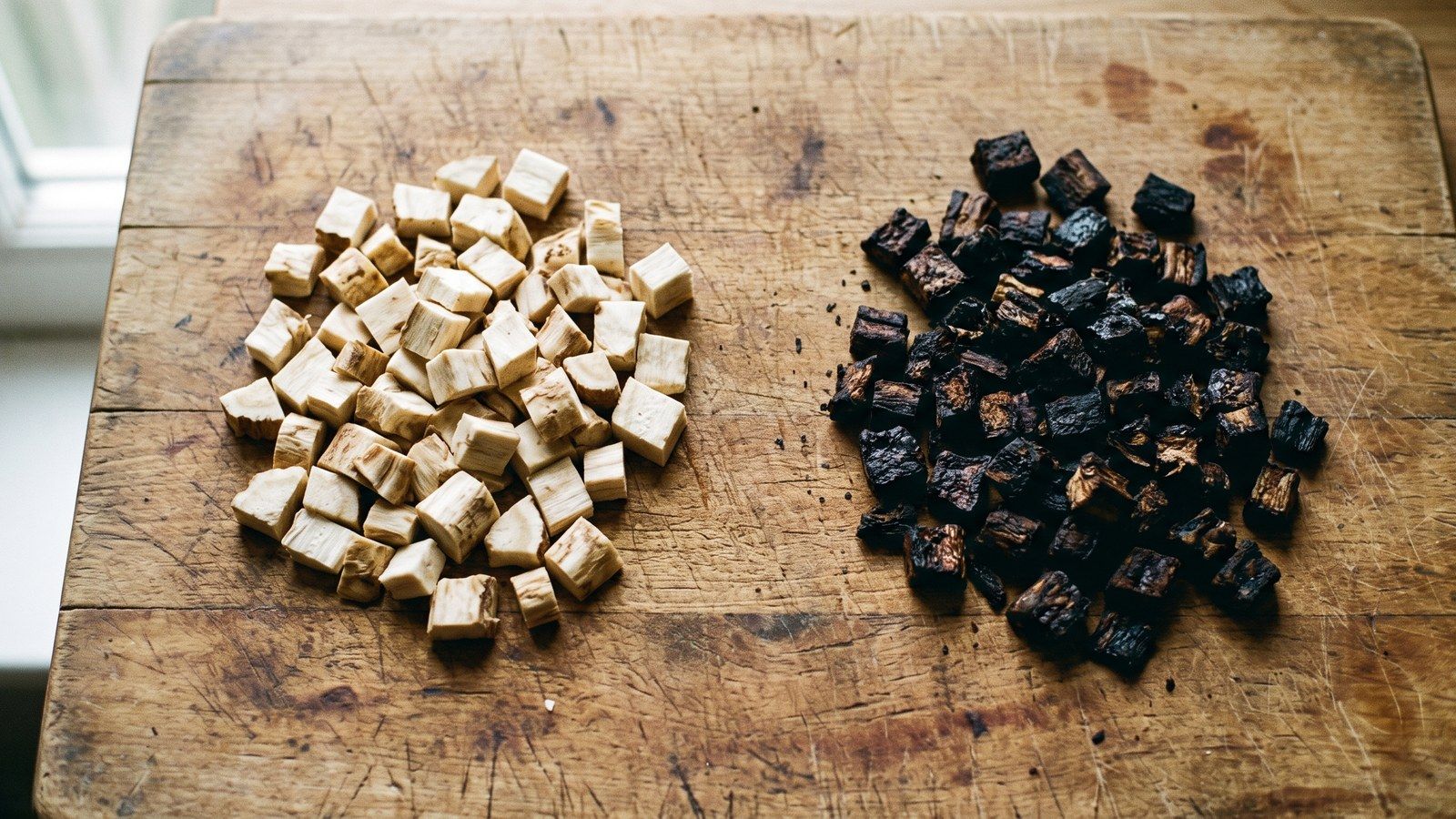
The mechanics are the same whether you’re a Belgian processing plant’s roasting line or a home cook with a countertop oven, just at wildly different scale. Roots are harvested, washed, and cut into pieces or thin slices to expose more surface area, since a whole taproot would take far too long to roast through evenly. The pieces are dried, then roasted at high heat until they turn from pale tan to a deep, near-black brown — visually and chemically closer to a dark-roast coffee bean than to any raw root you’d recognize from a grocery bin.
That roasting step is doing real chemical work, not just changing color. Heat caramelizes sugars and inulin fragments and produces a family of bitter compounds that chicory shares with almost nothing else in the produce aisle, which is precisely why roasted chicory approximates coffee’s flavor better than most other roasted plants do. Once roasted, the pieces are ground to a coarse, coffee-grounds-like consistency and brewed the same way you’d brew actual coffee grounds — French press, percolator, or drip. If you want the step-by-step home version, including ratios and steep times, we’ve written that up separately in how to brew chicory root.
Does chicory coffee have caffeine? Depends which one you mean
This is worth its own section because it’s the question I’d want answered plainly if I were a reader instead of writing this. “Chicory coffee” is used for two structurally different drinks, and only the label tells you which one you’re holding.
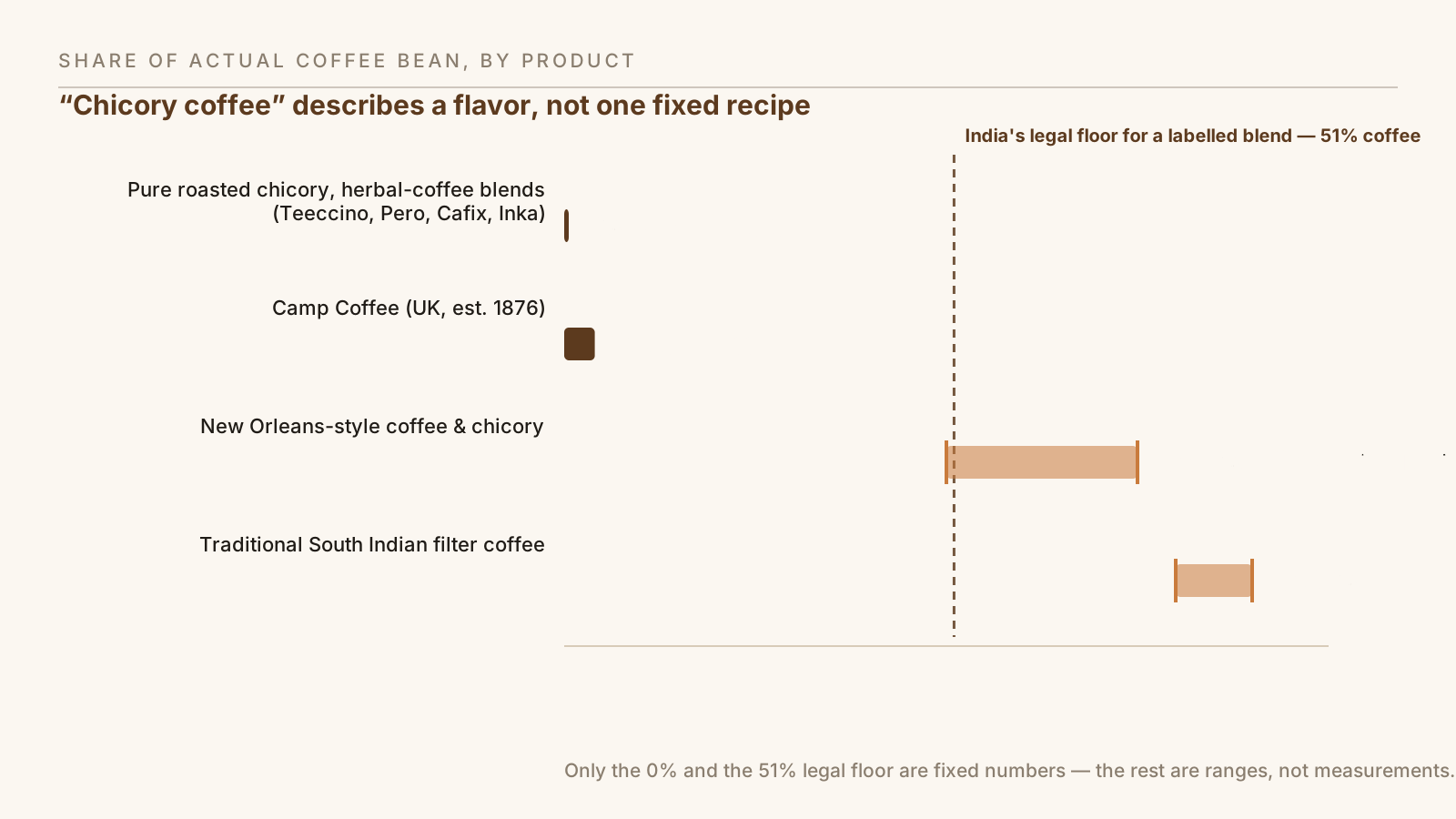
Chicory instead of coffee is the caffeine-free end of the spectrum: pure roasted chicory root brewed alone, and the herbal-coffee blends — Teeccino, Pero, Cafix, Inka — built on it as a base with no coffee bean anywhere in the recipe. Zero percent coffee, zero caffeine, by composition rather than by decaffeination.
Chicory added to coffee is the other end, and it’s the older, more geographically widespread tradition. New Orleans-style “coffee and chicory” — the drink Café du Monde has served since 1862 — is real coffee cut with roasted chicory, traditionally as a way to stretch a coffee supply that Union naval blockades cut off during the Civil War. The exact ratio was never standardized and Café du Monde has never published its own recipe; independently reviewed home and commercial versions we found while researching this piece ranged anywhere from an even 1-to-1 coffee-to-chicory mix up to 3-to-1, which is a wide enough spread that we’re reporting it as a range rather than inventing a precise number the sources don’t support. Traditional South Indian filter coffee sits further toward the coffee-dominant end, typically 80 to 90 percent coffee to 10 to 20 percent chicory. India regulates this directly: as of a rule that took effect July 1, 2026, the Food Safety and Standards Authority of India requires any product sold as a “coffee-chicory mixture” to declare its exact percentages on the front of the pack, and sets a floor of at least 51 percent coffee by mass — chicory is legally barred from being the majority ingredient in anything still called a coffee blend there.
Both of those coffee-and-chicory traditions contain real caffeine, scaled down only by however much chicory dilutes the coffee. Neither is remotely equivalent to a cup of pure chicory, and treating “chicory coffee” as a single, predictable caffeine number is the mistake this whole section is trying to head off. If full caffeine removal is the point for you, check whether the product you’re holding contains any actual coffee at all — the word “chicory” on the label doesn’t tell you that by itself. Our herbal coffee vs. decaf comparison covers the closely related distinction between naturally caffeine-free and chemically decaffeinated.
What it tastes like
Roasted chicory alone tastes bitter, woody, and earthy, with a roasted depth that genuinely resembles coffee’s darker notes but without coffee’s acidity or the fruitier, more volatile aromatics that come from actual coffee beans. Most people who taste pure roasted chicory for the first time describe it as “close, but heavier” — the bitterness is more one-note than coffee’s layered acid-bitter-sweet profile, and there’s a faint vegetal quality underneath that never fully disappears no matter how dark the roast.
That’s exactly why chicory rarely appears alone in the American herbal-coffee market. In blends, it’s usually the ingredient supplying the dark, bitter backbone, while carob, barley, or dates round out sweetness and body — the same logic we described in our carob explainer, where carob does the opposite job. In coffee-and-chicory traditions like New Orleans’s, chicory’s bitterness is doing something else entirely: rounding out and darkening real coffee’s flavor rather than replacing it, which is part of why café au lait made with a coffee-chicory blend tastes distinctly different from café au lait made with straight coffee, even before you get to the caffeine question.
The nutrition picture, briefly
We’ve covered chicory’s nutrition story in far more depth elsewhere, so this is deliberately the short version rather than a repeat. The headline compound is inulin, a fermentable fiber that human digestive enzymes can’t break down — it passes to the colon largely intact, where gut bacteria ferment it. That fermentation is the source of both of chicory’s most-discussed effects, and they cut in opposite directions depending on your gut: it’s associated with mild, generally favorable shifts in blood sugar and gut bacteria composition in the metabolic literature, which we detail in does chicory coffee raise blood sugar; and it’s a reliable trigger for bloating and discomfort in a meaningful share of people with IBS, which we detail in chicory coffee and IBS. Both are real, well-supported observations about the same molecule — which one shows up in your own experience depends on your gut, not on the strength of the evidence behind either finding.
Beyond inulin, plain brewed chicory is close to calorie-free, contains no meaningful protein or fat, and carries small amounts of minerals and polyphenols. It is not a source of vitamins in any dietary-relevant amount, and no legitimate reading of the research supports calling it a detox, an immune booster, or a treatment for any medical condition — claims like that show up in marketing more often than they show up in the evidence, and we’d flag them the same way regardless of which brand is making them.
Where chicory shows up today
Three distinct formats account for nearly everywhere you’ll encounter this root:
- Pure roasted chicory root, sold loose or ground for home brewing, closest to the traditional wartime-era product and the cheapest way into the category. We compared pricing across brands and regions in chicory price: Europe vs. the US.
- Herbal-coffee blends, where roasted chicory is combined with carob, barley, dates, or dandelion to build a fuller cup. Teeccino (opens in a new tab) is the most recognizable US brand in this format — its French Roast pairs chicory with carob, barley, dates, and almonds, which is worth flagging plainly: that recipe contains barley (not gluten-free) and almonds (a tree-nut allergen), so anyone managing either needs to read the label rather than assume “herbal” means allergen-free. Pero, Cafix, and Inka are the longer-running European entries in the same format, generally leaning more on barley and rye than on chicory and carob. We ranked the field in our best chicory coffee roundup.
- Coffee-and-chicory blends, the real-coffee-plus-chicory tradition of New Orleans and South India described above — the one format on this list that reliably contains caffeine.
The bottom line
Chicory is a daisy-family root, not a coffee relative, and the same plant feeds two industries that have almost nothing in common: a food-science fiber-extraction business that never roasts it, and a coffee-substitute tradition built entirely around roasting it dark. What actually determines whether the drink in your hand has caffeine isn’t the word “chicory” — it’s whether there’s any real coffee bean in the recipe at all, and that’s a question the ingredient list answers, not the marketing on the front of the bag.
This article is educational, not medical advice. If you’re managing a specific condition — IBS, diabetes, pregnancy, or anything else — talk to your own clinician about how chicory or any coffee alternative fits your situation.
Sources & further reading
- Coffee substitute (opens in a new tab) — Wikipedia
- FSSAI Makes Coffee-Chicory Labels Consumer-Friendly (opens in a new tab) — Food Safety Helpline
- Chicory — our raw materials (opens in a new tab) — Cosucra Groupe Warcoing
- Cichorium intybus (Chicory) (opens in a new tab) — Gardenia.net
Reader conversation (5)
We read every response. Selected reader notes below.
Worked the counter at a coffee shop in the Quarter for six years and got asked “does this have caffeine” about our coffee-and-chicory blend more times than I can count, and I never had a fully confident answer beyond “yes, it’s still mostly coffee.” Wish I’d had this article’s framing back then instead of just guessing at percentages.
That’s exactly the gap this piece was trying to close — “chicory coffee” doing double duty for two structurally different drinks is a genuinely reasonable thing to get confused about, especially behind a counter with a line building up. Glad it’s useful.
Grew up on filter coffee made with a coffee-chicory mix my grandmother bought in a specific tin because she trusted that brand’s ratio, and it never once occurred to me that a herbal blend with zero coffee in it would also get called “chicory coffee” in another country. The two-industries section explained something I’d never seen laid out this plainly.
Live about forty minutes from chicory fields that almost certainly feed the inulin plants mentioned here, and genuinely did not know until this article that the fiber extracted from them and the roasted stuff in a coffee substitute barely resemble each other in processing. Assumed it was all basically the same product at different concentrations.
Have been drinking Teeccino for two years specifically because I was told it was “just like chicory coffee” and never actually confirmed there was zero real coffee in it until reading this. Checked the bag afterward — you’re right, no coffee bean listed anywhere, just chicory, carob, barley, dates, and almonds. Small relief to have that confirmed instead of assumed.
Worth doing that same label check with any “herbal coffee” you drink regularly rather than trusting the category name — it’s usually accurate, but “usually” isn’t the same as “always,” and it’s a five-second check.
Family recipe has always been “a good handful of chicory to the pot,” which is a completely useless ratio in any objective sense but has been passed down for three generations anyway. Reassuring to learn that even Cafe du Monde apparently never nailed down an exact number either.
Have something to add? Email us and we may include it in a future update.