My surgery is in three weeks. Do I quit caffeine now, or keep drinking it until the morning of?
Regular caffeine drinkers who keep drinking it right up to a procedure get fewer headaches afterward than those who stop cold — which runs against what most pre-op paperwork implies. What the research actually says, and the plan I landed on for my own countdown.

I have a fairly routine outpatient procedure booked for three weeks from now — nothing dramatic, the kind of thing that comes with a pre-op packet and a list of things not to eat or drink after midnight. I read that packet twice before I noticed what it didn’t say anything about: caffeine. Not “cut it out,” not “keep drinking it,” nothing. Just the standard fasting instructions that apply to food and water generally, with my two daily cups of coffee apparently filed under “water” and left for me to guess about.

So I did what I do for this site professionally and started reading the actual research on caffeine and surgery, expecting to find a clean “cut it out a week ahead” answer. That is not what’s out there. What’s out there is closer to the opposite: several studies on surgical patients have found that people who keep drinking their usual caffeine right up until a few hours before anesthesia get fewer headaches afterward than people who stop cold — because a lot of what gets blamed on “the surgery” or “the anesthesia” is caffeine withdrawal wearing a different name.
The three-week countdown
Here’s the shape of the decision, stripped down: I drink caffeine every day, the way something like 90% of adults do, according to the review I’ll get to below. My procedure has a mandatory fasting window beforehand. Fasting plus a caffeine habit is exactly the setup that produces a withdrawal headache — and depending on the procedure, that fast can run long. Patients having bowel surgery, for instance, are sometimes fasted for days beforehand, not hours, which stretches the caffeine gap far past anything a normal skipped-cup morning would produce.
So I have, roughly, two honest paths. I can keep drinking my normal amount and lean on whatever caffeine allowance my specific procedure’s rules give me right up to the cutoff. Or I can taper down over these three weeks so that by the day of the procedure, caffeine withdrawal isn’t really a live issue anymore because I’m not dependent on much of it in the first place. Both are real strategies with real research behind them. Neither is automatically right for every procedure, which is the actual point of this piece — it’s a framework for the conversation with your own anesthesia team, not a substitute for having it.
Why the timing works against you
I’ve written before about the ordinary caffeine withdrawal timeline — symptoms typically starting 12 to 24 hours after your last dose, peaking around day two, resolving within two to nine days for most people. Surgery doesn’t create a different kind of withdrawal. It creates worse timing for the same one, in two specific ways.
First, the fast itself. Regular pre-op instructions cut off food and drink hours before your procedure for a genuinely important reason — aspiration risk under anesthesia — but that instruction doesn’t distinguish between “you’ll miss breakfast” and “you’ll miss the dose your brain has been chemically expecting every morning for years.” One anesthesia practice’s own patient guidance notes that the earliest withdrawal symptoms can start as soon as three hours after your last caffeine intake, with the fuller symptom picture — headache, fatigue, trouble concentrating, mood dips — typically arriving by 12 to 24 hours. A routine overnight fast plus a delayed morning procedure can land you right in that window before you’ve even left the waiting room.
Second, the fast can run much longer than overnight. Coverage of this research point out that patients undergoing something like bowel surgery may be fasted for as long as five days beforehand — which means a heavy daily caffeine user isn’t looking at a 12-hour gap, but a multi-day one, arriving on the operating table already mid-withdrawal rather than about to start it.
The part that makes this genuinely easy to miss, for patients and apparently for a lot of hospitals too: withdrawal symptoms get masked by everything else going on. A pounding head after surgery reads as “normal post-anesthesia grogginess,” not “the same headache I get when I skip my Saturday morning coffee,” because nobody’s flagged the connection. A review co-authored by Dr. Jeffrey Goldberger at the University of Miami Miller School of Medicine makes exactly this point: hospitals routinely take a drug and alcohol history before a procedure, but caffeine dependence — arguably the most common substance dependence walking through the door — usually isn’t asked about at all.
The three-hour window almost nobody mentions
Here’s the detail that surprised me most, and the reason this piece exists instead of a shrug. Some pre-anesthesia protocols already have an answer for this, and it isn’t “no caffeine.” One anesthesiology practice’s own patient page states that patients with a regular high caffeine intake may be allowed to drink black coffee or other clear caffeinated beverages — no milk, no cream — up to two to three hours before anesthesia, under the same clear-liquid rules that already let patients have things like black tea, clear soda, or a sports drink in that window. The logic is straightforward: a clear liquid clears the stomach fast enough to not meaningfully raise aspiration risk, and it happens to also be caffeine, which sidesteps the withdrawal problem instead of triggering it.
The same source cites a dose-response relationship worth knowing whether or not the timing rule applies to you: each additional 100 mg of someone’s usual daily caffeine intake is associated with roughly a 16% increase in the odds of a postoperative headache. That’s not “caffeine is bad for surgery” — it’s the opposite. It’s a marker of how much withdrawal risk you’re personally carrying into the fast, based on how dependent your system already is.
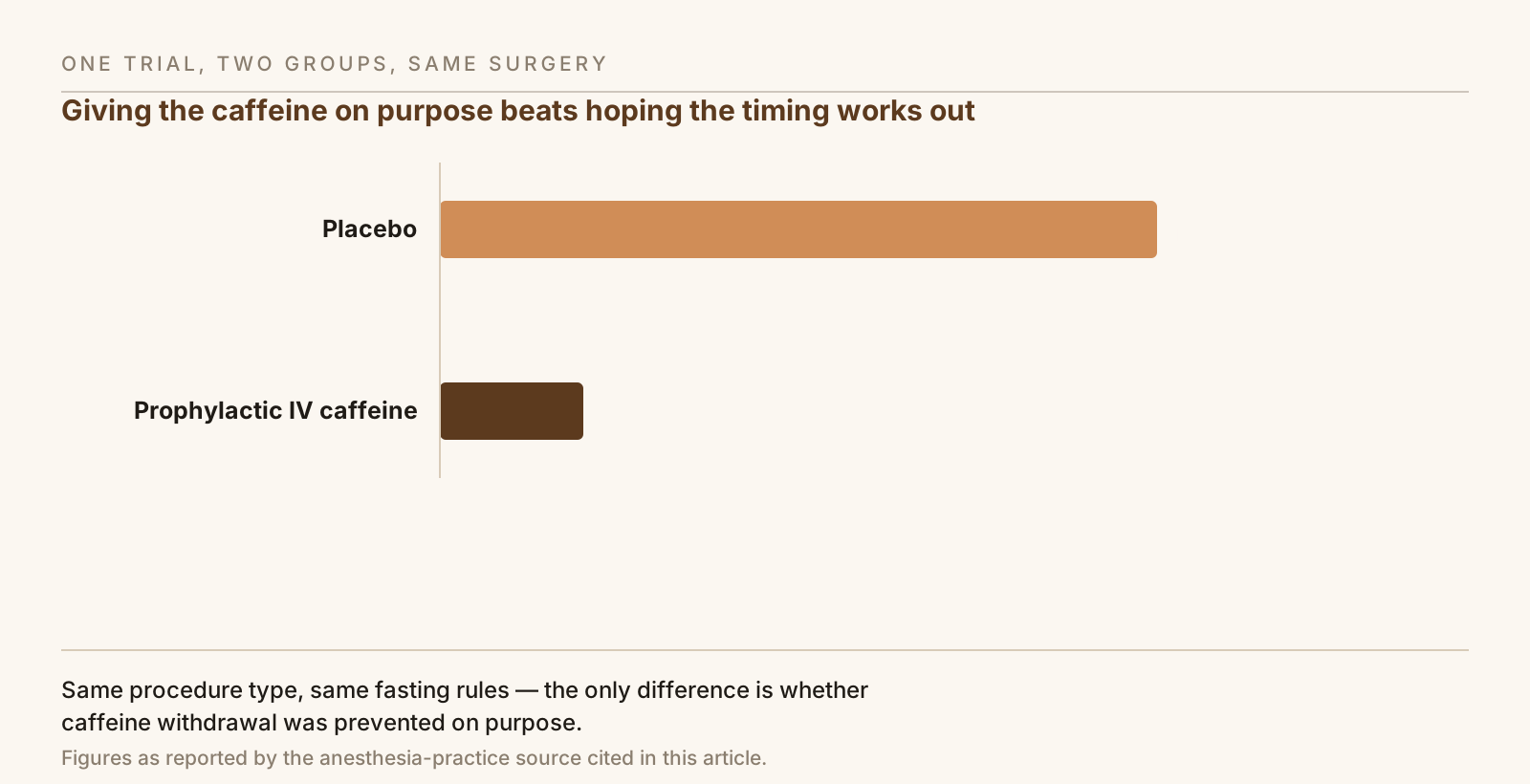
Hospitals have also tested the more direct fix: give the caffeine deliberately instead of hoping the patient’s own habits line up with the clear-liquid window. In one trial cited by that same source, patients who received prophylactic intravenous caffeine had a postoperative headache rate of about 2%, against roughly 10% for patients who received a placebo. That’s not a subtle effect. It’s the kind of number that makes you wonder why “ask about caffeine history” isn’t already a standard line on a pre-op intake form next to the alcohol and tobacco questions — which, per the Miami review above, it generally isn’t yet.
None of this means you should show up to your procedure and drink a large coffee on principle. It means the honest, medically grounded answer to “should I quit caffeine before surgery” is “ask your specific anesthesia team what their clear-liquid and caffeine rules are for your specific procedure,” rather than assuming abstinence is automatically the safer or more responsible choice.
Or: arrive already off it
The three-hour window is a real option, but it only helps if your procedure’s rules allow it and if you’re comfortable timing a coffee that precisely on the day. The other legitimate path is the one I’ve actually leaned toward for my own countdown: use these three weeks to taper down instead, so that by the day of the procedure, caffeine withdrawal simply isn’t much of a live risk regardless of what the day-of rules turn out to be.
This is the same math as tapering off caffeine any other time — reduce gradually rather than stopping abruptly, so your adenosine receptors have time to downregulate instead of getting yanked off a dependency all at once. Three weeks is enough runway to do this properly and still have a few caffeine-free days to confirm the taper actually took, rather than tapering right up until the morning of and hoping. I’ve swapped my second cup for a cup of herbal coffee — a roasted chicory-and-carob blend like Teeccino, in my case, though the specific brand matters less than the fact that it’s genuinely caffeine-free and still gives me a warm cup to hold in the same part of my morning — and I’m dropping my first cup’s strength gradually over the next two weeks rather than cutting it outright.
The honest caveat, because I don’t want to oversell tapering as the obviously better choice: if you start too late, you get the worst of both options — mid-withdrawal on the day of your procedure, with none of the “just have the allowed clear liquid” fix available to you because you’ve already quit. The two-week mark is roughly where most people I’ve talked to, myself included, stop feeling actively withdrawn and start just feeling normally caffeine-free. If your procedure is inside that window, tapering this late may not fully resolve before surgery day, and the three-hour-window path is probably the more realistic one for you.
What hospitals actually do about this
Not much, systematically, which is a little surprising given how well-documented the effect is. The Miami review argues that the tools already exist inside most hospitals — oral and intravenous caffeine are already used for other purposes, including treating headaches after spinal anesthesia and managing apnea in premature infants — but there’s no routine protocol turning that into “ask the patient about their caffeine habit and offer a dose if they’re at risk.” Coverage of the same research describes some practices allowing clear liquids, caffeine included, closer to procedure time than patients typically expect: as close as an hour or two before anesthesia, and a drink again within an hour after, specifically to shrink this gap.
The practical takeaway isn’t “hospitals are doing this wrong.” It’s “this isn’t automatically volunteered, so you may need to raise it yourself.” Nobody on your surgical team is going to guess how many cups of coffee you drink a day unless you tell them.
My plan, and the two questions I’m actually asking
I’m tapering, because I have three weeks of runway and I’d rather not be doing caffeine-timing math on a day when I have enough else to think about. But I’m also asking my pre-op nurse two specific questions rather than assuming my taper alone solves everything:
- What’s your clear-liquid and caffeine cutoff for my specific procedure, and does it include caffeinated tea or black coffee? Not every practice’s rule matches the two-to-three-hour window described above — some are stricter, some don’t address caffeine specifically at all, and mine might be either.
- If I do end up caffeine-free by the day of the procedure, is there anything you offer for a withdrawal headache afterward, or should I plan to manage it myself with hydration and an over-the-counter pain reliever once I’m cleared to take one? Even a tapered-down system can have a residual dip; I’d rather know the answer before I’m groggy in recovery asking it.
If your procedure is sooner than mine — days away rather than weeks — the taper option may simply not be available to you in time, and the conversation about your specific clear-liquid rules matters more, not less.
The bottom line
I went looking for a simple rule and found a genuinely useful, slightly counterintuitive one instead: for a lot of surgical patients, quitting caffeine cold turkey right before a procedure isn’t the cautious choice, it’s the one more likely to leave you with an extra headache to manage on top of everything else. The better-supported approaches are either keeping your usual caffeine going right up to whatever cutoff your specific anesthesia team allows, or tapering down early enough that you’re not dependent on it by the day of surgery. Both require actually asking your own team what applies to you — this piece is the background for that conversation, not a replacement for it.
I’ll report back after mine. For now: three weeks out, two cups down to one and a half, and a question already typed into my phone for the pre-op call.
Sources & further reading
- Better Managing Caffeine Withdrawal after Surgery (opens in a new tab) — University of Miami Miller School of Medicine
- For caffeine drinkers having surgery, withdrawal might be more than just unpleasant (opens in a new tab) — The Spokesman-Review
- Caffeine Withdrawal Headaches After Anesthesia (opens in a new tab) — James L. Rothschiller, MD
Reader conversation (5)
We read every response. Selected reader notes below.
I’m a pre-op nurse and this is more accurate than I expected from outside the field. We genuinely do not ask about caffeine on our intake form — alcohol, tobacco, recreational drugs, yes, caffeine, no — and I’ve lost count of the “why does my head feel like this” conversations in recovery that were almost certainly this. Bookmarking to actually push for adding the question at our next protocol review.
Wish I’d read this before my knee surgery in March. Nobody mentioned caffeine, I assumed “nothing after midnight” covered it same as everything else, and I spent my first day of recovery fairly sure something had gone wrong before a nurse finally asked if I was a big coffee drinker and put it together. Would have been one less thing to deal with that day.
That’s exactly the gap this piece is trying to close — thank you for saying it plainly. The frustrating part is how avoidable it is once someone actually asks the question, which is apparently still rare enough to catch people off guard in recovery.
Had a same-day procedure two years ago where the anesthesiologist specifically told me to have my usual filter coffee, black, up to three hours before arrival. At the time it felt like an odd thing to be told to do before surgery. Reading the actual reasoning now, it makes complete sense — genuinely no headache afterward, unlike a wisdom-tooth extraction years earlier where I white-knuckled a caffeine-free 18 hours and paid for it.
Worth flagging for anyone with a longer pre-op fast specifically: I had bowel surgery last year with a multi-day clear-liquid runway beforehand, and even “clear caffeinated liquids allowed” wouldn’t have covered a gap that long. Tapering in the weeks before, like this piece describes, is really the only workable option once the fast itself stretches past a day or two.
Good catch, and an important edge case the three-hour window genuinely doesn’t solve. Once the fast itself runs multi-day, you’re not managing a same-day cutoff anymore — you’re already deep into withdrawal before you’re anywhere near the operating room, which is exactly the scenario where starting a taper weeks out earns its keep.
Asked my anesthesia team this exact question after reading an early version of this logic somewhere else, and got a slightly apologetic “we don’t really have a specific caffeine policy, just the general clear liquid rule” — which at least meant black coffee technically qualified. Confirms the piece’s point that this varies by practice and you really do have to ask rather than assume either a strict ban or a clear allowance.
Have something to add? Email us and we may include it in a future update.