Why caffeine wrecks your afternoon: the half-life math nobody does
Your 2pm coffee is still in your system at bedtime — and the afternoon crash that makes you want a 4pm refill is the same molecule catching up with you. Here's the half-life math nobody does, why you crash, and the one swap that breaks the loop.

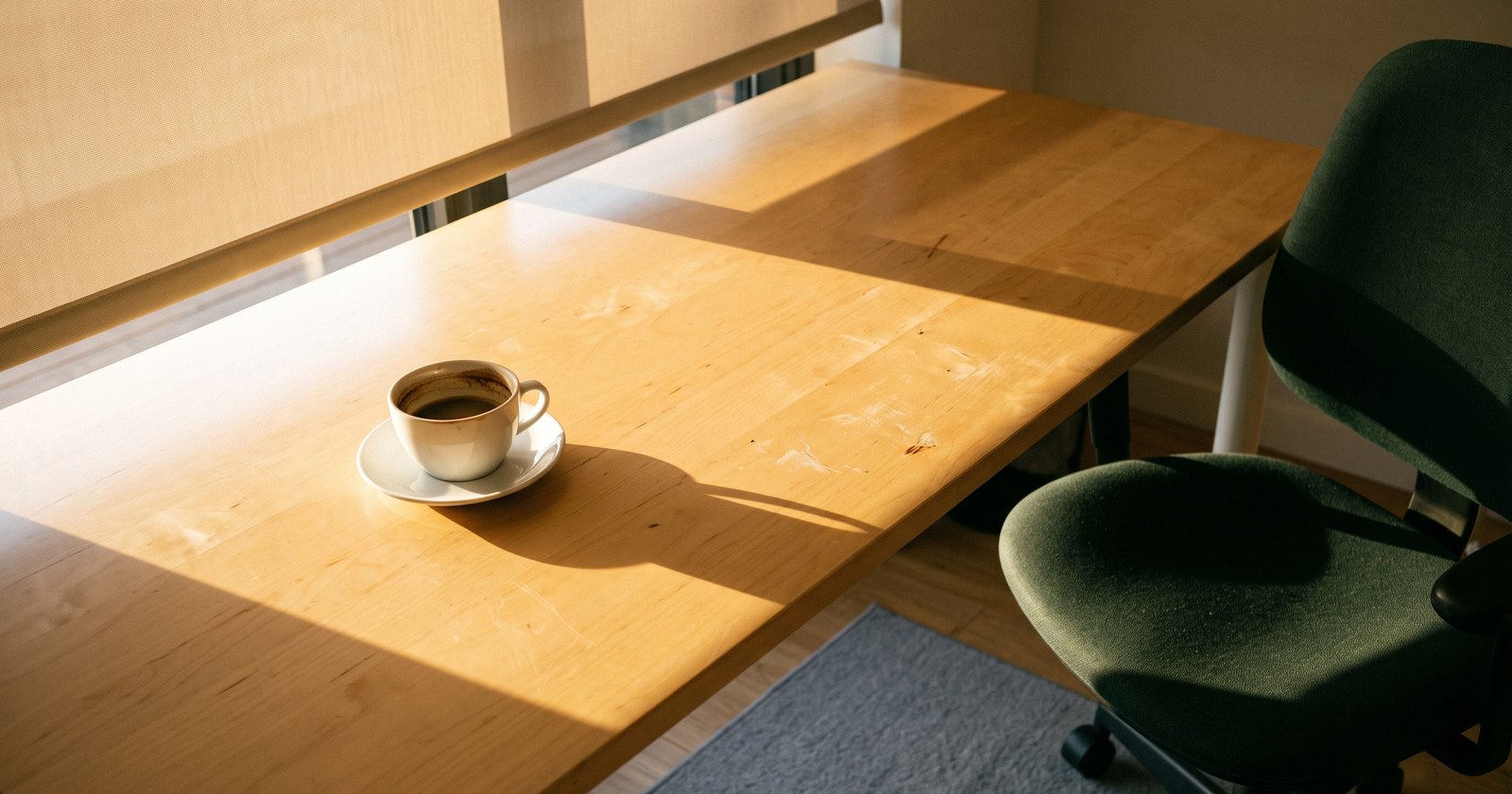
I used to think my afternoon was just like that. A good morning, a productive run until about 1pm, and then a wall — that heavy, can’t-focus, why-is-everything-hard slump that arrived around 3 o’clock like clockwork. So I did what everyone does. I drank another coffee. And it worked, sort of, for a couple of hours, and then I lay in bed that night wide awake at midnight wondering why I couldn’t sleep when I was so obviously exhausted.
It took me an embarrassingly long time to connect those two things. The bad afternoon and the bad night weren’t two problems. They were one molecule, doing exactly what it does, and I was the one feeding it. The piece I needed back then was the boring arithmetic of how long caffeine actually sticks around — the half-life math that nobody does, because the coffee feels done long before it actually is.
Your 2pm cup, still here at midnight
Let’s start with the number that reframes everything: caffeine’s half-life in a healthy adult averages about five hours (opens in a new tab).
Half-life is the time it takes your body to clear half of a dose. That word — half — is where the intuition breaks. We think of a coffee the way we think of a meal: you have it, it’s processed, it’s gone. But a five-hour half-life means that five hours after your cup, you still have half the caffeine on board. Five hours after that, a quarter. And so on, the dose trailing off in a long slow tail rather than a clean finish.
Run the actual numbers on a single 2pm coffee — call it 200mg, a fairly standard mug:
- 2pm: 200mg, the full hit.
- 7pm: ~100mg still circulating — about the caffeine of a fresh cup, sitting in you at dinner.
- Midnight: ~50mg — a half-cup’s worth, while you’re trying to fall asleep.
- 5am: ~25mg — still measurable when the alarm goes off.
That’s one afternoon coffee. Not an espresso bender — one ordinary cup, doing exactly what the chemistry says it will. The reason this matters isn’t academic. It’s that the cup you barely remember drinking at 2pm is still chemically present at the two worst possible times: when you’re trying to wind down, and when you’re trying to wake up the next morning, groggy and reaching for the thing that caused it.
What half-life actually means
The trap is that caffeine feels like it wears off fast. The lift fades after a couple of hours, so we assume the molecule faded with it. It didn’t. The subjective buzz and the actual blood level come apart almost immediately — the buzz is front-loaded, the clearance is slow.
This gap is the whole problem. Your experience of caffeine says “that wore off around 4, better top up.” The pharmacology says “you’re still carrying most of the morning, and you just added more on top.” Stack a 7am cup, a 10am cup, and a 2pm cup, and by evening you’re not running on the 2pm coffee — you’re running on the slowly-accumulating residue of all three, because each one was still half-present when the next arrived. People who swear they “only had coffee in the morning” are often carrying a meaningful afternoon level without realizing it, because the morning never fully left.
None of this means caffeine is bad. It means it’s long, and almost nobody budgets for how long. Once you see the tail, the timing of your last cup stops being trivia and starts being the single biggest lever you have over your sleep.
Why you crash in the first place
So where does the 3pm wall come from? To explain the crash, I have to explain the lift, because they’re the same mechanism running in opposite directions.
Through the day, a molecule called adenosine builds up in your brain. It’s your sleep-pressure gauge — the longer you’re awake, the more it accumulates, and the more it binds to its receptors, the sleepier you feel. That’s the body’s honest signal that you’ve been up a while. Caffeine works by impersonating adenosine and jamming those receptors (opens in a new tab): it fits the lock without turning it, so adenosine can’t dock and the sleepiness signal goes quiet. That’s your alertness.
Here’s the part that explains the crash. The adenosine doesn’t stop being produced while the receptors are blocked. It keeps piling up behind the dam. So when the caffeine finally clears — right around the time your afternoon dose is wearing thin — all that backed-up adenosine rushes in at once and binds the receptors it was locked out of. The result is a wave of tiredness that can feel worse than where you started, because you’re not feeling normal sleep pressure anymore. You’re feeling several hours of it arriving simultaneously.
That’s the afternoon crash. It isn’t your body running low on caffeine. It’s the bill coming due for the caffeine you already had.
The loop: crash, refill, repeat
Now put the two halves together, because this is the trap that kept me stuck for years.

The crash feels exactly like a caffeine shortage. Heavy eyes, fog, the specific 3pm wish to lie down. So the obvious move is a second coffee — and it works, briefly, because you re-block the receptors and hold the adenosine wave back for another couple of hours. But you’ve solved nothing. You’ve just rescheduled the same crash to early evening and added a fresh five-hour tail that now reaches deep into your night.
So you sleep badly. You wake up under-rested, with more sleep pressure than you went to bed with, which means you need a bigger morning dose to feel human, which means a steeper crash, which means an afternoon cup, which means another bad night. That’s the loop. I ran laps in it for years and called it “being tired.” It’s not a personality trait — it’s a feedback cycle, and the afternoon cup is the hinge the whole thing swings on.
The cruel part is that the fix and the symptom feel identical. The crash and a genuine need for rest produce the same sensation, so your instinct points you at the one move — more caffeine — that keeps the cycle spinning. When I tracked my first two weeks off caffeine, the single clearest change wasn’t mornings. It was that the 3pm wall quietly stopped showing up, because there was no longer a dose to wear off.
Why some people get away with it
Here’s the objection I always get: “My uncle drinks espresso after dinner and sleeps like a rock.” Fair. And probably true — for him.
How fast you clear caffeine is largely set by a liver enzyme called CYP1A2, and the gene that codes for it varies a lot between people. Clearance rates differ several-fold across the population (opens in a new tab) — “fast metabolizers” blow through a dose in a few hours, while “slow metabolizers” can take twice as long to clear the same cup, dragging that half-life from five hours toward nine or ten. Other things nudge it too: smoking speeds clearance up; pregnancy and certain medications, including some oral contraceptives, slow it down, sometimes dramatically.
So the after-dinner-espresso uncle isn’t lying and you’re not weak. You may simply be carrying his espresso for twice as long as he is. This is also why generic advice fails: “caffeine doesn’t affect my sleep” is a genuinely true statement for some fast metabolizers and a comforting myth for slow ones, and the only way to know which you are is to watch your own afternoons and nights, not someone else’s. If you’re a light sleeper who crashes hard, the smart bet is to assume you’re on the slow end and set your cutoff earlier than feels necessary.
The bedtime tax nobody connects
Even when the afternoon cup doesn’t keep you from falling asleep, it can quietly tax the quality of the sleep you do get — and this is the part that genuinely surprised me.
In a controlled study, researchers gave people a dose of caffeine at bedtime, three hours before bed, and six hours before bed, then measured their sleep. Even the six-hours-before-bed dose significantly cut total sleep time (opens in a new tab) — often by more than an hour — and, tellingly, people frequently didn’t notice it was happening. They thought they’d slept fine. The monitor said otherwise. That’s the bedtime tax: a 4pm or 5pm coffee can shave real sleep off your night without ever producing the obvious “I’m wired and staring at the ceiling” feeling that would warn you.
This is why I now treat my last cup’s timing as the highest-leverage decision in my whole day. It’s the same principle that makes day-sleep so hard to protect for shift workers, and why building a caffeine plan around your actual schedule beats drinking on autopilot. The math is unforgiving: stop at least six hours before bed, and earlier if you’re a slow metabolizer. For an 11pm bedtime, that’s a hard stop around 4 or 5pm — and honestly, noon is the cutoff that changed my sleep most.
What to actually do about it
You don’t have to quit to fix the afternoon. You have to fix the timing, and the afternoon slot is where almost all the payoff lives. Here’s the order I’d do it in.
Front-load the day. Get your caffeine done earlier, not bigger. A morning cup clears comfortably before bed; a 3pm cup does not. If you need a lift to start the day, that’s partly a cortisol-timing thing you can work with rather than out-caffeinate.
Set a real cutoff and protect it. Pick a stop time at least six hours before bed and treat it like a fact, not a goal. The afternoon cup is the one to move first, because it’s the one sitting in you at midnight.
Swap the afternoon ritual, don’t delete it. This was the unlock for me. The 3pm cup is half habit — the warm mug, the desk break, the reset — and you can keep all of that while dropping the half-life tail. I switched my afternoon slot to a caffeine-free roasted herbal “coffee” so my hands still had somewhere to go at 3pm. A chicory-based roast like Teeccino (opens in a new tab) gives me the dark, bitter, coffee-shaped cup without the molecule that wrecks the night — though it’s one of several in that lane, and the point isn’t the brand, it’s that the ritual survives the swap. An herbal tea or even a glass of water does the same structural job.
Skip the second-coffee reflex. When the 3pm wall hits, name it for what it is — the morning wearing off, not a shortage — and ride it out with a short walk, water, or a few minutes outside. The wall passes on its own in 20 minutes, and you’ve broken the loop instead of feeding it.
And if the afternoon crash is bad enough that you’re reaching for a cup just to function, that’s worth taking seriously as its own signal — it often means the whole caffeine cycle has tightened to the point where the drug is mostly just holding off its own withdrawal. If you’ve ever wondered whether a supplement could smooth the edges instead, it’s worth knowing what the evidence does and doesn’t support. But the cheapest, most reliable fix is also the most boring one: do the half-life math, move the cup earlier, and let your afternoon belong to you again.
The afternoon is usually the easiest place to start, because you keep your whole morning routine intact. If you want to go further, here’s what actually changes after a month off caffeine — and a caffeine-free cup to put in the 3pm slot while you find out.
Sources & further reading
- Caffeine Effects on Sleep Taken 0, 3, or 6 Hours before Going to Bed (opens in a new tab) — Journal of Clinical Sleep Medicine (Drake et al., 2013)
- Pharmacology of Caffeine (opens in a new tab) — Institute of Medicine / NCBI Bookshelf
- Adenosine, caffeine, and performance: from cognitive neuroscience of sleep to sleep pharmacogenetics (opens in a new tab) — Current Topics in Behavioral Neurosciences (PubMed)
Reader conversation (5)
We read every response. Selected reader notes below.
The 2pm/7pm/midnight breakdown genuinely stopped me cold. I have been blaming “stress” for my bad sleep for two years and I drink a cup at 3 every single afternoon without thinking about it. Going to move it to the morning this week and see what happens. Thank you for doing the actual arithmetic — I’d never connected the cup to the night.
My husband is the after-dinner-espresso guy you described almost exactly and it has been a source of genuine bafflement in our house for years because the same coffee leaves me staring at the ceiling. The CYP1A2 thing is the first explanation that made both of us feel like we weren’t crazy.
That dynamic is so common it’s almost a relationship rite of passage. The frustrating part is there’s no willpower difference between you — you’re just clearing the same dose at very different speeds. If you’re the light sleeper, assume you’re on the slow end and set your cutoff earlier than feels necessary; it’s the safest bet when you can’t easily test your own genetics.
The “the crash feels identical to needing rest” line is the whole thing for me. That’s exactly why I always reach for the second cup — my body sends the same signal either way. Naming it as the bill coming due instead of a shortage is weirdly the most useful reframe I’ve read on this.
Okay but what do I do at 3pm when I actually have three more hours of work and the wall hits? Walking is nice in theory but I have meetings. Genuinely asking.
Totally fair — you can’t always walk it off. Two things that work at a desk: get the warm-mug ritual without the caffeine (an herbal cup gives your hands and your break the same cue), and get light + water, even just standing by a window for two minutes between meetings. The wall is real but it’s usually a 20-minute wave, not a three-hour state. The second coffee feels like it helps because it re-blocks the receptors, but it just moves the same wall to 6pm and into your night.
Slow metabolizer here (did the genetic test out of curiosity) and can confirm — anything after about 11am and I’m wired at midnight. Took me 35 years to figure out it was the coffee and not “just how I am.” Wish this article had existed in my twenties.
Have something to add? Email us and we may include it in a future update.