Quitting caffeine as an airline pilot: the FAA won't let most crews nap on duty, so the taper has to happen on the ground
Federal rest rules assume you can fall asleep the moment your break starts, and most U.S. flight decks aren't allowed the in-seat catnap that pilots in Europe, Canada, and Australia can take. That makes caffeine one of the few sanctioned fatigue tools left — and it means a taper has to be scheduled around your days off, not squeezed into a trip.

Most advice about quitting caffeine assumes a life where you control your own bedtime. Airline pilots don’t have that life. You have a federal rule that hands you a rest period and assumes your body can use it — and, on most U.S. flight decks, you don’t have the one other tool a lot of the world’s pilots are allowed to reach for when the assumption doesn’t hold.
That’s not a reason to leave caffeine alone forever. It’s a reason to think about tapering the way you already think about everything else in this job — scheduled, not improvised.
The short answer
Under FAA rules for passenger airline operations (14 CFR Part 117), a pilot is entitled to a minimum of 10 consecutive hours of rest before a flight duty period, which has to include at least 8 hours of uninterrupted sleep opportunity. Duty periods that repeatedly cut into the window of circadian low — roughly 2 to 6 a.m., when human alertness bottoms out regardless of how rested you are — are capped without an approved onboard rest facility. None of that is a suggestion. It’s the regulatory floor the job is built on.
Caffeine is one of the few things regulators explicitly acknowledge pilots use, in the moment, to manage the gap between that assumption and how they actually feel. Which is exactly why quitting it isn’t a private lifestyle choice here the way it is for most readers of this site — it’s something worth timing around the job, not against it.
Why the job leans on it this hard
Two things compound. The first is the window of circadian low itself: a stretch of hours where alertness drops on its own schedule, independent of how much sleep you got the night before, and long-haul or multi-leg trips route straight through it as a matter of course. The second is that crossing time zones doesn’t just shift your clock, it shifts your clock unevenly — your body doesn’t recalibrate all at once, so a multi-day trip can leave you circadian-mismatched for most of it.
Fatigue researchers, including NASA’s own Fatigue Countermeasures Lab, have studied flight-deck fatigue since the early 1980s, and one of the standing findings is that pilots on long flights already take turns resting in dedicated crew rest areas — an acknowledgment that the job cannot simply demand alertness for the full duration and expect it to show up unaided. Strategic caffeine use sits alongside activity breaks and crew-resource-management practices as one of the sanctioned tools crews lean on in the moment. It is not the only tool fatigue science recommends. It is one of the few this job actually lets you use mid-duty.
The nap gap
Here’s the detail that makes caffeine carry more weight for U.S. crews specifically than it does for a lot of the rest of the world’s pilots. On augmented long-haul crews — flights staffed with an extra pilot for exactly this reason — bunk rest in a dedicated area is standard practice and FAA-authorized while the remaining two pilots keep the flight deck running.
But most flights aren’t augmented. They’re flown by two pilots, and for that configuration, ICAO recommends and several major regulators — including authorities in Europe, Canada, and Australia — permit “controlled rest”: a short, planned, in-seat nap taken by one pilot while the other remains at the controls. The FAA does not endorse controlled rest for U.S. commercial two-pilot operations. So on a standard domestic or short-haul U.S. flight, the in-seat catnap that’s a sanctioned fatigue tool elsewhere isn’t available to you — which leaves caffeine, food timing, and light exposure carrying a heavier share of the load than they do for a counterpart flying the identical fatigue physiology under a different country’s rulebook.
That’s worth sitting with before you decide when to cut caffeine, not just how much.
Why quitting cold on a trip is its own hazard
The standard advice on this site is that caffeine withdrawal is a real, physiological event — not a character problem — and that’s true here too. What’s different is the stakes of when it shows up. Research on caffeine withdrawal has repeatedly found measurable declines in alertness and reaction time, including on simple and choice reaction-time tasks, alongside the more familiar headache and fogginess, as adenosine signaling that caffeine had been blocking reasserts itself. That’s a bad list of symptoms to have arrive unpredictably during a duty day, in a job where a lapse in attention doesn’t just cost you a bad afternoon.
Pilots already use a self-check before flying, IMSAFE — Illness, Medication, Stress, Alcohol, Fatigue, Emotion — to decide whether they’re fit for a given day. The checklist itself doesn’t name caffeine. But the fatigue and impaired concentration a fast, unplanned caffeine cut produces are exactly the category IMSAFE’s fatigue check exists to catch. If a cut leaves you meaningfully foggier than you expected on a duty morning, that’s data about that day, not a reason to feel like you failed at quitting.
The practical conclusion isn’t “don’t quit.” It’s “don’t let the hardest days of quitting land on a day you’re also flying.”
Timing a taper around a bid line, not a calendar
The taper shape doesn’t change from what’s recommended in how to quit caffeine without the headache: cut by roughly a quarter to a third every few days rather than stopping all at once. What changes is where you put the cut on your schedule.
- Land the roughest 1 to 2 days on reserve days or days off, not day one of a trip. The same taper that’s a minor inconvenience at home is a worse problem mid-duty, with no control over when you can step away.
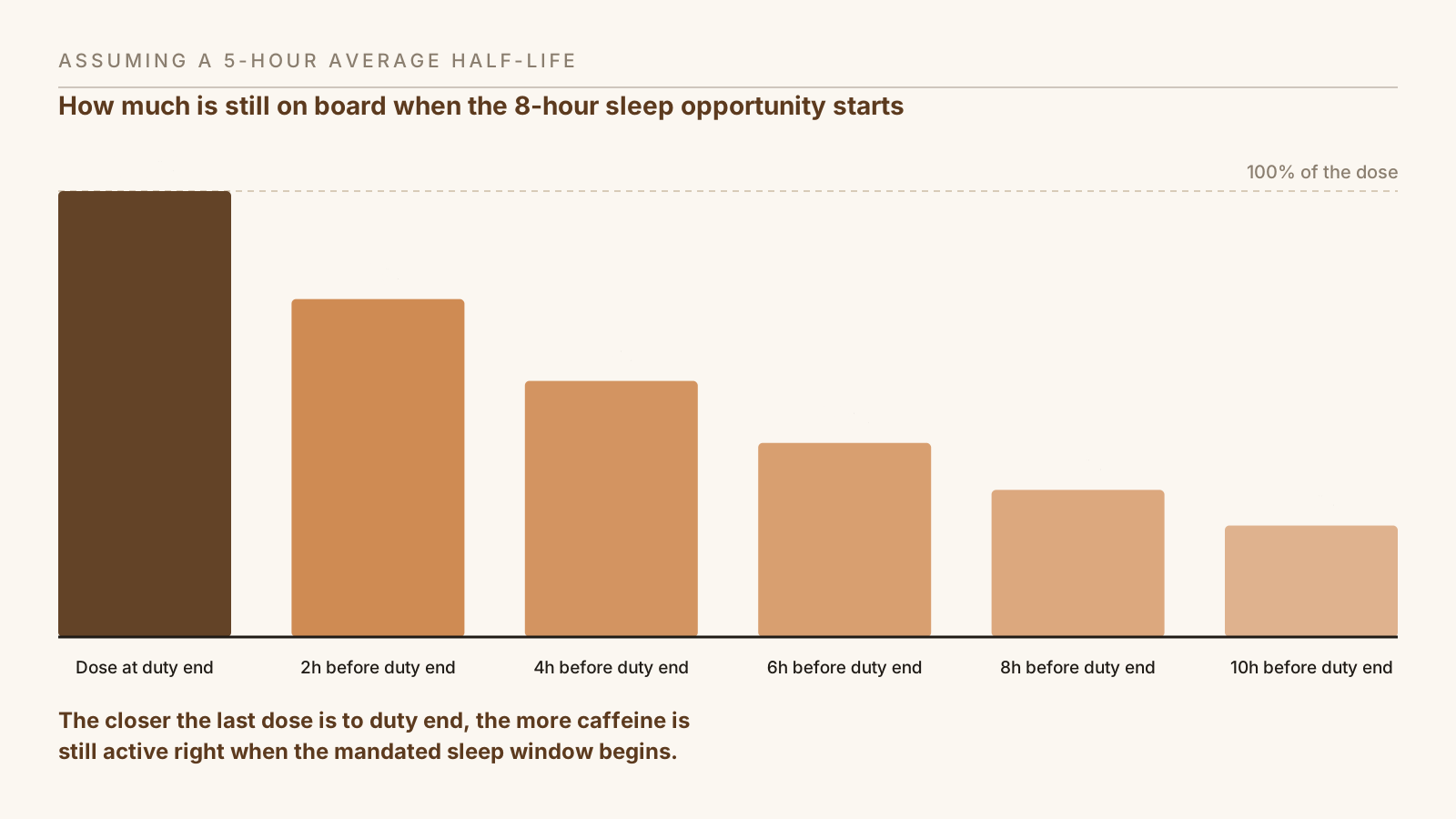
- Watch the arithmetic on your last cup before a rest period, the same way it matters for anyone on an irregular schedule. Caffeine’s average half-life is roughly 5 hours, with real individual variation — a dose taken late in a duty day can still be measurably active when your 8-hour sleep opportunity starts, working against the very rest the rule assumes you’ll get. Why caffeine wrecks your afternoon walks through the same math in a different context.
- Treat a rough taper day like any other IMSAFE flag, not a secret. Fatigue reporting exists precisely for days when you’re not at your baseline, whatever the cause.
- Coordinate the timing with your actual bid line, not an arbitrary start date — a reserve week or a run of days off is a genuinely better place to land the worst of it than the first leg of a four-day trip.
If you’re also managing a rotating or irregular sleep schedule apart from the caffeine question, day-sleep that actually works and a morning routine for shift workers cover the mechanics that matter more, not less, while you’re tapering. And if any of this sounds familiar from a different profession, it should — quitting caffeine on a long-haul trucking route runs the same collision between a federal rest rule and caffeine’s half-life, just with a 10-hour reset instead of an 8-hour sleep opportunity, and a cab instead of a cockpit.
What to drink down-route
One genuine advantage over some other occupational pieces on this site: a crew hotel room almost always has an in-room coffee maker, so a ground herbal-coffee blend brews exactly the way real coffee would — no galley problem, no cab-with-no-kitchen workaround needed.
A roasted-chicory or roasted-grain blend keeps the ritual — the smell, the cup in hand, the routine that goes with a hotel-room morning — through the stretch of a taper where the actual caffeine dose is dropping toward zero. Teeccino’s French Roast (opens in a new tab) is one option, though it contains barley, so it’s not gluten-free. Teeccino’s Dandelion Dark Roast is barley-free, but Teeccino’s own product page doesn’t carry an explicit gluten-free claim or certification, so that’s worth confirming directly if it matters for you rather than assuming. Pero and other roasted-grain blends work on the same principle. None of them will keep you alert — that’s not their job. For the legs where you genuinely need alertness, that’s still a caffeine decision, timed the way the section above describes, not a herbal-coffee one. The fuller field, including options with real caffeine if that’s what a given day calls for, is in the best caffeine-free coffee alternatives.
The bottom line
Caffeine isn’t optional color in this job the way it can be elsewhere — it’s one of a short, regulator-acknowledged list of tools available to manage a schedule built to cross your body’s low point, and for most U.S. two-pilot crews, it’s carrying weight that a sanctioned in-seat nap would carry in a lot of other countries. None of that means you can’t cut back or quit. It means the taper belongs on your reserve days and days off, not on the first leg of a trip, and a rough morning from cutting too fast deserves the same honest self-assessment IMSAFE already asks of you for every other kind of impairment. Same physiology as everyone else on this site. Different clock, and a schedule that isn’t yours to move.
This article is educational, not medical or aeromedical advice. Talk to your AME, your airline’s fatigue risk management program, or your physician before changing a caffeine routine you rely on for duty-day alertness.
Sources & further reading
- Controlled Rest (opens in a new tab) — Flight Safety Foundation, AeroSafety World
- What is the Fatigue Countermeasures Lab? (opens in a new tab) — NASA
- FAA Pilot Fatigue Rules Explained: What Every Pilot Needs to Know (opens in a new tab) — compliance summary of 14 CFR Part 117
- IMSAFE Acronym Explained (opens in a new tab) — Pilot Institute
- Caffeine (opens in a new tab) — NCBI Bookshelf
- Faster but not smarter: effects of caffeine and caffeine withdrawal on alertness and performance (opens in a new tab) — Psychopharmacology, 2012
Reader conversation (5)
We read every response. Selected reader notes below.
The controlled-rest gap is the part nobody outside the industry ever seems to know. I flew for a European carrier for two years before coming back to the U.S. and the in-seat nap being a non-thing here was one of the bigger adjustments — you just don’t have that pressure valve on a two-pilot domestic leg. Good to see it explained accurately instead of the usual “pilots just power through” take.
That’s exactly the contrast I was hoping to get right — thank you for confirming it from the seat instead of just the source pages. It’s a genuinely underreported difference.
Reserve week is absolutely the right place to land a rough taper day, not a four-day trip. Learned that the hard way trying to cut back before a Hawaii turn a few years ago — was fogged for the first two legs and it was not a good feeling to notice mid-climb.
Cabin crew have basically the same WOCL problem with none of the FAA rest-rule protection pilots at least have on paper. Would genuinely read a version of this article scoped to us.
That’s a fair callout — flight attendant duty-time rules are a different part of Part 117 than what this piece covers, and the fatigue physiology doesn’t care which side of the cockpit door you’re on. Adding it to the list.
Mildly skeptical of “IMSAFE would catch it” — in practice nobody self-grounds over a caffeine headache, they just white-knuckle the sim… er, the flight. The honest fix is scheduling the taper so it never gets tested against IMSAFE in the first place, which the article does say, so fine.
Flying for an EU carrier, controlled rest is just a normal briefed item on a long sector, so reading how absent it is from U.S. domestic ops was genuinely surprising. Makes the caffeine-timing math matter a lot more on your side of the Atlantic than on mine.
Have something to add? Email us and we may include it in a future update.