Does coffee block iron absorption? Yes — but the culprit isn't caffeine, and herbal tea can be worse
Coffee and tea really do reduce how much iron you absorb from a meal. The inhibitor is polyphenols, not caffeine — which means switching to a caffeine-free herbal cup does not automatically solve it, and peppermint tea inhibits about as hard as black tea. A dietitian's read on who actually needs to care, and the one timing change that does most of the work.

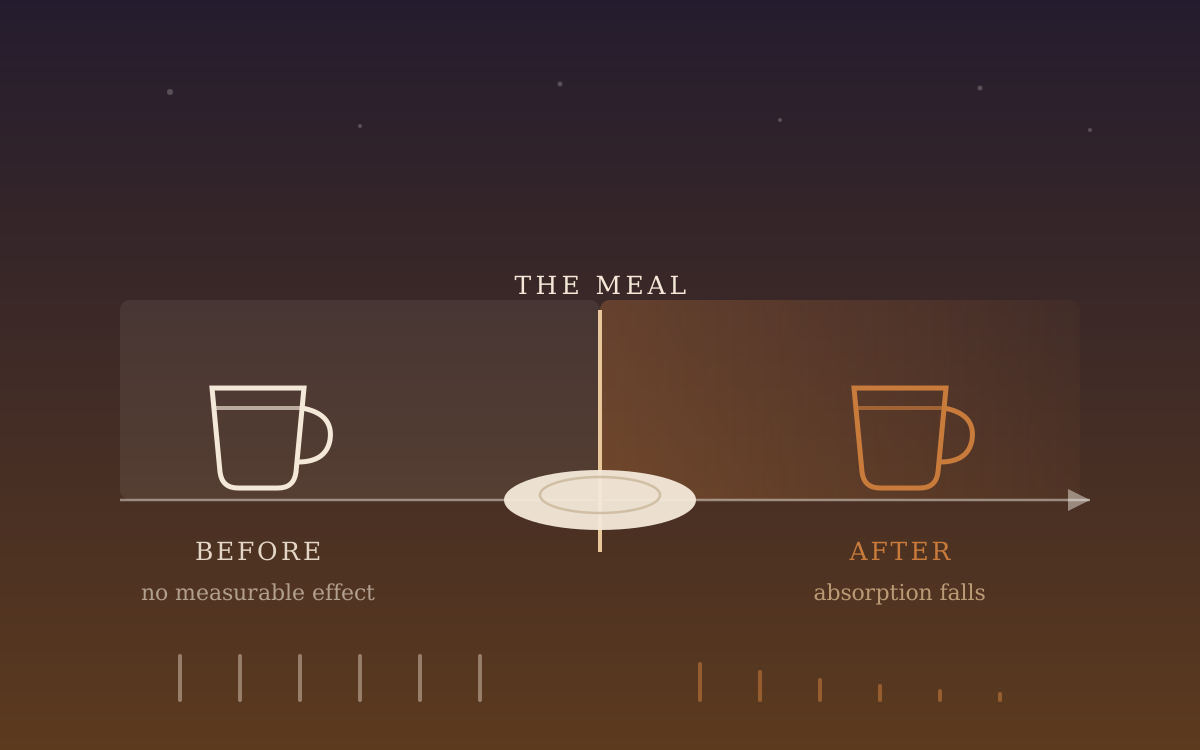
Someone asks me some version of this question almost every week, and it usually arrives already half-answered: I’ve cut out coffee because of my iron — herbal tea’s fine, right?
Not necessarily. And the reason it isn’t is the most useful thing in this article, so I’ll put it in the first paragraph rather than making you scroll for it.
The short answer
Yes, coffee and tea reduce the amount of iron your body absorbs from a meal. The effect is real, it is well replicated, and it is large enough to matter for some people.
But the compound doing it is not caffeine. It is a family of plant compounds called polyphenols — chlorogenic acid in coffee, tannins in tea. Caffeine happens to travel in the same cup. It is a passenger, not the driver.
That has three consequences that reorganise the whole question:
- Decaf and caffeine-free coffee still do it, because decaffeination does not remove polyphenols.
- Herbal teas do it too — and some of them do it harder than coffee does.
- The fix is timing, not abstinence, and the timing window is not shaped the way most people guess.
Two kinds of iron, and only one is affected
This distinction does most of the work, and almost nobody outside nutrition knows it.
Dietary iron comes in two forms. Heme iron comes from meat, poultry and seafood. Non-heme iron comes from plants, eggs, dairy and fortified foods — beans, lentils, spinach, tofu, fortified cereal.
They are absorbed by completely different routes, and only the non-heme route is vulnerable to what is in your mug. Heme iron is absorbed largely intact and is not meaningfully bothered by polyphenols.
The NIH Office of Dietary Supplements (opens in a new tab) puts the practical difference this way: overall iron bioavailability runs about 14 to 18 percent from mixed diets that include substantial meat, seafood and vitamin C, but only 5 to 12 percent from vegetarian diets. The requirement for iron is reckoned to be 1.8 times higher for people eating vegetarian than for people eating animal products.
So the population this article is really about is the one eating most of its iron from plants. If your iron comes mostly from a steak, your mug is a minor character. If it comes from lentils and fortified oats, your mug is a main one.
The inhibitor is polyphenols, not caffeine
Here is the study that settles it.
In 1999, Hurrell, Reddy and Cook ran a set of beverages against an identical bread meal and measured iron absorption directly, using radiolabelled iron and erythrocyte incorporation. They deliberately picked drinks with different polyphenol chemistry: phenolic acids (the chlorogenic acid in coffee), monomeric flavonoids (a set of herb teas), and complex polymerised polyphenols (black tea and cocoa).
Every one of them was a potent inhibitor (opens in a new tab), and the amount of inhibition tracked the total polyphenol content rather than anything else. Beverages carrying 20–50 mg of total polyphenols per serving cut iron absorption by 50–70 percent. Beverages carrying 100–400 mg cut it by 60–90 percent.
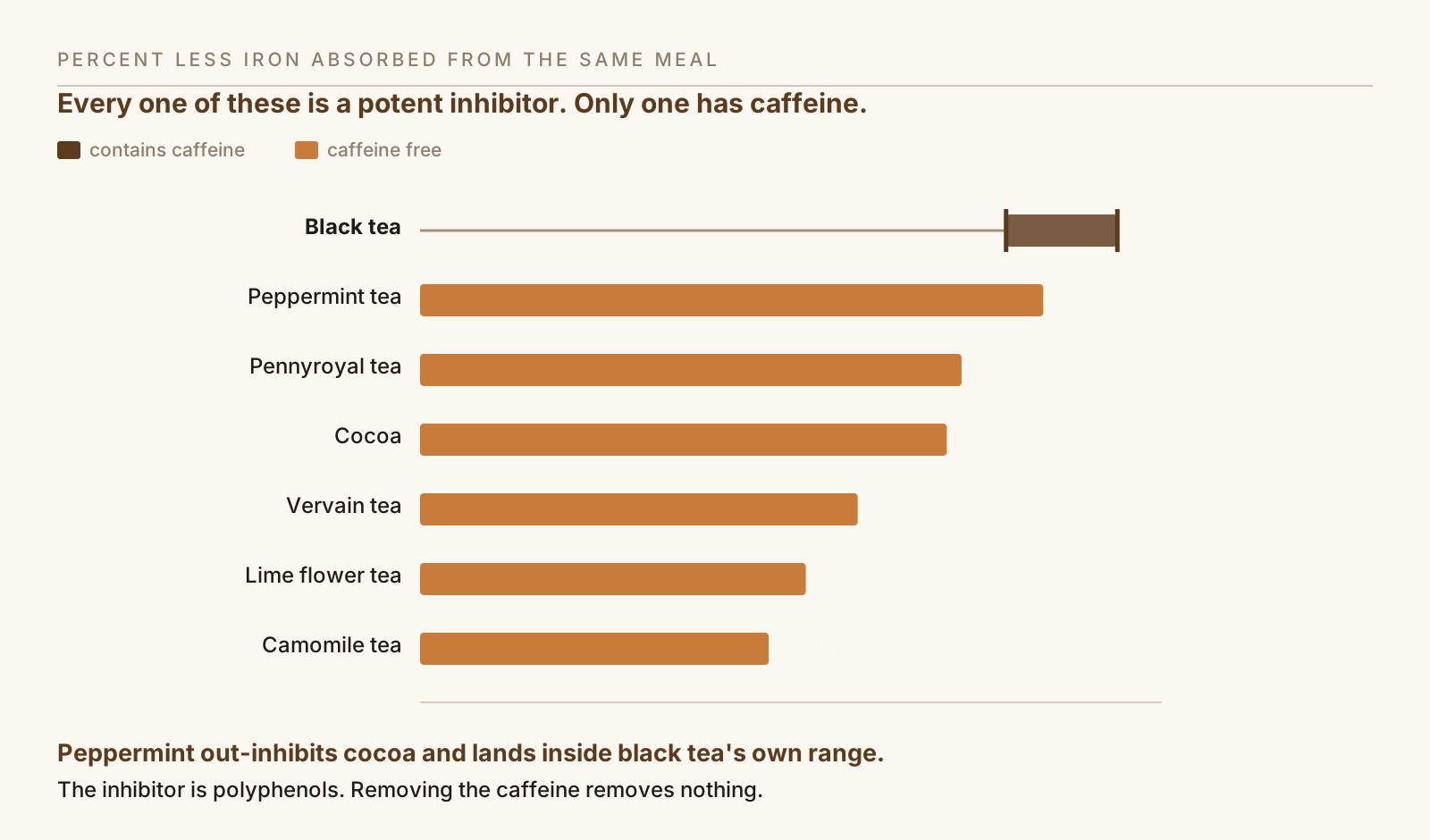
Look at where peppermint lands. Peppermint tea reduced iron absorption by 84 percent — more than cocoa, and inside black tea’s own range. Peppermint has no caffeine in it at all.
If caffeine were the mechanism, that chart would be almost entirely empty. It isn’t. The authors’ own closing line is worth quoting, because it is unusually blunt for a nutrition paper: “herb teas, as well as black tea, coffee and cocoa can be potent inhibitors of Fe absorption. This property should be considered when giving dietary advice.”
Cocoa’s 71 percent is worth a note of its own if you’ve been using it as your evening swap — we’ve written separately about carob as a cocoa alternative, and carob is a different plant with a different composition, but I have not seen a radio-iron study run on it and I’m not going to imply one exists.
How much absorption actually disappears
The 1983 study by Morck, Lynch and Cook is the one most often quoted, and the numbers are stark because the meal was stripped down to make the effect measurable.
| What was drunk with the meal | Iron absorbed |
|---|---|
| Nothing (control) | 5.88% |
| A cup of drip coffee | 1.64% |
| A cup of instant coffee | 0.97% |
| Instant coffee at double strength | 0.53% |
Those are absorption percentages from a semipurified test meal, not from dinner, and they are not the numbers to quote at a party. The more transferable figure from the same paper (opens in a new tab) came from a real hamburger meal: coffee cut iron absorption by about 39 percent, and tea by about 64 percent.
Two things in that table matter more than the headline.
It is dose-dependent. Double the strength, halve the absorption again. A weak cup is not the same intervention as a strong one, which is also why “a cup of tea” is a useless unit of measurement in this conversation.
Instant beat drip. Not because instant is a different substance, but because the cup that was brewed to be stronger inhibited more. Everything here is a story about how much polyphenol arrives, not about what the label on the jar says.
The timing window is asymmetric
This is the finding I most wish were better known, because it is genuinely counterintuitive and it is the one lever that costs nothing.
In the same 1983 study, the researchers moved the coffee around relative to the meal. The result:
- Coffee taken one hour before the meal produced no decrease in iron absorption at all.
- Coffee taken one hour after the meal inhibited absorption just as much as drinking it with the meal.
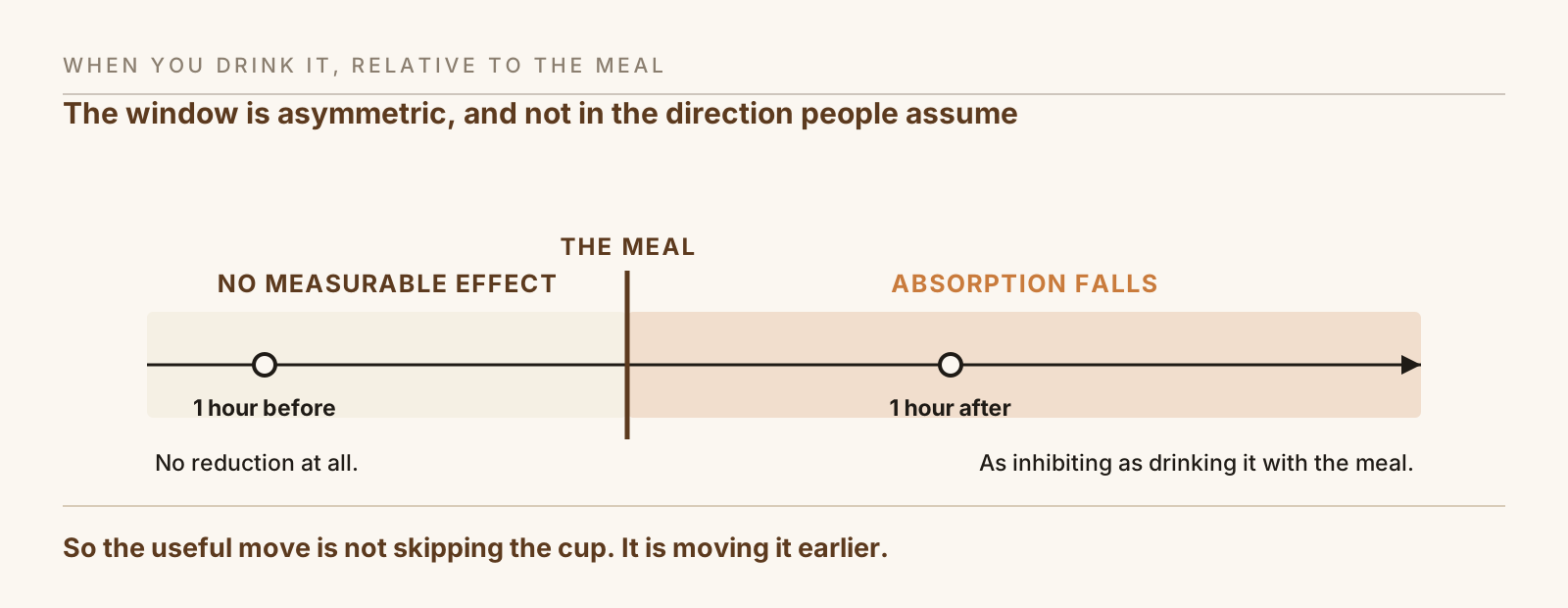
Most people assume the danger zone is before eating — that you shouldn’t drink coffee on an empty stomach ahead of breakfast. For iron, it is the reverse. Your stomach clears the polyphenols before the food arrives. What it cannot do is un-bind iron that is already sitting there waiting to be absorbed.
So the practical advice is not “give up coffee.” It is “move it earlier.” Have it before the meal, or leave a real gap afterwards — and note that the study demonstrates one hour is not a real gap. I don’t have a well-evidenced number for how long is enough, and I would rather say that than invent one. Two hours is the figure most commonly given in clinical practice; treat it as a reasonable convention rather than a measured threshold.
Who actually needs to change anything
Most people reading this don’t. I want to be as clear about that as about everything above, because nutrition writing has a bad habit of turning a real mechanism into a universal anxiety.
If your iron status is normal, your body already regulates iron absorption dynamically — it absorbs more when stores are low and less when they are adequate. A 39 percent reduction from one meal’s non-heme iron, in someone with comfortable stores and a varied diet, is unlikely to be the thing that changes your life. The observational evidence reflects that ambivalence: some large cohort studies find lower ferritin among heavy tea and coffee drinkers, others find no association at all.
The people for whom this stops being academic:
- Anyone with diagnosed iron deficiency, with or without anaemia
- People taking an iron supplement — the interaction is strongest here, because a supplement is a large, concentrated, entirely non-heme dose
- Menstruating people, whose RDA is 18 mg against 8 mg for adult men
- People who are pregnant, where requirements rise sharply — a context we’ve looked at from the other direction in our pieces on chicory during pregnancy and coffee alternatives while breastfeeding
- Vegetarians and vegans, per the 1.8× requirement above
- Frequent blood donors, and people with gastrointestinal conditions affecting absorption
If you’re in one of those groups, the timing change is close to free and worth making. If you’re not, this is interesting rather than urgent.
One thing that is not optional: if you suspect you are low in iron, that is a blood test and a clinician, not a beverage decision. Iron deficiency has causes that matter far more than your mug, and taking iron you don’t need is its own risk. Nothing here is medical advice or a substitute for it.
Where chicory and herbal coffee sit
This is the part I care most about getting honest, because it is exactly where a site about coffee alternatives is tempted to oversell.
Nobody has run this study on roasted chicory. I looked. There is no radio-iron absorption trial for chicory root brew, herbal coffee blends, roasted barley or roasted grain beverages of the kind Hurrell ran on peppermint and camomile. Anyone who tells you a chicory brew is iron-safe is telling you something the literature does not currently support.
What we can say is what the raw material is like, and it points toward caution rather than away from it:
- Roasted chicory root is polyphenol-containing. Analyses of chicory root put total polyphenols in the range of roughly 13–20 mg gallic-acid-equivalent per gram of dry matter. At a normal mug dose, that is a meaningful quantity of polyphenol in the pot — how much ends up in the cup depends on extraction, which nobody has characterised for this purpose either.
- On one specific measure, chicory is genuinely lower than coffee: chlorogenic acid. Work on coffee substitutes found chlorogenic acids in roasted chicory at levels roughly two orders of magnitude below the corresponding roasted coffee products. That is a real difference, but chlorogenic acid is one polyphenol among many, and the 1999 study’s whole point was that several structurally different polyphenol families all inhibit.
- Inulin, the chicory fibre, is not the rescue some people hope for. It is a well-established prebiotic, and human studies do show favourable effects on calcium and magnesium absorption. The iron evidence is weaker and mostly from animal models, with human trials small and inconsistent. We looked at inulin from a different angle in does chicory coffee raise blood sugar, and it has its own tolerance issues, covered in chicory coffee and IBS. It is not an iron-absorption strategy.
The same honest uncertainty applies to the commercial herbal-coffee blends. Teeccino’s (opens in a new tab) blends are built on roasted chicory, carob and barley — all plant materials that carry polyphenols. Carob is often shelved beside cocoa as a substitute, but the two are unrelated plants with different chemistry, so cocoa’s 71 percent on the chart above tells you nothing about carob either way. That is not an accusation aimed at anybody’s blend; it is the absence of evidence in both directions. I’d treat any roasted plant brew as a polyphenol-containing beverage and apply the timing rule to it, until somebody runs the study.
That is a less satisfying answer than “switch to this and you’re fine.” It is the accurate one.
The one genuinely low-tannin cup
If you want a hot drink with a meal and you have a reason to protect your iron, rooibos is the option with actual evidence behind it.
Rooibos is naturally low in tannins — around 4 percent, against roughly 11 to 17 percent in black tea. In 1979, Hesseling and colleagues gave three matched groups of ten healthy young men radiolabelled iron with 16 mg of elemental iron, followed by rooibos, ordinary tea, or boiled water. Mean absorption (opens in a new tab) was 7.25 percent after rooibos, 1.70 percent after ordinary tea, and 9.34 percent after water. Rooibos did not significantly affect absorption.
Caveats, because thirty people is thirty people: it is one small study, it is old, and it used a supplement-style iron dose rather than a meal. But it is a direct measurement of the thing we actually care about, and no herbal alternative has better.
We’ve written more about what rooibos is and whether it’s truly caffeine-free, and about its close relative honeybush, which is also low in tannins — though I’m not aware of an iron study on honeybush specifically, so that’s an inference from composition rather than a measured result.
Camomile, at 47 percent, was the gentlest of the herb teas Hurrell tested. That still means roughly half the iron. “Gentle” is relative.
What actually helps, and how much
Vitamin C is the real counterweight. Ascorbic acid reduces ferric iron to the more absorbable ferrous form and keeps it soluble, and it directly counteracts the dose-dependent inhibition caused by polyphenols and phytates. Roughly 50 mg with a main meal is the figure usually cited for a useful effect — about one orange, or a decent squeeze of lemon, or a handful of strawberries or bell pepper.
With one honest caveat that gets left out of most write-ups. Cook and Reddy found the facilitating effect of vitamin C on iron absorption from a complete diet is far less pronounced than from single test meals. The dramatic numbers come from controlled single-meal studies. Real diets are messier and the benefit is more modest. That is worth knowing before you build a strategy on it.
Two other things that genuinely help:
- A little meat, poultry or seafood in the same meal enhances non-heme iron absorption from the rest of the plate. If you eat them, this is one of the more efficient levers available.
- Moving the mug, per the section above. Free, and mechanically the cleanest of the lot.
And one that doesn’t: adding milk. The 1999 study tested it and found milk had little or no influence on coffee’s or tea’s inhibitory effect. If you drink decaf with milk believing you’ve solved two problems, you have solved neither.
What I actually tell people
When someone with genuinely low iron asks me what to change, the list is short, in this order:
- Separate iron supplements from all polyphenol drinks, by as much of the day as you can manage. This is the highest-yield change and it isn’t close.
- Move your cup to before the meal, or leave a solid gap after it. Longer than an hour.
- Put 50 mg of vitamin C on the plate at your main plant-iron meal.
- Don’t assume the caffeine-free swap did anything for this. It may have helped your sleep, your anxiety, or your afternoon — all good reasons, covered elsewhere on this site. It did not address iron.
- If a hot drink with dinner is non-negotiable, rooibos is the best-evidenced choice, with the honest note that “best-evidenced” here means one small 1979 trial.
Notice that none of those five is “give up tea.” I’ve watched people strip every enjoyable drink out of their day over this and end up no better off, because they were never in an at-risk group and the actual problem was somewhere else entirely. The mechanism being real does not make it the thing that is wrong with you.
The bottom line
Coffee and tea reduce non-heme iron absorption, sometimes dramatically. Caffeine has nothing to do with it — the inhibitors are polyphenols, which survive decaffeination and are abundant in plenty of caffeine-free herbal drinks. Peppermint tea inhibited harder than cocoa in the best study we have.
For most people with normal iron, this is a mechanism, not a problem. For people who are deficient, supplementing, pregnant, menstruating heavily, vegetarian or donating blood, it is worth a small, cheap change: move the cup earlier, add vitamin C, and keep supplements well away from anything brewed from a plant.
And if you switched to a caffeine-free cup for iron reasons specifically — that switch was made on a premise that doesn’t hold. There may be excellent reasons to keep it. This just wasn’t one of them.
This article is educational and is not medical advice. If you think you may be iron deficient, ask your clinician for a blood test — iron deficiency has causes worth identifying, and iron supplementation carries its own risks when it isn’t needed.
Sources & further reading
- Inhibition of food iron absorption by coffee (Morck, Lynch & Cook) (opens in a new tab) — American Journal of Clinical Nutrition, 1983
- Inhibition of non-haem iron absorption in man by polyphenolic-containing beverages (Hurrell, Reddy & Cook) (opens in a new tab) — British Journal of Nutrition, 1999
- The effect of rooibos tea on iron absorption (Hesseling, Klopper & van Heerden) (opens in a new tab) — South African Medical Journal, 1979
- Iron — Fact Sheet for Health Professionals (opens in a new tab) — NIH Office of Dietary Supplements
- Effect of ascorbic acid intake on nonheme-iron absorption from a complete diet (Cook & Reddy) (opens in a new tab) — American Journal of Clinical Nutrition, 2001
Reader conversation (5)
We read every response. Selected reader notes below.
I have been anaemic on and off since my twenties and I switched to peppermint tea about four years ago on the advice of a well-meaning relative who said I should get off the caffeine for my iron. Four years. Reading that peppermint was the second-worst thing on your chart was not a fun paragraph. I am not annoyed at you, to be clear — I am annoyed that in four years of appointments and leaflets nobody mentioned that the tannins were the issue and the caffeine was a red herring. The timing thing I can actually do tomorrow.
We’re sorry it landed that way, and your experience is exactly why we led with the mechanism instead of the advice. The peppermint result surprises most people, including us — it out-inhibited cocoa. Worth saying clearly for anyone reading over your shoulder: none of this means four years of peppermint caused your anaemia, and the cause is a question for your clinician rather than your mug. But separating the tea from the meal is free, and if you’re taking a supplement, separating it from that matters more than either.
Pharmacist here. The supplement point deserves more than fifth billing in your list — it’s the one I spend the most counselling time on. People take the ferrous sulfate with breakfast because that’s when they remember, and breakfast is the meal most reliably accompanied by coffee or tea. If I get one behaviour change out of a patient it’s that one, and the reason is exactly the dose-dependence you describe: a supplement is a big concentrated non-heme load, so proportionally you lose more. Nice to see the 1983 timing data laid out; I’ve been quoting “wait an hour” for years and I now realise I had the direction of the asymmetry wrong.
That last sentence is the whole reason we drew the window as a diagram. “Wait an hour” is such a natural-sounding rule that it took us a second read of Morck to accept the paper says the opposite: one hour after inhibited as much as drinking it with the meal, while one hour before did nothing measurable. If a pharmacist had the direction wrong then the rule is genuinely badly transmitted, not just poorly remembered.
Appreciated the honesty about chicory, though I want to push on it a little. You say nobody has run the study, then spend three bullets implying it is probably a bit of a problem. Is that not also going beyond the evidence, just in the cautious direction? I would rather read “we don’t know” full stop than “we don’t know, but be careful”, because the second one still shapes what I do.
A fair challenge and we’ve thought about it. Our reasoning: “we don’t know” is the right answer to has this been measured, but it isn’t the right answer to what should I do tomorrow, and readers are asking the second question. Given the 1999 finding that several structurally unrelated polyphenol families all inhibit, treating a roasted plant brew as a polyphenol beverage until measured is the lower-cost error — the recommended action is only “move the cup earlier”, which costs nothing if we’re wrong. We’d rather be explicit about that reasoning than hide it, so: it’s an inference from composition, not a finding, and we’ve tried to label it as one throughout.
Vegan, regular blood donor, so I appear twice on your risk list. The one thing I’d add is calcium, which you mention in passing in the milk answer and then drop. My haematologist was much more exercised about my calcium supplement sitting next to my iron than about tea. Might be worth its own piece — the plant-based plate has about four of these interactions stacked on it and I have never seen them written down in one place, only ever one at a time.
Nice piece. Small gripe: the rooibos study is ten men in 1979 and you build a recommendation on it. You do say so, which is more than most would, but I notice the caveat is a sentence and the recommendation is a heading. Not asking you to remove it, just noting that the visual weight and the evidential weight point different ways.
That’s a good catch about structure rather than content, and it’s the kind we don’t usually get. You’re right that a heading confers more confidence than one small 1979 trial earns. Our defence is thin — it’s the only direct measurement that exists for any herbal option, so it’s simultaneously the best-evidenced choice and barely evidenced at all, and those two things are uncomfortable in one section. We’ve kept the heading and we’ll take the note; if we ever find a modern replication we’ll say so loudly either way.
Have something to add? Email us and we may include it in a future update.