What is malt coffee? The roasted-barley cup Europe drinks without thinking about it
Malt coffee is barley that's been germinated, kilned and roasted — and that germination step is why it tastes sweet without any added sugar. Here's what malting actually does, why malt coffee wasn't invented by a war, the one word on a German label that decides whether your cup has caffeine, and where grain genuinely beats chicory.

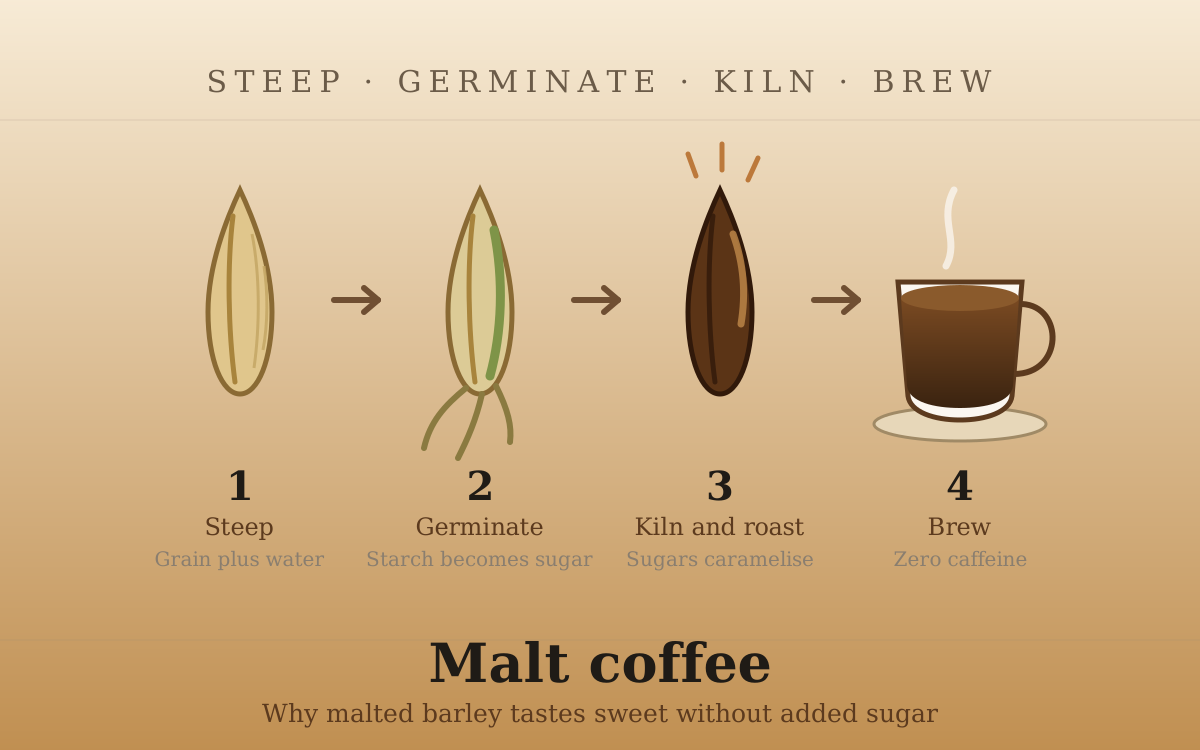
There is a drink that several hundred million Europeans have been raised on, that sits in ordinary supermarkets between the instant coffee and the cocoa, that is caffeine-free by nature rather than by processing — and that almost no English-language writing about coffee alternatives bothers to explain properly.
It’s malt coffee. In German, Malzkaffee. And the reason it usually goes unexplained is that the interesting part is a step nobody mentions: before the barley is roasted, it is deliberately made to sprout.
That single step is the whole story. It’s why malt coffee tastes noticeably sweeter than the roasted barley cup Italians drink as caffè d’orzo or the roasted barley tea Japan drinks iced all summer — same grain, three different drinks, and the difference is germination.
What malting actually is
Malting is a controlled, interrupted sprouting. It runs in three stages, and maltsters have been doing it more or less this way for thousands of years — mostly to make beer and whisky, occasionally to make a hot drink.
Steep. The barley is soaked until the grain takes up enough moisture to think it has landed in wet soil.
Germinate. The grain begins to grow, and this is the part that matters. A seed is a packed lunch — a dense store of starch the plant needs before it has leaves to feed itself — and to use that starch the seedling has to break it down. Germination switches on the grain’s own enzymes, which cut long starch chains into simple sugars, principally maltose. In brewing, those sugars are what the yeast later eats.
Kiln. Before the seedling can consume what it just unlocked, the maltster stops it with heat, drying the grain to around 5% moisture and removing the rootlets. What’s left is malt: the same barley, with a good deal of its starch already converted to sugar.
Then, for malt coffee specifically, the malt gets roasted dark.
That order is everything. You are roasting a grain that is already sweet, so the browning has far more sugar to work with. Roasting is largely the Maillard reaction — sugars and amino acids rearranging under heat into hundreds of aromatic compounds, the same chemistry that makes bread crust smell like bread crust. Give it more sugar to start from and you get more caramel, more toffee, more bread.
Nothing is added. No sweetener, no flavouring. The sweetness in the cup came out of the grain’s own starch, unlocked by the grain’s own enzymes, days before it ever met a roaster.
What it tastes like, and why
Malt coffee is not a convincing impersonation of coffee, and I’d rather say that plainly than oversell it.
What it is: dark brown in the cup, low in acidity, faintly bitter at the finish, distinctly sweet and bready in the middle — closer to the smell of a bakery, or the malty note in a stout, than to espresso. Body without sharpness. It takes milk better than most caffeine-free options, because the malt sugars and the dairy sugars pull in the same direction.
What it isn’t: bright, fruity, acidic or intense. No crema, no bite, no snap. If what you miss about coffee is the sharpness, malt coffee won’t give it to you and making it stronger won’t help.
Against the roasted roots, the trade is clean: chicory brings coffee-like bitterness and earthy depth, malt brings sweetness and softness. Which is exactly why so many commercial products blend both — the grain rounds the root off, the root stops the grain being merely pleasant. Once you can taste the two components separately, most of the instant powders on the shelf get much easier to shop for.
It wasn’t invented by a war
Here’s where the standard account goes wrong, including in some of the histories I’ve read while researching this site.
Malt coffee gets filed under wartime privation — the thing Germans drank when the ships stopped coming, the Muckefuck of the rationing years. That’s not false, but it has the chronology backwards, and the chronology is the interesting bit. When I traced the wider history of ersatz coffee, the pattern that emerged was that the substitutes which survived were the ones people had chosen before they were forced to. Malt coffee is the cleanest example on the list.
It was launched as a branded health product, in peacetime, with a celebrity endorsement.
In 1889 a Munich food chemist named Heinrich Trillich began working on a barley-based coffee substitute; the grocery firm Franz Kathreiner Nachfolger started financing him the following year, and his roasting method was granted a German patent on 8 March 1892. But the marketing coup came first. On 1 March 1891, Sebastian Kneipp — the Bavarian priest and hydrotherapist whose naturopathic movement was then sweeping the German-speaking world — agreed to lend his name to the product. His portrait and signature went on every packet of Kathreiner’s Kneipp-Malzkaffee, and that blue package with the priest’s face became one of Germany’s first genuinely national branded goods. Kneipp’s slogan for the switch was as neat as any modern tagline: wie der Bohnenkaffee zehrt, so nährt der Getreidekaffee — as bean coffee depletes, grain coffee nourishes.
It worked to a degree that’s hard to overstate. By 1900 the Munich firm was selling something like 16 million pound-packages a year and holding roughly 80% of the malt coffee market; by 1912 it had overtaken chicory — the incumbent, roasting roots since 1828 — to take more than half the entire German coffee-substitute trade.
All of that is before the First World War. The wars didn’t create malt coffee; they made it, for a while, the only thing available. And when coffee came back, malt coffee stayed — precisely the test that okra seed, cottonseed and roasted acorn all failed.
The timing parallel with America is almost comic: Kathreiner launched its anti-coffee grain drink in 1891, C.W. Post launched Postum in 1895, and both long outlived the physiology they were sold on. Which is the necessary caveat — Kneipp’s nourishes line was advertising, not evidence, and I won’t launder it. Malt coffee is a pleasant caffeine-free infusion. It is not nutrition.
The one word that decides whether it has caffeine
If you take one practical thing from this article, take this one.
Malt coffee made from grain and chicory has no caffeine in it, because none of those plants make any. But German-market shelves also carry products labelled Malzkaffee mit Bohnenkaffee — malt coffee with bean coffee — which are typically something like half malt and half real ground coffee. Those absolutely contain caffeine.
And the historical advertising line, still echoed on packaging today, was Malzkaffee mit Bohnenkaffee-Geschmack: malt coffee with the taste of bean coffee. One suffix apart. One means it tastes like coffee. The other means it is partly coffee.
I keep running into versions of this. Camp Coffee is sold on its chicory and contains coffee essence. Coffee ice cream, the obvious scoop for a caffeine-free affogato, is made with real coffee. The caffeine is almost never hiding in the ingredient the packaging is shouting about — it’s in the component nobody checked, because all the attention went to the obvious one.
The rule that has never let me down: ignore the front of the pack and read the ingredients list. Grain, malt, chicory, rye, sugar beet — you’re fine. The word coffee anywhere in that list, in any language, and you are not. And none of this is decaf, which is a different situation entirely — we’ve put numbers on what’s left in a cup of decaf, and it isn’t zero.
Gluten: the clearest no in the category
Malt coffee is not gluten-free, and unusually for this subject, there is no argument to have about it.
When I wrote about barley coffee I spent a while on the claim that roasting degrades barley’s gluten and that little of it extracts into the brew anyway. There’s real laboratory work behind that idea, and I still declined to treat it as a green light, because celiac organisations don’t classify barley as gluten-free and the conservative reading protects the person with the most to lose.
With malt, the case is stronger still. Malt and malt extract are barley concentrates, and when tested they have come back at roughly 320 to 1,300 parts per million of gluten, against the 20 ppm threshold that defines a gluten-free food. In the United States the FDA does not permit barley malt, malt extract or malt flavouring in any product labelled gluten-free, regardless of how much gluten the finished food actually contains. Rules differ elsewhere — the UK permits barley malt extract in gluten-free foods at Codex-compliant levels, Australia and New Zealand don’t — worth knowing if you buy imported.
So if you have celiac disease, malt coffee is off the list, and the durable rule from the barley piece holds: roots and pods are safe, grains and grain blends are not. The naturally gluten-free half of this category is large and genuinely good — chicory and dandelion root, carob, chickpea, acorn and fig.
For a different set of readers: most malt coffee products are blended with chicory, which is high in inulin. If you’re managing IBS, that’s the ingredient to watch rather than the malt — we’ve covered what the FODMAP research says about chicory and the gut in detail.
Acrylamide: where grain beats root
This is the section that cuts against the ingredient this site recommends most often, which is exactly why it belongs here.
Acrylamide forms when starchy foods are cooked dry above about 120°C. It’s a by-product of the same Maillard browning that makes roasted things taste good, so anything roasted dark carries some: coffee, bread crust, roasted potatoes, and every roasted coffee substitute including malt.
But not in equal amounts, and European regulators have quietly documented the gap. Commission Regulation (EU) 2017/2158 sets “benchmark levels” for acrylamide by food category, and for coffee substitutes it sets two very different ones: 500 µg/kg for substitutes made exclusively from cereals, and 4,000 µg/kg for substitutes made exclusively from chicory — eight times higher, and the highest figure anywhere in the annex. Chicory root is simply more prone to it than grain, having more of the precursor amino acid asparagine to begin with.
Correction, 9 August 2026: this paragraph originally added that a 2024 analysis had measured roughly 510 µg/kg in cereal-based substitutes against about 2,940 in chicory-based ones. Going back to that study to cite it properly, we found it reports no such breakdown — and no significant difference between instant coffees and substitutes overall. We could not trace those figures to any primary source and have removed them. The regulatory gap above is unchanged and checkable in the annex; what we could not support was the claim that retail products track it eightfold. The full account, with the occurrence data that does exist, is in acrylamide in coffee alternatives.
Now the honest framing, because this is the kind of finding that becomes a scare or a sales pitch within a day. Benchmark levels are not safety limits — they’re performance indicators telling manufacturers when a process needs attention, and the regulation and EFSA both say so explicitly. IARC classifies acrylamide as Group 2A, “probably carcinogenic to humans”, a category resting here mainly on animal studies; EFSA’s summary of the human evidence is that it is “limited and inconsistent”. No safe intake has been established, and EFSA names coffee and coffee substitutes together among the more significant adult dietary sources — so switching from coffee to a roasted substitute doesn’t remove the question, and for most people fried potato products and baked goods contribute far more than anything in a mug.
So: not a reason to worry about your cup, and not a reason to call malt coffee healthier. It is a reason to know that roasted grain as a raw material tests lower than roasted chicory — a mean of about 240 µg/kg across 45 commercial roasted barley samples, against industry descriptions of untreated roasted chicory in the low thousands. If you drink several mugs a day, that is the first argument I’ve found for choosing malt over root that has nothing to do with taste. It is also a tiebreaker rather than a finding, and most products are blends rather than the pure chicory the 4,000 figure describes — we work through all of it here.
Malt coffee vs orzo, mugicha, and chicory
Four drinks that get conflated constantly, sorted by what actually distinguishes them:
- Malt coffee (German, Central European). Malted then roasted barley, usually with chicory and rye. Sweet, bready, low-acid. Sold overwhelmingly as instant powder. Contains gluten.
- Caffè d’orzo (Italian). Roasted barley, not malted. Drier and more toasted, less sweet. Sold as a grind for moka pots and espresso machines, so it arrives as a short dark shot. Contains gluten.
- Mugicha (Japanese). Roasted unhulled barley, not malted, brewed weak and drunk cold in enormous quantities in summer. Treated as a tea, not as a coffee substitute at all. Contains gluten.
- Chicory (French, American South, everywhere). A roasted root, not a grain. Genuinely bitter, coffee-adjacent, naturally gluten-free, higher in acrylamide.
The useful generalisation: malting adds sweetness, roots add bitterness, and format decides the ritual. Same handful of plants, and almost all the perceived difference between these drinks comes from processing and serving rather than from botany.
What to buy and how to brew it
If you’re in the United States and have never knowingly seen malt coffee, you may well have walked straight past it.
Pero is the US name for Caro, Nestlé’s malt-and-chicory instant — roasted barley, malted barley, chicory and rye — launched in West Germany in 1954 and sold as Eko in Spain. That date is worth a pause: it came almost a decade after rationing ended, which is to say it was aimed at people who could buy coffee and chose not to.
Kathreiner is still the German icon, 135 years after the Kneipp packet, and Inka is the Polish institution — kawa zbożowa, roasted rye, barley, chicory and sugar beet, in production since 1927. Both are easy to find online, and malt coffee turns up regularly in the international aisle under names that don’t announce themselves in English.
Brewing is easy, which is much of the appeal. Instant malt coffee is a spoonful in a mug — start at a heaped teaspoon and adjust; unlike a ground substitute you cannot over-extract it, so strength is purely how much powder you use. Ground malt coffee, where you find it, brews like coffee in a drip machine or French press, and the same rules that govern any coffee-free grind apply. Malt is also the traditional caffeine-free pour for children in Germany and Austria, which puts it on the short list for families cutting caffeine.
Since malt coffee is so overwhelmingly instant, one option for the drip-machine crowd: herbal-coffee roasts such as Teeccino (opens in a new tab) come as a grind for an ordinary coffee maker, blending chicory and carob with other roasted botanicals rather than leading with malt — useful if you want to keep your existing equipment and only change what goes in the basket. They cost more per cup than a jar of instant, several blends are barley- or rye-based so the gluten caveat applies unchanged, and the chicory brings the inulin question with it. Our roundup of caffeine-free options and the herbal coffee comparison cover more of the field.
One last disambiguation, because it catches people: malt coffee is not malted milk. Ovaltine, Horlicks and their relatives are malt drinks built on milk powder and sugar, some with cocoa — so some carry a little caffeine and a fair amount of theobromine. Similar word, different product, different label to read.
The bottom line
Malt coffee is barley that was made to sprout before it was roasted, and that one extra step — germination, the grain unlocking its own starch into sugar — is why the cup tastes sweet and bready without anything being added to it.
It is caffeine-free by nature, and it has been an ordinary, voluntary, everyday drink in Germany, Austria and Poland since the 1890s — sold first as a health product with a priest’s face on the packet and never really dislodged since. It contains gluten and is not an option with celiac disease. It carries markedly less acrylamide than chicory-based substitutes. And the only thing that will trip you up in a shop is a blend with real coffee in it, which the ingredients list will always tell you.
If what you miss about coffee is the bitterness, brew chicory instead. If it’s the sharpness, nothing in this category will satisfy you and it’s better to know that now. But if what you want is a hot, dark, gently sweet mug that asks nothing of your sleep — a hundred and thirty-five years of Central Europeans drinking this without thinking twice about it is a reasonable recommendation.
This article describes what malt coffee is and how it’s made, and makes no health claims about it. If you have celiac disease, are pregnant or breastfeeding, are managing IBS or another medical condition, or are choosing drinks for a child, read ingredient labels carefully and talk to a clinician about what’s appropriate for you.
Sources & further reading
- Dominantes Heißgetränk – Die Anfänge von Kathreiners Malzkaffee (opens in a new tab) — Uwe Spiekermann (food historian)
- Kathreiner (opens in a new tab) — Wikipedia (German)
- Caro (drink) (opens in a new tab) — Wikipedia
- The Malting Process (opens in a new tab) — Murphy & Son
- Is Barley Gluten-Free? (opens in a new tab) — Beyond Celiac
- Updated statement from FDA on malt, malt extract, malt syrup and similar malt-derived ingredients (opens in a new tab) — Gluten Free Watchdog
- Commission Regulation (EU) 2017/2158 establishing benchmark levels for the reduction of acrylamide in food (opens in a new tab) — EUR-Lex
- Acrylamide (opens in a new tab) — European Food Safety Authority
Reader conversation (6)
We read every response. Selected reader notes below.
Inka gets a single sentence here and I want to argue for more. In Poland this is not a niche wellness product, it is what half the country’s grandmothers have poured every afternoon for fifty years, usually with a lot of milk and a spoon of sugar, and children drink it from the age of about four. Nobody in my family has ever once described it as a coffee substitute. It is simply kawa zbożowa, which translates as grain coffee, and it is its own drink with its own name. Reading an English article that treats it as a replacement for something else is a bit like reading about tea as a replacement for beer.
This is the second time a reader from Central Europe has told me the same thing in slightly different words, and I think it’s the most important correction anyone makes about this category. The English framing is structurally condescending: it can only describe these drinks in terms of what they aren’t. Your own language doesn’t do that — kawa zbożowa names the thing rather than its absence. I’m increasingly convinced that the reason malt and grain coffees kept their footing in Germany, Austria and Poland while Postum faded in America is partly linguistic. If a drink has its own name, it stops being a stand-in.
The Bohnenkaffee paragraph earned its place. I have been buying a German malt coffee from an online deli for about four months, on a caffeine taper, and I went and pulled the pouch out of the cupboard while reading this. Gerstenmalz, Zichorie, Roggen — and then Röstkaffee, fourth on the list. It has been in there the whole time. I do not read German beyond menu level and the front of the pack says Malzkaffee in large friendly letters, so I never got as far as the ingredients. That explains a couple of restless evenings I had put down to something else entirely.
Röstkaffee is exactly the word to watch — roasted coffee, and fourth on an ingredients list means it’s a real proportion rather than a trace. I’m sorry it cost you sleep, and grateful you posted it, because you’re the fourth reader in as many months to be caught by caffeine in the component nobody thought to audit. It has never once been in the ingredient the packaging was advertising. If it helps as a rule of thumb for imported packs: Kaffee, caffè, café, kawa and koffie all mean what you’d expect, and any of them in an ingredients list is your answer regardless of what the front says.
Thank you for not hedging on the gluten. I read your barley coffee piece last year and came away genuinely unsure — you laid out the argument that roasting degrades it and not much extracts, said you weren’t treating that as a green light, and I spent about a week going back and forth. Coeliac diagnosed at thirty-one, and what I need from an article is a decision, not a balanced summary of a debate I am not qualified to arbitrate. “The FDA doesn’t allow it in a gluten-free product regardless of the tested level” is a sentence I can act on immediately. Chicory it is.
I malt my own barley for brewing and I appreciate that you kept kilning and roasting as two separate steps, because almost everything written about malt collapses them into one and it makes the whole process incomprehensible. Kilning stops the germination and dries the grain; roasting is a later and much hotter operation that is entirely about flavour. A practical note your readers might like: the dark roasted malts sold for stout — chocolate malt, black malt — are the same material as malt coffee at an earlier stage, and a homebrew shop will sell you a kilo for very little. Steeped like a coffee it is startlingly close to what comes out of a Caro jar.
That’s a genuinely useful tip and I hadn’t thought of the homebrew supply route, so thank you. Two caveats I’d want to attach for anyone tempted, neither of which is a reason not to try it: brewing malts are sold as a brewing ingredient rather than as a beverage in their own right, so the handling and labelling assumptions are different from a food product, and it is of course still barley — everything in the gluten section above applies unchanged. Your point about the two heat steps is the one I’d most like people to take away. Germination makes the sugar, roasting caramelises it, and the kiln in between is just the pause button.
A dissenting data point, offered in the spirit of your acorn commenter. I ordered Pero after reading your grocery-store roundup, drank it for three weeks, and it is not for me. It is perfectly nice. That is the problem. I wanted something with an edge to it in the morning and what I got was closer to a very thin malted drink — pleasant, comforting, and completely unable to mark the start of the day. Your sentence about making it stronger not helping is accurate; I tried two heaped spoons and simply got more of the same thing. I have gone back to a dark chicory blend, which is harsher and much better at the job I actually need done.
I have to be honest, the acrylamide section unsettled me more than I think you intended. I drink four or five cups of chicory a day and have done for two years, and the figure of nearly three thousand micrograms per kilo against a benchmark of four thousand does not feel like a comfortable margin. I understand you hedged it carefully and I am not accusing you of scaremongering, but I would find a straight answer helpful: should I be switching to a grain blend or not?
Fair to ask directly, so a direct answer: on the published evidence I would not switch on this basis alone, and I would not tell you to. Three things are load-bearing. The benchmark isn’t a safety line — it’s the level above which a manufacturer is expected to go and look at their process, so being under it isn’t reassurance and being near it isn’t a warning. The concentration in dry powder is also not the dose in your cup; you’re brewing a few grams per mug, not eating a kilogram. And the human evidence remains, in EFSA’s own words, limited and inconsistent, which is why nobody credible is issuing switching advice. What I’d actually say is this: if you already enjoy grain blends, the acrylamide comparison is a small extra point in their favour and worth knowing. If you prefer chicory and drink it because you like it, that’s a better reason to keep drinking it than this number is to stop. If it’s genuinely bothering you, that’s a conversation for a clinician who knows your history, not for a comments section.
Have something to add? Email us and we may include it in a future update.