Ersatz coffee: how war, blockade, and rationing invented most of today's coffee alternatives
Chicory, roasted barley, acorn, fig, malt — nearly every caffeine-free roast in your cupboard was invented or popularized because coffee ran out. Here's the honest history of ersatz coffee, from Napoleon's blockade to the 1977 East German coffee crisis, and why the substitutes that survived are the ones worth drinking today.

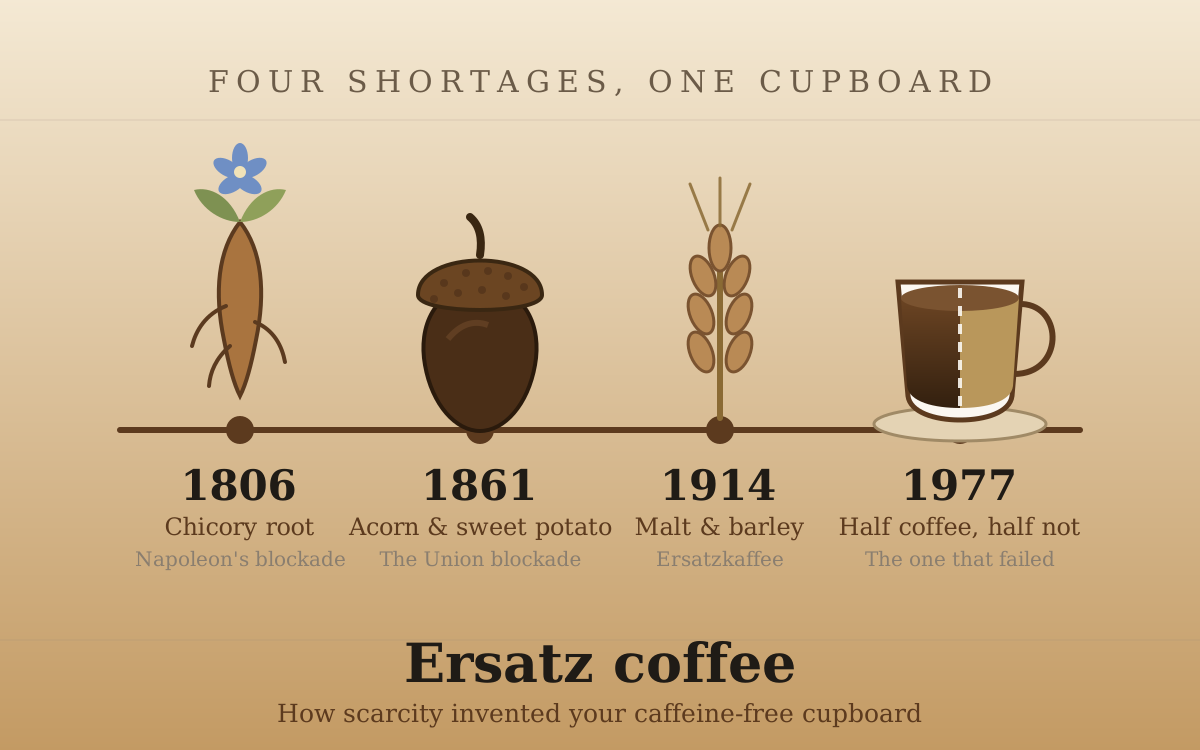
Line up the caffeine-free roasts we’ve written about on this site — chicory, roasted barley, acorn, fig, chickpea, lupin, soybean, Postum — and a pattern shows up that’s hard to unsee. These aren’t a scattered collection of folk curiosities. They’re a set of survivors, and most of them trace back to the same handful of events: a blockade, a war, a rationing scheme, a currency crisis.
Somebody’s government cut off the coffee. People roasted whatever was in the field instead.
That history gets treated as trivia — a charming footnote about what your great-grandmother drank. I’d argue it’s the opposite. It’s the single most useful thing you can know about this category, because it explains why some of these drinks are genuinely good and others are curiosities nobody has voluntarily brewed in eighty years. The shortages ran an enormous, involuntary taste test across two centuries. What’s on the shelf today is what passed.
What “ersatz” actually means
Ersatz is simply the German word for a replacement or substitute, from the verb ersetzen, “to replace.” In German it carries no insult — an Ersatzteil is just a spare part.
English borrowed it and added the contempt. The word appears in English from the middle of the 1800s but became common during the First World War, when it was attached to exactly the things wartime shortage produced: ersatz coffee from acorns, ersatz flour from potatoes, ersatz rubber, ersatz butter. By the Second World War, ersatz in English had settled into its modern meaning — not merely a substitute, but a disappointing one. A fake.
That semantic drift is worth pausing on, because it’s the whole problem this category has inherited. The English word bakes in the assumption that the replacement is worse. And for most of the things on the wartime list, it was. The question this history can actually answer is which ones weren’t.
1806: the blockade that made chicory a crop
The first mass-scale coffee substitution in Europe wasn’t an accident of taste. It was policy.
Prussia’s Frederick the Great had already spent the 1760s and ’70s pushing back against imported coffee — partly on balance-of-trade grounds, partly because he regarded beer as the properly German drink and coffee as a foreign import draining money out of the kingdom. He established a state monopoly on coffee imports, and Prussians who couldn’t afford or obtain the real thing turned to roasted chicory, barley, wheat, and dried figs.
Then in 1806 Napoleon escalated it to a continental scale. Unable to beat Britain at sea, he tried to strangle it economically: the Continental System closed European ports under French control to British trade. Since Britain controlled the shipping lanes that carried coffee, the practical effect across much of Europe was that coffee stopped arriving.
Chicory was the answer, and it was a good one for reasons that were partly luck. The root grows readily across northern European farmland, it’s cheap, and — critically — when you roast it dark it produces a genuinely coffee-adjacent bitterness and a deep brown brew rather than a thin, sour, or grassy one. It was not merely available. It worked.
Chicory stopped being a stopgap and became an agricultural industry, with processing plants and brand names. When the blockade ended and coffee came back, chicory did not leave. France kept it. Prussia kept it. New Orleans, by a separate route, kept it. There’s a line long attributed to Napoleon in exile, brooding on how his continental strategy came apart: When I think that, for a cup of coffee with more or less sugar in it, they checked the hand that would set free the world. Whether or not he said it, the sentiment is about right — the blockade failed, and its most durable legacy turned out to be a root vegetable in a coffee pot.
1861: the American substitute boom
Fifty-five years later the same mechanism ran again, on the other side of the Atlantic, with a much wider and stranger ingredient list.
The Union blockade of Southern ports from 1861 made imported coffee scarce and then essentially unobtainable in the Confederacy. Coffee had been a staple of the soldier’s ration and a fixture of civilian life, and its disappearance was felt as a genuine hardship. What followed was the most inventive — and most desperate — substitution effort in the history of the drink.
The documented list is remarkable: acorns, sweet potatoes, okra seeds, persimmon seeds, peanuts, chicory, dandelion root, rye, wheat, corn, barley, field peas, beets, cottonseed. Whatever it was, the method was the same — dry it, chop it, parch or roast it dark over a fire, grind it, boil it. Contemporary accounts describe mashed sweet potato added for body, and a Confederate nurse’s 1862 diary records trying parched sweet potato and pronouncing it very nice. At the far end of the scale, soldiers’ accounts include attempts at brewing things like cigar stumps, which tells you both how badly the coffee was missed and how little the substitutes satisfied.
Notice what almost none of that list did: survive. Sweet-potato coffee is not on your grocery shelf. Okra-seed coffee is not a product. Persimmon-seed coffee did not become a category. Of that entire improvised pharmacy, the things still commercially alive today are chicory, barley, rye, and dandelion root — and chicory only really thrived where it had a second, non-emergency reason to exist, as it did in New Orleans.
1914 and 1939: Muckefuck and the malt-coffee giants
The World Wars are where ersatz coffee got its name in English and its industrial scale in Europe.
Germany, cut off from imported coffee across both wars and the lean years after them, drank substitute coffee more or less universally. The everyday word for it was Muckefuck — usually explained as a corruption of the French mocca faux, “false mocha,” though the etymology is disputed and other origins have been proposed. It was brewed from roasted chicory, malted and roasted barley, rye, acorns, and whatever else came to hand. It was caffeine-free, and nobody involved considered that a feature.
The part that gets missed is that Germany didn’t invent this under wartime pressure — it scaled up an industry it already had. Johann Heinrich Franck had begun producing chicory-based coffee substitute in Vaihingen an der Enz in 1828, moving to Ludwigsburg in 1868 as the business grew. Kathreiner’s malt coffee was an established consumer brand well before 1914. So when imports stopped, there were factories, recipes, distribution, and shelf familiarity already in place. Shortage didn’t create German malt coffee; it made it compulsory.
And it outlasted the shortage. Nestlé introduced Caro in West Germany in 1954 — roasted barley, malted barley, chicory, and rye — nearly a decade after rationing ended, sold not as a hardship but as a drink. Roasted-grain coffee remains a normal, unremarkable supermarket product across German-speaking Europe today. It is the clearest proof available that an ersatz drink can graduate.
One honest caveat, since it matters to a lot of readers: barley and rye are gluten grains. Traditional European malt coffees and many roasted-grain blends contain gluten, which is why anyone with celiac disease should read the ingredient list rather than assuming a caffeine-free coffee substitute is automatically safe. The naturally gluten-free members of this family are chicory, dandelion, carob, chickpea, and acorn.
Which ones survived, and why
Here’s the pattern the whole history points at.
The substitutes that vanished were the ones that were only ever imitations. Nobody roasted okra seeds because okra-seed brew is delicious. They did it because coffee was gone and okra was there. The moment the ships came back, the drink had no argument for its own existence, and it disappeared inside a year.
The substitutes that survived had a second life available to them. Roast chicory dark and you get a bitter, full-bodied, slightly sweet brew that people turn out to enjoy on its own terms — enough that New Orleans still puts it in the pot with coffee by choice, not necessity. Malted barley brings a bready, faintly sweet roundness that stands up as a drink and reads as comforting rather than deprived. Figs and carob bring genuine sweetness. These weren’t the best fakes. In several cases they weren’t very convincing fakes at all. They were the ones good enough to be drunk on purpose.
That’s the filter. Two centuries of forced experimentation, run across millions of people who badly wanted their coffee back and were merciless about anything that didn’t hold up, left roughly six or seven plants standing. Every one of them is still sold today.
1977: the failure that proves the rule
The best evidence for that theory isn’t one of the successes. It’s the last great state-run substitution effort, and it failed spectacularly.
In 1975 a catastrophic frost in Brazil destroyed a huge share of the world’s largest coffee harvest, and global prices spiked. East Germany, already short of hard currency, could no longer afford to import coffee at anything like the volume its citizens expected. In 1977 the government’s answer was Mischkaffee, marketed as Kaffee-Mix: roughly half real coffee, half filler — pea flour, rye, sugar beet.
It went very badly. The taste was widely disliked, and the mixture had a practical defect that turned irritation into fury: it clogged coffee machines. Citizens filed complaints on a scale the state was not used to — by the end of 1977 the government had received something on the order of fourteen thousand petitions about it. It acquired a mocking nickname, Erichs Krönung, needling Erich Honecker by way of a well-known West German coffee brand. The Stasi took an interest. The product was pulled.
Now sit with the detail that makes this instructive: Kaffee-Mix contained real coffee, and people hated it more than Germans had hated the entirely coffee-free Muckefuck of the war years. It was, objectively, closer to coffee than roasted chicory is. That didn’t help. What people were being handed was a coffee they were told was coffee, that fell short of coffee — a dilution, framed as the real thing, in a context where everyone knew exactly what had been taken from them and why.
Malt coffee never pretended. It was its own drink with its own name, and it survived seventy years past the shortage that popularized it. Kaffee-Mix pretended, and it lasted months. The lesson generalizes further than 1977: a substitute measured against the thing it replaces will always lose. A substitute that is simply a different good drink can win.
The ones scarcity didn’t invent
It would be too tidy to claim war created all of this, and a couple of prominent counterexamples keep the story honest.
Camp Coffee — Scotland, 1876, from Paterson & Sons of Glasgow — came out of logistics rather than shortage. The story attached to it involves the Gordon Highlanders wanting something brewable in a field kitchen without grinding and boiling beans, and the answer was a thick liquid essence. It’s still made. Note carefully that it is not caffeine-free: it’s roughly 4% coffee essence and 26% chicory essence, plus sugar and water. It was designed to make coffee convenient, not to replace it — a different project entirely, and one of the reasons “chicory” on a label never by itself guarantees zero caffeine.
Postum — 1895, from C.W. Post — was a health argument, not a scarcity one. It was sold to Americans who could perfectly well buy coffee, on the premise that they’d be better off not drinking it. That makes Postum the closest ancestor of how this category is actually marketed today.
Mugicha, Japan’s roasted barley tea, is the cleanest counterexample of all: same plant, same dark roast, no shortage anywhere in its history. It’s simply a drink people like, served cold by the pitcher every summer. Roasted barley didn’t need a war to be worth drinking. A war just introduced it to Europe under worse circumstances.
Why this history is a quality signal
Most writing about coffee alternatives treats the wartime past as either an apology or a novelty — the poor things drank acorns — and then pivots to whatever is being sold. I think that gets the inference exactly backwards.
A drink that was invented under duress, tested by millions of unwilling and highly motivated critics, dropped the moment it wasn’t needed, and still ended up back on the shelf as a voluntary purchase eighty years later has been through a more punishing selection process than almost anything in your kitchen. Chicory has survived Napoleon, the Confederacy, two World Wars, and the return of cheap coffee every single time. That is not a sad story. That’s a track record.
Which is also the practical takeaway. If you’re new to this category and unsure where to start, the historical survivors are a genuinely sensible shortlist — roasted chicory, roasted and malted barley, dandelion root, carob, fig — and they are, not coincidentally, the backbone of most of what you’ll find in a shop today. Our guide to the caffeine-free options worth knowing and the aisle-by-aisle grocery rundown both end up leaning on the same handful of plants, for the same reason.
You’ll find them in three broad forms now. Loose roasted chicory or dandelion root, brewed like coffee grounds, is the cheapest way in and the closest to what a 19th-century kitchen actually made. Instant grain-and-chicory powders in the European tradition — Caro, Pero, Dandy Blend and their relatives — dissolve in a mug and are the direct commercial descendants of Kathreiner and Franck. And herbal-coffee roasts such as Teeccino (opens in a new tab) blend chicory and carob with other roasted botanicals and are built to brew in an ordinary drip machine or French press, which suits anyone who wants to keep the existing morning equipment and ritual and only change what goes in the basket. They cost more per cup than loose chicory and several of the blends are barley-based, so the gluten caveat above applies — worth checking the label rather than assuming.
One last honest note, because it’s the most common mix-up in this whole area: none of this is decaf. Ersatz coffee and its descendants contain no caffeine because the plants never made any, which is a different situation from coffee that has had most of its caffeine stripped out. If you want the full comparison, we’ve put actual numbers on what’s left in a cup of decaf — and the answer is not zero.
The bottom line
Nearly every caffeine-free roast you can buy today was invented or popularized because somebody, somewhere, couldn’t get coffee: Napoleon’s blockade, the Union blockade, two World Wars, a Brazilian frost. Hundreds of plants were tried. Almost all of them were abandoned the instant the real thing came back.
The half-dozen that stayed — chicory, barley, malt, rye, fig, carob, dandelion — stayed because they were good enough to choose. That’s the part worth carrying out of the history. You’re not drinking the sad wartime version of coffee. You’re drinking the short list that two centuries of very reluctant, very demanding testers refused to give up.
This article is a history of coffee substitutes and makes no health claims about any of the plants discussed. If you’re managing a medical condition, are pregnant or breastfeeding, or have celiac disease or a legume allergy, check ingredient labels carefully and talk to a clinician about what’s appropriate for you.
Sources & further reading
- Ersatz — etymology and origin (opens in a new tab) — Online Etymology Dictionary
- From Chicory to Cigar Stumps: Confederate Coffee Alternatives in the Civil War (opens in a new tab) — Emerging Civil War
- Coffee and Comradery in the Civil War — The Confederates (opens in a new tab) — National Museum of Civil War Medicine
- East German coffee crisis (opens in a new tab) — Wikipedia
- Camp Coffee (opens in a new tab) — Wikipedia
Reader conversation (6)
We read every response. Selected reader notes below.
Thank you for writing about Malzkaffee as a normal drink rather than as a pitiable wartime thing. My grandmother drank Caro every morning of her life and it was never framed in our house as a substitute for anything — it was simply what she drank, the way someone else drinks tea. English-language articles always describe this category with a slight air of condolence and it does not match the experience of anyone I know who grew up with it.
That gap is exactly what sent me down this rabbit hole. The English word ersatz carries a sneer that the German word simply doesn’t, and I think a lot of the condescension in English writing about these drinks is inherited from the vocabulary rather than from the cup. Caro launching in 1954 — years after rationing ended, sold as a drink people wanted — is the fact I keep coming back to.
The Camp Coffee note stopped me mid-scroll. I bought a bottle specifically because I was cutting caffeine and the label is all about chicory, and it genuinely did not occur to me to check whether there was coffee in it as well. There is. Four percent doesn’t sound like much but I was using it daily and wondering why I still felt rough in the evenings. That paragraph is worth the whole article for me.
You are far from the first person caught by that one, and it’s why I flagged it rather than leaving Camp Coffee as a charming aside. Chicory on a label tells you what’s in the bottle, not what isn’t. The general rule from the history holds up well as a shopping rule: anything invented to stretch or simplify coffee usually still contains coffee, and anything invented to replace it usually doesn’t.
Born here, drank chicory before I drank coffee, and I’ve always heard it explained purely as a Civil War blockade story. Your point that it only really stuck in the places where it had a second reason to exist beyond the shortage feels much closer to the truth. Nobody down here keeps putting it in the pot out of hardship nostalgia in 2026. We do it because the cup tastes wrong without it.
Counterpoint from someone who tried to be clever: I foraged and roasted acorns last autumn after reading your acorn piece, and I want to gently confirm your thesis from the failure side. Even done properly with the leaching, it was fine at best. Drinkable, interesting once, absolutely not something I’d choose over the chicory I already had in the cupboard. Two centuries of people quietly not brewing acorns anymore turns out to be pretty good evidence.
This is the most useful kind of comment and I appreciate you volunteering it. The acorn piece stands — it’s a real drink with a real history and worth trying once — but “worth trying once” and “worth keeping in the cupboard” are different verdicts, and the historical record separated them for us a long time ago. Your autumn was not wasted; you just re-ran the experiment and got the same answer everyone else did.
Coeliac here, and I want to underline the gluten paragraph because the historical framing actually makes the risk clearer than the usual warning does. Once you know this whole category grew out of roasted grain during grain-rationing years, it stops being surprising that so many of the traditional European products are barley and rye based. I default to pure chicory or dandelion now and treat anything described as a grain coffee as suspect until the label says otherwise.
The 1977 East German section is the smartest thing I have read on this site. A half-real coffee failing harder than a zero-coffee one is completely counterintuitive until you say it out loud, and then it explains a lot about why the current market keeps producing disappointing products. Everything sold as almost coffee is competing on a scale where it can only lose. The ones I’ve actually stayed with are the ones that never asked to be compared.
That’s the sentence I was reaching for and you’ve put it better than I did. A drink positioned as almost-coffee has agreed to be scored against coffee, and it will lose that comparison every morning forever. Malt coffee never entered that contest. Neither, for what it’s worth, does anyone who switches and then stops thinking of the new cup as a replacement at all.
Have something to add? Email us and we may include it in a future update.