What is cascara? The dried coffee-cherry husk that brews like fruit tea, and the caffeine catch
Cascara is the dried skin and pulp of the coffee cherry, steeped like tea. It tastes fruity rather than roasted, and it still contains caffeine. Here is what we could verify, and what we couldn't.

Most coffee alternatives try to taste like coffee. Cascara doesn’t try. It is the fruit that grows around the coffee bean, dried and steeped like tea, and it is the one item on this site’s ingredient list that comes from the coffee plant itself. That is also why it carries a caffeine catch worth knowing about before you swap it in.
The short answer
Cascara (Spanish for “husk”) is the dried outer skin and pulp of the coffee cherry. You steep it in hot water, and the result tastes more like a fruity herbal tea than like coffee. It has caffeine, usually described as much less than a cup of coffee, but not none.
If you want less caffeine and a warm, interesting drink, it is worth trying. If you need none, look at the options near the end.
What cascara actually is
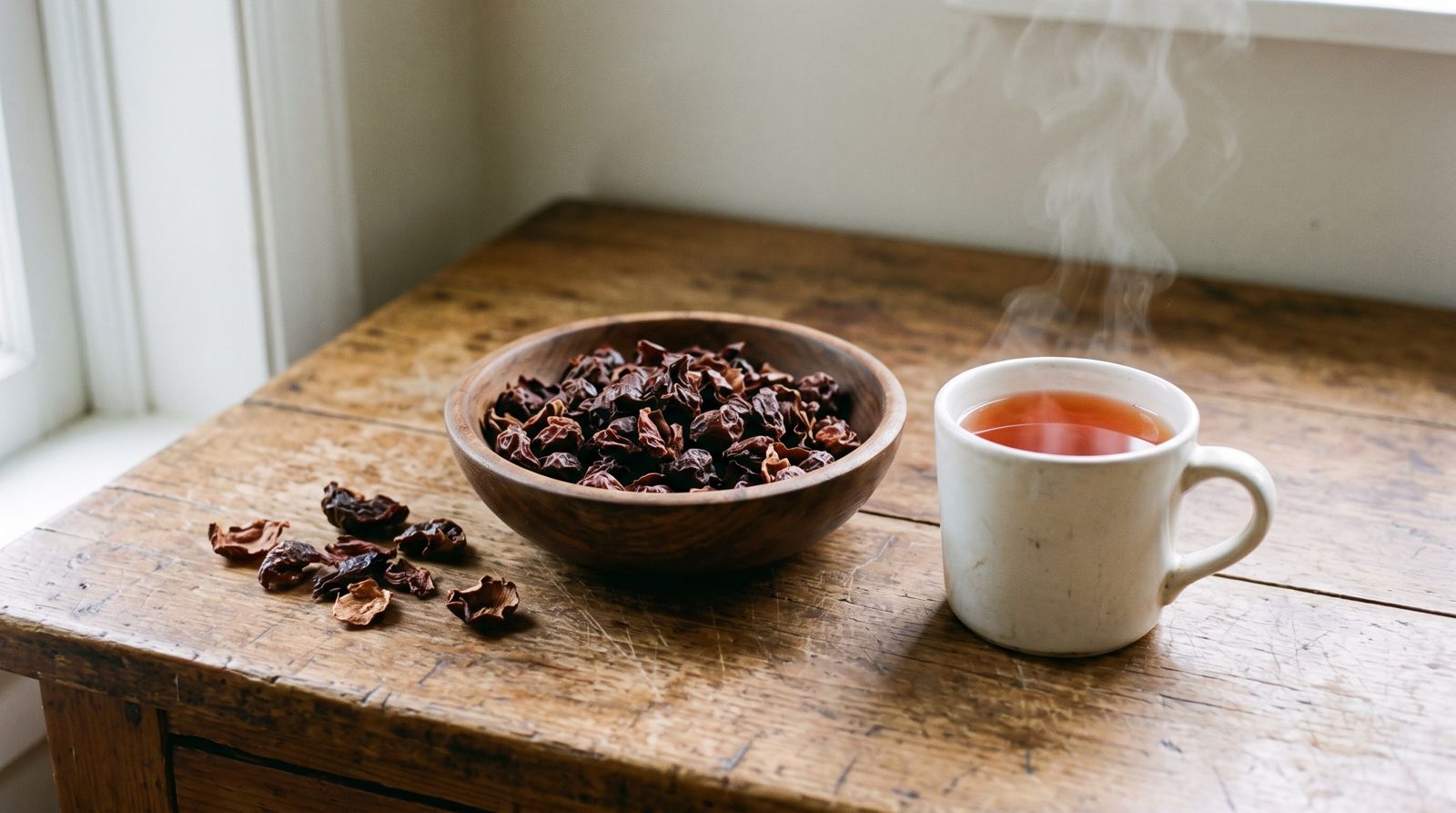
A coffee bean is a seed inside a small red fruit. When producers process the beans, the skin and pulp are removed and have traditionally been treated as waste, sometimes composted. Cascara is that discarded layer, dried. The Roasters Pack, a coffee supplier, describes it as collected after the beans are de-pulped and washed, then dried in the sun or in a dehydrator.
We have not traced its history to a primary source, so we won’t repeat the origin stories you will see online. What we can say is that it is now sold as a tea by specialty roasters, and that the European Union formally set out conditions for its use as a food ingredient in 2022 (more on that below).
The caffeine question
The coffee plant makes caffeine, and some of it ends up in the fruit, so cascara is not caffeine-free. How much is where sources get loose, so here is what we found and how much weight it deserves.
- The reported figures are low. A Tasting Table article says lab tests commissioned by Square Mile Coffee Roasters found cascara infusions peaked at an average of 111.4 milligrams of caffeine per liter, against 400 to 800 milligrams per liter for brewed coffee. We could not open the original Square Mile report, so this is a relayed figure from a roaster-commissioned test, not an independent analysis. A rough conversion, which is our arithmetic and an estimate: 111 milligrams per liter is about 26 milligrams in an 8-ounce cup.
- Other numbers circulate. Some coffee sites quote about 25 milligrams a cup against 80 for coffee, citing “one study” without naming it. We couldn’t find that study, so we’re not leaning on it.
- How much you use matters more than how long you steep. Both write-ups say the amount of husk per cup shifts the caffeine, and steep time has little effect. That is a claim from those sources, not something we measured.
The practical reading: expect noticeably less than coffee and roughly tea-like levels, but don’t treat it as negligible, especially if you drink several cups. For context, the FDA has cited 400 milligrams a day as an amount not generally associated with negative effects for most adults, and sensitivity varies a lot. Our caffeine half-life piece explains why even a small afternoon dose can linger into the evening, and the decaf breakdown shows another “low, not zero” drink.
What it tastes like
Descriptions agree it is fruity and not roasted. Tasting Table lists floral, berry or hibiscus-like sweetness, sometimes with hints of mango or tobacco. The Roasters Pack lists honey and floral notes with prune, raspberry and golden raisin, and says flavor varies by variety, altitude and processing.
We haven’t done a side-by-side tasting for this piece, so we won’t tell you it tastes like anything in particular. What can be said fairly is that if you miss the dark, bitter, toasty side of coffee, cascara will not scratch that itch. Roasted chicory is closer. If you miss having a warm, slightly sweet mug in your hands, it might.
How to brew it
The Roasters Pack gives a French press method: roughly 1 gram of cascara to 25 grams of water, boiled water, four minutes, stir and plunge. That works out to about 10 grams for a 250 milliliter mug. Treat it as a starting point and adjust to taste.
- Measure the husk and put it in a press, teapot or mug with a strainer.
- Pour just-boiled water over it.
- Steep about four minutes, then strain.
- Drink it plain, or over ice for a cold version.
Because it is a tea-style infusion, it is quick and needs no grinder. Our guide to waking up without coffee covers keeping the morning ritual while you change what’s in the mug.
What the EU rules say
Cascara is one of the few ingredients here with a clear regulatory text. According to Commission Implementing Regulation (EU) 2022/47, as reproduced by LawPlayer (we read that copy, not the Official Journal itself):
- Typical infusions are prepared with up to 6 grams of coffee cherry pulp per 100 milliliters of hot water above 75 °C.
- Products above 150 milligrams per liter of caffeine must carry the warning “High caffeine content. Not recommended for children or pregnant or breast-feeding women,” plus the caffeine content per 100 milliliters.
That 150 milligrams per liter line is a labeling threshold, not a measured value for cascara. It is useful because it tells you regulators consider the caffeine question real enough to require a warning above a certain strength. We did not find an equivalent U.S. rule, and we haven’t verified how U.S. products are labeled, so check the package.
Who should look elsewhere
- Anyone who needs zero caffeine, for example if your clinician has advised cutting it out in pregnancy, or caffeine triggers palpitations or anxiety. Rooibos and roasted chicory or grain blends are genuinely caffeine-free.
- Anyone whose clinician has told them to limit caffeine for a medical reason. Count cascara in your daily total.
- People who want a roasted, bitter cup. Cascara is fruit tea, not a coffee stand-in.
We haven’t reviewed any specific cascara brand, and some products blend it with other ingredients, so read the label.
The bottom line
Cascara is the dried husk of the coffee cherry, brewed like a fruity tea. It is lighter in caffeine than coffee by every figure we found, but those figures are thin and partly second-hand, and it is not caffeine-free. Use it as a gentle step down if you’re cutting back, and pick a caffeine-free herbal or chicory option if you need none. More options are in our roundup of caffeine-free coffee alternatives.
This article is educational, not medical advice. If you are pregnant, managing a health condition or taking medication, ask your clinician how much caffeine is right for you.
Sources & further reading
- Commission Implementing Regulation (EU) 2022/47 on coffee cherry pulp (cascara), as reproduced by LawPlayer (opens in a new tab) — European Commission via LawPlayer
- Here's How Much Caffeine Is In Cascara Vs Coffee (opens in a new tab) — Tasting Table
- What Is Cascara? (opens in a new tab) — The Roasters Pack
- Spilling the Beans: How Much Caffeine Is Too Much? (opens in a new tab) — U.S. Food and Drug Administration
Reader conversation (4)
We read every response. Selected reader notes below.
We always called the dried husk by a different name and never thought of it as a drink people would buy. Glad the caffeine point is stated plainly rather than “basically none.”
Thanks, Tomás. The figures we found are thin and partly second-hand, so we kept it to “lower, not zero.”
I tried it cold over ice and it reminded me of a hibiscus tea. Nothing like coffee, but I liked it for afternoons.
Appreciated that you didn’t repeat the “25 mg” number without a source. Every shop page quotes it and none of them say where it’s from.
I’m cutting back during pregnancy and wasn’t sure whether this counted. Good to see it flagged. I’ll check with my OB before trying it.
Have something to add? Email us and we may include it in a future update.