Does coffee cause kidney stones? Large studies point the other way, and decaf looks the same
Several big cohort studies link coffee and caffeine to a lower, not higher, risk of kidney stones, and decaf shows a similar pattern. Here is what the research found, what it can't prove, and why it isn't a reason to start drinking coffee.

If you have ever had a kidney stone, you have probably been told to drink more water, and someone may have told you to cut back on coffee. I wanted to see whether the coffee part rests on anything. I read five papers: two early Harvard cohorts, a three-cohort analysis of caffeine itself, a pooled analysis, and a review. The surprise is the direction. The research I found leans the opposite way from the warning.
The short answer
Large observational studies link higher coffee and caffeine intake to a lower risk of kidney stones, not a higher one. A pooled analysis of seven studies found about a third lower risk in the highest caffeine group compared with the lowest. Decaf looked about as protective as regular in the two Harvard cohorts, which hints that caffeine is not the whole explanation.
That is not a reason to start drinking coffee. These studies can’t show that coffee prevents stones, and they say nothing about what’s right for a person with a stone history. But “coffee causes kidney stones” is not what the evidence shows.
Why people worry
The worry has a plausible root. Caffeine is a mild diuretic, so people assume it dries you out and concentrates your urine. A 2018 review in Advances in Nutrition noted that earlier studies had reported contradictory effects, and that caffeine’s diuretic action might slightly raise a stone risk index. Then it pointed to three large cohorts that suggested a protective role instead. If you want the fluid side of the story, does coffee dehydrate you? goes through it.
The Harvard cohorts: men and women
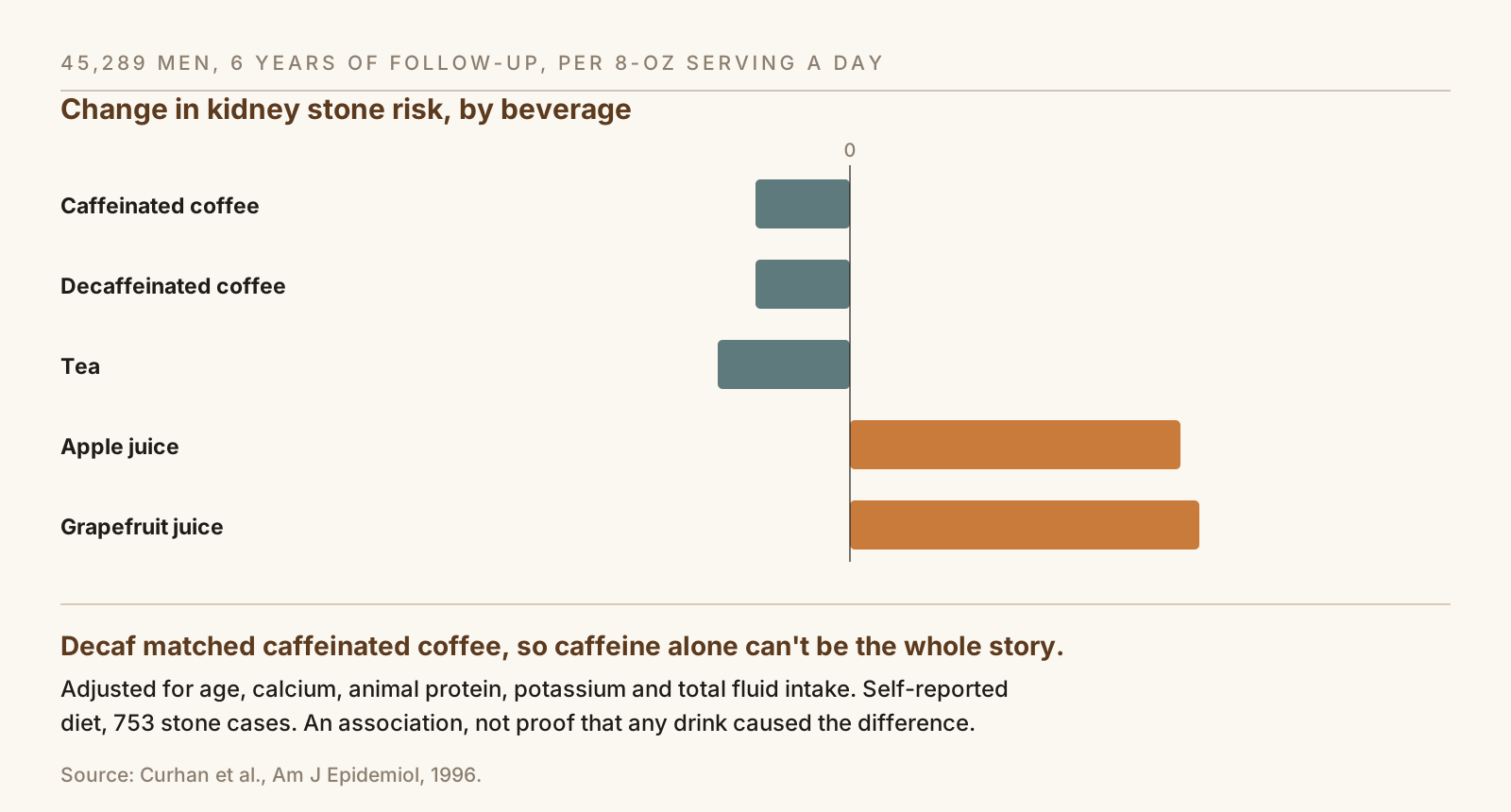
The oldest studies here come from Gary Curhan and colleagues at Harvard. In 1996 they reported on 45,289 men aged 40 to 75 with no history of stones. Diet was assessed with a food-frequency questionnaire, and over six years 753 men developed symptomatic stones. After adjusting for age, calcium, animal protein, potassium, thiazide use, region, profession and total fluid intake, each daily 240 mL (8-ounce) serving of caffeinated coffee was associated with 10% lower risk (95% confidence interval 4% to 15%). Decaffeinated coffee: 10% lower (3% to 16%). Tea: 14% lower (5% to 22%). Apple juice and grapefruit juice went the other way, with 35% and 37% higher risk per serving.
Two years later the same group reported on 81,093 women in the Nurses’ Health Study, aged 40 to 65, followed for eight years with 719 stone cases. Women in the highest fifth of total fluid intake had a relative risk of 0.62 compared with the lowest fifth (95% CI 0.48 to 0.80), so fluid itself matters. On top of that, each daily serving of caffeinated coffee was associated with 10% lower risk (5% to 15%), decaf with 9% lower (2% to 15%), and tea with 8% lower (1% to 15%). Grapefruit juice was linked to a 44% increase. The authors concluded that “the choice of beverage may be meaningful.”
Three cohorts and 217,883 people
In 2014, Pietro Manuel Ferraro and colleagues looked at caffeine directly, rather than coffee, in the Health Professionals Follow-Up Study and both Nurses’ Health Studies. The analysis covered 217,883 participants and 4,982 incident stones over a median follow-up of more than eight years. Comparing the highest fifth of caffeine intake with the lowest, and adjusting for age, BMI, fluid intake and other factors, risk was 26% lower in the men’s cohort, 29% lower in the first women’s cohort and 31% lower in the second (all with trend p-values under 0.001).
They also looked at 24-hour urine collections from 6,033 participants. Higher caffeine intake was associated with higher urine volume, calcium and potassium, and with lower urine oxalate and lower supersaturation for calcium oxalate and uric acid. Supersaturation is a measure of how ready the urine is to form crystals. So the urine data fit the cohort result: more volume, and less crystal-forming pressure.
Pooling the studies
A 2022 systematic review and meta-analysis in International Urology and Nephrology pooled seven studies with 9,707 stone cases among 772,290 people. The pooled relative risk for the highest caffeine category versus the lowest was 0.68 (95% CI 0.61 to 0.75), and the inverse relationship held in every subgroup the authors checked. They reported moderate heterogeneity (I² of 57%), meaning the studies did not all agree on the size of the effect. Their conclusion was careful: higher caffeine intake “may be associated” with lower risk.
Is it the caffeine?
Here the data get interesting. In both Curhan cohorts, decaf tracked closely with regular coffee, and tea, which has less caffeine, did too. If caffeine were the active ingredient, you would expect decaf to look different. It didn’t, in the studies we read.
Ferraro’s group found the caffeine association persisted among men with low or no intake of caffeinated coffee, which points to caffeine from other sources having its own signal. So the honest reading is that nobody has pinned down the mechanism. It could be caffeine, other compounds in coffee and tea, the extra fluid, or something about the kind of person who drinks them. I’d rather say that plainly than pick a favorite. If you are curious how much caffeine remains in decaf, we have a piece on that.
What these studies can’t tell you
- They’re observational. People who drink coffee differ from people who don’t in ways questionnaires can’t fully capture.
- Diet was self-reported. Food-frequency questionnaires are useful at scale and imprecise for any one person.
- The cohorts are health professionals and nurses in the United States. How well the results carry over to other groups isn’t something these papers settle.
- They measure who developed a first stone. Most of the work we read looked at new stones, not recurrence in people who already have a history. The pooled analysis was about incident stones too.
- There are different kinds of stone. The papers we read looked at kidney stones overall. We did not read evidence on how coffee relates to any particular stone type.
If you’ve had a stone, or are cutting back
None of this is medical advice, but a few practical points follow.
- Total fluid is the most consistent finding. The women’s study found the highest fluid group had 38% lower risk than the lowest. Your clinician can tell you how much is right for you.
- Quitting caffeine doesn’t look like a stone-prevention move. Nothing here suggests you should drink coffee for stones either. If you are stopping for sleep, anxiety or another reason, a gradual step-down avoids most of the withdrawal. Our guide to quitting caffeine without the headache lays one out.
- Watch what replaces it. In the Harvard studies, apple and grapefruit juice were the drinks linked to higher risk. Coffee, decaf and tea were not. Our look at herbal coffee versus decaf explains how those options differ on caffeine.
- Herbal coffees are an open question. Caffeine-free blends built on roasted chicory, carob or barley are popular substitutes, but we didn’t find oxalate data for them or any stone research on them. If you are managing stones, check with your clinician or dietitian before making one a daily habit.
- Other body systems have their own caffeine stories. Caffeine and bone health and caffeine and iron absorption are worth a look if you are reading about minerals.
The bottom line
The best available evidence doesn’t back the idea that coffee causes kidney stones. Large cohorts found lower risk with more coffee, decaf and tea, a pooled analysis found about a third lower risk in the highest caffeine group, and the urine data fit. Apple and grapefruit juice were the drinks linked to more stones.
What the evidence can’t do is tell you what to drink. It can’t prove cause, it can’t separate caffeine from the rest of the cup, and it says little about people who already have stones. Fluid intake is the part that keeps coming up, and your own clinician is the right person to put numbers on it.
This article is educational and is not medical advice. Questions about kidney stones, fluids or caffeine in your own situation belong with your doctor or a registered dietitian.
Sources & further reading
- Prospective study of beverage use and the risk of kidney stones (opens in a new tab) — Curhan GC, Willett WC, Rimm EB, Spiegelman D, Stampfer MJ, American Journal of Epidemiology, 1996
- Beverage use and risk for kidney stones in women (opens in a new tab) — Curhan GC, Willett WC, Speizer FE, Stampfer MJ, Annals of Internal Medicine, 1998
- Caffeine intake and the risk of kidney stones (opens in a new tab) — Ferraro PM, Taylor EN, Gambaro G, Curhan GC, American Journal of Clinical Nutrition, 2014
- Caffeine intake and the risk of incident kidney stones: a systematic review and meta-analysis (opens in a new tab) — Zhao J, Huang Y, Yu X, International Urology and Nephrology, 2022
- Caffeine in kidney stone disease: risk or benefit? (opens in a new tab) — Peerapen P, Thongboonkerd V, Advances in Nutrition, 2018
Reader conversation (4)
We read every response. Selected reader notes below.
I’ve had two stones and my urologist’s only beverage advice was “drink more water.” I’d quietly been avoiding coffee out of guilt. Good to know the research doesn’t back that up, though I’ll still ask him directly.
Asking is the right move. The studies describe groups, and your stone type and history matter more than any average here.
The apple juice result surprised me. I’d have guessed juice was the “healthy” swap. Thank you for showing the chart rather than just saying it.
Decaf matching regular coffee is the part I keep rereading. It makes the whole “caffeine is the villain” story feel too simple.
Appreciate the line about herbal coffees being an open question. Most sites would have just waved them through.
We looked and couldn’t find oxalate figures, so we said so. If you’re managing stones, a dietitian can check a specific blend against your plan.
Have something to add? Email us and we may include it in a future update.