Quitting caffeine when your partner still drinks it: two mugs, one counter
You can move your desk, skip the office pot, and turn down the airport coffee. You can't relocate the person who grinds beans three feet from you every morning. Here's the honest version of going caffeine-free next to someone who hasn't — why it's genuinely harder, why trying to recruit them backfires, and the ritual fix that actually worked.

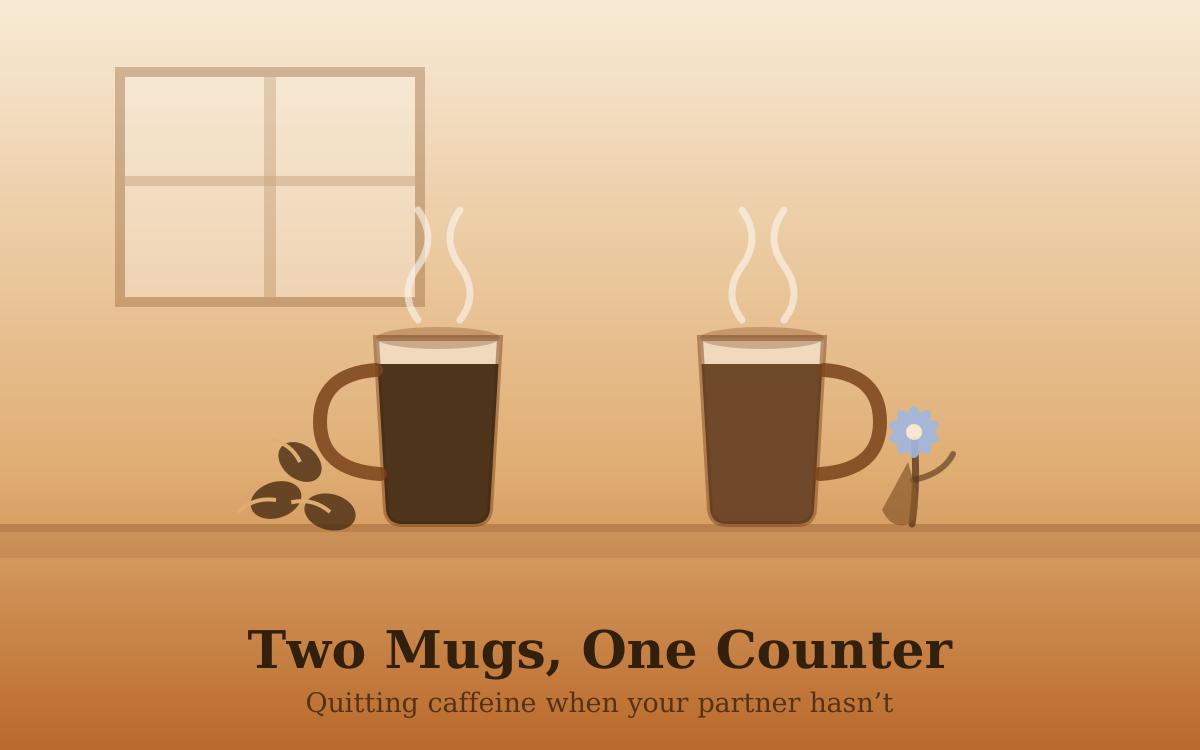
I’ve written about most of the places caffeine ambushes you. The office pot and the 3pm coffee run. The airport at 6am. The kitchen ten feet from your desk when you work from home. The broad social version, where everyone you know drinks coffee and you’ve become the person who has to explain themselves at brunch.
Every one of those has a workaround, and the workarounds all share a shape: you change your relationship to a place. Take a different route. Stand somewhere else. Bring your own.
Then there’s the one I put off writing, because it doesn’t work that way. My wife drinks coffee. She grinds the beans in the kitchen we share, at the hour I’m awake, in the room I have to be in, and there is no version of this where I take a different route. On day 0 of my own quit she was the person I told, and on day 3 she was the one who said take a nap and don’t be a hero — the single most useful sentence anyone said to me that fortnight. She was, and is, entirely on my side. She also still makes coffee every morning, and she should.
So this is the version nobody writes: going caffeine-free next to someone who hasn’t, and would rather not, and shouldn’t have to.
The honest part first: this is the harder version
I want to start where most articles about this won’t, because I think the reassurance you actually need is not this is easy but you’re right that it’s hard.
There’s a well-known study of couples drawn from a long-running English cohort of older adults that looked at what predicts someone changing an unhealthy behavior. The researchers followed thousands of married and cohabiting couples and asked a simple question: if you smoke, or you’re inactive, or you’re carrying extra weight, what makes you more likely to change? The strongest single thing they found wasn’t motivation, or income, or having been told to by a doctor. It was whether the partner changed too (opens in a new tab).
The gaps weren’t subtle. Among smokers whose partner also quit in that window, around half stopped smoking; among smokers whose partner kept smoking, it was closer to one in twelve. Physical activity and weight loss showed the same direction — dramatically better odds when the other person moved at the same time. And notably, having a partner who was already healthy in that respect helped too, just less than having one who changed alongside you.
Two important caveats, because I’d rather you trust the rest of this piece. That research is about smoking, exercise and weight, not caffeine, and caffeine is a much smaller thing than any of them. And it’s observational — it follows people through time rather than assigning them to conditions, so it can show a pattern without proving what causes what. Couples who change together may be different in other ways from couples who don’t.
But the shape of it matches what everyone I’ve compared notes with has said, so I’ll state it plainly: quitting a daily habit next to a person who keeps it is the difficult setting, not the normal one. If your last attempt fell apart in week two and you concluded you were weak-willed, consider the alternative explanation. You were running the harder version of the experiment and grading yourself against people who ran the easier one.
Why the smell is worse for you than for anyone else in the house
Here’s the part I found genuinely vindicating.
When I stopped drinking coffee, the smell of it got louder. Not metaphorically — I could tell from the bedroom whether she’d started the grinder, at a distance where I’d previously have noticed nothing. I assumed this was ordinary deprivation making me dramatic.
It might not be. A study from a group at the University of Portsmouth tested how well people could detect a heavily diluted coffee odor, comparing non-consumers with moderate and heavy caffeine consumers. The habitual consumers detected the coffee odor at lower concentrations and recognized it faster (opens in a new tab) — and the effect scaled with how much they craved caffeine. Crucially, there was no group difference for a control odor that had nothing to do with coffee. It wasn’t that coffee drinkers have better noses. It was specifically that coffee drinkers have better noses for coffee.
It’s a small study and it measures detection, not willpower — nobody has shown that smelling coffee more keenly makes you more likely to break. But as an explanation for lived experience it fits almost too well. Years of pairing that aroma with a reliable pharmacological reward appears to have tuned you to it. Which means that in a two-person household where one of you has quit, the person who has to live with the smell is also, plausibly, the person in the building best equipped to detect it. That’s a rough deal, and it’s worth naming rather than white-knuckling.
The practical upshot is small but real. Don’t hover over the machine during the first minute or two, which is when the aroma peaks. Crack a window or run the fan. And this is the one that mattered most for me: be holding something warm already. Standing empty-handed in a kitchen that smells like coffee is a completely different experience from standing in the same kitchen with a full mug. Same air, different morning.
It does fade. Not to nothing, but from summons to weather. For me that took somewhere in the region of two to three weeks, which lines up with roughly how long the rest of the recalibration takes.
The mistake I made in week one: trying to recruit her
I’d like to say I handled this gracefully. I did not.
Somewhere around day five, feeling righteous and under-slept, I started making a case. Nothing aggressive — I’m not a shouter. Just a steady drip of interesting facts over dinner. Did you know the half-life means your 3pm cup is still working at bedtime? Did you know you can sleep fine and still sleep worse? Every fact was true. Every one was also, transparently, a lobbying effort.
It went about as well as you’d expect, and there’s a body of research that would have predicted it.
Psychologists studying couples use the phrase social control for the ways partners try to steer each other’s health behavior. Three daily-diary studies published in 2020 tracked people for three to four weeks and split those attempts into positive forms — encouragement, praise, doing the thing together — and negative forms — pressure, criticism, guilt, nagging. The split in outcomes was stark. Positive control was associated with the desired behavior on the same day and with better mood. Negative control wasn’t linked to behavior change at all (opens in a new tab) — and it did predict worse mood, plus what the authors call reactance: participants reported doing the opposite of what their partner wanted, and concealing the behavior.
That fits an older and more uncomfortable finding, too. A 1999 study of social control in close relationships found it was associated with somewhat better health practices and with more psychological distress (opens in a new tab) at the same time. Being managed by someone who loves you can work a little and cost a lot.
Read those two together and you get the sentence I wish I’d had on day five: you cannot recruit your way out of the harder version. The evidence says a partner changing alongside you would help enormously. The same evidence says pressure is the one lever that reliably doesn’t produce that, and does produce a worse morning for both of you.
So the trade is straightforward, if unglamorous. Tell them once, warmly, what you’re doing and what would help. Ask for specific things — those are gettable. Then stop. Her coffee is not your project. And honestly, if it had become my project, I’d have converted the one person reliably on my side into an opponent, over a drink she enjoys and has every right to.
You’re not giving up a drink — you’re giving up ten minutes
Once I stopped campaigning, I could finally see what was actually bothering me, and it wasn’t the caffeine.
For years, the first ten minutes of our day happened around a shared object. One brew, two mugs, both of us leaning on the counter in a kitchen with the radio too quiet to really hear. When I quit, I didn’t just subtract a beverage. I subtracted myself from the thing we did.
That first week I’d make tea in the other room, or drink a glass of water and go straight to my laptop, and it registered as loss in a way the caffeine never did. Then she’d come through with her mug and I’d feel — this is embarrassing but it’s true — slightly left out of my own kitchen.
This is the thing I’d most want a stranger in week one to understand. The hard part of quitting next to a coffee drinker isn’t temptation. It’s that the obvious way to avoid temptation is to leave the room, and leaving the room is how you accidentally opt out of something you liked. People report this as a willpower problem because it shows up as breaking. It’s usually a design problem.
Which is good news, because a design problem you can fix without anyone else’s cooperation.
Building the parallel ritual
The rule I ended up with: don’t remove the ritual, duplicate it. Same room, same hour, same counter, same size mug, different contents.
Concretely, that meant the caffeine-free drink had to be something I actively wanted, not a consolation prize. A cup of hot water with lemon is not a ritual; it’s a penance, and it lasted four days. What worked was a genuinely dark, bitter, coffee-shaped brew that took the same amount of effort to make as hers did — because the effort turned out to be part of the pleasure. Grinding, waiting, pouring. If your replacement is instant and hers involves a burr grinder and a scale, you’ll feel the asymmetry every single morning.
For me that meant roasted chicory root brewed properly, and later a chicory latte when I wanted something with more presence. A few things I’d pass on:
- Brew it strong, then stronger. Nearly everyone underdoses caffeine-free grounds on the first attempt, and a thin cup next to a proper coffee is a losing comparison. The strength problem and its fix is the single most common reason people write off the whole category.
- Use the good mug. I’m aware of how this sounds. It mattered more than any other single change. If your drink lives in a chipped one you found at the back, you’ve encoded which of you is having the real morning.
- Brew at the same time, not before or after. The point is standing there together. If you make yours at 6:40 and she makes hers at 7:05, you’ve built two separate rituals and rebuilt the loneliness you were trying to fix.
- Keep a fast fallback. Some mornings there is no time to grind anything. An instant caffeine-free option by the kettle means the ritual survives a bad morning instead of being skipped, and skipped mornings are where quits quietly die.
The two-brewer kitchen, practically
The logistics are less annoying than people expect, largely because a lot of caffeine-free options are ground to brew in ordinary equipment rather than needing their own machine.
If you use a drip machine or a French press, the simplest arrangement is one brewer and two batches, back to back — hers, then a rinse, then yours. That’s an extra three or four minutes and no extra hardware. Which caffeine-free grounds actually hold up in a press or a pour-over is worth knowing before you buy, because the fine, silty ones behave badly in a press regardless of how they taste.
Among the packaged herbal coffee roasts, Teeccino (opens in a new tab) is the one I reach for most in this specific situation, for one unglamorous reason: it’s ground to go straight into a normal drip basket or press, so the shared-brewer routine works without buying anything new or explaining a new gadget to anyone. Honest trade-offs, though — it costs meaningfully more than a bag of loose roasted chicory, several of the blends are barley-based and therefore contain gluten, and the chicory content means the inulin is worth watching if you have a gut that objects to it. Loose chicory or dandelion root is the cheapest way in and brews just as well; Dandy Blend and Pero and the other instant grain powders are the fastest. Any of the three does the job the ritual needs. Buy the one you’ll actually make at 6:40am.
Two small logistics notes that saved arguments in our house. Label your tin, or someone will make a cafetière of chicory for a guest expecting coffee. And decide out loud who cleans what, because doubling the number of morning brews doubles the grounds, and “I quit caffeine” is not a compelling reason for a partner to inherit more washing up.
When they hand you a coffee because they love you
This is the delicate one, and I got it wrong twice before I got it right.
About two weeks in, my wife brought me a coffee in bed. Not as a test. She’d been up first, she was being kind, and her hands did what they’d done a thousand mornings. I said, gently, no thank you — and watched something small and disappointed cross her face, because what she’d handed me wasn’t caffeine. It was I thought about you before I thought about me.
If you decline that a few times in a row, no matter how kindly, it stops landing as a dietary preference and starts landing as a rejection of the gesture. That’s the failure mode to avoid, and it’s much more corrosive than any amount of temptation.
What worked was replacing the gesture instead of refusing it. One short conversation, warm, not a lecture: this is one of my favourite things you do, please keep doing it, here’s the tin, same mug. She now brings me a herbal roast maybe twice a week and it means exactly what the coffee meant. Nothing was lost. The only thing that changed was which container the affection arrived in.
The general principle, which I think holds well beyond caffeine: when someone’s habit of loving you collides with your new habit, redirect it rather than blocking it. Blocking is efficient and it costs you something you’ll miss.
The version where it goes better than quitting alone
I’ll finish on the outcome I didn’t anticipate, which is that a household with two different morning drinks can end up better than a household with one.
Some of it is accountability, though not the kind anyone plans. She knows what I’m doing. Not because I asked her to police it — the research above is clear about how badly that goes — but because a person who watches you make a deliberate drink every morning is a person in front of whom quietly reverting is slightly awkward. That mild, unspoken visibility is the useful part. It’s also roughly what happened to me the first time round: on day 10 she asked what I was on, and being seen doing it well was worth more than any tracking app.
Some of it is that the ritual got better. We used to both drink the same thing without thinking about it. Now there are two brews on the counter, and we both pay slightly more attention to what we’re drinking. She’s fussier about her beans than she used to be. I’m fussier about my grind than I have any right to be. The ten minutes did not shrink; it got more interesting.
And a few couples I’ve heard from end up somewhere I didn’t: the partner drifts, unprompted, toward the caffeine-free cup in the evenings, or on weekends, or on the days they slept badly — not because they were converted but because it was simply there and it was good. That’s the only version of recruitment that seems to work, and you get it by making something worth drinking and then leaving it alone.
If you’re heading the other way and you ever drink coffee again after a long stretch off it, the two-mug kitchen makes that a choice rather than a collapse, which is a much better place to make it from.
The bottom line
Quitting caffeine next to a partner who still drinks it is the hard mode of a fairly easy game. The evidence on couples says a partner changing with you is a real tailwind, and you don’t have one. Believe that, stop grading yourself against people who had it, and then stop trying to acquire it — because the pressure that would take is the one approach the research says doesn’t work and does damage.
What’s left is entirely yours to build. Same counter, same hour, same good mug, a drink strong enough to stand next to theirs. You are not subtracting coffee from your morning. You are keeping the whole morning and changing what’s in one of the cups.
Somewhere in week three, you’ll be leaning on the counter next to someone drinking a thing you no longer drink, and you’ll notice that you’re not counting anything. That’s the whole goal. Not resisting the coffee — genuinely not being in the market for it, in the room where it’s being made, next to the person you like most.
If you’re still working out where to start on the drink itself, our rundown of caffeine-free options is the practical next stop, and the taper approach is worth reading before you stop rather than after.
This is a personal account, not medical advice. If you’re pregnant or breastfeeding, take medication that interacts with caffeine, or have a heart, anxiety or sleep condition, talk to a clinician about the right approach to changing your caffeine intake — and note that some caffeine-free options carry their own considerations, including gluten in barley-based blends and inulin in chicory.
Sources & further reading
- The influence of partner's behavior on health behavior change: the English Longitudinal Study of Ageing (opens in a new tab) — Jackson, Steptoe & Wardle, JAMA Internal Medicine (2015)
- How do people experience and respond to social control from their partner? Three daily diary studies (opens in a new tab) — Scholz et al., Frontiers in Psychology (2020)
- Social control in personal relationships: impact on health behaviors and psychological distress (opens in a new tab) — Lewis & Rook, Health Psychology (1999)
- Higher olfactory sensitivity to coffee odour in habitual caffeine users (opens in a new tab) — Stafford et al., Experimental and Clinical Psychopharmacology (2019)
Reader conversation (6)
We read every response. Selected reader notes below.
I need to confess to the exact thing in your week-one section. I quit in February and spent about a month sending my husband articles. Not angry, just relentless. What actually happened is that he stopped making coffee at home and started buying it on the way to work, so I “won” the kitchen and lost the mornings, and he never once said he was avoiding the conversation. Reading that people hide the behaviour and do the opposite on purpose was uncomfortable because that is precisely what he did and I forced it.
Thank you for writing this down, because it’s the version of the story I only half-lived. I stopped campaigning before it got that far and mostly through luck. The detail that stands out is that he never told you — the concealment is the part that makes it hard to notice you’ve caused it, since from the inside it just looks like the coffee went away. Worth knowing it seems to be reversible: most people I’ve heard from who backed off got the shared morning back within a few weeks.
The smell section is the most useful paragraph I’ve read on this site and I’ve read a lot of them. I have been quietly convinced for two months that I was losing my mind. I can tell from the top of the stairs whether my wife has ground beans or just reheated yesterday’s, and when I mentioned it she looked at me like I’d claimed to hear colours — she genuinely cannot smell it from up there. Knowing there’s a study where the coffee drinkers were sharper only for coffee and not for other smells reframes the whole thing from “I’m obsessing” to “I’m calibrated”.
Calibrated is a better word than the one I used. Do hold it loosely — it’s one fairly small study measuring detection thresholds, and nobody has shown that smelling it more keenly makes anyone more likely to break. But it lines up with so many people’s experience that I think the honest position is: you’re not imagining the volume. And it does drop back. Mine went from an announcement to just what the kitchen smells like somewhere in week three.
Gentle pushback on the parallel ritual, because it failed for me the way you’ve written it. In the first fortnight, standing at the counter with my own brew next to my wife’s coffee was not neutral — it was a side-by-side comparison I lost every morning, and I caved twice. What worked was the opposite of your advice for about three weeks: I took my drink out to the back step and stayed out of the kitchen entirely until the wanting had gone quiet. Then I came back in and the two-mug thing worked exactly as you describe. So maybe the sequencing matters more than the design.
This is the most valuable comment on the page and I think you’re right that I’ve underweighted the sequencing. My own first fortnight was during a stretch when I barely registered anything, so I don’t have the direct comparison you do — and “duplicate the ritual” as a day-one instruction assumes a level of steadiness that a lot of people simply don’t have in week one. Temporary retreat, then re-entry, is a sounder order of operations. The bit I’d keep either way is that the retreat has to be explicitly temporary, because the failure mode is quietly never coming back into the kitchen.
I laughed at “use the good mug” and then sat there feeling seen. I’d been drinking chicory out of a lidded travel cup because I didn’t want to add to the washing up, while my partner had the big ceramic one from our wedding. Swapped to a proper mug this week and the difference in how the morning feels is out of all proportion to the change. I was treating my own drink like a compromise and it turns out the crockery was telling me so every day.
The section on gestures landed hard. My partner used to bring me a coffee before I was properly awake and I spent a month declining it politely and could not work out why we both felt slightly off afterwards. We had the conversation you describe about a fortnight ago and now he brings me the roasted dandelion instead, same cup, same time, and it’s completely fine. Nothing about the morning changed except what was in it. I’d add one thing for anyone reading: have the conversation early, because I let three or four small refusals stack up first and I think they cost more than one honest chat would have.
“Nothing about the morning changed except what was in it” — that’s the whole piece in one line, and I wish I’d had it. And your addition is right: the refusals accumulate. A single warm conversation reads as information, and four polite noes read as a pattern, even though the second one is technically gentler each time.
Practical note from six months into the one-press-two-batches arrangement: it takes about four extra minutes and no extra hardware, exactly as you say, and the labelling tip is not a joke. I served a visiting relative a very confident cafetière of roasted barley last winter and he was too polite to say anything until half of it was gone. Big handwritten label on the tin ever since. Also worth agreeing who does the grounds — we split it and it stopped being a thing.
Have something to add? Email us and we may include it in a future update.