How to walk back into a coffee shop: the four-minute version, for people who've been waiting outside
A coffee shop is the worst-designed room in the world for someone avoiding coffee — the smell is industrial-strength, you have to speak to a stranger while you're standing in it, and the menu is organised around the one thing you don't want. So stop treating it as a test of nerve and treat it as a procedure. Here's the one I'd use.

Five days ago I published a piece arguing that avoiding coffee is the right move early and the wrong move forever, and that the failure mode nobody counts is ending up with a permanently coffee-shaped hole in your life.
A reader named Fenella J., in Norwich, wrote in to say she is that hole.
Six years off caffeine, and she waits on the pavement
Six years caffeine-free. Entirely successful by any measure you’d put in a magazine. And she has not been inside a coffee shop since 2020 — she waits outside while her daughter orders, and they both pretend this is normal.
She’d always filed it as a preference. Her sentence about reading the article was that it was “unpleasant in the way that accurate things are.”
I’ve been thinking about it since, because it exposes something thin in what I wrote. That piece established why re-entry matters and gave you a test for whether you’re ready. Then it handed you the single hardest venue in four words — “a café, ordering something you actually want” — and moved on. That’s not advice. That’s a to-do item with the difficulty removed by not describing it.
So this is the missing half. Not a pep talk. A procedure.
A café is the worst-designed room for this
Before the procedure, the thing I wish someone had said to me plainly: it is not soft of you to find this hard. A coffee shop is genuinely the most hostile room on the list, and it’s worth being precise about why, because each reason has a countermeasure.
The cue is industrial-strength. Your kitchen smells of coffee for about four minutes a morning. A café is a room in which the smell is the product, pumped out continuously and deliberately. Nothing in the home or office versions of this problem is at that concentration.
You have to speak while you’re inside it. Every other venue lets you be a bystander. In an airport you can walk past. At a friend’s brunch the drinks arrive without you doing much. In a café you have to stand at a counter, in the smell, and perform a transaction while a stranger waits. That’s a small amount of pressure applied at exactly the worst moment.
The menu is organised around the one thing you don’t want. Nine-tenths of the board is coffee, sorted by coffee. Your options are in the corner, in small type, usually described badly.
And you don’t get to leave halfway through. Once you’ve ordered you’re committed to a few minutes of standing there. That’s not a big deal. It is a known not-a-big-deal that feels like a big one from the pavement.
Notice that three of those four are solved before you go in. That’s the whole design of what follows.
This isn’t a diagnosis, and I’m not treating one
I want to be careful here, because there’s an obvious and slightly tempting frame for this article and I don’t think it’s the honest one.
The clinical literature on avoidance is enormous, and it’s genuinely interesting. The best-known modern account, from Craske and colleagues (opens in a new tab), argues that what makes practice stick is not getting calmer — it’s the expectation being violated, plus doing it in more than one place, plus dropping the little props you’d been leaning on. That maps onto this problem so neatly it’s almost annoying.
But that work is about anxiety disorders, and not going into cafés is not one. Fenella isn’t a patient. She’s a person who found a workaround six years ago and never revisited it, which is an extremely ordinary thing for a human to do. Borrowing the shape of that research is fair. Borrowing its vocabulary and pointing it at a reader would be dressing a lifestyle piece up as treatment, and I’d be doing it to make my advice sound better sourced than it is.
The one piece I’ll take, because we’ve already leaned on it and it earns its place: laboratory research on context and relapse (opens in a new tab) describes learning that is tied to the room it happened in. Being fine at home does not automatically transfer to the café. That’s not a flaw in you. It’s the reason the café needs its own go, separately, on purpose.
And the ordinary caveat: if avoiding a place is genuinely distressing, or the list of places has been quietly growing, that’s worth raising with a professional rather than with a website about chicory.
Pick the shop before you pick the day
Most people default to the nearest café, or the one they used to go to. Both are bad picks. The nearest one is a coin flip on whether it can serve you anything, and the old one carries the most cues.
Choose on three criteria:
- A real non-coffee menu. Somewhere with an actual tea list, or that visibly makes hot chocolate and steamers, not a specialist coffee bar with three herbal sachets behind the till.
- A quiet hour. Mid-afternoon on a weekday. The 8am rush is a queue, a crowd, and a barista with no time — three difficulties stacked onto one.
- Somewhere to stand that isn’t the counter. A window seat, a shelf, anywhere you can be for four minutes without being in the way.
You can settle all three from your phone before you leave the house. That’s not avoidance; that’s not making the errand harder than it has to be.
What to actually order, and the two traps
Here’s the honest news first, because everything else in this section depends on it: a café almost certainly cannot give you a coffee-shaped drink without coffee in it. Roasted chicory, barley and dandelion blends — the things that actually taste like a dark cup — are a home format. They’re in our roundups because you brew them in your own kitchen. Almost no café stocks them.
So walk in knowing you’re ordering something different, not a substitute. People who go in expecting a near-miss of coffee tend to come out disappointed and file the whole trip as a failure, which it wasn’t.
The two genuinely zero orders, available nearly everywhere:
- An herbal infusion — mint, chamomile, rooibos, fruit. Caffeine-free because the plant never made any.
- A steamed milk with a flavour syrup. Chains sell these as “steamers” or crème drinks; most independents will do it if you ask. It’s sweet, and it’s warm, and it’s zero.
And the two traps, which catch people constantly:
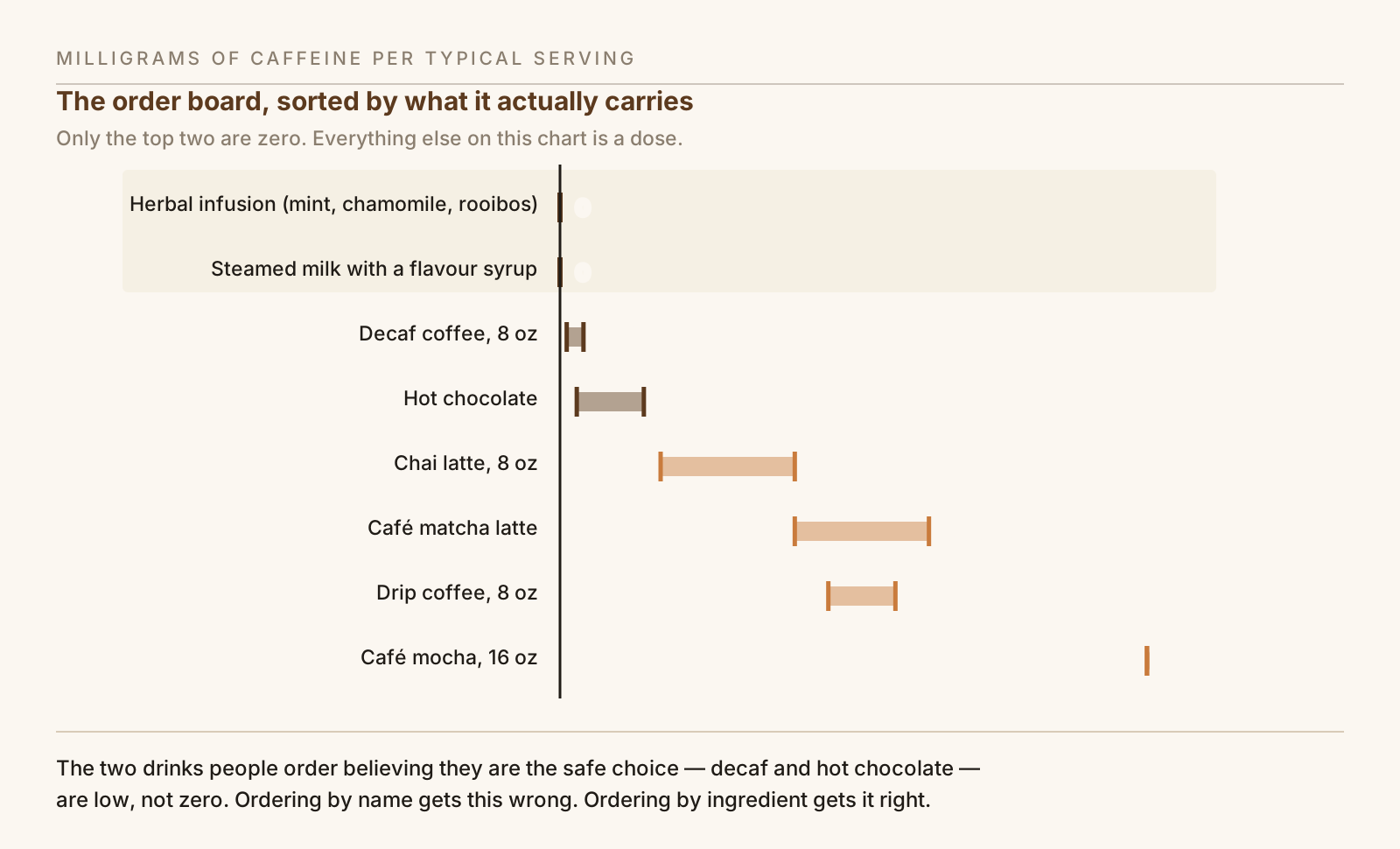
Trap one: decaf is not caffeine-free. A cup of decaf typically runs a few milligrams, and we’ve gone through the numbers properly. For most purposes that’s a rounding error. If you need a true zero, it isn’t one, and “decaf” and “caffeine-free” are two different words behind the counter.
Trap two: half the “not coffee” menu has caffeine in it. A chai latte is built on black tea. A café matcha is often stronger than a small drip coffee, because shops use more powder than you would at home. And hot chocolate carries a real if small dose from the cocoa — our chocolate piece puts a typical cup around 5 to 10 mg and a rich one closer to 25.
| What you order | Caffeine, typical serving | Where our figure comes from |
|---|---|---|
| Herbal infusion (mint, chamomile, rooibos) | 0 | the plant never made any |
| Steamed milk with a flavour syrup | 0 | no caffeine-bearing ingredient |
| Decaf coffee, 8 oz | 2–7 mg | our decaf piece |
| Hot chocolate | 5–25 mg | our chocolate piece |
| Chai latte, 8 oz | 30–70 mg | our chai piece (black tea base) |
| Café matcha latte | 70–110 mg | our matcha piece (2–4 g dose) |
| Drip coffee, 8 oz | 80–100 mg | our matcha piece |
| Café mocha, 16 oz | ≈175 mg | our chocolate piece |
One more that sounds like it should be safe and isn’t: “coffee and chicory” on a menu is coffee. The famous New Orleans version is, in the seller’s own words, “a rich blend of dark roasted coffee and chicory” (opens in a new tab) — chicory is in there to stretch and soften the coffee, not to replace it. If you’ve read anything of ours about chicory and got excited seeing it on a board, that’s the disappointment I’d rather you had here than at the counter.
Decide which one you’re getting before you leave the house. This is the single highest-value instruction in the article. Reading a menu board while standing in the smell, with someone waiting, is the hardest ninety seconds of the trip, and it is entirely optional.
The four-minute floor
Set a floor, not a goal.
“Stay as long as you can” is an endurance test with no defined end, and it has a nasty property: the better you do, the longer you have to keep doing it, and the visit always ends at the moment it got difficult. That’s the last thing you want to be the memory.
Four minutes. Long enough that you ordered, were served, stood there like a person, and left under your own steam. Short enough that you can’t fail it.
Then leave while it’s still easy. Not when you’ve proved something. This is the opposite of how most people approach it, and it’s the reason I’d bet on a second visit happening.
If you want a version that’s smaller still: go in with someone, order, and take it outside. You have been inside a coffee shop. That counts, and there is no committee.
How to answer “just water for you?”
The bit nobody plans for, and the bit that stops people going back.
You don’t owe anyone an explanation. “Just a mint tea, thanks” is a complete sentence, delivered at normal volume, and roughly nobody follows it up.
If you want something in your pocket for the people you’re with — who are far more likely than the staff to ask — the version I’ve landed on after a couple of years of this is: “caffeine and I stopped getting along.” It’s true, it’s short, it explains nothing, and it doesn’t invite a debate about whether you’re being extreme. Announcing a health project invites opinions. Reporting a mild personal incompatibility does not. We went through the social mechanics of this at more length last month.
The one moment worth being fussy: if you need a genuine zero for a medical reason, say “caffeine-free, not decaf” out loud. Those are two different things behind the counter, and this is not the moment to be polite about the distinction.
Go with someone whose order isn’t your business
Take a person, and take the right one.
The right one is someone with their own reason to be there — a daughter who wants a coffee, a friend meeting you between things. Their order gives the visit a purpose that isn’t you, and it gives you something ordinary to do with your attention while you’re standing in the smell.
The wrong one is someone who has come along for you. That turns four minutes into a supervised attempt, with an audience watching to see how you’re doing. If you’ve been running a two-mugs-one-counter arrangement at home with a partner who still drinks coffee, they may well be the wrong person for this specific trip, purely because they know what it costs you.
Fenella’s daughter, as it happens, is exactly right. She was already going in.
The bottom line
- Decide the order at home. Reading the board in the room is the hardest part and it’s optional.
- Pick the shop for its non-coffee menu and a quiet hour, not for being nearest or familiar.
- Order by ingredient, not by name. The two true zeroes are an herbal infusion and a steamed milk. Decaf, hot chocolate, chai and matcha all carry a dose.
- Four minutes is the floor, and leaving early is the plan, not a retreat.
- Take someone who was going anyway.
None of this is about proving you’re over it. It’s about a building going back on the list of places you can walk into, which is a smaller and better goal than it sounds. Six years is six years; nobody is in danger. But a life with a room removed is still a life with a room removed, and the last two steps are much shorter than the walk that got you to the door.
Fenella — no obligation, and no timetable. But if you ever do it, I’d genuinely like to know how the four minutes went.
Sources & further reading
- Context-induced relapse after extinction versus punishment: similarities and differences (opens in a new tab) — Marchant et al., Psychopharmacology (2019)
- Maximizing exposure therapy: an inhibitory learning approach (opens in a new tab) — Craske, Treanor, Conway, Zbozinek & Vervliet, Behaviour Research and Therapy (2014)
- Coffee and Chicory (product page) (opens in a new tab) — Café du Monde
Reader conversation (5)
We read every response. Selected reader notes below.
I did not expect to open the site and find a whole article pointed at me, and I am still deciding how I feel about it. Mostly grateful. One objection, offered in the spirit it’s meant: the four-minute floor assumes I can order, and ordering is the part I can’t picture. Standing there for four minutes I could do tomorrow. It’s the twenty seconds at the counter that I have been avoiding for six years, and your fix for that — decide at home — helps more than you probably realise, because it turns out what I’ve actually been dreading is being asked a question I don’t have an answer ready for. I haven’t gone. I’ve picked the shop.
Picking the shop is further than most of this article’s readers will get, and I’d count it. You’ve also put your finger on something I got slightly wrong in the emphasis: I framed “decide the order at home” as a way to skip a hard ninety seconds of reading a board, when for you it’s doing something else entirely — removing an unanswered question. Those are different problems with the same fix, and yours is the more common one. No timetable from me. But the shop’s picked, which means the next bit is a Tuesday afternoon rather than a decision.
Your line that a café almost certainly cannot give you a coffee-shaped drink without coffee is true where you are and simply not true here. Caffè d’orzo is on the board in every bar in this city — you order it exactly like a normal coffee, it comes in the same small cup, and nobody blinks or asks you why. My mother has drunk it in bars for thirty years. I mention it not to be pedantic but because the article’s hardest moment, standing at a counter with nothing to order, is a local problem rather than a universal one, and it might be worth an Italian reader knowing the room is on their side.
You’re right and I overstated it. I wrote a sentence about cafés and meant a sentence about British and American cafés, which is exactly the kind of thing that’s invisible from inside one. Barley coffee being an ordinary bar order rather than a special request changes the whole shape of this piece for an Italian reader — there’s no gap in the menu to work around, so most of my procedure is unnecessary and only the walking-in part is left. We’ve written about orzo as a drink; we haven’t written about it as a thing you can simply order, and on this evidence that’s the more useful article.
Six years behind a counter, so let me confirm the bit people won’t believe. Nobody is judging your order. On a normal shift I am thinking about the queue, the milk, and whether the grinder needs adjusting, and your mint tea is genuinely the easiest thing anyone has asked me for all morning. The one place you’re right to be firm is decaf versus caffeine-free — I have watched colleagues use those words interchangeably, and if it matters medically you should say the words “no caffeine at all” rather than trusting the menu category. Also: ask for the steamer unsweetened or half-syrup. The standard build is very sweet and most people would prefer it isn’t.
The unsweetened steamer is a better tip than anything in my own section and I wish I’d had it before publishing — I described the drink as sweet and left it there, when “ask for half the syrup” fixes the objection entirely. And thank you for confirming the decaf thing from the other side of the counter. I wrote that paragraph slightly worried I was being precious about a distinction nobody makes in practice. Apparently the problem is that nobody makes it in practice.
Thirty-one weeks pregnant and this table is the first one I’ve seen that puts the chai latte and the matcha where they actually belong. I had been ordering chai for about two months on the assumption that “not coffee” meant “fine,” and nobody in my life corrected me because nobody in my life knew either. It’s not a disaster at my numbers, but I’d rather have been counting it than not.
The four-minute floor is the part I’ll steal, and not for coffee shops. I’ve been out of gyms for two years for reasons that have nothing to do with caffeine, and “set a floor and leave while it’s still easy” is the first framing of re-entry I’ve read that doesn’t secretly grade me on how long I lasted. Slightly odd to get that from an article about herbal tea, but I’ll take it where I find it.
Have something to add? Email us and we may include it in a future update.