Ordering caffeine-free abroad: the countries where it's already on the menu
A reader in Turin corrected a line I wrote about cafés: 'a coffee-shaped drink without coffee in it' is not universal, it's local. Here's the honest map — where a caffeine-free roast is a normal menu order, where it's poured before you even ask, and where the tradition is real but stays in the grocery aisle.

Five weeks ago I wrote a sentence I was confident about: “a café almost certainly cannot give you a coffee-shaped drink without coffee in it.” A reader in Turin read it, and took it apart in one paragraph.
The claim I got wrong
Giulia Ferrero left a comment on the piece about walking back into a coffee shop that I’ve been turning over since. Her version: “Your line that a café almost certainly cannot give you a coffee-shaped drink without coffee is true where you are and simply not true here. Caffè d’orzo is on the board in every bar in this city — you order it exactly like a normal coffee, it comes in the same small cup, and nobody blinks or asks you why. My mother has drunk it in bars for thirty years.”
She’s right, and I overstated it in the exact way people who’ve only ever ordered coffee in Britain or the US tend to. I wrote a sentence about “a café” and meant “a café where I’ve stood at the counter” — which turns out to be a much smaller category than the sentence implied. Barley coffee being an ordinary bar order rather than a special request doesn’t tweak my original piece. It removes the entire problem it was solving, for an Italian reader.
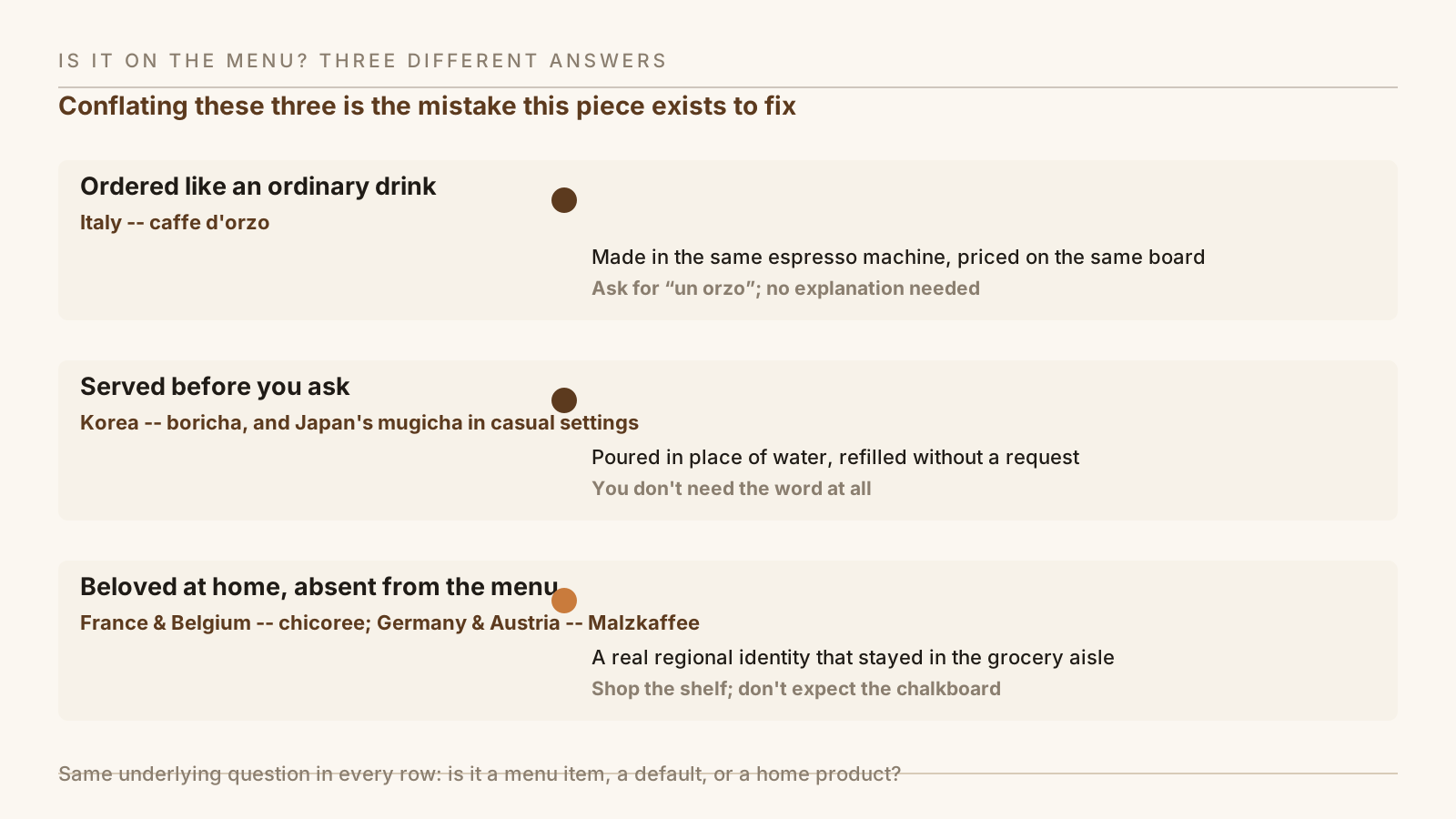
That’s worth fixing properly rather than patching with a footnote, because the real question underneath — where in the world can you order something coffee-shaped and caffeine-free without a special request — has an honest, mappable answer, and it’s more interesting than “it depends.” Some countries have a genuine on-menu order. Some go a step further and just hand it to you before you ask. And some have a deep, beloved caffeine-free-roast tradition that, for reasons worth being straight about, never made it onto a café’s drink board at all. Conflating those three is the same mistake I made the first time, just spread across more countries — so this piece keeps them separate on purpose.
Italy: order it exactly like a coffee, because it is one
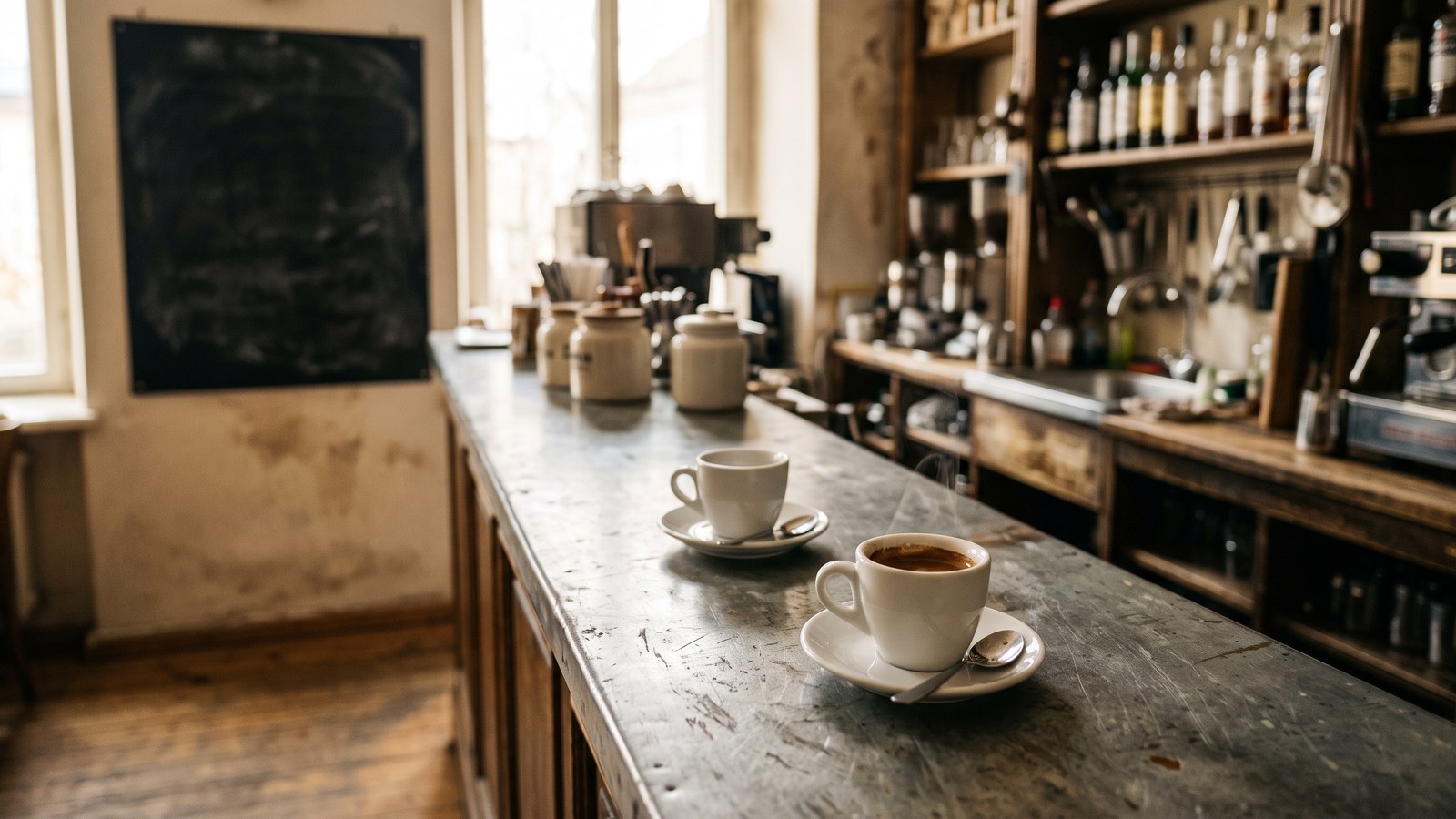
Start with the correction itself. Caffè d’orzo — the roasted-barley brew Maya wrote about back in June — isn’t a home-kitchen curiosity that happens to also exist somewhere. Wikipedia’s entry on it states plainly that in Italy it’s “made in traditional Italian espresso machines in cafes,” and that’s the detail that actually matters: it goes through the same machine, behind the same counter, as everything else on the board. It isn’t a workaround. It’s a menu item.
Ordering it is unremarkable in exactly the way Giulia described. You ask for un orzo, say small or large if the bar wants to know, and it arrives the way an espresso would — no explanation, no raised eyebrow, no gap in the menu you have to talk your way around. That’s the entire difference between Italy and the counter I was standing at when I wrote the original piece: there, “not coffee” means “explain yourself.” In an Italian bar, it means “order like everyone else.” Dozens of Italian roasters make it, Saveur reported in its own reporting on the tradition (opens in a new tab), and it’s a popular order on its own terms, not a museum piece kept alive for tourists.
Korea and Japan: you don’t even have to ask
If Italy is “on the menu,” Korea goes a full step further. Boricha — roasted barley tea — is routinely poured before you’ve said a word. Cha2go’s guide to the drink puts it plainly: at restaurants it’s served in place of water, with free, unlimited refills (opens in a new tab), the same way a server elsewhere might set down a glass of ice water without being asked. You don’t order boricha. You simply have it, the way you’d have water you never requested either.
Japan’s mugicha — the lighter-roast, cold-brewed cousin Maya covered in July — runs a close but slightly softer version of the same custom. Just One Cookbook describes it (opens in a new tab) as “a homey drink that you won’t find served at high-end restaurants but at ramen shops and casual eateries,” and in most households it simply lives in a pitcher in the fridge all summer, poured before anyone asks for anything. I want to be precise about the strength of this one: I can point you to a source that states flatly that Korean restaurants treat boricha as the default water substitute. I can’t point you to an equally direct source making the identical claim for every Japanese restaurant — only that it’s the norm in casual dining and near-universal at home. So take Korea as the clean case and Japan as its close, slightly less absolute cousin, and don’t assume either guarantees it at a formal dining room.
Either way, this is a genuinely different mechanism from Italy’s, and it’s worth knowing before you land: you may not need the vocabulary at all. The traveler who knows this recognizes what’s already in front of them at a Seoul barbecue table instead of pushing it aside to flag someone down for water.
France and Germany: real, beloved, and not on the menu
Here’s the part of this piece I almost didn’t write, because it isn’t a third win, and I went in expecting one.
Chicorée has arguably the strongest regional identity of anything in this article. The French Wikipedia entry on industrial chicory says plainly that the drink, “in beverage form combined or not with coffee, remains very popular in Belgium, as well as in Nord-Pas-de-Calais, to the point of being one of the symbols of this region.” If any country outside Italy was going to have a standing café order, this looked like the favorite going in — a beloved regional drink with a hundred-plus years of local identity behind it.
It doesn’t have one, as far as I can establish. I went looking for a café or brasserie menu anywhere in northern France that lists chicorée as an actual drink you can order at the counter, and I came up empty. What exists instead is chicorée soluble on the grocery shelf — the same Wikipedia entry describes it as something people “prepare rapidly and enjoy throughout the day,” which is the language of a home product, not a service item. Even Brasserie La Chicorée in Lille, the most obvious search result for the word, is named for the region’s most famous crop rather than for anything on its actual drink list, which runs to beer, wine, and cider like any other regional brasserie.
Germany and Austria’s Malzkaffee — the Kathreiner’s tradition we’ve covered before — followed the identical path. It’s a genuine, generations-old household drink, and today it “turns up regularly in the international aisle,” not on a modern café’s chalkboard.
I don’t think this makes the French or German tradition less real, and I’d be careful reading it that way — a hundred and thirty years of a product surviving in the grocery aisle is its own kind of staying power. It just means the honest answer to “where is this on the menu” and “where do people actually drink this” are two different maps, and this article is specifically about the first one. If you want the home version in either country, you’re shopping an aisle, not scanning a board.
The map, in one table
Three tiers, and the whole point of separating them is that the fix for a traveler is different in each one.
What this actually changes about packing a plan
The practical upshot isn’t “relax, it’s fine everywhere.” It’s narrower and more useful than that: know which of the three tiers you’re flying into, and plan accordingly.
- Landing in Italy? You don’t need a backup plan for the morning cup. Learn one word — orzo — and the whole trip’s caffeine-free mornings are solved at any bar you walk into.
- Landing in Korea, or eating casually in Japan? Relax about needing the word at all. Pay attention instead, because what’s poured in front of you by default may already be exactly what you’d have ordered if you’d known to ask.
- Landing in France, Belgium, Germany, or Austria? Don’t expect the café to solve this one. If you want the home version, a grocery store or a supermarket’s international aisle is the move, the same way our own grocery-store roundup points US readers to that aisle for the reverse trip.
- Landing anywhere else, or just not sure? This is where what actually packs for travel does the real work — a tea-bag herbal coffee or a single-serve instant sachet turns any hot-water station into your order, regardless of what the local board offers. A menu tradition is a nice bonus. It was never the plan you should be relying on everywhere.
None of this replaces the honest baseline from the original café piece: an herbal infusion and a steamed milk with syrup are near-universal safe orders almost anywhere on Earth, café tradition or not. What this article adds is the shorter, better version available in a specific handful of places — and the honesty to say which places those actually are, rather than assuming my counter is every counter.
The bottom line
A café’s caffeine-free menu isn’t one universal answer — it’s a local one, and this article is the map I should have included the first time. In Italy, caffè d’orzo is an ordinary bar order, made in the same machine and priced on the same board as an espresso. In Korea, and often in casual Japanese dining, roasted barley tea is poured before you ask, standing in for water rather than needing a request. In France, Belgium, Germany, and Austria, the caffeine-free tradition is just as real, but it stayed home — in the grocery aisle, not on the chalkboard. Knowing which tier you’re flying into is worth more than any single phrase you could memorize.
Giulia — thank you for the correction, and for the thirty years of your mother’s bar orders that backed it up. If any other reader can confirm or correct one of these three tiers from the actual counter, the comments are exactly where that belongs.
Sources & further reading
- Caffè d'orzo (opens in a new tab) — Wikipedia
- Barley Coffee: It's Just as Good as it Sounds (opens in a new tab) — Saveur
- Korean Barley Tea (Boricha): Complete Guide, Benefits & Where to Buy (opens in a new tab) — Cha2go
- Mugicha (Japanese Barley Tea) (opens in a new tab) — Just One Cookbook
- Chicorée industrielle (opens in a new tab) — Wikipédia
Reader conversation (5)
We read every response. Selected reader notes below.
I did not expect a comment on a different article entirely to turn into this. For the record, my mother orders hers “grande e ben caldo” — large and properly hot — which apparently marks her as someone who takes it more seriously than the average customer. I asked her tonight if she’s ever had to explain the order to a barista and she looked at me like I’d asked something absurd. That’s the whole point of your piece, I think: the absence of that look is the entire difference.
“Grande e ben caldo” is going straight into my own vocabulary for the next trip. And your mother’s reaction is a better proof of the claim than anything I could have written — the absurdity of the question is the finding.
Can confirm from the inside: I genuinely had to think for a second when you asked whether boricha is “ordered.” It isn’t, in the sense you mean. It just arrives, the same as the metal chopsticks and the little side dishes. I didn’t know until reading this that this was unusual anywhere, which I suppose is exactly your point about the traveler who doesn’t need the vocabulary.
Your hedge on Japan is the right one to make. Growing up it was absolutely the default at my grandmother’s house and at the udon place near our old apartment, but I’ve eaten at plenty of newer, nicer restaurants in Osaka where you get a menu of teas and pay for them like any other drink. So “casual and homey, not universal” matches my experience much better than a blanket claim would have.
Nord local here, and this is exactly right, though it stung a little to see it stated so plainly. My grandfather drank chicorée every morning of his life and I have never once, not one time, seen it on a café menu here — you’re right that it’s a cupboard item, not an order. I’d never actually noticed the gap between how proud we are of it regionally and how invisible it is the moment you sit down somewhere.
Curious whether you looked at Turkey and the wider region at all — a lot of restaurants here will bring çay (black tea, so not what you’re after) automatically after a meal without being asked, and I know herbal options like sage or linden tea have a similar “of course, here you go” status in some places. Not sure if any of it is caffeine-free by the same standard your other two tiers use, but it felt like a gap in an otherwise thorough list.
Fair flag, and I’d rather say that plainly than guess at it here: Turkey, the Balkans and North Africa didn’t make this piece because I hadn’t verified any of it the way I verified Italy, Korea and Japan, and “probably similar” isn’t the standard the rest of this article holds itself to. That’s a real gap, not a settled “no,” so it’s going on the list as its own piece rather than a paragraph bolted onto this one from a guess.
Have something to add? Email us and we may include it in a future update.