Quitting caffeine when everyone around you drinks coffee: the social part nobody warns you about
The headaches end. The coffee meetings, the office pot, the 'oh come on, one won't hurt' — those don't. Here's the part of quitting caffeine nobody warns you about: the social friction, and the actual scripts for handling it without making every interaction weird.


The first time I quit caffeine, I braced for the headache. Everybody warns you about the headache. Three days of feeling like someone parked a car on my forehead, and then it lifted, and I thought: okay, that was the hard part.
It wasn’t. The hard part started the next Monday, when a coworker swung by my desk with the usual “coffee run?” and I said “I’m actually off caffeine right now” and watched his face do a small, confused thing. The hard part was the team meeting where everyone arrived clutching a cup and I had water. It was my mom pressing a fresh pot on me at Sunday dinner like she always had, and the flicker of something — was it hurt? — when I said no. Nobody warns you that the genuinely difficult part of quitting caffeine isn’t your body. It’s everyone else’s habits running straight into yours.
So this is the piece I wish I’d had — not about the withdrawal timeline, which is well covered, but about the social friction that nobody puts on the brochure. The coffee meeting. The office pot. The “oh come on, one won’t kill you.” And the actual scripts I’ve worked out over a few rounds of doing this, because “just be confident” is not advice, it’s a poster.
The part nobody warns you about
Here’s what surprised me most: the caffeine was easy to give up. The ritual was not — and almost none of the ritual was mine alone.
Coffee is woven into how we do things together. It’s the meeting, the catch-up, the first-date default, the thing your hands do at 10am because everyone else’s hands are doing it. When I went through my first two weeks off caffeine, the physical symptoms got a day-by-day diary in my head, but the social moments are the ones I actually remember — because each one was a tiny negotiation I hadn’t planned for. Caffeine is, by a wide margin, the most widely used psychoactive substance in the world (opens in a new tab), which means quitting it isn’t a private dietary tweak. It’s stepping out of a ritual that nearly everyone around you is still inside.
That reframe helped me more than any tip: the awkwardness isn’t because you did something wrong. It’s because you stepped out of a default that’s so normal it’s invisible until someone declines it.
Why it’s harder than it should be
There are two things working against you, and naming them takes most of their power away.
The first is your own habit loop. Habits run on a cue, a routine, and a reward, and they’re sticky precisely because they’re automatic — researchers who tracked people forming new habits found it takes a median of around two months for a new behavior to feel automatic (opens in a new tab), and old habits don’t politely vanish to make room. So at 10am your body still goes looking for the cup, not because you crave caffeine but because the cue — the time, the place, the people — is still firing. If you leave that cue pointing at nothing, you’ll feel the gap and so will everyone watching you not-drink.
The second is social. When you decline the shared ritual, people read it through their own relationship to it. Some hear “I’m quitting caffeine” as “you should too,” which nobody enjoys. Some take it as a faint judgment of a thing they do every single day. Most aren’t judging you at all — they just don’t have a script for it either, so they fill the silence with “are you sure? just one?” The friction is rarely about you. It’s about a missing script on both sides. So let’s write yours.
The coffee meeting and the office pot
The workplace is where this comes up most, because the cues are relentless: the run, the pot, the meeting that’s secretly a coffee meeting.
The move that changed everything for me was deciding to always arrive with a drink in my hand. This is the whole trick, honestly. When you’re holding a cup of something — herbal tea, a roasted herbal “coffee” from home, sparkling water, anything — the questions stop, because the thing people are actually reacting to is the empty hand, not the absent caffeine. A full hand reads as “participating.” An empty one reads as “opting out,” and opting out is what invites commentary. I started keeping a stash of caffeine-free options at my desk for exactly this, and the coffee run stopped being a negotiation and became “sure, I’ll walk with you” — I just order something else when we get there.
For the meeting, the script is boring on purpose: “I’m off caffeine these days, but I’ll grab a tea.” Said lightly, while reaching for the kettle, it’s a non-event. The mistake I made early was over-explaining — launching into the sleep thing, the anxiety thing, the whole arc — which turned a five-second aside into a debate I’d accidentally opened. Short and neutral closes the topic. Long and earnest reopens it.
The “just one won’t hurt” people
Every group has one, and they’re usually well-meaning, which makes it trickier. “Come on, one coffee won’t hurt.” “You used to love this.” “Live a little.”
The instinct is to justify yourself, and that’s the trap — the more reasons you give, the more it sounds like a position you can be argued out of. You can’t be argued out of a fact, so I make it a fact. “Yeah, caffeine and I just stopped getting along.” “It was wrecking my sleep, so I’m out for now.” No moralizing, no health lecture, no implied “and you should quit too.” Just a closed loop about me. If they push a second time, I’ve found warm repetition works better than a new argument: same line, same smile, change the subject. People are testing whether you mean it; once it’s clear you do, almost everyone drops it. The persistent ones are usually reacting to a perceived judgment, so the most disarming thing you can do is visibly not judge them — clink your herbal cup against their coffee and move on.
It also genuinely helps to have a real reason you believe in, even if you don’t say it out loud. If you’ve felt the difference — the steadier sleep, the missing afternoon crash that I dug into in what happens at day 30 off caffeine — the pressure bounces off, because you’re not white-knuckling a rule. You’re protecting something you can feel.
Dating, family, and the people who take it personally
The closer the relationship, the more a “no thanks” can land as more than it is, and this is where I see people cave hardest.
Family is its own thing because coffee is often love made liquid — my mom’s pot wasn’t caffeine, it was come sit down. The fix there isn’t to refuse the gesture, it’s to accept the gesture and swap the substance. “I’d love to sit with you — got any of that herbal stuff?” keeps the connection and quietly drops the caffeine. If I’m going to someone’s house and I know it’ll be weird, I bring my own and frame it as a quirk, not a critique: “I brought my weird non-coffee, don’t mind me.” Self-deprecation does a lot of work; it tells everyone you’re not the food police.
Dating, surprisingly, is easy once you stop treating “let’s grab coffee” as literal. It’s a format, not a beverage — you can absolutely get coffee with someone and order a tea, and no first date in history has been sunk by what was in one person’s cup. If anything, “I’m off caffeine” is a low-stakes way to be a little interesting. The only people who take that personally are telling you something useful early.
What to actually order
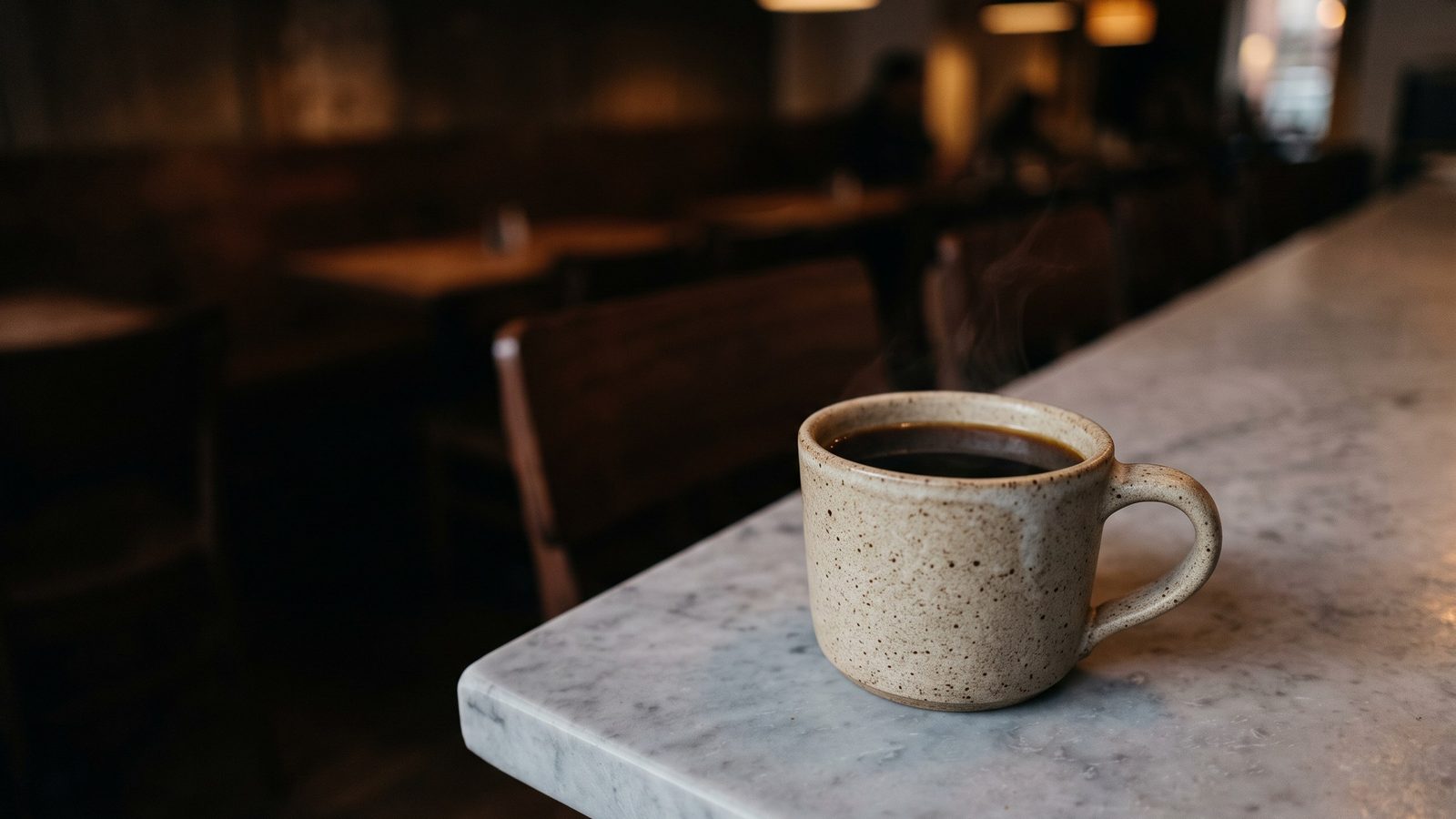
The practical question under all of this: when you’re standing at a counter someone else picked, what do you get?
In public, lower the bar — the goal is a warm cup in your hand, not the perfect coffee replacement. Most places have caffeine-free herbal tea. A growing number carry a roasted herbal “coffee” or will make you a steamer or a hot chocolate. Decaf is on the table if a few milligrams of caffeine is fine for you (it’s not zero, but it’s close). And there’s no shame in a sparkling water — it counts as “holding a drink,” which, again, is the actual job. If you want to scout options before you’re on the spot, I went through what’s genuinely available out in the world and what to drink while the caffeine is leaving your system.
At home is where you get to be picky, and where the ritual really gets rebuilt. A roasted herbal coffee — chicory, carob, that family — is the closest thing to the cup-shaped habit I missed, and having a good one waiting is what made mornings feel normal again instead of deprived. Among the ones I keep around, a chicory-based herbal roast like Teeccino (opens in a new tab) brews up dark and bitter enough to scratch the coffee itch, though it’s one of several that do — Pero, Dandy Blend, and a few others all live in that lane, and I’ve compared the contenders if you want to find your own. The point isn’t the brand. It’s that when your hands have somewhere to go at 10am, the cue stops pointing at nothing — which is half the battle, socially and otherwise.
The quiet part: it gets easier
Here’s the thing I most want the 2am version of me to have known: the social friction is loudest in the first couple of weeks, and then it just… stops.
Your “no caffeine, thanks” goes from news to fact. People recalibrate fast — faster than they’d predict — once it’s clear you’re not wavering and not judging them. The coworker stops offering. The family pot conversation happens once and never again. The “just one” person finds a new bit. What felt like a standing negotiation becomes a quiet preference nobody clocks, the same way nobody comments that you don’t take sugar. The trick across all of it is the same: keep the ritual, swap the substance, and don’t apologize for a thing that’s making you feel better. If you’re still in the rough early stretch, the headache side is the part that ends first — but the social part ends too. It’s just on a slightly longer clock, and nobody warns you, so now you’re warned.
New to this and bracing for the physical side too? Start with how to quit caffeine without the headache, then keep a caffeine-free option within reach for the 10am cue.
Sources & further reading
- How are habits formed: Modelling habit formation in the real world (opens in a new tab) — European Journal of Social Psychology (Lally et al., 2010)
- Caffeine Use Disorder: A Comprehensive Review and Research Agenda (opens in a new tab) — Journal of Caffeine Research (PMC)
Reader conversation (5)
We read every response. Selected reader notes below.
The “always arrive with a drink in your hand” thing is so dumb and so true. I quit in March and spent a month feeling vaguely interrogated at every meeting, then started bringing a thermos of herbal stuff and the questions just stopped overnight. It really was the empty hand, not the caffeine. Wish I’d figured that out on week one instead of week five.
Week five is exactly when it clicked for me too — there’s a whole month of unnecessary awkwardness you can just skip if someone tells you the trick early. That’s half of why I wrote it. Glad the thermos is doing its job.
The over-explaining warning hit home. I used to launch into the whole sleep-and-anxiety saga and could feel people’s eyes glaze, and somehow it always turned into a debate. “Caffeine and I stopped getting along” is going in my back pocket. Short really is better.
The family section made me a little emotional honestly. My dad shows love through coffee — there’s always a pot on — and saying no to it felt like saying no to him. “Accept the gesture, swap the substance” is exactly the reframe I needed. Asked for tea at his place on Sunday and just sat with him longer. He didn’t even notice the cup.
This is the comment I’ll be thinking about all week. You nailed the thing I was trying to say better than I said it — the pot was never about caffeine, it was about sit down and stay a while. You can keep all of that. Glad Sunday was good.
Counterpoint, gently — some of us work in places where declining the coffee run genuinely does read as antisocial, and “just hold a different drink” doesn’t fully fix the culture. Curious if you’ve got anything for workplaces where the coffee thing is basically mandatory bonding.
Totally fair, and you’re right that the cup trick handles the optics, not the culture. What’s worked for me: separate the bonding from the beverage — still go on the run, still sit at the table, just order your own thing. The bonding is the walk and the conversation; almost nobody actually cares what’s in your cup once you’re clearly still showing up for the social part. If you opt out of the event, that reads as antisocial. Opt out of only the caffeine and keep the event, and most of it resolves.
Three months off now and can confirm the “it just stops” ending is real. The first few weeks everyone had a comment, and now nobody mentions it at all — it’s just a thing about me, like the article says. Hang in there if you’re in the loud part.
Have something to add? Email us and we may include it in a future update.