Caffeine and sleep, even when you sleep fine: how a daytime cup reshapes the night you don't notice
You can fall asleep on time, stay asleep, wake up feeling normal — and still have measurably worse sleep because of a cup you drank eight hours earlier. Here's what caffeine actually does to sleep depth, why the damage is invisible from the inside, and how early is early enough.

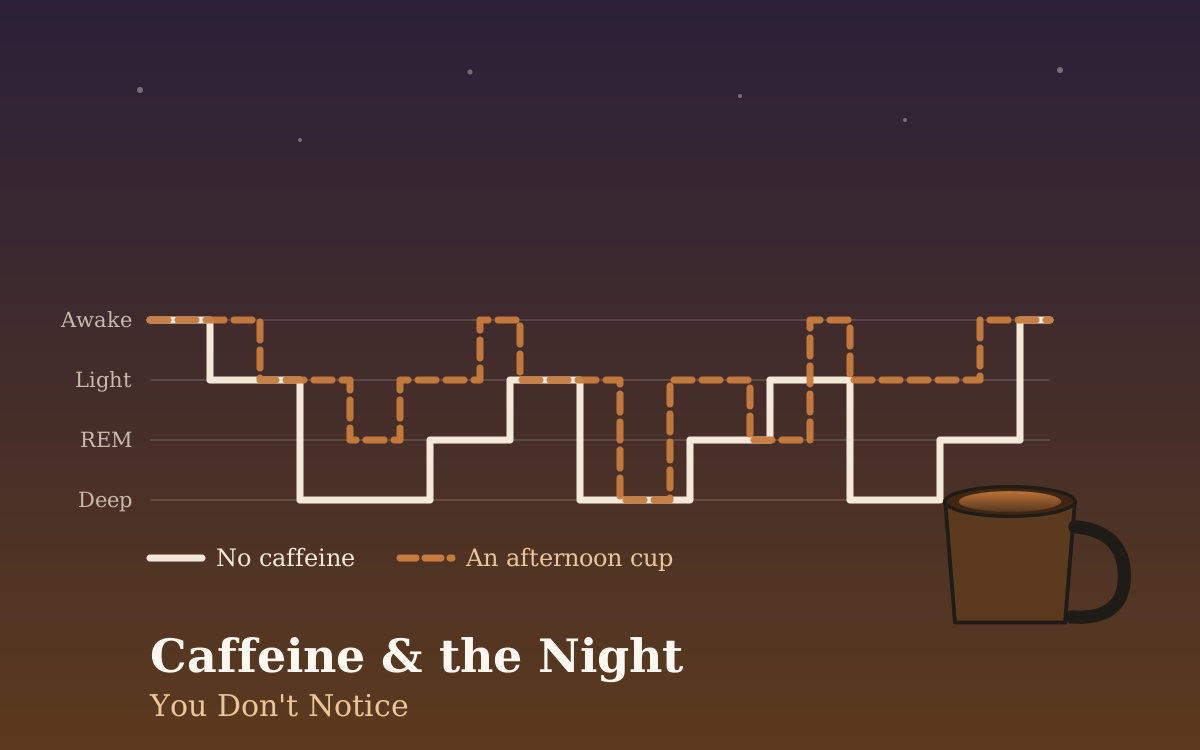
The most common thing I hear from people defending their afternoon coffee is some version of: “caffeine doesn’t affect my sleep — I’m out cold by eleven.”
I believe them. That’s the strange part. Falling asleep on time is a real observation, honestly reported, and it is almost entirely beside the point. The sleep research on caffeine keeps finding the same uncomfortable thing: the biggest measurable costs show up in the shape of the night, not the start of it — and people reliably cannot feel them happening.
This is the piece I’ve wanted to write since we did the half-life math on the afternoon crash. That article was about how caffeine’s long tail wrecks your day. This one is about what it does to the night you’d have sworn was fine.
The short answer
Caffeine in the second half of your day tends to make your night shorter, lighter, and more broken up — even at doses and timings you’d consider harmless, and even when you don’t notice a thing.
The headline number is still the one from a 2013 trial in the Journal of Clinical Sleep Medicine: a 400mg dose taken six hours before bedtime (opens in a new tab) reduced objectively measured total sleep time by more than an hour — and, in the researchers’ words, participants’ own reports suggested they were unaware of the disturbance.
Two caveats I want to put up front, because I’d want them if I were reading this. That study was small — twelve healthy sleepers — and 400mg is a big dose, closer to four cups than one. It’s a demonstration that the effect is real and invisible, not a measurement of what your one 2pm cup does. For the more moderate picture, we have better evidence now, and I’ll get to it.
Falling asleep isn’t the same as sleeping
Here’s the mental model worth replacing.
Most people treat sleep as a switch: awake, then asleep. If the switch flipped at the usual time, the night worked. But sleep is a structure — a repeating cycle through light stages, deep slow-wave sleep, and REM, four or five times a night, in a fairly specific pattern that shifts as the night goes on. Sleep scientists call the layout of that structure sleep architecture, and it’s the thing a sleep lab actually measures.
Deep sleep is where a lot of the physical restoration is concentrated, and it’s front-loaded — you get most of it in the first half of the night. That timing matters, because it means a substance still circulating at 11pm doesn’t have to keep you awake to cost you something. It only has to make those first cycles a little shallower than they’d otherwise have been.
And crucially: you have no direct access to any of this. You can perceive roughly how long it took to fall asleep and whether you woke up. You cannot perceive how many minutes of slow-wave sleep you got. Nobody can. Which is why “I slept fine” is a sincere report about a variable that isn’t the one in question.
What actually changes in the night
The best single summary we have is a 2023 systematic review and meta-analysis in Sleep Medicine Reviews, which pooled controlled trials of caffeine and subsequent sleep. Averaged across that literature, caffeine:
- Reduced total sleep time by roughly 45 minutes
- Reduced sleep efficiency — the share of time in bed actually spent asleep — by about 7 percent
- Increased how long it took to fall asleep by around 9 minutes
- Increased time awake after falling asleep by about 12 minutes
- Reduced N3 (deep, slow-wave) sleep by roughly 11 minutes, and by about 1.4 percentage points of the night
- Increased N1 — the lightest, most easily-interrupted stage
Read that list as a shape rather than a set of numbers. The night doesn’t fail to start; it gets thinner. You spend a bit longer getting in, a bit more of it awake, and you trade some of your deepest sleep for your shallowest. Nine minutes here and eleven minutes there sounds trivial in isolation — but sleep efficiency dropping seven percent, night after night for years, is not a rounding error.
These are averages pooled across studies with different doses, timings, and populations. Your individual night could be considerably better or considerably worse.
The REM claim, honestly
You will read, in a great many places, that caffeine “suppresses your REM sleep.” I’ve seen it in wellness copy, on sleep-tracker dashboards, and in the marketing for products I’d otherwise like.
The evidence for that specific claim is weaker than its popularity suggests. In the same 2023 meta-analysis, caffeine did not significantly change REM duration or REM as a proportion of the night, and across the ten studies that looked at how long it took to reach REM, none found a significant effect.
I’m flagging this because the deep-sleep finding is the one that holds up, and it doesn’t need embellishment. If we tell you caffeine steals your REM and a careful reader checks, we’ve spent credibility we need for the parts that are true. The honest version: caffeine’s clearest cost is depth, not dreaming.
(Consumer sleep trackers do often show REM changes. Worth knowing that wrist-based stage estimates are inferences from heart rate and movement, not brain-wave measurements, and stage-level accuracy is the weakest thing they do. Trends over months, useful. Last night’s REM number, treat gently.)
Why an afternoon cup reaches midnight
The mechanism is worth understanding because it explains why the timing rules are so much longer than intuition.
All day, as your cells burn energy, a molecule called adenosine accumulates in your brain. Adenosine binding to its receptors is a large part of what sleepiness feels like — it’s the rising pressure that eventually makes bed irresistible. Caffeine’s main trick is that it’s shaped enough like adenosine to occupy those receptors without activating them. It’s a key that fits the lock and turns nothing.
The important consequence: caffeine doesn’t stop adenosine from building up. It just stops you from registering it. The pressure keeps accruing behind a blocked door — which is why the crash when caffeine clears feels so abrupt, and why caffeine masks sleep debt rather than repaying it. (We made the same argument from a different angle in quitting caffeine with young kids, where the imposed sleep debt makes the loop especially punishing.)
Then there’s clearance. Caffeine’s half-life in a typical adult runs somewhere around five hours, meaning a 3pm cup still has roughly half its caffeine on board at 8pm and something like a quarter of it at 1am. Not a lot. But “not a lot” of a compound whose entire job is to blunt sleep pressure, arriving exactly when your first and deepest sleep cycles are supposed to run.
How early is early enough
This is the practical question, and we finally have a reasonable answer to it.
A 2025 randomized crossover trial in SLEEP gave participants placebo, 100mg, or 400mg of caffeine at 12, 8, and 4 hours before bed, and the authors translated their results into usable timing guidance (opens in a new tab): to avoid measurable reductions in sleep time, a standard coffee of about 107mg should be finished at least ~8.8 hours before bedtime, and a large pre-workout-sized dose of about 217mg at least ~13.2 hours before.
Do the arithmetic on your own schedule, because it’s bracing:
| Bedtime | Cutoff for one standard cup | Cutoff for a strong double |
|---|---|---|
| 10:00pm | ~1:10pm | ~8:50am |
| 11:00pm | ~2:10pm | ~9:50am |
| Midnight | ~3:10pm | ~10:50am |
For most people with a normal bedtime, that means the coffee that goes with lunch is already borderline, and the 3pm pick-me-up is over the line. The AASM’s own framing of the older evidence was blunter and easier to remember: avoid caffeine after about 5pm — which, as these numbers show, is generous rather than strict.
Three honest qualifications. This trial ran in 23 men with moderate habitual intake, so it isn’t the last word for everyone. The doses are totals, and caffeine hides in tea, cola, energy drinks, chocolate, and pre-workout — we cover the stacking problem in how much caffeine is in decaf and it applies here too. And these are thresholds for population-average sleep time, not for how you’ll feel.
“But I sleep fine on coffee”
Let me take the objection seriously, because there are two real things inside it.
The first is that the subjective/objective gap is the finding, not a flaw in your self-awareness. Drake’s group found participants who couldn’t detect an hour of lost sleep. If a well-monitored trial can’t get people to notice, your Tuesday isn’t going to either. This is one of the few health questions where introspection is genuinely the wrong instrument.
The second is that habitual caffeine changes what “fine” means. If you’ve been drinking coffee daily for years, your baseline mornings already include mild withdrawal, and your first cup is partly relieving that rather than lifting you above neutral. So “I sleep fine and function fine” is measured against a ruler caffeine itself calibrated. People who quit for a few weeks often describe the change not as more energy but as a flatter day — less spike, less trough. Our two-week log has the day-by-day texture of that, and how to wake up without coffee covers the cortisol side of why mornings work at all without it.
None of which means your sleep is secretly terrible. Some people really do clear caffeine fast and sleep robustly. It means you can’t find out by asking yourself.
Why the same cup wrecks your friend and not you
Individual variation here is genuinely large, and a good chunk of it is genetic.
Roughly 95% of caffeine metabolism runs through a liver enzyme encoded by the CYP1A2 gene, and common variants make people meaningfully faster or slower at it. Fast metabolizers may clear caffeine with a half-life in the neighborhood of 2–4 hours; slower ones can run 6–8 hours or longer. A separate receptor gene, ADORA2A, is associated with caffeine sensitivity — how strongly a given blood level lands, particularly for anxiety and sleep disruption. Two people can drink the identical 2pm cup and have genuinely different amounts of drug on board at midnight, hitting genuinely differently.
Other things move the same dial: age, pregnancy (which slows caffeine clearance substantially), oral contraceptives, smoking (which speeds it up), liver function, and some medications.
I’d steer you away from buying a consumer gene test to settle it. The associations are real but probabilistic, panels vary in quality, and you already have a better instrument: a two-week experiment on yourself, described below. If you’re the person whose sleep frays after a single early-afternoon cup while your partner drinks espresso after dinner and sleeps like a stone — you’re not imagining it, and you don’t need a swab to act on it.
What to actually do about it
In rough order of effort:
1. Move your cutoff earlier than feels necessary. Not to 5pm — to roughly nine hours before bed. For most people that lands somewhere between 1pm and 2:30pm. This single change does more than anything else on this list.
2. Run the two-week test properly. Keep your dose and your bedtime the same and change only the timing: one week with caffeine after 2pm, one week with none. Track three things each morning — how rested you feel out of 10, how many times you remember waking, and your mood by mid-afternoon. Compare weekly averages, not individual days. If you have a tracker, use its deep sleep and sleep efficiency trends and ignore the REM number.
3. Don’t quietly reintroduce it. The stacking problem is where this falls apart: an afternoon iced tea, a cola with dinner, dark chocolate at 9pm, an evening decaf. Individually small, collectively a dose. And if you’re using L-theanine to take the edge off, be clear about what it does and doesn’t do — smoothing the jitters is not the same as clearing the caffeine.
4. Keep the ritual, change the contents. For most people the afternoon cup isn’t really about the drug; it’s a break, a warm thing, a hinge in the day. That’s exactly why “just skip it” fails and a swap sticks. Roasted, coffee-adjacent brews built from chicory, dandelion root, barley, or carob give you the bitter-and-warm experience with no caffeine to metabolize — nothing to count backward from your bedtime. Plain roasted chicory is the cheapest way in; instant blends like Dandy Blend or Pero dissolve in a mug; and among the herbal-coffee roasts, Teeccino (opens in a new tab) brews in a regular drip machine, which is a real advantage if the ritual you’re protecting is a machine-and-mug one. Two honest caveats: many of these blends are barley- or rye-based and therefore not gluten-free, and chicory’s inulin can cause gas or bloating in people sensitive to FODMAPs. Our full map of caffeine-free options sorts them by what you’re actually after.
5. If your sleep is bad in ways caffeine timing doesn’t explain, stop optimizing the coffee and talk to a clinician. Persistent insomnia, loud snoring with daytime exhaustion, or unrefreshing sleep despite adequate hours are worth a real evaluation. Caffeine is a common contributor to poor sleep. It is not the only one, and it’s the easiest one to blame while something else goes unexamined.
The bottom line
Caffeine’s cost to your sleep is mostly invisible by design. It doesn’t announce itself as insomnia; it shows up as a night that’s a little shorter, a little lighter, a little more interrupted — and as a self-report that everything was fine, which is exactly what the research predicts you’d say.
The evidence is clearest on depth and duration: less slow-wave sleep, less total sleep, lower efficiency. It’s much weaker on REM, and I’d rather tell you that than sell you a tidier story. The timing guidance is genuinely surprising — about nine hours for a single cup — and it’s the piece most worth acting on, because almost nobody’s real cutoff is that early.
And there’s one lever that removes the question rather than managing it. If the afternoon cup has nothing in it to metabolize, there’s no half-life to calculate, no cutoff to respect, and no invisible tax on the first half of your night. You don’t have to guess whether you’re a slow metabolizer. You just get the ritual, and the night stays yours.
This article is educational and not medical advice. If you have persistent insomnia, suspected sleep apnea, or you’re managing caffeine for pregnancy, anxiety, a heart condition, or a medication interaction, your clinician is the right person to advise you.
Sources & further reading
- Caffeine Effects on Sleep Taken 0, 3, or 6 Hours before Going to Bed (Drake, Roehrs, Shambroom, Roth) (opens in a new tab) — Journal of Clinical Sleep Medicine, 2013
- Late afternoon and early evening caffeine can disrupt sleep at night (opens in a new tab) — American Academy of Sleep Medicine
- The effect of caffeine on subsequent sleep: A systematic review and meta-analysis (Gardiner et al.) (opens in a new tab) — Sleep Medicine Reviews, 2023
- Dose and timing effects of caffeine on subsequent sleep: a randomized clinical crossover trial (Gardiner et al.) (opens in a new tab) — SLEEP, 2025
Reader conversation (5)
We read every response. Selected reader notes below.
I commented on your decaf piece a few weeks ago about an evening decaf wrecking my sleep, and this article is the other half of that answer. What got me here was the line about not being able to perceive slow-wave sleep. I have spent years telling my husband caffeine doesn’t affect me because I fall asleep in ten minutes. I still fall asleep in ten minutes. Apparently that was never the question.
It’s the most common version of the misunderstanding, and it isn’t a failure of self-knowledge — sleep onset is genuinely the only part of the architecture we get to observe from inside. You noticed the thing you could notice. The 2013 trial found people missing a full hour of lost sleep under monitoring, so you’re in excellent company.
The table did it. My bedtime is eleven and I’d been having a coffee at three thinking that was already virtuous — the “9 hours” number puts my real cutoff at two, which I have never once respected in my life. Moved the second cup to right after breakfast for a fortnight. I’m not going to claim a transformation but I’m waking up at 6 instead of at 4:30 and then again at 5:30, which I’ll take.
Fewer awakenings in the back half of the night is exactly the change the fragmentation numbers predict, so that’s a very plausible result rather than a placebo — and it’s a more reliable signal than “did I feel rested,” which is noisy day to day. Worth staying with it for another couple of weeks to see whether it holds.
Thank you for the REM paragraph. My sleep tracker has been telling me for a year that my REM is “low” and I have genuinely lost sleep worrying about losing sleep. Finding out that wrist trackers are weakest at exactly the number I’ve been fixating on, and that the meta-analysis didn’t even find a REM effect, is more reassuring than any article that tried to help me fix it.
Anxiety about a sleep metric costing you actual sleep is a real and well-documented loop, and stage-level estimates from a wrist are the shakiest input to build it on. Watch efficiency and total time as monthly trends if you want something from the device. The nightly stage breakdown is not solid enough to be worth a worry.
My wife has a double espresso after dinner and sleeps nine hours. I have a single cup at one in the afternoon and I’m staring at the ceiling. We have argued about this — genially — for eleven years, with an undertone of her thinking I’m a bit precious about it. The CYP1A2 section is getting printed and left on the counter. Vindication at last.
What actually worked for me was the last suggestion — keeping the ritual. I tried simply dropping the 3pm coffee twice and failed both times, because the thing I wanted was the walk to the kitchen and the warm mug, not the caffeine. A pot of roasted chicory in the afternoon and the habit survived on the first attempt. Nine months now. The night difference took about two weeks to show up, and then it was obvious.
Have something to add? Email us and we may include it in a future update.