Coffee before a breathing test: caffeine is a mild airway opener, so the instructions usually say skip it
Caffeine can modestly improve airflow for a few hours, which is why some lung function tests ask you to skip it first. What a Cochrane review found, how long to wait, and how to avoid a headache while you do.


The short answer
If you’re booked for a lung function test, such as spirometry, check the instruction sheet for caffeine before you pour the morning cup. Many clinics ask you to skip it for a set number of hours, because caffeine can loosen the airways a little and make a result look better than your usual.
The exact window is your clinic’s call, and it wins over anything here. I’m not a clinician, and this isn’t medical advice. It’s a look at what the research says, so the instruction makes sense and you can plan around it.
Why caffeine matters here
Caffeine is chemically related to theophylline, a drug that has been used in breathing treatments. The Cochrane review we’ll get to describes caffeine as a weak bronchodilator, meaning it can relax the muscles around the airways slightly. It also appears to reduce fatigue in the breathing muscles.
A breathing test tries to measure how open your airways are, and how fast you can move air out. If a cup of coffee nudges that number up, the test can understate a problem. That’s the reason for the instruction, and it’s why it appears most often when the test is checking for airway narrowing.
What the review found
A 2010 Cochrane review pulled together randomized trials of caffeine in adults with mild to moderate asthma. It included seven small crossover trials with 75 people in total, which is not a lot of evidence, so treat the numbers as a rough guide.
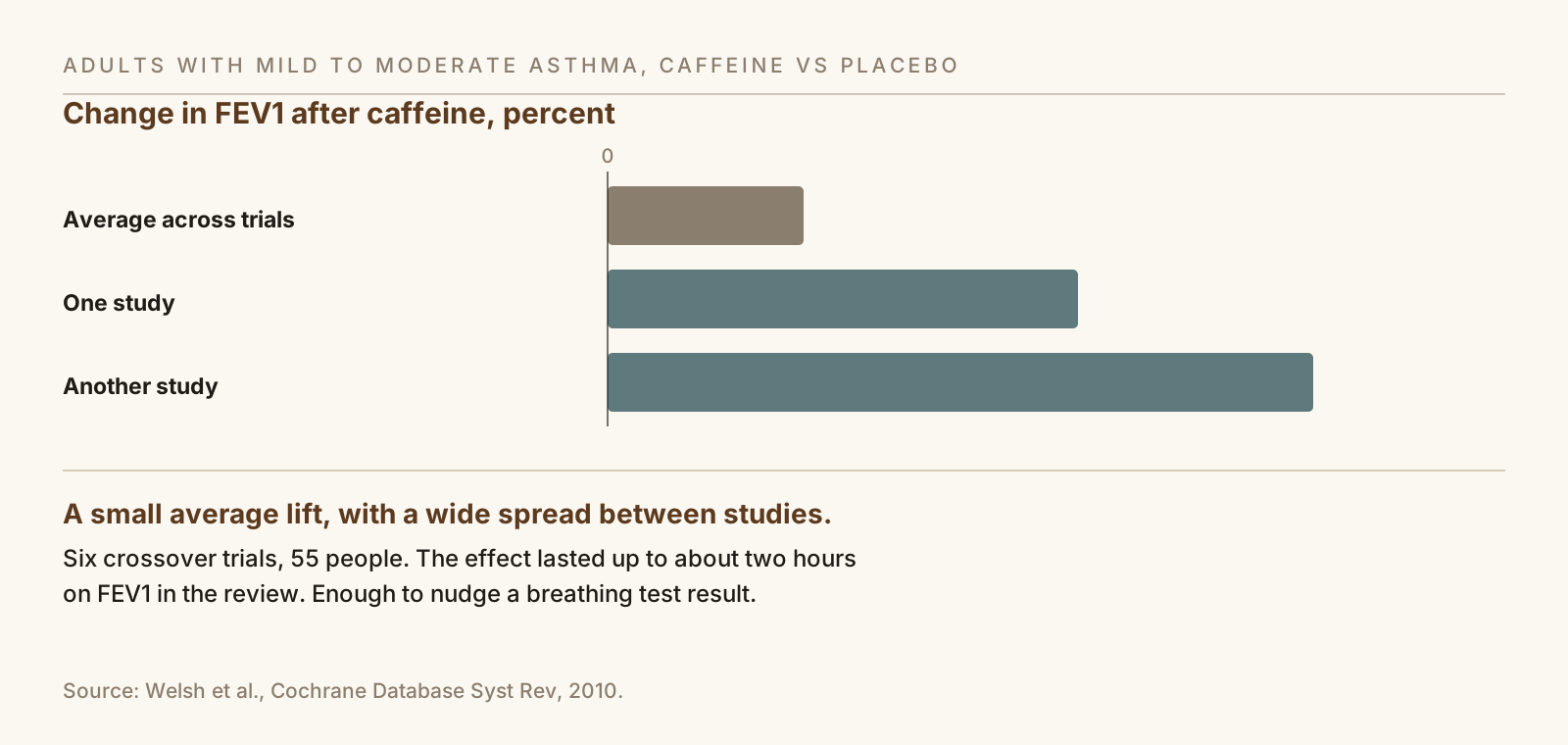
Six of the trials, covering 55 people, compared caffeine with placebo. Caffeine, even at a lower dose (under 5 mg per kilogram of body weight), appeared to improve lung function for up to two hours. FEV1, the amount of air you can blow out in the first second, was about 5 percent higher on average. In two studies the difference was 12 percent and 18 percent. Mid-expiratory flow rates improved too, and that lasted up to four hours.
For scale, 5 mg per kilogram works out to roughly 350 mg of caffeine for a 70 kg (154 lb) adult. That’s our arithmetic, not a figure from the review.
Two older trials point the same way. In an 11-man trial from 1991, 10 mg per kilogram of caffeine reduced the airway narrowing triggered by a breathing challenge test, and the effect tracked how much caffeine was in the blood. A 1990 trial of 10 people with asthma found that only the higher dose (7 mg per kilogram) prevented a drop in FEV1 after exercise.
Some cautions. These were small studies in people with asthma, and this is not a reason to use coffee for breathing. The review wasn’t recommending caffeine as a treatment. Its practical conclusion was the testing one: control caffeine before the test.
How long to wait
The review’s authors concluded that people may need to avoid caffeine for at least four hours before lung function testing. That matches the effect on flow rates, which lasted up to four hours.
Clinics set their own windows. Some ask for only the morning of the test, others for longer, and some add tea, cola, chocolate or energy drinks to the list. Our piece on caffeine’s half-life explains why the effect can outlast the cup. Your sheet’s number is the one to follow.
One more finding from the same review: a trial of 20 people found that coffee versus decaf made no significant difference to exhaled nitric oxide, another breathing-clinic measurement. The authors said more studies were needed. If you’ve been booked for that test, ask the clinic rather than relying on this.
The headache problem
For a daily coffee drinker, skipping caffeine for four hours is usually easy. The trouble comes if the clinic asks you to stay off it from the night before, or if your appointment is first thing and you’d normally have a cup on waking.
Withdrawal headaches can begin within hours of your usual time. Our guide to how long caffeine withdrawal lasts covers the typical range. A few ways to make it easier:
- Book later in the day if you can. If the clinic allows it, a late morning slot after a normal caffeine day may mean you only need to skip one cup.
- Taper a little beforehand. Halving your usual amount for several days means a gap lands softer. Our guide to quitting caffeine without the headache has a schedule.
- Plan the first cup for after. Once the test is done, have coffee waiting.
Breathing tests join a short list where the instruction sheet and the daily habit collide. We’ve covered a cardiac stress test, a sleep study, a fasting blood test and surgery, and the rules differ for each.
A caffeine-free herbal coffee, such as one made from roasted chicory, doesn’t contain caffeine, so it wouldn’t have the airway effect described above. Whether it’s allowed is a question for the clinic, since their list may include other drinks. If you want to know what’s in these brews, start with what is chicory coffee.
What to ask the clinic
- How many hours before the test should I stop caffeine?
- Does that include tea, cola, chocolate, energy drinks and decaf?
- Is there anything else I should skip, such as inhalers or other medication? Do not stop prescribed medicine unless the clinic tells you to.
- Can I book a later appointment?
- Can I drink water on the day?
Write the answers on the instruction sheet so they’re in front of you on the day.
This article is general information, not medical advice. Follow the instructions from your clinician and testing clinic.
Sources & further reading
- Caffeine for asthma (opens in a new tab) — Cochrane Database of Systematic Reviews, 2010 (Welsh et al.)
- Caffeine consumption decreases the response to bronchoprovocation challenge with dry gas hyperventilation (opens in a new tab) — Chest, 1991 (Duffy and Phillips)
- The effect of caffeine on exercise-induced bronchoconstriction (opens in a new tab) — Chest, 1990 (Kivity et al.)
Reader conversation (4)
We read every response. Selected reader notes below.
My sheet said four hours and I assumed that meant coffee only. Good to be reminded that tea and cola count too.
I booked the first slot of the morning and now I see why that was a bad idea for a daily coffee drinker. I am calling to move it.
That is worth a call, Omar. Some clinics are flexible about times, and some are not, so it never hurts to ask.
Useful that you said plainly the studies were small. I appreciate not being oversold on anything.
The question list at the end is what I needed. I will take it to my appointment next week.
Have something to add? Email us and we may include it in a future update.