Coffee before a glucose tolerance test: small trials found caffeine can worsen the result, and not for everyone
Should you skip coffee before a glucose tolerance test? Small trials found caffeine before the drink changed insulin and blood sugar in some groups, not others. What the studies show and what to ask your clinic.


The short answer
A glucose tolerance test, the one where you fast, drink a measured sugar solution and have blood drawn over the next one to three hours, is a test where the morning routine matters. If you drink coffee first thing, it’s fair to ask whether the cup will change your result.
The small trials I found say it can. In two of them, caffeine taken an hour before the sugar drink worsened measures of how the body handled it, though in one group it didn’t. None of them used a clinic’s actual protocol, so your clinic’s instructions come first.
I’m not a clinician, and this isn’t medical advice. This is a guide to what the studies found, so you can ask better questions and plan the morning.
The 2004 trial: 12 men, 5 mg/kg of caffeine
A 2004 trial in the Journal of Nutrition recruited 12 obese men whose blood sugar was already hard to manage. Each did two trials a week apart, in a randomized, double-blind design. Before each, they stayed off caffeine, alcohol, exercise and their usual blood-sugar medication for 48 hours, plus an overnight fast. Then they swallowed capsules of caffeine (5 mg per kg of body weight) or placebo, and an hour later started a 3-hour, 75 g glucose test.
The results after caffeine, compared with placebo:
- Insulin area under the curve was 25% greater.
- Blood glucose was higher too, and stayed elevated at the 3-hour mark (8.9 mmol/L, against 6.7 at baseline).
- The insulin sensitivity index was 14% lower.
The authors read that as an acute, caffeine-induced impairment in blood-sugar management in this group.
The pregnancy trial: two groups, two answers
Glucose tests are also routine in pregnancy, so a 2009 trial from the same research group is the one many readers will want. Nineteen women whose routine screen was negative and eight women whose initial screen was positive took part in a double-blind crossover. Each had caffeine (3 mg per kg of pre-pregnancy body weight) or an identical-looking placebo capsule, then an hour later a 75 g, 2-hour test.
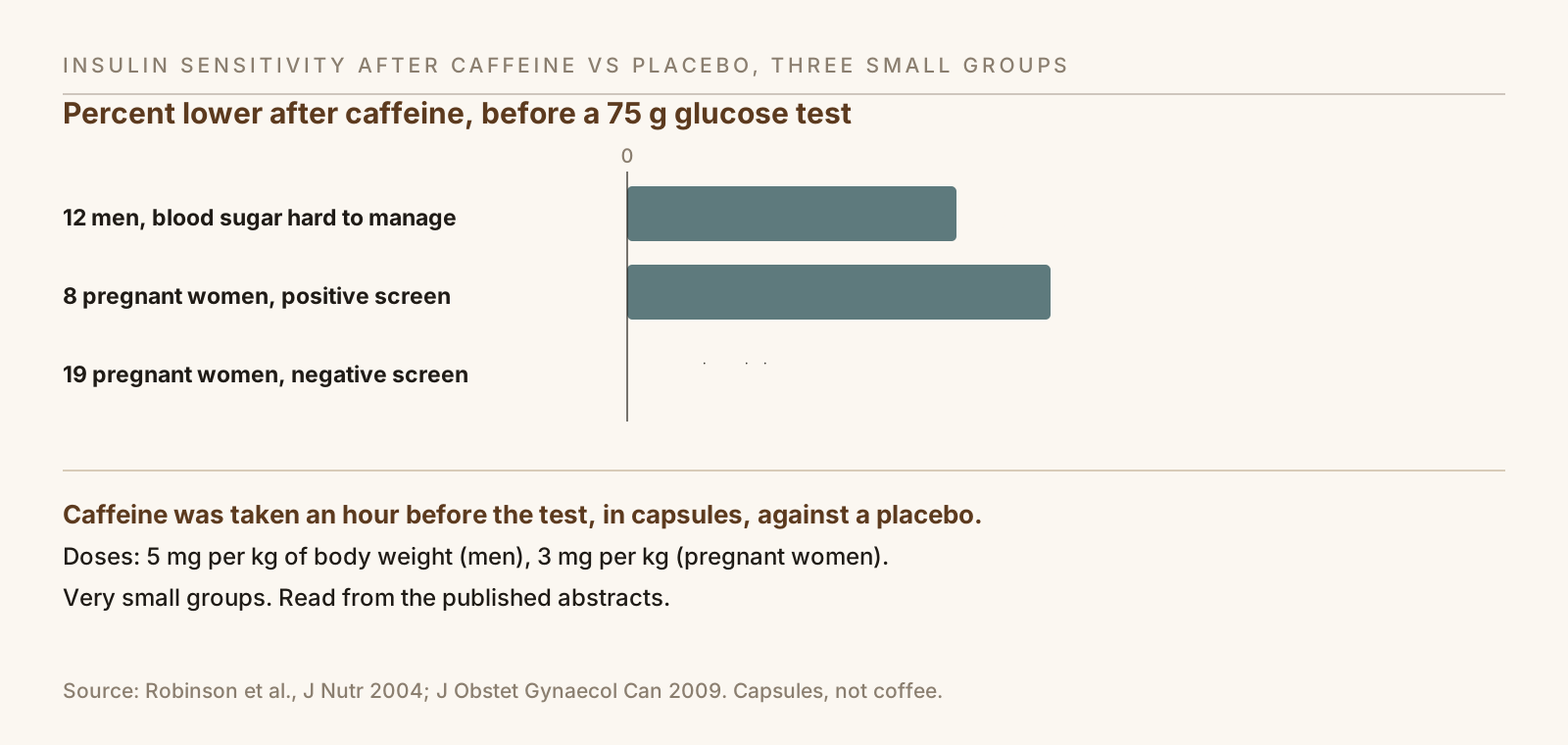
In the 19 women with a negative screen, caffeine didn’t significantly affect blood glucose, insulin or C-peptide. In the 8 women with a positive screen, glucose and C-peptide areas under the curve were greater after caffeine, and the insulin sensitivity index was 18% lower. The authors called for more research before giving specific dietary caffeine advice to that group.
Eight women is a very small group. Treat it as a signal worth raising with your own clinician, not a rule.
What about actual coffee?
Those two trials used capsules. Two others used coffee, both in healthy people:
- A 2016 trial in 11 healthy volunteers had them drink 300 mL of light roast, dark roast or water, then take a 75 g test 30 minutes later. Glucose area under the curve didn’t differ between treatments, but both coffees raised insulin compared with water, and both lowered the insulin sensitivity index.
- A 2011 trial in 10 healthy young men found that caffeinated coffee, taken after a fat-heavy challenge, produced the highest glucose readings in the following test.
So the picture isn’t uniform: glucose itself didn’t always move, but insulin often did. These are tiny, short trials, and they don’t say how a clinic would read a result taken after a cup.
For the longer-term picture, which points in a different direction, see our look at coffee and long-run blood sugar. A study of years of drinking and a study of one cup an hour before a test are answering different questions.
What none of this tells you
- Small trials. The groups ranged from 8 to 19 people.
- Mostly capsules, not a standard cup. The dose in your mug varies by brew. Our piece on caffeine’s half-life explains how long a dose stays active.
- Research protocols, not clinic ones. The 48-hour abstinence in the 2004 trial was part of a study, not an instruction. I couldn’t find a single standard rule for coffee before a glucose test, and I’d rather say so than invent one.
- Abstracts only. I read the published abstracts, not the full papers.
- Your result is your clinician’s to read. A change in a study’s average doesn’t tell you what a cup would do to your numbers.
Planning the morning
- Ask first. Whether to skip caffeine, and for how long, is the clinic’s call.
- Ask about decaf and tea. The coffee trials suggest it isn’t only about the caffeine capsule.
- Don’t change everything on the day. Stopping suddenly can bring a headache within hours. Our guide to how long caffeine withdrawal lasts covers the typical range.
- Taper beforehand if you’ve been told to stop for longer. Our guide to quitting caffeine without the headache has a schedule.
- Know what’s in the cup. A brew from roasted chicory or barley has no caffeine, so these trials don’t apply to it, but nobody has tested it before a glucose test either. See what is chicory coffee for what’s in these brews.
Other appointments with their own instruction sheets are covered in coffee before a fasting blood test and caffeine before a cardiac stress test.
What to ask your clinic
- Should I avoid caffeine before this test, and for how long?
- Does that include decaf, tea and energy drinks?
- Can I drink water on the morning of the test?
- Should I keep taking my usual medications?
- If I’ve already had coffee, should I rebook or tell the lab?
This article is general information, not medical advice. Follow the instructions from your clinic and your clinician.
Sources & further reading
- Robinson et al., caffeine before an oral glucose tolerance test in 12 obese men (randomized, double-blind crossover) (opens in a new tab) — Journal of Nutrition, 2004
- Robinson et al., acute caffeine and glucose tolerance in pregnant women, 19 with a negative and 8 with a positive screen (opens in a new tab) — Journal of Obstetrics and Gynaecology Canada, 2009
- Rakvaag and Dragsted, acute effects of light and dark roasted coffee on glucose tolerance in healthy volunteers (opens in a new tab) — European Journal of Nutrition, 2016
- Beaudoin, Robinson and Graham, an oral lipid challenge and caffeinated coffee in healthy men (opens in a new tab) — Journal of Nutrition, 2011
Reader conversation (4)
We read every response. Selected reader notes below.
My pregnancy screening paperwork only said “fasting” and I wasn’t sure if black coffee counted. I just asked the nurse and she said no. Wish I’d known to ask earlier.
Thanks, Renata. “Fasting” means different things to different clinics, so asking is the right move.
Appreciate that you pointed out the groups were tiny. Most articles on this make it sound settled.
I tapered off coffee for a week before my test, partly because of the headache worry. Ended up fine, though I have no idea whether it mattered for the result.
Good list of questions to bring. I’d never have thought to ask about decaf.
Read this and have a question or something to add? Send us a note. With your OK, we may publish it here with an editor's follow-up. We only publish notes you've said we can.