Does coffee lower your diabetes risk? Big studies say yes, small trials say a cup nudges glucose up, and the sugar in the cup matters
Large studies link coffee, decaf included, to lower rates of type 2 diabetes. What a 28-study analysis, a 2025 Harvard cohort study and three small trials found, and what it means if you're cutting back.


Coffee drinkers get type 2 diabetes less often than non-drinkers, and that pattern has turned up in dozens of studies. Yet small trials that hand people a cup and measure their blood sugar often see a short-term nudge in the other direction. Both findings are real, and they answer different questions.
The short answer
- In a pooled analysis of 28 cohort studies, each extra cup of coffee a day went with a lower rate of type 2 diabetes, and decaf showed a similar pattern.
- In a 2025 Harvard-led study, sugar or sweetener in the cup weakened that link, while cream didn’t.
- Small trials found a single cup can raise glucose or insulin responses for a few hours, which is a separate question from long-term risk.
- None of this shows coffee prevents diabetes, and it isn’t a reason to start drinking it.
The 28-study analysis
The biggest summary we read is a dose-response meta-analysis in Diabetes Care (opens in a new tab) by Ding and colleagues. It pooled 28 prospective studies covering 1,109,272 participants and 45,335 cases of type 2 diabetes. Follow-up ranged from 10 months to 20 years.
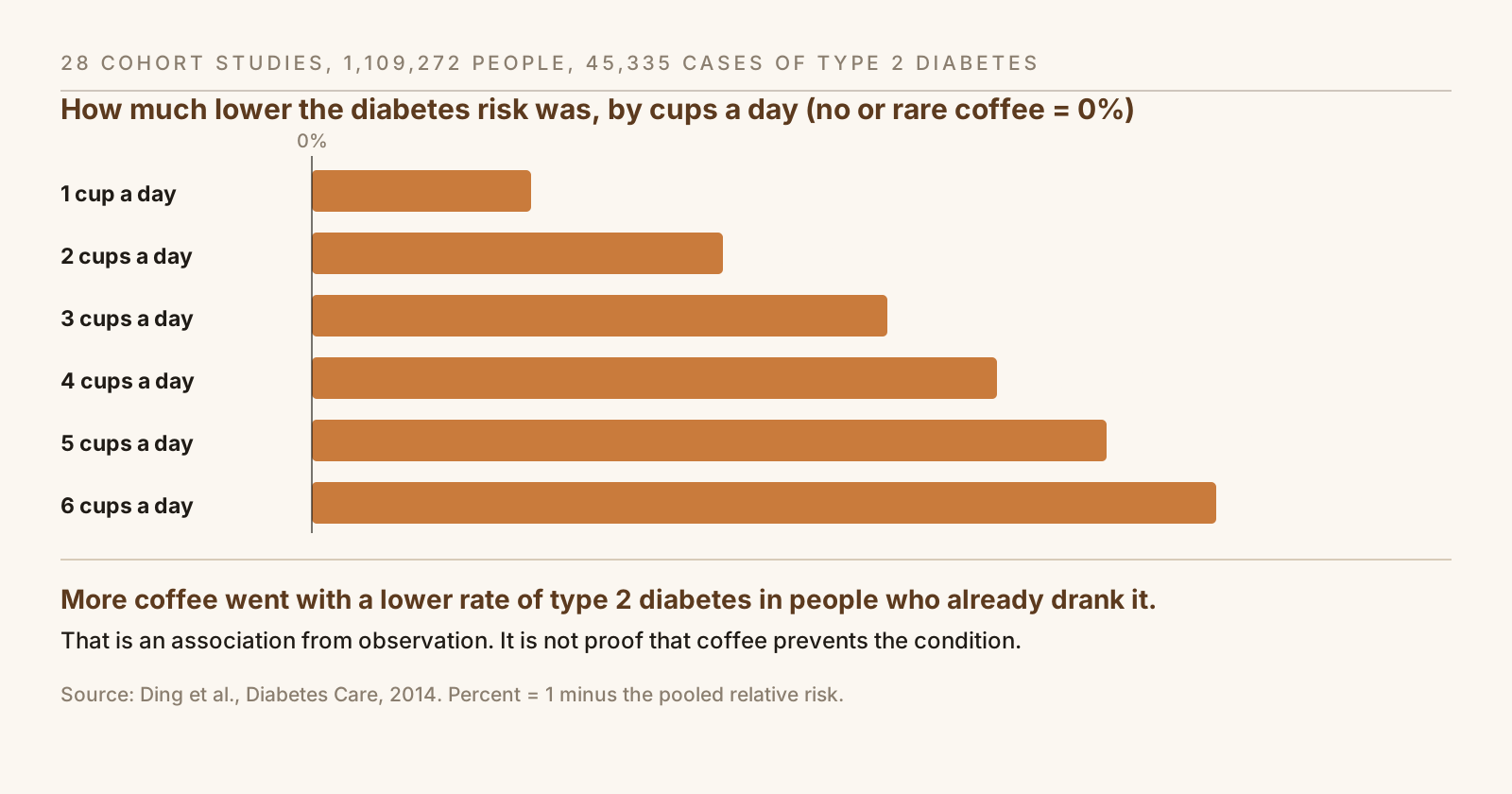
Compared with people who drank no coffee or rarely drank it, the relative risk of diabetes was 0.92 for one cup a day, 0.85 for two, 0.79 for three, 0.75 for four, 0.71 for five and 0.67 for six. A relative risk below 1.00 means fewer cases in the coffee group. The chart shows the same numbers as “percent lower.”
Six cups a day is a lot of caffeine for most people, and these numbers are statistical comparisons, not a recommended dose. Our piece on caffeine and migraine shows how a higher intake can cost you in other ways.
What decaf shows
The same analysis split coffee by type. For each extra cup a day, the relative risk was 0.91 for caffeinated coffee (95% range 0.89 to 0.94) and 0.94 for decaf (0.91 to 0.98). The authors found no significant difference between the two (P = 0.17).
So decaf looks associated with a slightly smaller step per cup, though the study can’t tell us the gap is real. The authors concluded that both caffeinated and decaffeinated coffee were associated with lower risk. That points toward something in coffee other than caffeine, but it doesn’t say what. If you’re curious what decaf is, see is decaf coffee bad for you and how much caffeine is in decaf.
What you put in the cup
A 2025 study in the American Journal of Clinical Nutrition (opens in a new tab) followed the Nurses’ Health Study, Nurses’ Health Study II and the Health Professionals Follow-up Study. Across 3,665,408 person-years it recorded 13,281 new cases of type 2 diabetes.
Each additional cup of coffee with no additive went with a 10% lower risk (hazard ratio 0.90, range 0.89 to 0.92). The pattern changed with what people added:
| What was added | Hazard ratio per cup |
|---|---|
| Nothing | 0.90 |
| Cream | Unchanged from nothing, per the authors |
| Sugar (about 1 teaspoon per cup, on average) | 0.95 |
| Artificial sweetener | 0.93 |
| Nondairy whitener | 0.95, with an interaction that was not statistically significant |
In plain terms, the link was weaker when the cup was sweetened, and the authors report that sugar and sweetener weakened it significantly. This is still observational. People who sweeten their coffee may differ in other ways, so it points to a pattern, not a proven effect of the sugar.
If you’ve moved to a herbal coffee, this is a fair reminder that the cup is more than the beans. Our look at whether chicory coffee raises blood sugar goes through the roasted-root side.
The single-cup trials
Cohort studies track people for years. Trials like these test one cup, then measure what happens in the next few hours. We read three small ones:
- Eighteen people with type 2 diabetes, all habitual coffee drinkers. In a crossover study in Metabolism (opens in a new tab), a double-shot black espresso was followed an hour later by a glucose tolerance test. Glucose rose a little more after caffeinated coffee than after water (the confidence range barely cleared zero, 0.1 to 198.1), and the gap versus decaf wasn’t statistically significant. Insulin sensitivity didn’t differ.
- Eleven young men. In a Diabetes Care study (opens in a new tab), glucose and insulin in the first hour were higher after decaf than after a placebo. The authors say some decaf may acutely impair glucose handling, but less than caffeine did.
- Eleven healthy adults. In a European Journal of Nutrition trial (opens in a new tab), light and dark roast both raised insulin responses compared with water, and glucose totals didn’t differ between treatments.
These are tiny, short tests, and they don’t contradict the large studies. They measure an acute response to one cup, and the cohorts measure who develops diabetes over years. Our post on coffee before a fasting blood test covers the practical side of the acute effect.
What these studies can’t tell you
- They compare groups. People who drink coffee may differ in diet, activity, income or health from those who don’t. Researchers adjust for what they measured, not for everything.
- Nobody randomized people to years of coffee. The trials above last hours, so we have no long-term trial.
- “A cup” varies. Size, strength and brew method differ between studies and between people.
- They say nothing about herbal coffees. We found no type 2 diabetes research on chicory, dandelion or carob blends, so we can’t say if they would show anything similar.
If you’re cutting back or quitting
This evidence shouldn’t change a decision to cut caffeine for sleep, anxiety, reflux or any other reason. It describes an association in people who already drank coffee, and it doesn’t show that stopping raises your risk.
A few practical points:
- If you’re keeping coffee in some form, leaving out the sugar is the one change this research points to, and it applies to a herbal cup too.
- If you want the taste without caffeine, herbal coffee versus decaf compares the two, and our caffeine-free coffee roundup is the place to start.
- If you have diabetes or prediabetes, or you’re monitoring your glucose, ask your care team before changing your routine. Coffee isn’t a treatment, and nothing here replaces medical advice.
The bottom line
Large studies link coffee, decaf included, to lower rates of type 2 diabetes, and sugar in the cup seems to weaken that link. Small trials show a cup can nudge glucose or insulin up for a few hours. Both can be true, and neither is a reason to start or stop drinking coffee. If you’ve moved on from it, there’s nothing in this research that says you should go back.
Sources & further reading
- Caffeinated and decaffeinated coffee consumption and risk of type 2 diabetes: a systematic review and a dose-response meta-analysis (opens in a new tab) — Ding M and colleagues, Diabetes Care, 2014
- Coffee consumption, additive use, and risk of type 2 diabetes: results from 3 large prospective US cohort studies (opens in a new tab) — Henn M and colleagues, American Journal of Clinical Nutrition, 2025
- A cross-over study of the acute effects of espresso coffee on glucose tolerance and insulin sensitivity in people with type 2 diabetes mellitus (opens in a new tab) — Krebs JD and colleagues, Metabolism, 2012
- Decaffeinated coffee and glucose metabolism in young men (opens in a new tab) — Greenberg JA and colleagues, Diabetes Care, 2010
- Acute effects of light and dark roasted coffee on glucose tolerance: a randomized, controlled crossover trial in healthy volunteers (opens in a new tab) — Rakvaag E and Dragsted LO, European Journal of Nutrition, 2016
Reader conversation (4)
We read every response. Selected reader notes below.
My dad has type 2 and is forever told two opposite things about coffee. Seeing the long-term studies and the one-cup trials side by side finally explains why.
That’s the gap we wanted to show, Helen. They measure different things, so they can both be true. His care team is the right place to turn it into advice for him.
The table on sugar and cream was the useful part for me. I’ve been putting two sugars in for years without thinking about it.
I switched to decaf last year and was relieved to see it get its own section. Good that you said the decaf gap might not be real.
I’m prediabetic and cutting caffeine for sleep. Thanks for saying plainly that this shouldn’t push anyone back to coffee.
Thanks, Wei Lin. Cutting back for sleep is a perfectly good reason, and your care team can help with the glucose side.
Have something to add? Email us and we may include it in a future update.