Coffee before a cortisol test: caffeine pushes cortisol up in trials, and the effect shrinks if you drink it daily
Should you skip coffee before a cortisol blood or saliva test? Controlled trials show caffeine raises cortisol, less so in daily drinkers. What the studies found and what to ask your clinic.


The short answer
If you’ve been asked to give a cortisol sample, whether blood or the saliva kind you spit into a tube, and you drink coffee in the morning, it’s reasonable to wonder whether the cup will skew the result. The research is clear on one point: in controlled trials, caffeine raised cortisol in healthy adults. What it doesn’t tell you is how a particular lab will read your result, so your clinic’s instructions come first.
I’m not a clinician, and this isn’t medical advice. This is a guide to what the studies found, so you can ask better questions and plan the morning.
The trial that tested daily drinkers
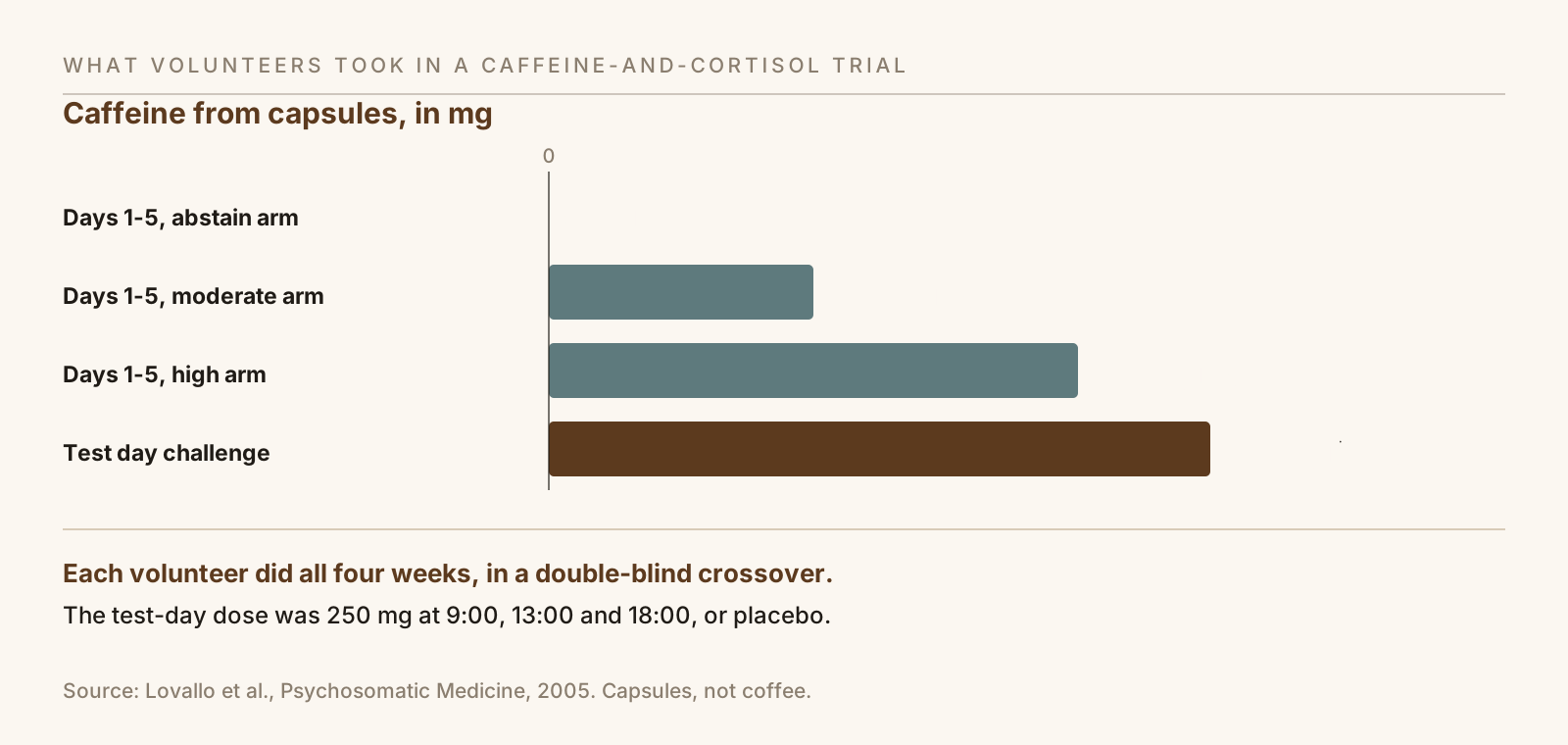
The most useful study I found for this question is a 2005 trial in Psychosomatic Medicine. Researchers recruited 48 men and 48 women and ran a double-blind crossover over four weeks. In each week, the volunteers abstained from dietary caffeine for five days and took capsules instead, totaling 0, 300 or 600 mg a day. On day 6 they took capsules of either 0 or 250 mg at 9:00 AM, 1:00 PM and 6:00 PM, while saliva was collected eight times from 7:30 AM to 7:00 PM.
The findings:
- After five days without caffeine, the test-day doses caused a robust rise in cortisol across the day (p < .0001).
- After five days at 300 or 600 mg a day, the cortisol response to the first 9:00 AM dose was abolished.
- Later in the day, cortisol was elevated again between 1:00 PM and 7:00 PM after the second dose, in those same groups.
- By evening, cortisol had declined to control levels.
The authors’ summary is that the response is reduced, but not eliminated, in healthy young people who consume caffeine daily. So habit blunts the effect. It doesn’t remove it.
Caffeine, stress and exercise
The same lead author ran a 2006 trial with men and women taking 250 mg three times on test days, then doing either a mental stress task or exercise, followed by a meal. Caffeine added to the effect of mental stress, and caffeine taken before exercise raised cortisol in both sexes, even though exercise alone didn’t. Across the day, repeated caffeine doses raised cortisol regardless of sex or type of stressor.
That matters for test mornings because a clinic visit isn’t a calm lab, and many people arrive a little stressed or after a commute. My own inference from those results: stress and caffeine seem to stack, so a nervous morning with a big coffee isn’t the same as a quiet one without. That’s my reading, not something the authors tested in a clinic.
What a 2024 study of habitual drinkers found
A 2024 paper in the same journal looked at two samples of emerging adults, 128 and 148 people, who completed a lab stress task. In both samples, habitual caffeine use, but not same-day caffeine use, predicted heightened cortisol reactivity. The authors also noted that caffeine may mask other influences on the cortisol response.
Keep it in proportion. This is an association in young adults under lab stress, not a controlled trial, and the p-values were modest (.048 and .007). It’s one more sign that caffeine habits and cortisol are tangled together.
What none of this tells you
- None of these studies used coffee. They used capsules, so the dose in your cup is different and varies by brew. Our piece on caffeine’s half-life explains how long a dose stays active.
- None tested a clinical protocol. Labs differ in sample timing, method and reference ranges, and I couldn’t find a single standard instruction for coffee before a cortisol test. I’d rather say that than invent one.
- The volunteers were healthy. That may not match your situation.
- A cortisol rise in a study isn’t a verdict on your result. Interpreting your numbers is your clinician’s job.
Planning the morning
- Ask first. Whether to skip caffeine, and for how long, is the clinic’s call.
- Mind the time of day. If your sample is early in the morning, ask whether you can have anything to drink before it.
- Don’t change everything on the day. If you usually have coffee and are told to skip it, a withdrawal headache can arrive within hours. Our guide to how long caffeine withdrawal lasts covers the typical range.
- Taper beforehand if you’ve been told to stop for longer. Our guide to quitting caffeine without the headache has a schedule.
- Know what’s in the cup. A brew from roasted chicory or barley has no caffeine, so these studies don’t apply to it, but nobody has tested it against a cortisol sample either. See what is chicory coffee for what’s in these brews.
If you’ve seen cortisol mentioned on product labels, our look at adaptogen and cortisol claims is a separate question from the one here. Other appointments with their own instruction sheets are covered in coffee before a fasting blood test and caffeine before a cardiac stress test.
What to ask your clinic
- Should I avoid caffeine before this test, and for how long?
- Does that include decaf, tea and energy drinks?
- Is there a time of day the sample has to be taken?
- Can I drink water beforehand?
- If I’ve already had coffee, should I rebook or tell the lab?
This article is general information, not medical advice. Follow the instructions from your clinic and your clinician.
Sources & further reading
- Caffeine stimulation of cortisol secretion across the waking hours in relation to caffeine intake levels (opens in a new tab) — Psychosomatic Medicine, 2005 (Lovallo et al.)
- Cortisol responses to mental stress, exercise, and meals following caffeine intake in men and women (opens in a new tab) — Pharmacology Biochemistry and Behavior, 2006 (Lovallo et al.)
- Habitual caffeine use is associated with heightened cortisol reactivity to lab-based stress in two samples (opens in a new tab) — Psychosomatic Medicine, 2024
Reader conversation (4)
We read every response. Selected reader notes below.
My saliva kit said nothing about coffee at all, and I only wondered afterward. Good to know to ask next time.
Thanks for saying plainly that you couldn’t find a standard rule. I had three different answers from three websites.
Thank you, Marcus. When sources disagree, the clinic that ordered the test is the one to ask.
I drink two cups before work and never thought about the stress of the commute stacking on top. Useful point.
I was told to skip caffeine for the whole day before mine. Wish I had known to taper first, that headache was rough.
Read this and have a question or something to add? Send us a note. With your OK, we may publish it here with an editor's follow-up. We only publish notes you've said we can.