Does coffee make dental numbing fail? Many dentists believe it, but we found no human trial, and one rat study points the other way
Dentists and patients often blame coffee when numbing doesn't take. We read the one survey, one rat study and two pain-relief reviews to see what's actually known, and what to tell your dentist.


Ask around and someone will tell you their dentist said coffee drinkers need more numbing. It’s the kind of thing that gets repeated in waiting rooms. We went looking for the evidence behind it, partly because anyone planning to cut back on caffeine reasonably wonders whether it matters for their next appointment.
The short answer
- We found no trial in people that tested whether coffee or caffeine changes how well dental numbing works.
- A 2020 survey found the belief is common among patients and clinicians, but it measured beliefs, not numbing.
- The one animal study we found saw the opposite of the belief: rats on months of caffeine had a stronger lidocaine effect.
- Caffeine does show up in pain-relief research, but as an add-on to painkillers, which is a different question.
A belief with a survey behind it
The clearest source for the belief is a 2020 survey in Cureus (opens in a new tab) from a dental school in Riyadh. The authors had noticed patients who reported numbing failing after heavy coffee drinking and needed more than the usual dose. So they asked.
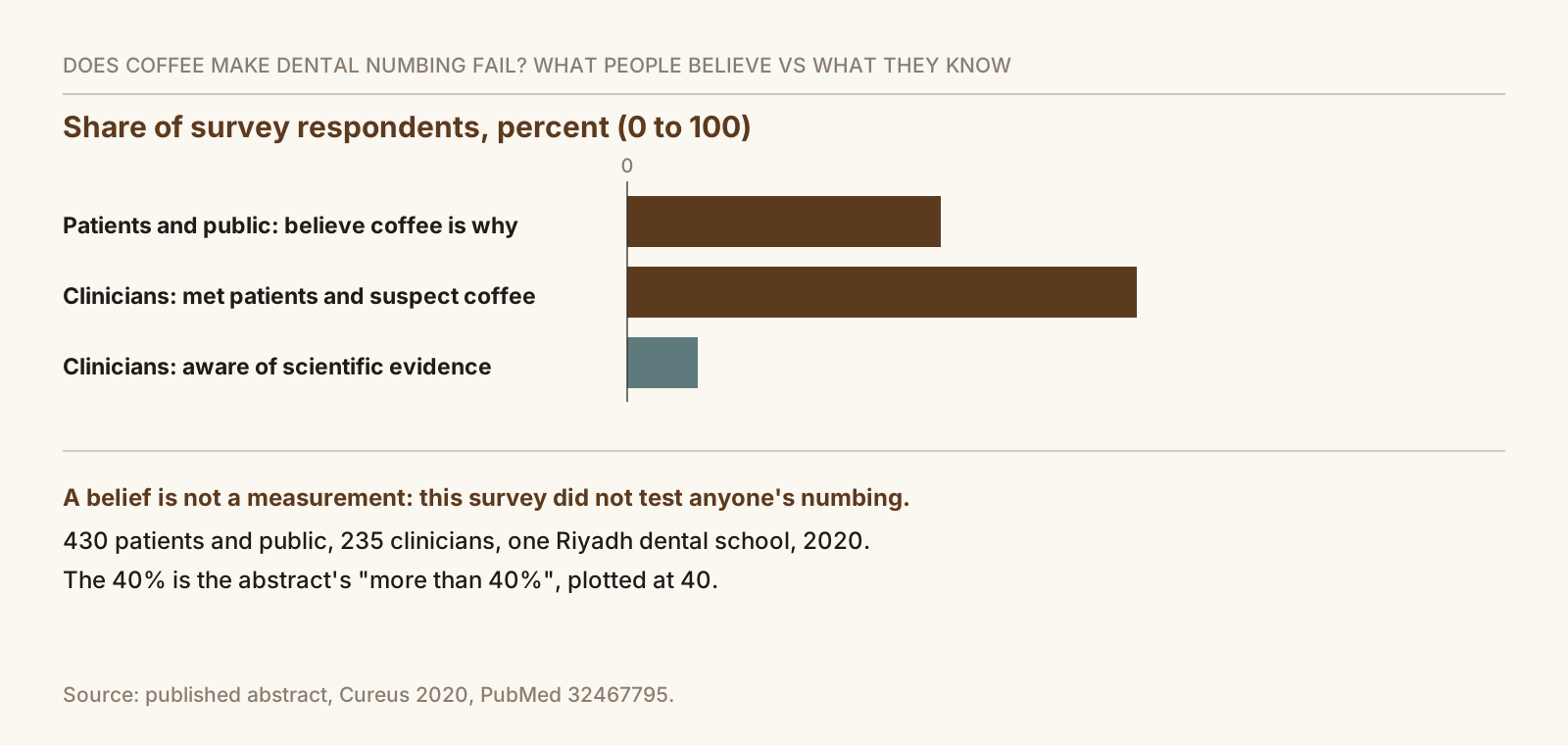
Of 430 patients and members of the public, more than 40% believed excessive coffee was behind failed numbing. Of 235 clinicians, 65% said they’d met patients with failed numbing and thought coffee could be the reason. Only 9% of clinicians knew of any scientific evidence on the question.
That last number is the useful one. The authors themselves wrote that the available science relates mainly to caffeine’s effect on alertness, and to poor sleep causing stress, which they proposed partly explains the failures. That’s their suggestion, not something the survey tested. Their practical conclusion was that dentists should make stress reduction routine.
Our reading: this is a good account of what people think, and a reason to take a patient’s report seriously. It isn’t evidence about the drug.
The rat study that points the other way
The nearest thing to a direct test we found is a 2022 study in Pain Research and Management (opens in a new tab). Researchers gave rats caffeine as a habit over 10 to 12 weeks, injected lidocaine into a paw, and then tested how well the rats felt pressure and heat at 30, 60 and 90 minutes.
The result ran against the folk belief. Rats on habitual caffeine plus lidocaine had a stronger numbing effect than rats on lidocaine alone, at some time points, for pressure and for heat. The authors also reported higher activity of genes for certain sodium channels in the nerve tissue, and proposed that as the mechanism.
Why we don’t hand you a verdict from this:
- It’s rats, not people, with a paw injection, not a dental nerve block.
- The effect showed at some time points, not all of them.
- The caffeine was given for weeks, which says nothing about one cup that morning.
- We read the abstract, not the full paper.
What it does show is that the belief isn’t a settled fact in either direction. A single animal result and a survey don’t settle it for you.
Caffeine in the painkiller aisle
Caffeine appears in dentistry in another way, and the two get mixed up. A Cochrane review of caffeine as an add-on to painkillers (opens in a new tab) pooled randomized trials where people took a painkiller with or without 100 mg or more of caffeine. Many of the pain conditions studied were pain after dental surgery. About 5% to 10% more people reached a good level of relief with caffeine added, which the reviewers called small but important, with a number needed to treat of about 14.
Our arithmetic, not theirs: a number needed to treat of 14 means you’d treat about 14 people with the add-on for one extra person to reach good relief. That’s a modest effect.
A 2019 systematic review (opens in a new tab) narrowed to dental pain found only three controlled trials of acetaminophen plus caffeine, and said clinical recommendations couldn’t be made from so few. This is about pain after the appointment, taken as a pill, which tells you nothing about numbing during it.
One more study is worth knowing about because it’s the cheerful one. In a 2021 trial in Scientific Reports (opens in a new tab), people having a dental cleaning breathed either roasted-coffee aroma or a sham scent. Stress markers in saliva fell in the coffee-aroma group and rose in the sham group, and pulse rates were lower. Smelling coffee isn’t the same as drinking it, but it’s a reminder that a warm roasted smell can do some work on its own, which matters if you’re trading the cup for a caffeine-free brew.
Before your appointment
None of this studied people cutting back, so these are practical suggestions from us, not study results:
- Tell the dentist how much caffeine you usually have. It’s one more detail about you, and if numbing has failed before, say so.
- Don’t change your routine on a guess. The evidence doesn’t say a skipped cup helps. If skipping makes you headachy, which our piece on caffeine withdrawal covers, that may cost you more than it saves.
- Mind the whitening and stain questions separately. That’s a different issue, covered in coffee while whitening your teeth.
- Fasting or sedation visit? Different rules apply. Our look at caffeine before surgery covers what clinics usually ask, and your instructions come first.
- Try a warm swap. Our guide to caffeine-free alternatives lists roasted-grain and chicory options that keep the ritual.
If numbing didn’t work last time, or you take any medicine that your dentist should know about, that conversation is worth more than anything here.
The bottom line
Coffee making dental numbing fail is a widely held belief with a survey behind it and, as far as we found, no human trial. The one animal study leaned the other way. So the honest answer is that nobody has shown it either way, and your dentist’s view of your own mouth beats a rule of thumb. Tell them about your caffeine, and don’t skip a cup based on a hunch.

Sources & further reading
- The Association Between Coffee Consumption and Local Anesthesia Failure: Social Beliefs and Scientific Evidence (opens in a new tab) — Cureus, 2020
- Caffeine Consumption Influences Lidocaine Action via Pain-Related Voltage-Gated Sodium Channels: An In Vivo Animal Study (opens in a new tab) — Pain Research and Management, 2022
- Caffeine as an analgesic adjuvant for acute pain in adults (opens in a new tab) — Cochrane Database of Systematic Reviews, 2014
- Efficacy and safety of acetaminophen and caffeine for the management of acute dental pain: A systematic review (opens in a new tab) — Saudi Dental Journal, 2019
- The calming effect of roasted coffee aroma in patients undergoing dental procedures (opens in a new tab) — Scientific Reports, 2021
Reader conversation (4)
We read every response. Selected reader notes below.
My dentist told me years ago that I would need extra numbing because of my coffee habit, and I have always believed it. Interesting that the only real test is in rats and goes the other way.
It surprised me too, Carla. One rat study is thin, so I would not read it as proof either, but it does mean the belief is not settled.
The 9% number is the one that got me. Most clinicians had the belief and almost none knew of any research behind it.
I get jumpy in the chair if I have had coffee, so I skip it before appointments now. Not about the numbing, just the nerves. Good to see the aroma study mentioned.
Told my dentist how much I drink after reading this. She said she appreciated knowing and made a note. Small thing, but it was an easy conversation.
Read this and have a question or something to add? Send us a note. With your OK, we may publish it here with an editor's follow-up. We only publish notes you've said we can.