Does caffeine make you grind your teeth? Reviews link heavy coffee drinking to more grinding, on limited evidence
What reviews of the research say about caffeine and nighttime teeth grinding: a modest link for heavy coffee drinkers, shaky measurement, and no study of what happens when you cut back.


If you wake with a sore jaw or a partner who hears you grinding at night, it’s natural to look at what you do all day. Coffee is an easy suspect. We read the reviews to see how much support the idea has.
The short answer
- A 2016 systematic review found a link between heavy coffee drinking and reported nighttime grinding, but only one of its seven studies looked at coffee, and the authors called the evidence limited.
- Later reviews list caffeine among factors “consistently associated” with grinding, but also say inconsistent findings and weak measurement make firm conclusions hard.
- Two large population studies didn’t report self-reported caffeine intake among the factors linked to grinding.
- We found no study that asked whether cutting back caffeine changes grinding.
What the reviews found
The 2016 review in the Journal of the American Dental Association (opens in a new tab) pooled 7 studies with between 51 and 10,229 participants. Nighttime grinding was linked most strongly to alcohol and tobacco. For coffee, the authors noted a positive but weak association for heavy drinkers in one study: odds rose almost 1.5 times for people drinking more than 8 cups a day, against almost 2 times for alcohol and more than 2 times for current smokers.
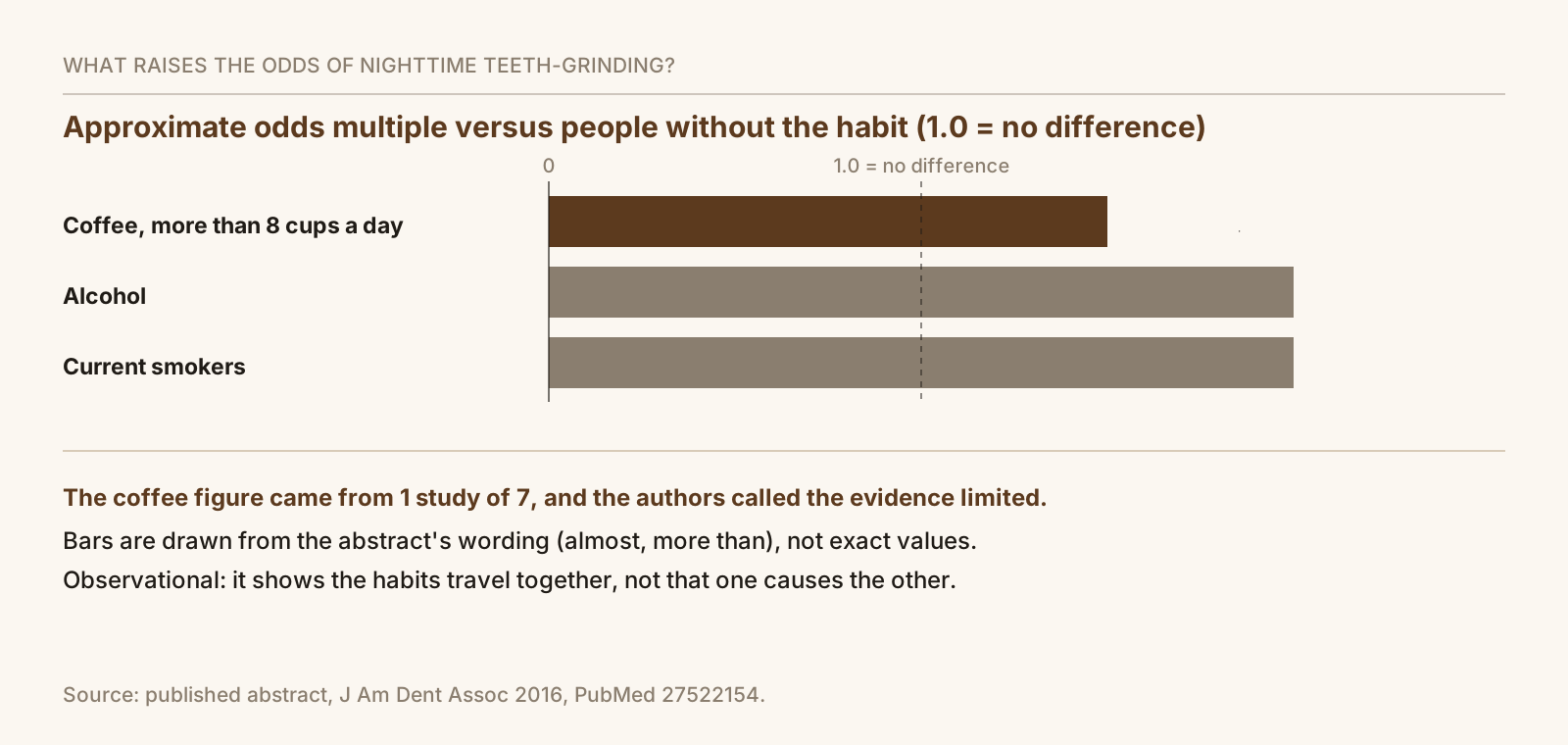
Eight cups a day is well beyond what most people drink, so this says little about a daily mug or two. The authors concluded that, on limited evidence, grinding was associated with alcohol, caffeine and tobacco, and that stronger studies are needed.
A 2019 umbrella review in the Journal of Oral Rehabilitation (opens in a new tab) gathered 41 systematic reviews. It reported alcohol, caffeine, tobacco and some medications among factors consistently associated with grinding, while also describing the associated factors as “considerably heterogeneous and inconsistent.” A 2021 consensus statement (opens in a new tab) said there is moderate evidence for associations with stress and mood as well as caffeine, alcohol and smoking.
Why it’s hard to pin down
Three things keep the picture blurry.
Measurement. A 2024 study in the Journal of Sleep Research (opens in a new tab) followed 915 adults in São Paulo who slept overnight in a lab and answered questions, including about caffeine. Self-reported grinding was tied to sex, mood-related measures and sleep trouble, but grinding confirmed by the overnight recording was not tied to any of the factors tested. Caffeine wasn’t among the associations the abstract reports. A 2022 registry study of 2,251 people, built on questionnaires, likewise names a mood-related factor, not caffeine, for self-reported grinding. If people’s own reports and the sleep lab disagree, a link built on reports deserves caution.
Cause and effect. Everything above is observational. Our reading: people who sleep badly or feel stressed may both drink more coffee and grind more, so coffee could be a bystander. A 2024 narrative review (opens in a new tab) says the scarcity of controlled studies doesn’t allow a causal or time-order claim for caffeine and these related factors.
Rarity of tests. We found no trial that gave people caffeine, or took it away, and watched grinding. The studies also didn’t separate decaf, and none looked at herbal coffees. We read abstracts, not full papers.
If you’re cutting back
The research can’t tell you that less caffeine will quiet your jaw, so what follows is practical, not a study result:
- Start with your dentist. The 2019 umbrella review judged mouth guards effective for managing grinding, and evidence for other approaches weak. Wear on teeth is something to have looked at whatever you drink.
- Try a late-day cutoff first. Caffeine’s effect on sleep is better documented than its effect on grinding. See our look at how long caffeine stays in your system and the piece on sleep architecture.
- Taper if you quit. Withdrawal headaches and poor sleep in the first days can muddy what you notice. Our taper guide has a schedule.
- Keep a short log. Note cups, bedtime and jaw soreness for two weeks. It’s your own small experiment, with all the limits of one.
- Swap the ritual, not just the cup. A warm roasted-grain or chicory drink fills the habit. Our guide to caffeine-free alternatives lists options, and our piece on coffee and teeth whitening covers another reason people talk to a dentist about coffee.
If you have jaw pain, headaches on waking or chipped teeth, get it checked rather than managing it through your cup.
The bottom line
Reviews connect heavy coffee drinking with more nighttime grinding, but the coffee evidence is thin, self-reports and sleep-lab recordings don’t always agree, and nobody has tested what happens when you cut back. A late-day cutoff is a reasonable low-cost experiment. A dentist’s view of your teeth is the step with the most support.

Sources & further reading
- Association between sleep bruxism and alcohol, caffeine, tobacco, and drug abuse: A systematic review (opens in a new tab) — Journal of the American Dental Association, 2016
- Bruxism: An umbrella review of systematic reviews (opens in a new tab) — Journal of Oral Rehabilitation, 2019
- Bruxism: Best Evidence Consensus Statement (opens in a new tab) — Journal of Prosthodontics, 2021
- Network analysis of sleep bruxism in the EPISONO adult general population (opens in a new tab) — Journal of Sleep Research, 2024
- Secondary bruxism: A valid diagnosis or just a coincidental finding of additional masticatory muscle activity? A narrative review of literature (opens in a new tab) — Journal of Oral Rehabilitation, 2024
Reader conversation (4)
We read every response. Selected reader notes below.
My dentist found wear on my back teeth last spring and I immediately blamed my third cup of coffee. Good to see how thin the coffee evidence actually is. The night guard has done more for me than anything.
That fits what the reviews say, Dana: the mouth guard is the best-supported step. Your dentist can tell you more about your own teeth than any study can.
The point about self-report versus the sleep lab is interesting. My wife says I grind, but I’ve never been recorded doing it.
I cut my afternoon coffee and my jaw felt less sore after a few weeks, but I was also sleeping better, so I can’t say which did it. Your two-week log idea is a fair way to look at it.
Eight cups a day is wild. Nice that the chart says plainly it’s one study.
Read this and have a question or something to add? Send us a note. With your OK, we may publish it here with an editor's follow-up. We only publish notes you've said we can.