Do you have to give up coffee while whitening your teeth? A 2025 review says a pigment-free diet wasn't needed, with limits
A 2025 review of seven clinical studies found coffee, tea, cola and red wine didn't change how well in-clinic whitening worked. What that does and doesn't cover, and why fillings are a separate question.


If you’ve just booked a whitening treatment, the instruction sheet may say to avoid coffee, tea and red wine for a while. That’s a lot to ask of a morning routine. We looked for what clinical research says about whether it matters.
The short answer
- A 2025 review of seven clinical studies found coffee didn’t significantly change how well in-clinic whitening worked.
- The same review found the same for black tea, cola, grape juice, red wine and an unrestricted diet.
- That is about whitening results. It isn’t a claim that coffee never stains anything.
- Fillings and crowns are a separate question, and lab tests show some materials change color more than others.
What the whitening review found
The review in the Journal of Dentistry (opens in a new tab) pooled seven clinical studies, four randomized and three not, that compared people on a “white diet” (no strongly colored food or drink) with people who drank pigmented drinks or ate normally during bleaching. The authors rated all seven as low risk of bias and the evidence as moderate quality.
Their finding: color change was similar across the white-diet group and the groups drinking grape juice, coffee, tea, wine or cola, or eating without restriction (p > 0.05). Their conclusion was that restricting dietary pigments during bleaching isn’t essential.
We read the abstract, not the full paper, so we can’t tell you how long each study ran, how much coffee people drank, or which bleaching product was used.
What it doesn’t cover
A few limits are worth holding on to:
- It measures how well the bleaching worked. Our reading, not the authors’: a similar result at the end doesn’t tell you every reason an aftercare sheet might give for a rule, so ask if you’re unsure.
- It’s seven studies. That is a decent pile for dentistry, but not a huge one.
- Your dentist knows your product. Different treatments come with different aftercare. If yours says to avoid coffee for a set period, follow it, and ask why if you’re curious.
- No herbal drinks. The studies tested coffee, tea, cola, grape juice and wine. We found nothing on chicory, carob or other roasted-grain drinks, so we can’t say they behave differently, in either direction.
If you’re weighing a switch for other reasons, our guide to quitting caffeine without the headache covers the taper.
Fillings are a separate question
Natural enamel isn’t the only thing in your mouth that can change color. A 2025 systematic review in Cureus (opens in a new tab) pooled eight lab studies of tooth-colored restorative materials soaked in Arabic coffee and black tea. It measured color change on a scale called delta-E, where larger numbers mean a bigger change.
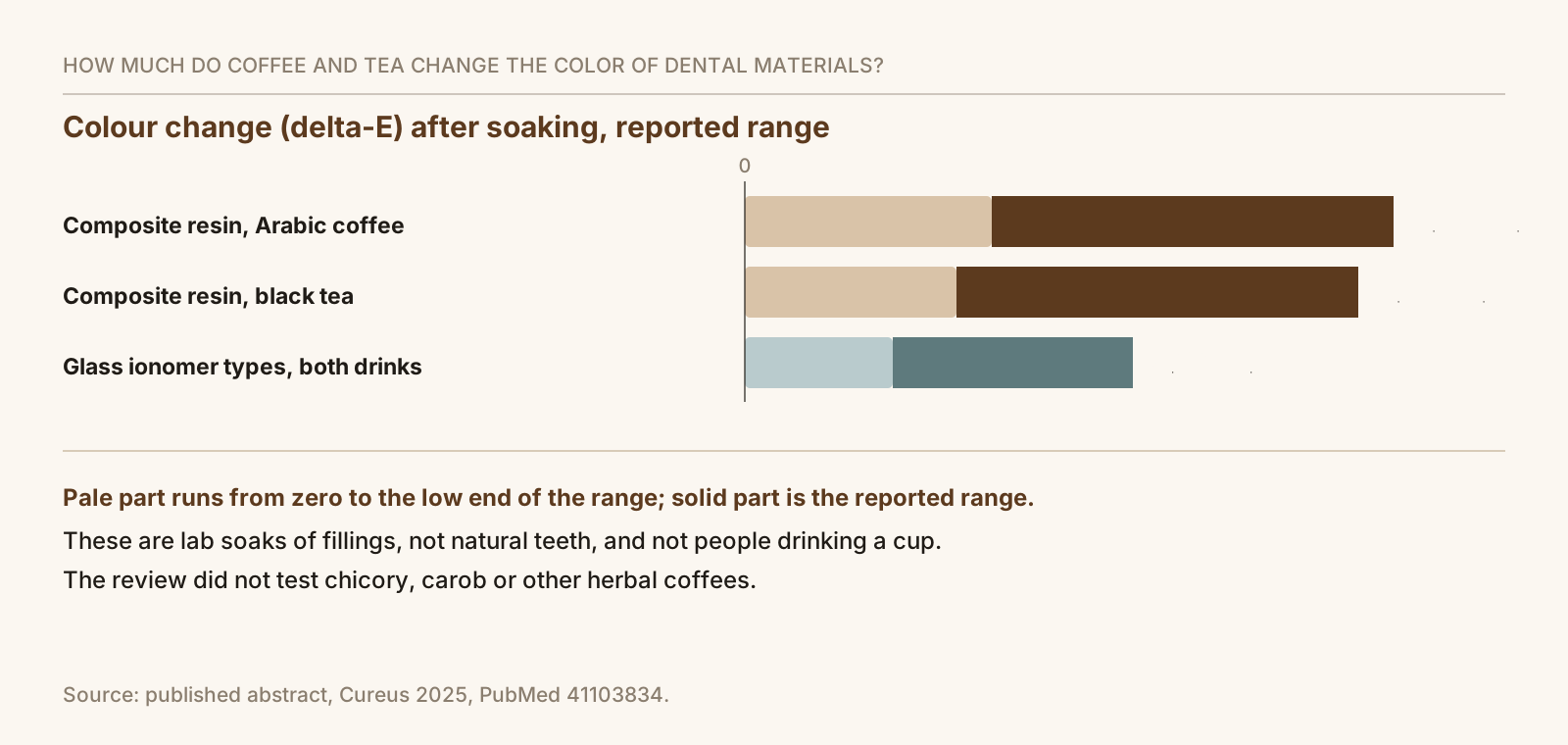
The review reported that composite resins, particularly nanohybrid composites, changed the most: 3.5 to 9.2 for Arabic coffee and 3.0 to 8.7 for black tea. Glass ionomer cements and resin-modified versions ranged from 2.1 to 5.5. The authors suggested those may suit people who drink a lot of staining beverages, and called for studies in real mouths.
Two cautions from us. These are soaks of material samples, so they overstate or understate what happens with a morning cup. And coffee wasn’t the only culprit: black tea sat in nearly the same range. If you have tooth-colored fillings, ask your dentist what they’re made of.
If you’d rather switch anyway
Some people will skip coffee for a week after whitening just to be safe, and that’s reasonable. A few practical points, none from the studies above:
- Rinse with water afterward. It’s a low-effort habit, and your dentist can tell you whether to add anything else.
- Check the color of what you switch to. A dark roasted chicory or grain drink is dark in the cup. The research here didn’t test those, so treat them like any dark drink.
- Use a straw for iced drinks if you like. Again, our suggestion, not a studied result.
Our guide to caffeine-free alternatives has a range of options if you want to try something different, and our look at what chicory coffee is explains the most common base.
The bottom line
For in-clinic whitening results, one 2025 review of seven clinical studies found coffee didn’t significantly change the outcome, so a strict pigment-free diet may not be essential. For fillings, lab tests suggest material type matters. We found no evidence either way on herbal coffees. When your dentist’s aftercare sheet and a review disagree, follow the sheet, and ask them why.

Sources & further reading
- White diet is not necessary during dental bleaching treatment: A systematic review and network meta-analysis of clinical studies (opens in a new tab) — Journal of Dentistry, 2025
- Color Stability of Tooth-Colored Restorative Materials After Exposure to Arabic Coffee and Black Tea: A Systematic Review (opens in a new tab) — Cureus, 2025
Reader conversation (4)
We read every response. Selected reader notes below.
My dentist handed me a sheet saying no coffee for two days and I wondered if it was really necessary. Good to know the research is more relaxed, though I’ll still follow the sheet.
That’s the right call, Dana. The sheet is written for your product, and the review can’t speak to that.
Had no idea fillings could change color differently. I have a couple of white ones, so I’ll ask next visit.
Appreciate the line about herbal coffees not being tested. I drink a chicory blend and wondered.
Black tea looking nearly the same as coffee in the chart surprised me.
Read this and have a question or something to add? Send us a note. With your OK, we may publish it here with an editor's follow-up. We only publish notes you've said we can.