Does caffeine weaken your bones? What the calcium research shows
A review says caffeine's effect on calcium is very small, one study found extra bone loss only in women with low calcium intake, and a meta-analysis found fracture risk went up in women and down in men. Here is what the research does and doesn't show.

Ask around about caffeine and you’ll hear that it “leaches calcium” and weakens bones. I wanted to know how much of that holds up, so I read four papers that between them cover the physiology, a close-up look at one group of women, a very large cohort, and a pooled analysis of 15 studies. The short version is that the effect, where there is one, looks small and depends heavily on how much calcium you’re getting.
The short answer
The research does not support the idea that moderate caffeine is a major threat to bone. A 2002 review found that caffeine has a very small effect on calcium absorption that a little milk can offset. One study found extra bone loss at high caffeine intakes only in women eating less calcium than recommended. A large Swedish cohort found a small reduction in bone density at four or more cups a day, but no higher rate of fractures. A pooled analysis found slightly higher fracture risk in women and lower risk in men at the highest coffee intakes, and its authors asked for better studies.
Nothing here says caffeine is good for bones, and none of it settles the question for any one person. But “caffeine rots your bones” isn’t what the evidence shows.
What caffeine does to calcium
The idea has a real physiological root. In 2002, Robert Heaney of Creighton University reviewed the evidence in Food and Chemical Toxicology. He noted that caffeine-containing drinks have been linked to lower bone mass and higher fracture risk in some, but not most, observational studies. Controlled studies of what the body actually does, he wrote, show “a clear but only a very small depressant effect” of caffeine itself on calcium absorption in the intestine, and no effect on total 24-hour urinary calcium excretion.
He also suggested a reason the observational studies might mislead. People who drink more coffee tend to drink less milk, so a high caffeine intake may often be a marker for a low calcium intake. In his reading, the small absorption effect could be fully offset by as little as one to two tablespoons of milk, and the studies implicating caffeine were all in populations eating less calcium than ideal. His conclusion was that there’s no evidence of harm to bone or the calcium economy in people who get the recommended amounts.
That is one researcher’s synthesis from 2002, not the last word. But it frames everything that follows: calcium intake keeps turning out to be the variable that matters.
The study that found extra bone loss
The best-known study behind the worry is a 1994 paper in the American Journal of Clinical Nutrition by Susan Harris and Bess Dawson-Hughes at Tufts. They followed 205 healthy, nonsmoking postmenopausal women for a year, measuring bone density at the spine and whole body and estimating diet from a food-frequency questionnaire.
Among women whose calcium intake was above the group median of 744 mg a day, bone change did not differ by caffeine intake. Among women who ate less calcium than that, the highest-caffeine group (over 450 mg a day) lost significantly more bone than women in the lower caffeine groups.
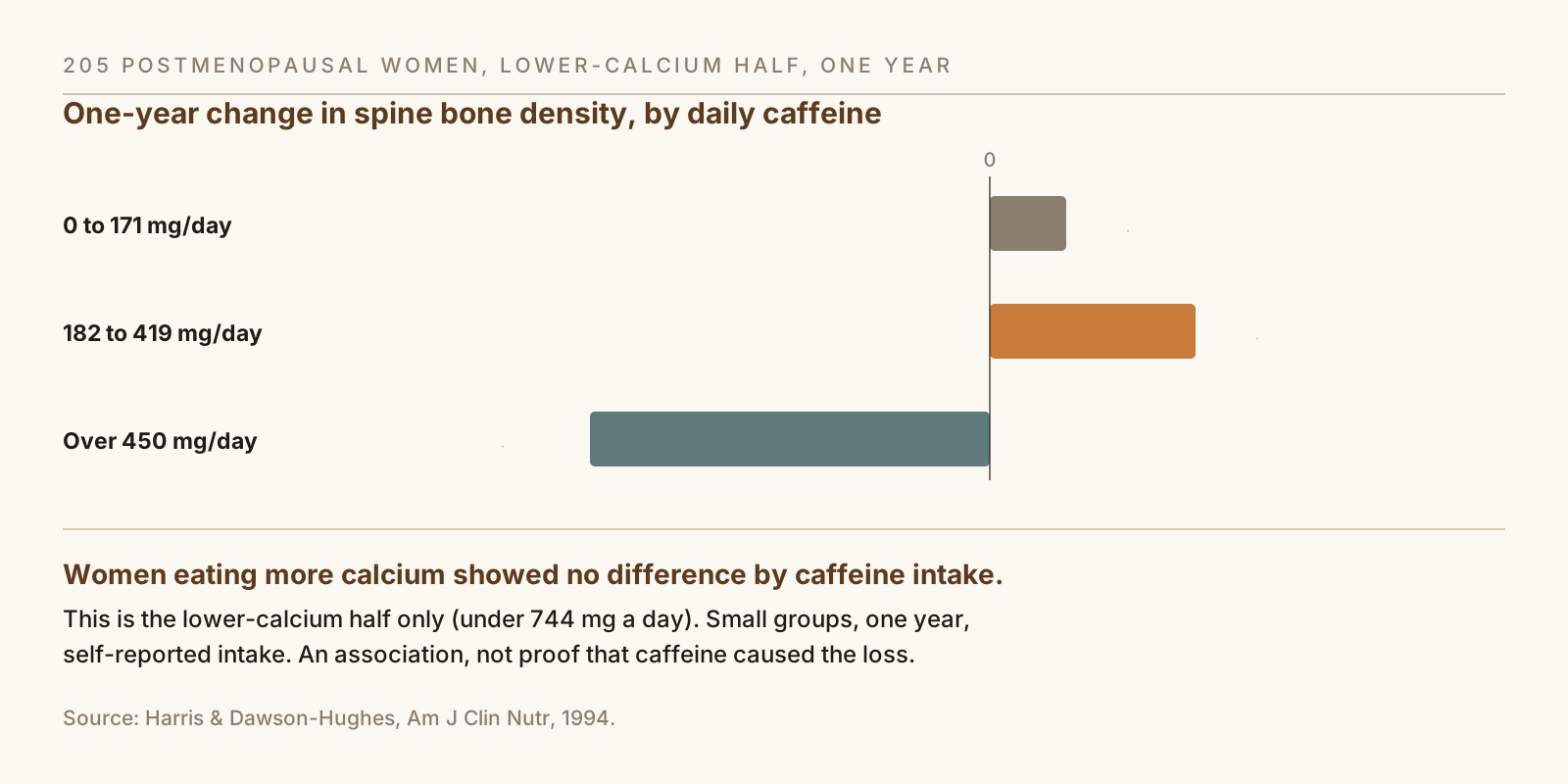
The authors estimated that caffeine at or above what you’d get from about two to three servings of brewed coffee “may accelerate bone loss” in women whose calcium intake is below the recommended 800 mg a day. Note the wording: may, and below the recommended intake. This was an observational study of a small group over one year, and the lower-calcium half was split into thirds, so each caffeine group was small. The spine measurements also varied a lot from woman to woman (the published standard deviations are larger than the differences between groups), which is a reason to hold the result loosely.
A 61,000-woman cohort
A much bigger study looked at coffee specifically. The Swedish Mammography Cohort followed 61,433 women born between 1914 and 1948 from 1987 to 2008, asking about coffee repeatedly through food-frequency questionnaires. During that time 14,738 women had a fracture of some kind, and 3,871 had a hip fracture. A subgroup of 5,022 women also had bone density measured.
The researchers, writing in the American Journal of Epidemiology in 2013, found no evidence of a higher rate of any fracture (hazard ratio of 0.99 per 200 mL of coffee, 95% confidence interval 0.98 to 1.00) or of hip fracture (0.97, 0.95 to 1.00) as coffee intake rose. Women drinking four or more cups a day did have 2% to 4% lower bone density than those drinking under a cup, depending on the body site. But the odds ratio for osteoporosis was only 1.28, with a confidence interval of 0.88 to 1.87, which includes no difference at all. Their summary: a small reduction in bone density that did not translate into more fractures.
Two things to keep in view. This studied coffee, not caffeine alone, so it can’t separate caffeine from everything else coffee contains. And it was women in Sweden, so it tells us little about men or other populations.
Pooling the studies: women and men differ
A 2014 systematic review and dose-response meta-analysis in Bone pooled 15 studies (9 cohort, 6 case-control) with 253,514 participants and 12,939 fracture cases. At the highest level of coffee intake compared with the lowest, the pooled relative risk of fracture was 1.14 (95% CI 1.05 to 1.24) in women and 0.76 (95% CI 0.62 to 0.94) in men. In women, the dose-response estimates were 1.02 at two cups a day and 1.54 (95% CI 1.19 to 1.99) at eight cups.
That is a modest increase in women at typical intakes and a larger one at very high intakes, alongside an apparent decrease in men. The authors’ own conclusion was cautious: they said future well-designed studies should confirm these findings. I would read it the same way. A pooled analysis of mostly observational studies can be skewed by what each study measured and adjusted for, and the opposite-direction result in men is the kind of thing that makes you wonder what is going on beyond coffee. The sex difference is a reason to be curious, not a conclusion.
What these studies can’t tell you
- Most of it is observational. People who drink a lot of coffee differ from those who don’t in diet, smoking, activity and more. Questionnaires and statistical adjustment can’t fully remove that.
- Coffee is not caffeine. Several of these studies measured coffee. They can’t separate caffeine from the many other compounds in the cup.
- Bone density isn’t fracture. The Swedish cohort found a small density difference that did not show up as more fractures.
- Most of the work is in women, often older women. What it means for younger adults, for men, or for teenagers is less clear.
- The “calcium offset” idea is a hypothesis. Heaney argued it from controlled studies and the pattern of milk intake, but a trial of caffeine and fractures with calcium varied on purpose is not something we found.
If you’re cutting back anyway
If you have been told your bone density is low, or you’re past menopause and thinking about it, a few practical points follow from the research. None of them is medical advice.
- Calcium intake is the recurring theme. Every study above that found a signal found it where calcium was lowest. Your clinician or a registered dietitian can tell you what’s right for you.
- Taper rather than stop. If you do decide to cut caffeine, a gradual step-down reduces withdrawal. Our guide to quitting caffeine without the headache lays out a schedule, and what to drink during withdrawal covers the in-between.
- Mind the other absorption interactions. Caffeine and coffee also interact with iron and with some medications. Our pieces on caffeine and iron absorption and on how plant compounds affect what you absorb cover those.
- Menopause may be the reason you’re asking. If so, our look at caffeine and hot flashes covers a related question.
If you want a warm cup that isn’t caffeinated, roasted-chicory-and-carob herbal coffees are one option. Teeccino’s French Roast (opens in a new tab) is one of several, alongside Pero and Dandy Blend. It is caffeine-free but contains barley, so it is not gluten-free, and it contains almonds, so check the label for your own needs. No herbal coffee has been shown to do anything for bones, and swapping drinks does not replace calcium from food. Our herbal coffee versus decaf comparison explains the caffeine difference.
The bottom line
The best-supported reading is a modest one. Caffeine has a very small effect on how much calcium you absorb. In the one study that found extra bone loss, it appeared only in women eating less calcium than recommended. A large cohort found slightly lower bone density at four or more cups a day without more fractures. A pooled analysis found higher fracture risk in women at the highest coffee intakes and lower risk in men, and called for better studies.
So the evidence argues against both extremes: caffeine is not a proven bone-wrecker, and it is not proven harmless at very high intakes. If bone health is a particular concern for you, calcium intake and your clinician’s advice matter more than a number of cups. For more on what caffeine does over a day, the half-life explainer is a good next read.
This article is educational and is not medical advice. Questions about your own bone health, calcium intake or caffeine belong with your doctor or a registered dietitian.
Sources & further reading
- Effects of caffeine on bone and the calcium economy (opens in a new tab) — Heaney RP, Food and Chemical Toxicology, 2002
- Caffeine and bone loss in healthy postmenopausal women (opens in a new tab) — Harris SS, Dawson-Hughes B, American Journal of Clinical Nutrition, 1994
- Long-term coffee consumption in relation to fracture risk and bone mineral density in women (opens in a new tab) — Hallström H, Byberg L, Glynn A, Lemming EW, Wolk A, Michaëlsson K, American Journal of Epidemiology, 2013
- Coffee consumption and risk of fractures: a systematic review and dose-response meta-analysis (opens in a new tab) — Lee DR, Lee J, Rota M, Lee J, Ahn HS, Park SM, Shin D, Bone, 2014
Reader conversation (4)
We read every response. Selected reader notes below.
My GP mentioned cutting back on coffee after my bone scan and I never knew whether that was evidence or habit. Good to see that calcium keeps coming up as the thing that matters. I’ll ask her about it at my next review.
That’s a sensible question to bring. The studies describe groups, so your GP’s view of your own scan and diet is worth more than any average here.
The men-versus-women split is the part that stuck with me. Thank you for not pretending to explain it.
I’m 58 and drink about three cups a day. I’d assumed the calcium thing was settled fact. The note about how small the groups were in that 1994 study was a helpful reality check.
Heaney’s point about milk intake being the hidden variable makes a lot of sense. In my house the people who drank the most coffee drank the least of everything else.
It’s a hypothesis rather than a proven explanation, but it fits how often calcium intake turns up in these results.
Have something to add? Email us and we may include it in a future update.