Does coffee cause gout? The research points the other way, and decaf shows the same pattern
Large studies link regular coffee, and decaf too, to a lower risk of gout, not a higher one. Here is what the research found, where it disagrees with itself, and why it isn't a reason to start drinking coffee.

If you have gout, or a parent who does, someone has probably told you to cut back on coffee. I wanted to see whether that advice rests on anything. I read five papers: a large Harvard cohort, two pooled analyses, a genetics-based study, and a review. The surprise is the direction. The research I found leans the opposite way from the warning.
The short answer
Large observational studies link higher coffee intake to a lower risk of gout, not a higher one. In the biggest cohort, men drinking four or more cups a day had roughly 40% to 59% lower risk than non-drinkers. Decaf looked protective too, and tea and total caffeine did not, which hints that caffeine isn’t the whole explanation.
That is not a reason to start drinking coffee. These studies can’t show that coffee prevents gout, and they say nothing about what’s right for someone who already has it. But “coffee causes gout” is not what the evidence shows.
Why people worry
The worry has a plausible root. Gout happens when uric acid crystals build up in a joint, and diet advice has long focused on foods and drinks that raise uric acid. Coffee, as a “stimulating” drink, often gets lumped in. A 2008 review by Hak and Choi noted that the evidence had moved: the drinks most clearly tied to higher risk were sugar-sweetened soft drinks and fructose, while coffee looked inversely related. Alcohol is the other consistent culprit. A 2018 pooled analysis found the odds of gout were about 2.6 times higher with alcohol and about 2.1 times higher with fructose.
The study of 45,869 men
The study everyone cites comes from Hyon Choi, Walter Willett and Gary Curhan. In 2007 they reported on 45,869 men with no history of gout, followed for 12 years in the Health Professionals Follow-Up Study. Coffee, decaf, tea and total caffeine were assessed by questionnaire every four years, and 757 men developed confirmed gout.
After adjusting for other risk factors, more coffee went with lower risk.
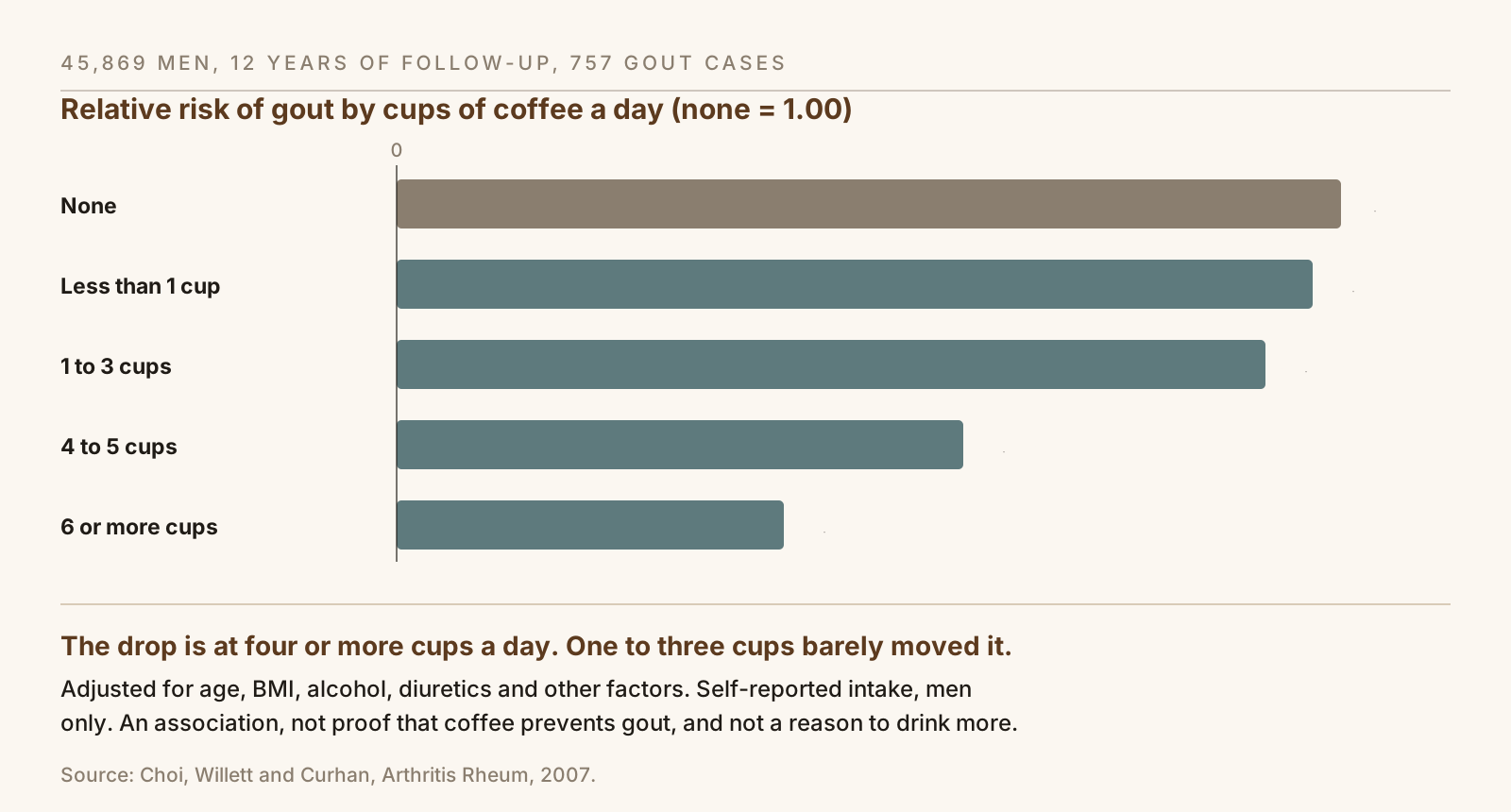
The pattern is not a smooth slope. Under one cup a day barely moved the number (0.97), and one to three cups only a little (0.92). The drop showed up at four to five cups (0.60, 95% confidence interval 0.41 to 0.87) and six or more (0.41, 0.19 to 0.88). The top group was small, which is why that last interval is wide.
For decaf, the relative risks were 0.83 for under one cup, 0.67 for one to three cups, and 0.73 for four or more (0.46 to 1.17). Total caffeine from all sources and tea were not associated with gout risk.
Pooling the studies
A 2016 systematic review in BMJ Open pooled 11 observational studies (six cross-sectional, three cohort, two case-control). For gout, the pooled relative risk for the highest coffee category versus the lowest was 0.43 (95% CI 0.31 to 0.59). The authors were careful, though: they said the number of studies was limited and that better prospective research and randomized trials were needed.
A 2018 meta-analysis of dietary factors in Asia Pacific Journal of Clinical Nutrition reported an odds ratio for gout of 0.47 for coffee (95% CI 0.37 to 0.59), and found dairy and soy foods leaned the same way. Two analyses, then, landing in the same neighborhood.
Is it the uric acid?
You might expect coffee to work by lowering uric acid. The evidence is murkier than that. The 2016 pooled analysis found no significant difference in serum uric acid between the highest and lowest coffee groups, and no significant difference in the odds of high uric acid either. So the gout link was clearer than the uric-acid link.
The 2018 analysis added a wrinkle: coffee was associated with lower odds of high uric acid in men but higher odds in women (odds ratio 1.58, 95% CI 1.16 to 2.16). Nobody I read could explain that, and I won’t guess.
A 2022 study in ACR Open Rheumatology tried to get past the “people who drink coffee are different” problem using genetics, an approach called Mendelian randomization. In Japanese data, habitual coffee drinking was inversely associated with gout, and the link held after adjusting for uric acid levels (odds ratio 0.50). But in the earlier European datasets, the authors found no significant link once they accounted for heterogeneity. That is a real disagreement, and it’s the kind of thing a single headline hides.
Is it the caffeine?
In the 2007 cohort, decaf tracked with regular coffee, while tea and total caffeine showed no link. If caffeine were the active ingredient, you would expect total caffeine to show something. It didn’t. So the honest reading is that nobody has pinned down the mechanism. It could be other compounds in coffee, or something about the kind of person who drinks it. I’d rather say that plainly than pick a favorite. If you are curious how much caffeine remains in decaf, we have a piece on that.
What these studies can’t tell you
- They’re observational. People who drink a lot of coffee differ from people who don’t in ways questionnaires can’t fully capture.
- Intake was self-reported. Food-frequency questionnaires are useful at scale and imprecise for any one person.
- The biggest cohort was men. The 2007 study followed male health professionals. How far the result carries to women is not something that paper settles.
- They measure who developed gout. The work we read looked at new cases, not flares in people who already have gout, so it doesn’t answer “can I drink this during an attack?”
- The genetics evidence is mixed. One analysis supported a protective link, and its European comparison didn’t.
If you have gout, or are cutting back
None of this is medical advice, but a few practical points follow.
- Sugar and alcohol are the better-supported targets. The drinks that kept showing up on the risk side were sweetened soft drinks, fructose and alcohol, not coffee.
- Quitting caffeine doesn’t look like a gout-prevention move. Nothing here suggests you should drink coffee for gout either. If you are stopping for sleep, anxiety or another reason, a gradual step-down avoids most of the withdrawal. Our guide to quitting caffeine without the headache lays one out.
- Watch what replaces it. Sweetened drinks are the thing to be careful of, so a sugary substitute isn’t a neutral swap. Our look at herbal coffee versus decaf explains how those options differ on caffeine.
- Herbal coffees are an open question. Caffeine-free blends built on roasted chicory, carob or barley are popular substitutes, but we didn’t find gout research on them. If you are managing gout, check with your clinician or dietitian before making one a daily habit.
- Other body systems have their own caffeine stories. Does coffee cause kidney stones? and does coffee raise your cholesterol? cover two more questions people ask.
The bottom line
The best available evidence doesn’t back the idea that coffee causes gout. A large cohort found lower risk at four or more cups a day, two pooled analyses found about half the odds in the highest coffee groups, and decaf looked similar in the big cohort. The uric-acid explanation is shaky, and one genetics analysis disagrees with another.
What the evidence can’t do is tell you what to drink. It can’t prove cause, it can’t separate caffeine from the rest of the cup, and it says little about people who already have gout. Sugar and alcohol are the part that keeps coming up, and your own clinician is the right person to put numbers on it.
This article is educational and is not medical advice. Questions about gout, uric acid or caffeine in your own situation belong with your doctor or a registered dietitian.
Sources & further reading
- Coffee consumption and risk of incident gout in men: a prospective study (opens in a new tab) — Choi HK, Willett W, Curhan G, Arthritis & Rheumatism, 2007
- Is coffee consumption associated with a lower risk of hyperuricaemia or gout? A systematic review and meta-analysis (opens in a new tab) — Zhang Y, Yang T, Zeng C and colleagues, BMJ Open, 2016
- Dietary factors and risk of gout and hyperuricemia: a meta-analysis and systematic review (opens in a new tab) — Li R, Yu K, Li C, Asia Pacific Journal of Clinical Nutrition, 2018
- Coffee consumption reduces gout risk independently of serum uric acid levels: Mendelian randomization analyses across ancestry populations (opens in a new tab) — Shirai Y, Nakayama A, Kawamura Y and colleagues, ACR Open Rheumatology, 2022
- Lifestyle and gout (opens in a new tab) — Hak AE, Choi HK, Current Opinion in Rheumatology, 2008
Reader conversation (4)
We read every response. Selected reader notes below.
My father had gout and swore coffee was the trigger. Interesting that the big study went the other way, though I would still let his doctor have the last word.
That is the right instinct, Walter. These studies describe groups, not any one person’s triggers, and they do not cover flares.
Thank you for pointing out that the genetics studies disagree. Most articles just quote the 59% figure and stop.
I gave up caffeine last year for sleep, and my doctor mentioned sugary drinks, not coffee, as the thing to watch. Lines up with what you wrote.
Clear that it is not a reason to start drinking coffee. I appreciated that.
Have something to add? Email us and we may include it in a future update.