Does caffeine make bladder urgency worse? Small trials say cutting back helps, and decaf is the cleaner test
Does coffee make you need the bathroom more often? Three small trials and a 2023 review found less urgency and frequency with less caffeine. What they tested and what they can't tell you.


The short answer
If a morning coffee sends you hurrying to the bathroom, or the sudden “I have to go now” feeling seems to follow a cup, you aren’t imagining a link. The trials we have, all small, point the same direction: less caffeine was followed by less urgency and fewer trips. They don’t show that caffeine is the cause of anyone’s particular symptoms, and persistent bladder trouble is worth a conversation with a clinician.
I’m a dietitian, not your doctor, and this isn’t medical advice. This is a read of what the studies found and how far they go.
What a 2023 review of the trials found
A 2023 systematic review in the International Neurourology Journal gathered studies on fluid and caffeine changes in adults with overactive bladder. Eight studies were included: seven randomized trials and one quasi-experimental study. The outcomes were too varied to pool, so the authors did not run a meta-analysis and summarized them instead.
- Urgency: four studies measured it. Caffeine reduction was statistically effective; increasing fluid intake was not.
- Frequency: five studies measured it, and decreasing caffeine and fluid intake was effective.
- Leaks and nighttime trips: restricting caffeine helped, but restricting both caffeine and fluids did not.
- Quality of life: five studies measured it, and changes to fluid and caffeine significantly improved it in two.
The authors concluded that caffeine and fluid changes effectively manage symptoms, with the caveat that there were few studies and that long-term acceptability still needs testing. The fluid result is worth a second look: it suggests that drinking less water is not the fix people sometimes assume. For the related question of whether coffee dries you out, see does coffee dehydrate you.
The coffee versus decaf trial
The cleanest design I found is a 2017 double-blind study from Loma Linda University. Volunteers were young and healthy, and were restricted from caffeine outside the study. After five days of abstinence, they drank either regular coffee (450 mg of caffeine a day) or decaffeinated coffee (12 mg a day) for five days. Forty-nine people completed it.
- Those on regular coffee reported a significant increase in urgency and in frequency (both P < 0.05).
- Those on decaf reported no difference from the days with no caffeine.
- The people who were used to little coffee had the largest rise in symptoms. Frequent drinkers had fewer symptoms on regular coffee.
That last point is a subgroup finding in a small study, and I’d hold it loosely. It fits a pattern we see elsewhere with caffeine, where regular use blunts some effects, and the same idea shows up in our piece on caffeine and cortisol tests. It also means a person who rarely drinks coffee and has one large cup could notice more than a daily drinker would.
The pilot and the education trial
Two older studies point the same way, with more limits.
A 2014 double-blind crossover pilot had women newly diagnosed with overactive bladder drink caffeinated or decaffeinated drinks, each for 14 days, with washout periods between. Fourteen were enrolled and eleven completed. During the decaf period, urgency (P < .01) and frequency (P < .05) were significantly lower on day 3 of the bladder diary, and the total symptom score improved (P < .01). There were no significant differences in caffeine-withdrawal measures. The authors called it a pilot, mainly meant to test the method for a bigger trial.
A 2002 trial randomized 95 adults with urinary symptoms who were seeing continence nurses. One group got caffeine-reduction education. A month later, that group had reduced its caffeine, and urgency (P=0.002) and frequency (P=0.037) were significantly improved. The abstract tested leakage as well but doesn’t report it as improved, so I won’t claim that it did. The authors also noted that there was little trial evidence for the caffeine and urinary symptom link before this one.
How big were these studies?
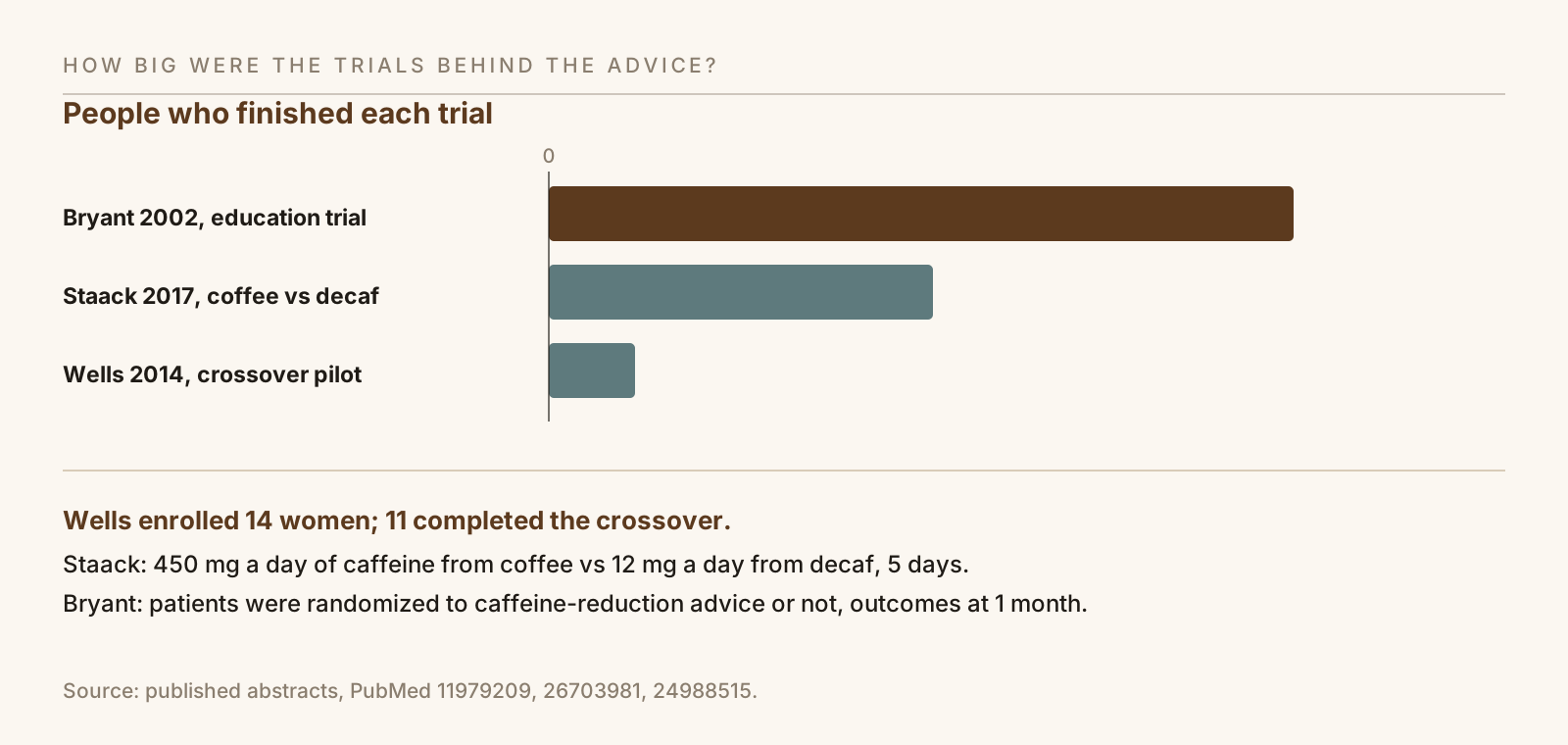
Small. The largest is 95 people, and the crossover pilot analyzed 11. That’s enough to make a pattern worth testing, and not enough to say how large an effect to expect or for whom.
What none of this tells you
- I read abstracts, not full papers. Details like exact doses per drink or how symptoms were scored are limited to what the abstracts say.
- Symptoms were self-reported. Bladder diaries and questionnaires are the standard tool here, but they depend on the person filling them in.
- Two different groups. Some trials used healthy young volunteers and others used patients with symptoms. Results from one don’t automatically carry to the other.
- Decaf isn’t zero. The decaf comparison helps point at caffeine rather than the liquid, but decaf still contains a small amount of caffeine. See how much caffeine is in decaf.
- Persistent symptoms need a clinician. Urgency, frequency or leaking can have many causes, and a coffee trial is not a substitute for checking.
If you want to test it yourself
This is a sensible, low-risk experiment for most healthy adults, though check with your clinician first if you have symptoms you’re worried about or take medicines.
- Keep a simple diary for a few days first. Note drinks and bathroom trips so you have a baseline.
- Taper rather than stop cold. Quitting suddenly can bring a headache within a day. Our guide to quitting caffeine without the headache has a schedule, and what to drink during caffeine withdrawal covers the in-between days.
- Change one thing at a time. Swap the coffee for decaf or a caffeine-free brew and leave everything else alone for a couple of weeks.
- Don’t cut water to compensate. The 2023 review didn’t find that restricting fluid added to the benefit.
- Compare your diary. If nothing changed, caffeine probably isn’t your lever, and that’s useful to know.
Roasted chicory, barley and carob brews contain no caffeine, so they fit step 3. They haven’t been tested against bladder symptoms, so treat the swap as your own experiment. Our explainer on what is chicory coffee covers what’s in them. For another question about what coffee does downstream, coffee and kidney stones has its own evidence.
This article is general information, not medical advice. Talk to your clinician about urinary symptoms that persist or worry you.
Sources & further reading
- Effectiveness of Fluid and Caffeine Modifications on Symptoms in Adults With Overactive Bladder: A Systematic Review (opens in a new tab) — International Neurourology Journal, 2023 (Park et al.)
- Prospective study on the effects of regular and decaffeinated coffee on urinary symptoms in young and healthy volunteers (opens in a new tab) — Neurourology and Urodynamics, 2017 (Staack et al.)
- The effect of caffeinated versus decaffeinated drinks on overactive bladder: a double-blind, randomized, crossover study (opens in a new tab) — Journal of Wound, Ostomy and Continence Nursing, 2014 (Wells et al.)
- Caffeine reduction education to improve urinary symptoms (opens in a new tab) — British Journal of Nursing, 2002 (Bryant et al.)
Reader conversation (4)
We read every response. Selected reader notes below.
Two cups and I’m mapping out every bathroom on my commute. I’ll try the diary idea for a week before changing anything.
Appreciate the note that you only read abstracts. Most articles on this don’t say what they didn’t check.
Thank you, Tomas. Abstracts only tell you so much, so I would rather say that than imply more.
Switching to decaf made a difference for me before I ever tried tapering. Good to see decaf treated as its own question.
I assumed drinking less water was the answer. The bit about fluids not being the lever surprised me.
Read this and have a question or something to add? Send us a note. With your OK, we may publish it here with an editor's follow-up. We only publish notes you've said we can.