What is rye coffee? The grain that's in more of your herbal coffee than you'd think, and the one that isn't gluten-free
Roasted rye was a Civil War-era coffee substitute and still sits in the ingredient lists of Pero, Barleycup, Dandy Blend and others. Here's how it's made, what it tastes like, and why the label matters if you avoid gluten.

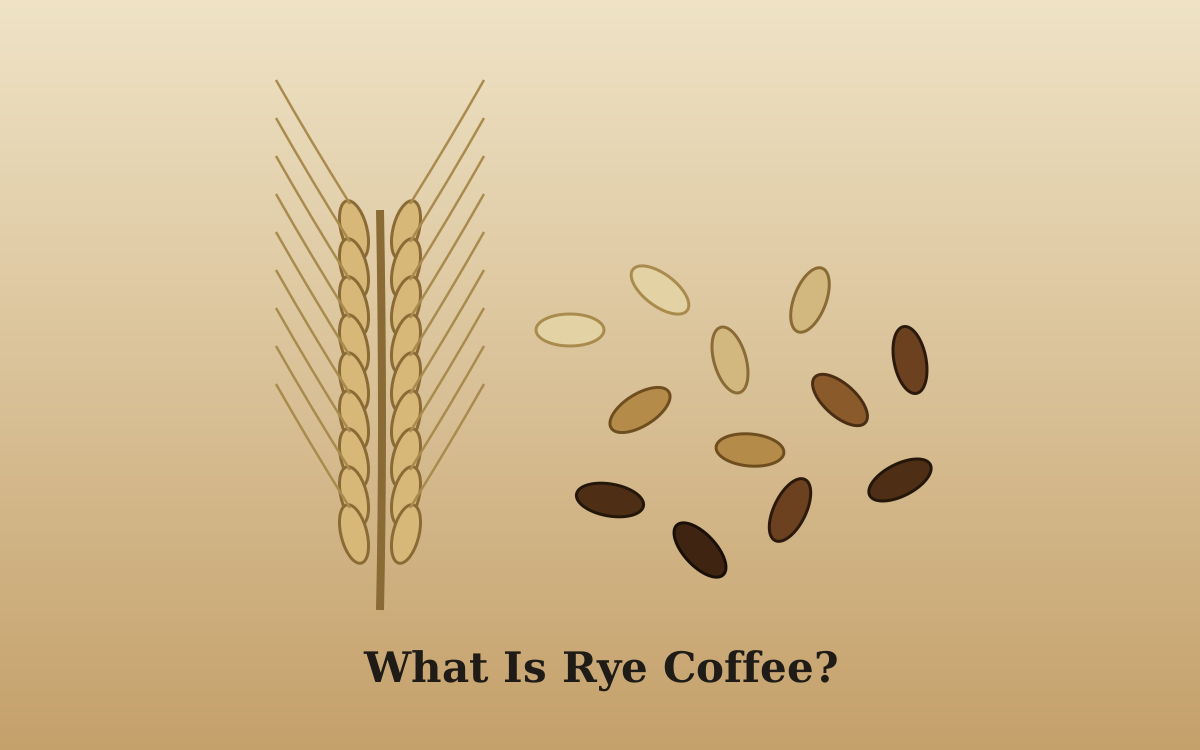
Rye is the quiet member of the grain-coffee family. Barley gets the headlines, and chicory gets the flavor credit, but read enough ingredient lists on herbal coffee tins and instant jars and rye keeps turning up. That matters for one practical reason, which we’ll get to: it is not gluten-free.
The short answer
Rye coffee is a hot drink made from roasted, ground rye grains. Rye is a cereal, not a relative of the coffee plant, so it contains no caffeine. It has been used as a coffee substitute for generations, on its own at home and as one component of commercial blends, usually next to barley and chicory.
The one caveat worth leading with: rye contains gluten. The National Institute of Diabetes and Digestive and Kidney Diseases names wheat, barley and rye as the grains where gluten is found naturally. If you avoid gluten, rye is off the table.
A substitute with a paper trail
Rye shows up in the historical record whenever real coffee became hard to get. Wikipedia’s overview of coffee substitutes notes that rye and ground sweet potato were among the most popular substitutes during the American Civil War. When the Union blockade squeezed Southern supplies, households improvised with whatever grain or root they had.
A good firsthand example is in our okra seed coffee piece. The Confederate surgeon whose 1863 letter praised parched okra seed said his household had already tried rye, ground peas, cornmeal and potatoes before settling on okra. In other words, rye was one of the first things people reached for, and for at least one family it wasn’t good enough to keep.
The wider story of what Europe and America drank when beans ran out is in our ersatz coffee history, and Postum’s story covers how a roasted-grain drink became a brand.
Where rye is hiding today
You rarely buy rye coffee by itself. You buy it as one line in an ingredient list. Here is what we could confirm from the sources we read:
| Product | Rye in the ingredients? | Source |
|---|---|---|
| Dandy Blend | Yes: roasted rye extracts, alongside barley, dandelion root and chicory root extracts | Dandy Blend’s own site |
| Pero | Yes: described as roasted barley, malted barley, chicory and rye | April Crowell’s grain-beverage guide; our grocery-store roundup |
| Barleycup | Yes: barley, rye and chicory | Wikipedia |
| Nestlé Caro | Yes: roasted barley, malted barley, chicory and rye | Wikipedia |
| Inka | Yes, though sources disagree on the other ingredients (one lists fig, another sugar beet) | Wikipedia; April Crowell |
The Inka disagreement is a useful reminder. Third-party descriptions of a product drift, and brands reformulate. The label on your package is the only reliable source.
Teeccino is a different case. Its French Roast is listed in our product notes as roasted chicory, carob, barley, dates and almonds. Rye isn’t among those ingredients, but barley and almonds are, so it is not gluten-free and it contains a tree nut. If you need a gluten-free option, confirm it on the package; our gluten-free label check goes through the whole aisle label by label.
How a home cook roasts it
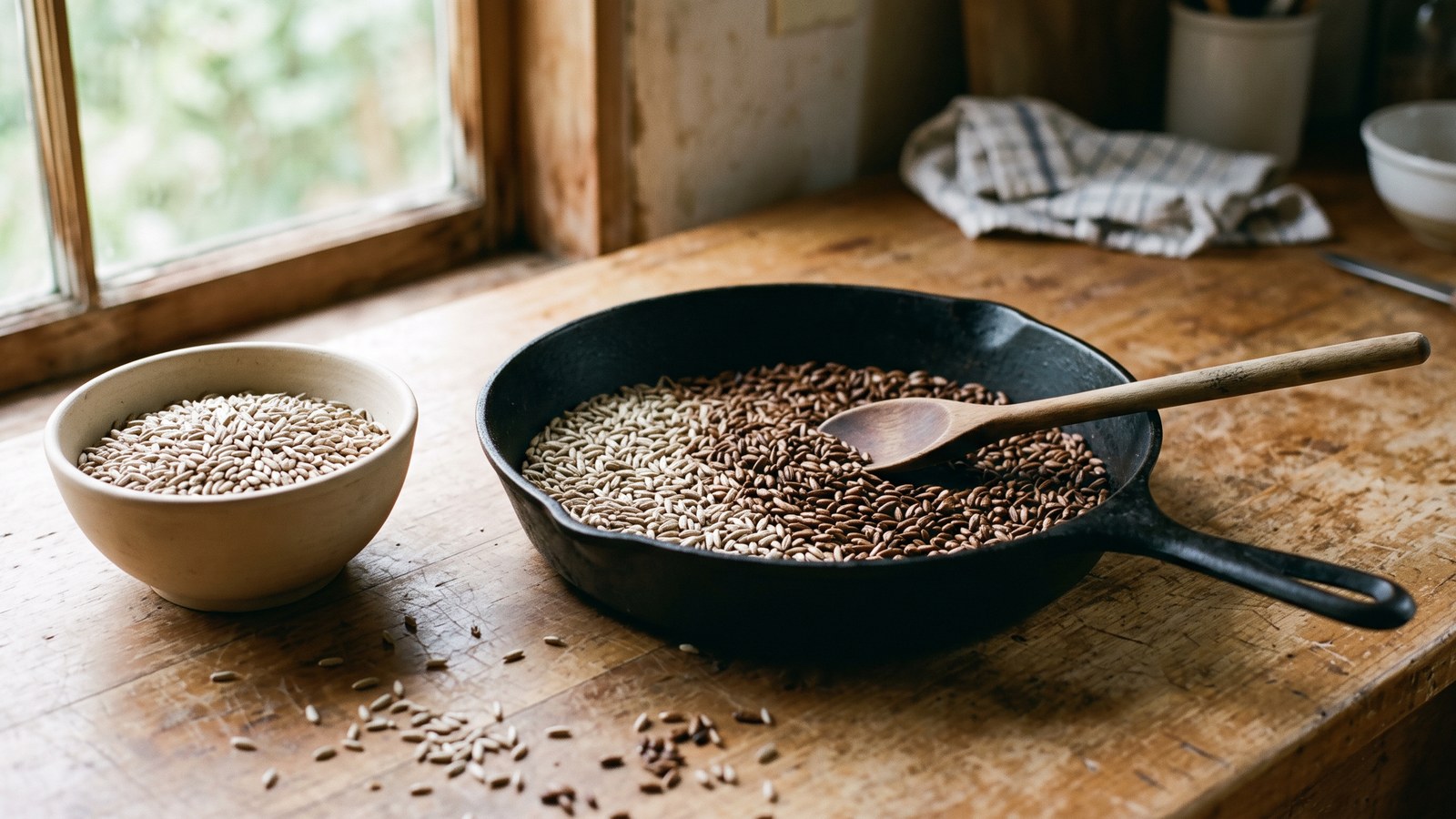
There is no standard recipe, and we have only one detailed home account to point to, so treat this as a starting point. Writer Sandra Merville Hart tested rye coffee while researching a Civil War novel and tried it three ways:
- Boil about a quarter cup of whole rye berries for 10 minutes.
- Dry them in a 275°F oven for 15 minutes.
- Roast them at 450°F for 10 minutes.
- Crush or grind, then brew by boiling or steeping.
Her notes are practical. Boiling longer than 10 minutes started to split the grain. The boiled version gave the strongest coffee-like flavor, though steeping also worked. A 10-minute roast felt slightly dark to her, and she guessed 8 minutes might taste better.
That is a single tester, and she described herself as a non-coffee drinker, so don’t read “tasted like coffee” as a verdict from someone who knows coffee well. If you try it, start with a small batch and roast a little shorter than you think you need.
What it tastes like
We haven’t brewed straight rye for this piece, so we’re not going to invent tasting notes. What the sources do support is that rye almost always appears as part of a blend, and blends are built around barley and chicory for body and bitterness. That fits with where rye sits in the products above: a supporting grain, not a lead.
If you want a sense of the roasted-grain flavor family, roasted barley coffee is the closest relative we’ve covered in depth.
The gluten problem
This is the section to read twice if you have celiac disease or avoid gluten for any reason.
- Rye contains gluten. NIDDK lists it with wheat and barley.
- Barley-and-rye blends are not gluten-free. That covers Pero, Barleycup and Caro as described above,.
- Dandy Blend lists barley and rye extracts. Our earlier grocery roundup reported that its maker says the extraction process leaves the gluten behind, but the pages we read for this piece don’t state that, and we couldn’t verify it. If you avoid gluten for medical reasons, ask the company directly and look for a certified gluten-free label.
- Rye also carries fructans, a type of carbohydrate some people with irritable bowel symptoms avoid. Our low-FODMAP label check covers that angle.
None of this makes rye a bad ingredient. It makes it one to read for, the way you would read for almonds or barley.
The bottom line
Rye coffee is a real, long-used grain substitute: caffeine-free by nature, historically common when coffee was scarce, and still a supporting ingredient in several well-known grain blends. It is rarely sold alone, it has no standard home recipe, and it isn’t gluten-free. If you drink a roasted-grain coffee and have any reason to avoid gluten, check for rye before you check the flavor.
This article is educational, not medical advice. If you have celiac disease or a diagnosed gluten-related condition, confirm any product with the manufacturer and your own clinician.
Sources & further reading
- Coffee substitute (opens in a new tab) — Wikipedia
- Rye Coffee (opens in a new tab) — Sandra Merville Hart
- Definition and facts for celiac disease (opens in a new tab) — National Institute of Diabetes and Digestive and Kidney Diseases (NIDDK)
- Dandy Blend (opens in a new tab) — Dandy Blend
- Coffee Substitutes - Getting To Know Your Grain Beverages (opens in a new tab) — April Crowell
- 21 April 1863: "Okra the best Substitute for Coffee" (opens in a new tab) — Civil War Day by Day, UNC Libraries
Reader conversation (4)
We read every response. Selected reader notes below.
I’ve been drinking Pero for years and never once clocked the rye in the ingredient list. Glad someone said it plainly, since I’ve been telling my sister it’s “just barley.”
My grandmother in Poland made a roasted grain drink every morning and rye was definitely part of it. Nobody wrote the recipe down, so the home-roast notes are a nice starting point.
That’s the pattern with a lot of these drinks: the recipe lives in someone’s hands, not on paper. If you try the home roast, start with a small batch and keep it on the shorter side.
The gluten section is the useful part for me. I have celiac and I would have grabbed a “grain coffee” assuming it was fine. Reading labels harder from now on.
Would love a follow-up on how a rye-heavy blend actually tastes next to a barley-heavy one.
Fair ask. We haven’t brewed rye on its own, so we left tasting notes out rather than guess. It’s on the list.
Have something to add? Email us and we may include it in a future update.