Which caffeine-free coffee is actually low-FODMAP? We checked every ingredient in the aisle
Chicory, dandelion, carob, barley — the roots and grains behind nearly every 'caffeine-free coffee' are also a FODMAP tracker's greatest hits. We checked six major brands ingredient by ingredient against the trackers dietitians actually use, and found one claim in our own IBS coverage needs a second look.

Chicory root’s whole reputation as a “gentle” coffee substitute rests on the same molecule that makes it a problem for a meaningful share of readers: inulin, a prebiotic fiber your gut bacteria ferment into gas. We wrote about that trade-off for chicory specifically back in May. What we hadn’t done is the rest of the shelf — dandelion, carob, barley, the grain blends, the brand-name products built from all four at once — checked the same way, against the same trackers.
So we did. We went through the FODMAP-tracking sites and dietitian blogs that people actually managing IBS use to make real purchasing decisions, cross-checked them against six mainstream “caffeine-free coffee” products’ own ingredient lists, and found that the aisle is more uniformly FODMAP-unfriendly than we expected — and that one claim in our own past coverage needs a caveat we didn’t give it the first time.
The short answer
Almost none of the caffeine-free “coffee” category is low-FODMAP, because almost all of it is built from the same short list of plants — chicory root, dandelion root, barley, rye — and every one of those shows up as a FODMAP concern at a typical serving size. Carob is the one genuinely gentler ingredient in common use, and even it comes with serving-size caveats the sources don’t fully agree on. If you need a hot, dark, caffeine-free drink and you’re also managing FODMAPs, your realistic options are mostly outside the “coffee alternative” aisle entirely: rooibos, honeybush, ginger tea, and brewed cacao.
Why “gentle on your gut” and “low-FODMAP” aren’t the same promise
Herbal coffee marketing leans hard on words like “gentle,” “gut-friendly,” and “prebiotic” — and none of that is dishonest, exactly. Inulin, the fiber chicory and dandelion are both built from, genuinely is a prebiotic that feeds beneficial gut bacteria, and that’s a real, published benefit for people with an unreactive gut.
The problem is that “prebiotic” and “low-FODMAP” point in opposite directions for a reactive gut. FODMAP stands for Fermentable Oligo-, Di-, Mono-saccharides And Polyols — the categories of carbohydrate that reach the colon largely undigested and get fermented by gut bacteria there. That fermentation is exactly the mechanism that makes a fiber “prebiotic.” It’s also exactly the mechanism that produces the gas, bloating, and cramping a low-FODMAP diet exists to avoid. The same process, read from two different guts.
So a product can be marketed entirely honestly as “prebiotic” and “gut-supporting,” and still be a FODMAP problem for the estimated 10 to 15 percent of people with IBS — because those two claims aren’t actually in tension with each other; they’re describing the same fermentation from either side of it.
Chicory and dandelion: the two roots behind most of the aisle
Chicory and dandelion root are close botanical cousins, and we’ve compared them directly before. For FODMAP purposes, they behave almost identically: both are concentrated sources of inulin-type fructans, both fall under the “oligosaccharide” umbrella that most reliably triggers IBS symptoms, and neither has an easy low-dose exception the way some other high-FODMAP foods do.
Chicory root is the better-documented of the two. As we detailed in our chicory-and-IBS piece, roasted chicory root runs roughly 40 to 70 percent inulin and oligofructose by dry weight — an unusually concentrated fructan source, higher per gram than garlic, onion, or wheat. Dandelion root is the less-studied sibling: every FODMAP tracker we checked describes it as “high in inulin, similar to chicory” and presumed high-FODMAP on that basis, but one of them states plainly that dandelion root itself “has not been tested for FODMAPs” by Monash — the presumption is a reasonable inference from shared chemistry, not a direct measurement.
Practically, that distinction doesn’t change the advice much: if you’re managing FODMAPs carefully, both roots belong in the same “treat as high-FODMAP, test cautiously if at all” bucket. It does mean you should be skeptical of any source — including us, on a specific point we’ll get to below — that states an exact “safe” serving size for either root with more confidence than the underlying testing actually supports.
Carob: the genuinely contested one
Carob is the one ingredient in this piece where the sources actually disagree with each other, which is itself worth knowing rather than smoothing over. One FODMAP-tracker site we checked states that the Monash app lists carob and carob powder as low-FODMAP “in moderate amounts,” without giving the gram threshold. A different tracker describes carob as “low or high FODMAP depending on serving size,” also without a confirmed cutoff, and flags fructans as the ingredient’s possible FODMAP component.
Both agree on the direction — carob is meaningfully gentler than chicory or dandelion root — and neither gave us a number we could independently verify by fetching a primary source. So the honest version of this section is: carob is very likely your best root-adjacent option if you want something closer to a “coffee” flavor than plain herbal tea gives you, but don’t treat “low-FODMAP” as a blank check on quantity the way you reasonably could with, say, plain white rice. We’ve covered carob coffee’s flavor and format on its own if you’re deciding whether it’s worth trying at all.
Barley, rye, and grain blends
Roasted-barley “coffee” (sometimes labeled orzo or malt coffee) is a real, long-standing category on its own — we’ve written about it separately — and it shows up as a base or blending ingredient in several herbal-coffee products. The FODMAP tracker we checked directly states plainly that barley is “high FODMAP in normal serving sizes,” citing GOS (galacto-oligosaccharides) and fructans as the concern, with no gram-level exception given for any preparation. We looked for cooked-cereal-grain fructan research that might break barley, rye, wheat, and rice apart by exact concentration, but the primary study we found was blocked behind a CAPTCHA wall on every attempt, so we’re not printing a specific milligram figure we couldn’t verify ourselves.
Rye, which shows up alongside barley in at least one major grain-blend brand, carries the same fructan profile as a wheat relative and isn’t treated any more favorably by the trackers we checked. Neither grain has an established “small amount is fine” exception the way, say, sourdough wheat bread does — sourdough’s long fermentation measurably breaks fructans down before you eat it, but a roasted-grain coffee isn’t fermented the same way, so that exception doesn’t transfer.
Dates: low-FODMAP, but only in the amounts nobody sells them in
Dates are the one ingredient in this piece with a genuinely specific, source-confirmed number attached — and the number matters because dates show up constantly as a sweetener in herbal-coffee blends, including several we checked for this piece. The FODMAP-tracker guidance we verified directly puts the low-FODMAP threshold at roughly five dried, pitted regular dates, or as little as one Medjool date — past that, sorbitol and fructans push a serving into high-FODMAP territory quickly.
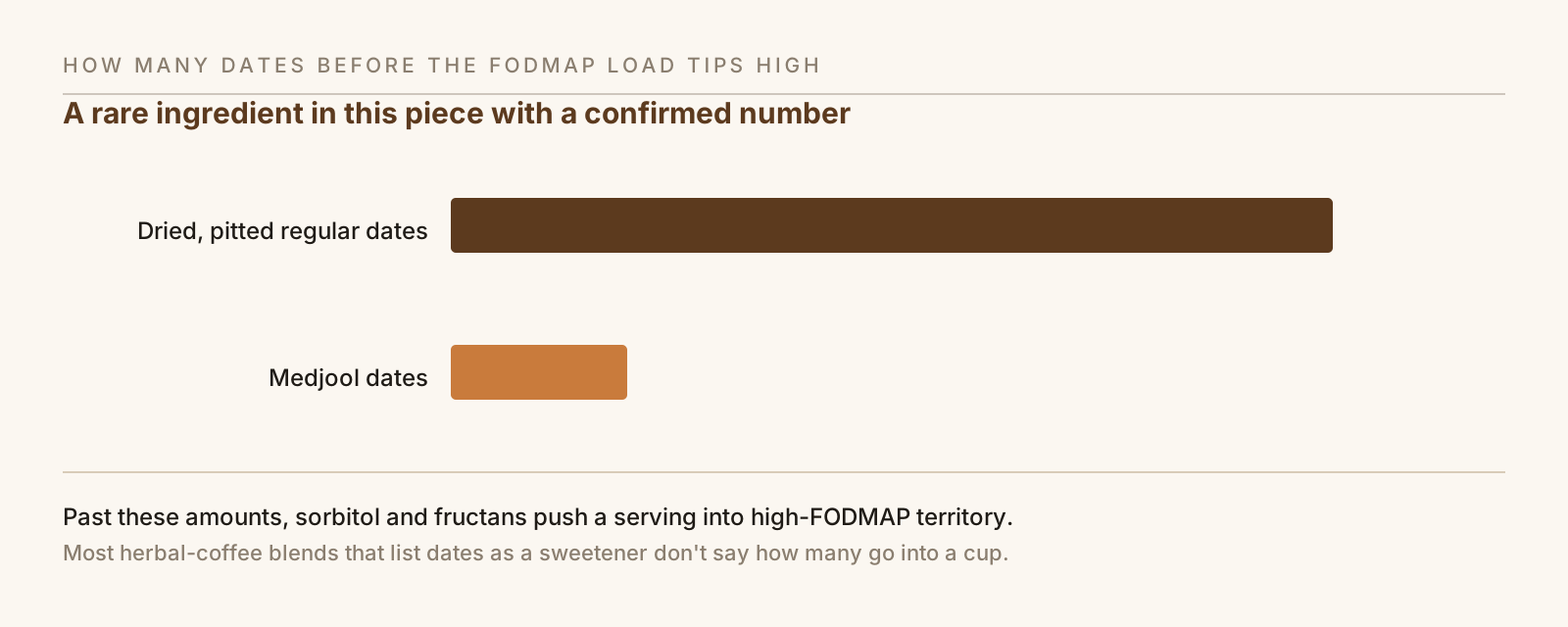
That threshold is easy to blow past without noticing. A blend that lists dates as an ingredient doesn’t tell you how many date-equivalents are in a serving, and a cup that also contains chicory or barley already has its own FODMAP problems regardless of how the dates land — the sweetener isn’t rescuing a blend that’s high-FODMAP for other reasons. Where the date threshold actually matters is a homemade drink where dates are doing real, countable work: a golden-milk-style blend sweetened with whole dates, for instance, where you control the count yourself.
What six brands are actually built from
We went to each brand’s own current ingredient list — not a retailer summary — and checked what’s actually in the bag, including Teeccino’s French Roast (opens in a new tab), one of the herbal coffees we’ve rated well on flavor in past roundups. “FODMAP flag” below means the ingredient is described as high-FODMAP, or serving-dependent with no confirmed safe cutoff, by at least one of the trackers we checked in this piece.
| Brand / product | Base ingredients | FODMAP-flagged ingredients present |
|---|---|---|
| Teeccino French Roast | Roasted chicory, carob, barley, dates, almonds | Chicory, barley (carob and dates are lower-risk in small amounts) |
| Teeccino Dandelion Dark Roast | Roasted dandelion root | Dandelion root |
| Teeccino Miraculous Mushrooms Adapt & Protect | Carob, chicory, ramón seed, mushroom extracts | Chicory (ramón seed has no FODMAP data we could find either way) |
| Dandy Blend | Roasted barley, rye, dandelion root, chicory root extracts | All four base ingredients |
| Rasa Original | Roasted chicory, roasted burdock, roasted dandelion, roasted date seed, eleuthero, adaptogens, mushroom extracts | Chicory, dandelion (roasted date seed’s FODMAP status wasn’t in any tracker we checked) |
| MUD\WTR Original | Mushroom + mycelium (oats/sorghum substrate), cacao, cinnamon, turmeric, ginger, cardamom, black pepper, nutmeg, cloves, black tea, salt | None found — but contains real caffeine (about 35 mg, from black tea) |
The pattern is stark: five of the six products are built on chicory and/or dandelion root, regardless of price point, adaptogen positioning, or how “gentle” the marketing sounds. MUD\WTR is the one clear exception, and it’s an exception because its formula skips the root-and-tuber base entirely in favor of mushroom, cacao, and spice — which also means it’s the one product on this list that isn’t actually caffeine-free.
What’s actually safe, if you need both
If low-FODMAP and caffeine-free are both non-negotiable for you, the honest answer is that your best options mostly aren’t marketed as “coffee” at all:
- Rooibos and honeybush. Both show up as Monash-app-listed low-FODMAP options across every tracker we checked, and both are naturally, unambiguously caffeine-free. Neither tastes like coffee, but both hold their own as a warm, dark, ritual-shaped drink.
- Ginger tea, and weak dandelion leaf tea. Leaf, not root — the two parts of the same plant have very different FODMAP profiles, and it’s an easy label detail to miss.
- Brewed cacao, like Crio Bru. Low-FODMAP by most accounts, with a small amount of theobromine — a mild stimulant, so not perfectly zero-buzz, but genuinely not caffeine.
- A spice-and-mushroom blend without a chicory or dandelion base, if a small, known amount of caffeine is acceptable. MUD\WTR is the mainstream example we found; read the ingredient list on anything similar before assuming it qualifies.
- Plain decaffeinated coffee, if what you actually miss is the taste of coffee rather than anything about the “alternative” framing. Coffee itself is broadly treated as low-FODMAP at ordinary serving sizes by the dietitian sources we checked, and decaffeinating it doesn’t add chicory, dandelion, or anything else to the FODMAP side of the ledger.
None of this is a substitute for a FODMAP-trained dietitian and your own tested tolerance — individual thresholds vary, and this piece is a starting map, not a diagnosis.
One of our own claims needed a second look
Part of the reason we did this piece the hard way — checking trackers directly rather than repeating our own prior summaries — is that it surfaced two things in our own back catalog worth flagging in the open rather than quietly leaving alone.
First: our chicory-and-IBS piece states that Monash’s database gives brewed chicory root coffee a specific low-FODMAP threshold, “approximately half a teaspoon.” Our later chicory-versus-dandelion piece says something different: that Monash has published a tested low-FODMAP serving for chicory leaves, but not for chicory root or dandelion root coffee, and that there’s “no official cup-size threshold to lean on” for the root. Checking independently for this piece, we found the same pattern the second post describes — a listed Monash-app portion for chicory leaves, nothing we could find for chicory root specifically. That doesn’t prove the half-teaspoon figure is wrong; Monash’s own app is a paid product we don’t have direct access to, so we can’t settle this ourselves with full confidence. It does mean two of our own posts currently disagree with each other on a specific, checkable number, and we’d rather say so than let it sit.
Second: the same chicory-and-IBS piece names “pure barley-only grain coffees in small amounts” as low-FODMAP at a single-cup serving. Every tracker we checked for this piece rates barley as high-FODMAP at normal serving sizes, with no small-amount or brewed-format exception stated anywhere we could find. It’s possible a coffee-style hot-water extraction pulls less fructan out of roasted barley than eating the whole cooked grain does — FODMAPs are water-soluble, so some clearly transfers into a brew, but we don’t know how much for barley specifically, and we didn’t find a source that had tested that version of the question. Until one does, we think that claim deserves more hedging than it originally got.
We’ve flagged both for a closer look rather than editing either post quietly. If you’re relying on either figure to manage real symptoms, treat it as unconfirmed for now and lean on your own tested tolerance instead.
Frequently asked questions
Answered in the front matter above, and repeated here for anyone skimming: chicory and dandelion root are both high-FODMAP at typical servings; carob is gentler but its exact serving limit is genuinely unsettled between sources; barley and rye carry their own fructan load; and the caffeine-free, low-FODMAP drinks with the cleanest evidence behind them — rooibos, honeybush, ginger, brewed cacao — mostly aren’t sold as “coffee” at all.
For the wider category context, our full caffeine-free coffee alternatives roundup covers taste and format without the FODMAP lens, and our mushroom-coffee label piece is the place to go if extraction ratios and mycelium-versus-fruiting-body claims are the label question you’re actually trying to untangle.
Sources & further reading
- Inulin and the low-FODMAP diet — ultimate guide (opens in a new tab) — The IBS Dietitian
- Update: Label reading and FODMAPs (opens in a new tab) — Monash FODMAP
- Is barley low FODMAP? (opens in a new tab) — Fig (foodisgood.com)
- Is dandelion root low FODMAP? (opens in a new tab) — Fig (foodisgood.com)
- Is Carob Low FODMAP (opens in a new tab) — Casa de Sante
- How many dates can you eat on the Low FODMAP Diet? (opens in a new tab) — A Little Bit Yummy
- What's in Your Cup? Tea & Coffee options for the FODMAPer (opens in a new tab) — Kate Scarlata, RDN
- 4 Hot Tips for Low-FODMAP Drinks (opens in a new tab) — IBS-Free at Last!
- MUD\WTR Original — full ingredient list (opens in a new tab) — MUD\WTR
- Dandy Blend FAQs — ingredient list (opens in a new tab) — Dandy Blend
- Rasa Original — full ingredient list (opens in a new tab) — Rasa
- Teeccino French Roast Herbal Coffee — ingredient list (opens in a new tab) — Teeccino
Reader conversation (5)
We read every response. Selected reader notes below.
Diagnosed IBS-D four years ago and it took me embarrassingly long to connect my “healthy” switch to chicory coffee with my symptoms getting worse, not better. Nobody in the wellness aisle mentions FODMAP at all. Bookmarking this to send to my sister, who just started the same switch for the same reason I did.
Genuinely didn’t expect Dandy Blend to come out worse than Teeccino on this specific axis — I’d always assumed “simpler ingredient list” meant “gentler,” and this is a good reminder that four ingredients can still be four bad-for-you-specifically ingredients. Switched to rooibos most mornings and honestly don’t miss it as much as I thought I would.
As a dietitian who works with a lot of low-FODMAP clients, I’ll add one practical note: the “start with a quarter cup, half-strength” testing approach from your chicory/IBS piece is still the right method even for ingredients like carob and barley where the exact serving cutoff is unsettled. A personal challenge test tells you more than any published gram threshold will for your specific gut.
Really appreciate that, thank you — and agreed, the structured self-test in that piece is the more durable advice than any single number we or anyone else prints, especially for the ingredients where the sourcing itself is thin.
Respect for publishing the part where two of your own articles disagreed with each other. That’s rarer than it should be for this kind of site. More useful to me than the roundup itself, honestly.
Question: where does mesquite powder or ramón seed fall on this list? Neither showed up in your ingredient table and I’ve seen both marketed as “gentler” coffee substitutes.
Good catch, and an honest answer: we couldn’t find FODMAP testing data for either one from the trackers we checked for this piece, so we left them out rather than guess. That’s a gap, not a clearance — “untested” isn’t the same as “safe,” and we’d treat both the same cautious way we treated ramón seed in the Teeccino line above until someone actually tests them.
Have something to add? Email us and we may include it in a future update.