What is ashwagandha? The root in some mushroom coffees, and the liver case reports behind its one real warning
Ashwagandha is a root used in traditional Indian medicine and added to some mushroom coffee blends. Trials are small and low-certainty, and a 2026 review collected 25 liver case reports. What to check before you buy.


Ashwagandha turns up in the ingredient lists of a few herbal and mushroom coffee blends, usually alongside rhodiola and a mushroom or two. Unlike most of the mushrooms, it has a safety literature worth knowing about. We read the recent abstracts, and the picture is small trials on one side and a pile of case reports on the other.
The short answer
- Ashwagandha is a plant root, not coffee, tea or a caffeine source.
- Human trials are small and the authors rate the evidence low to very low certainty.
- A 2026 scoping review collected 25 patients in 13 published reports of liver harm linked to ashwagandha products. Most recovered after stopping, and a few had severe outcomes.
- We found no trial of a coffee blend, and we can’t say how much ashwagandha any product holds.
What ashwagandha actually is
Ashwagandha is Withania somnifera, a shrub in the nightshade family. A 2026 review in Phytotherapy Research describes it as widely used in traditional Indian medicine and increasingly popular as a dietary supplement. The root, and sometimes the leaf, is dried and powdered or turned into an extract.
On a coffee label it is one name in a long list. Our check of which mushroom coffees are actually caffeine-free quotes a blend list that includes it next to rhodiola, maca and several mushrooms. A bare “ashwagandha” doesn’t tell you whether it is root or leaf, powder or extract, or how much.
Our piece on what adaptogen cortisol claims can and can’t support covers the marketing language. This one stays with what the studies counted.
What the human research shows
Here is how big the sources we read were. One bar counts patients in case reports, the other two count people in pooled trials:
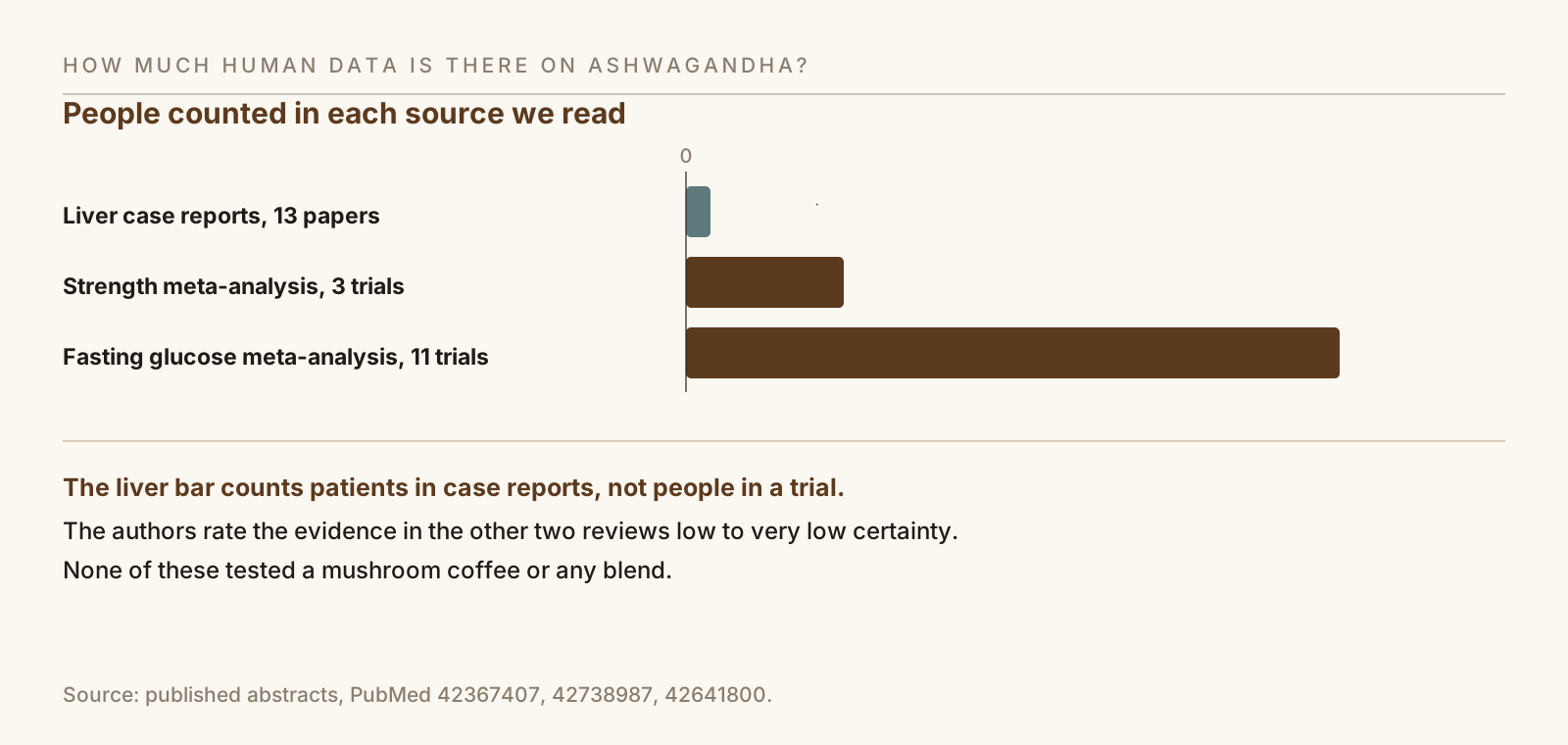
- Strength training, 2026. A meta-analysis (opens in a new tab) found four eligible trials and pooled three (161 people) that combined a standardized extract with resistance training in healthy adults. Ashwagandha was associated with bigger gains in bench press and lower-body strength than placebo. Under a stricter statistical adjustment both strength results lost significance, and each leaned on one influential trial. Certainty was low for strength and very low for chest circumference. The authors conclude the evidence doesn’t establish a meaningful boost.
- Fasting blood sugar, 2026. A meta-analysis (opens in a new tab) of 11 trials in 667 people reported a small drop in fasting glucose versus placebo (about 3 mg/dL, interval roughly 0.6 to 5.6) with substantial heterogeneity. The longer-term marker, based on three trials, was inconclusive. Certainty was very low, and the authors say that precludes clinical recommendations.
Our reading, not the authors’: a 3 mg/dL average difference at very low certainty is a signal for researchers to chase, not a reason to drink anything. These studies tested standardized extracts at set doses, which a coffee blend with no stated amount can’t match. The honest summary is “unproven.”
The liver case reports
This is the part to read slowly. A scoping review in Cureus searched the literature through December 2025 and found 13 publications covering 25 patients. Its main points:
- Liver harm typically developed after weeks of use, most often with yellowing of the skin and itching.
- Where causality was assessed, ashwagandha was generally classed as a probable or likely cause.
- Most patients recovered after stopping and supportive care, over weeks to months.
- Severe outcomes included one case of liver failure needing a transplant, and three deaths among patients who already had serious liver disease.
A single 2026 case report (opens in a new tab) describes a previously healthy 27-year-old who developed these symptoms after three days of use, scored “probable” on a standard causality scale, and improved with treatment. A separate safety review (opens in a new tab) also lists pregnancy, thyroid and kidney concerns as areas of risk and asks for stronger label warnings.
Limits matter here. Case reports can’t tell you how common this is, and we found no incidence figure in the abstracts. The reviews include multi-ingredient products, and we read abstracts, not full papers. Plenty of people take ashwagandha without trouble. But the pattern is consistent enough that the reviewers recommend asking about herbal products whenever liver problems are unexplained.
If you have liver, thyroid or kidney concerns, take regular medicines, or are pregnant or nursing, ask your clinician before using a product with ashwagandha. We found no blended-coffee reports either way.
How to read a label for ashwagandha
- Is it listed at all? It sits in the herbal “support” blends more than in straightforward chicory-and-grain coffees. If you want to avoid it, scan the full list, not the front panel.
- Is an amount given? Many blends name an ingredient without its own quantity, so the label can’t tell you whether you’re anywhere near the doses in the studies or the case reports.
- What else is in the cup? Other herbs, mushrooms and caffeine all change the picture. Our guide to reading mushroom coffee labels explains the terms.
For neighbors in the ingredients series, see reishi, chaga and adaptogens versus mushrooms.
The bottom line
Ashwagandha is a root used in traditional Indian medicine and added to a minority of herbal coffee blends. The trials we read are small and rated low to very low certainty, and a 2026 review pulled together 25 liver case reports, a few of them severe. That doesn’t mean it harms most people. It does mean this is an ingredient to check on the label, and to raise with your clinician first if any of the groups above sounds like you.
Sources & further reading
- Ashwagandha (Withania somnifera)-Associated Liver Injury: A Scoping Review of Clinical Characteristics and Safety Considerations (opens in a new tab) — Cureus, 2026
- Ashwagandha-Induced Herb-Induced Liver Injury Assessed With the Updated 2016 RUCAM (opens in a new tab) — Case Reports in Hepatology, 2026
- Evaluating the Safety of Ashwagandha as a Food Additive: A Focus on Reproductive, Thyroid, and Immune System Effects (opens in a new tab) — Phytotherapy Research, 2026
- Adjunctive Ashwagandha Supplementation and Resistance-Training Adaptations in Healthy Adults: A Systematic Review and Random-Effects Meta-Analysis (opens in a new tab) — Nutrients, 2026
- The effects of Ashwagandha supplementation on fasting blood glucose and HbA1c: a systematic review and dose-response meta-analysis of randomized controlled trials (opens in a new tab) — Diabetes Research and Clinical Practice, 2026
Reader conversation (4)
We read every response. Selected reader notes below.
I had no idea my blend listed this until I went back and read the whole ingredient panel. Glad I checked before the second bag.
Good that you labeled the chart so the case reports and the trials aren’t read as the same kind of evidence.
Thanks, Idris. That’s why the caption says what the first bar counts. Different kinds of evidence shouldn’t share a ruler without a label.
I showed this to my pharmacist. She said to bring the actual ingredient list next visit, which seems like the practical takeaway.
A 3 mg/dL difference at very low certainty is a fair summary of why I stopped reading supplement headlines.
Read this and have a question or something to add? Send us a note. With your OK, we may publish it here with an editor's follow-up. We only publish notes you've said we can.