Is coffee good for your liver? The studies are consistent, including for decaf, and still not a reason to start drinking it
Large studies link coffee to lower rates of liver disease, and decaf looks similar. What the UK Biobank and two meta-analyses found, what they can't prove, and what it means if you're cutting back.


Coffee drinkers have less liver disease than non-drinkers, and that finding keeps turning up across very different studies. It is one of the more consistent results in coffee research. It is also an association, and the honest reading is narrower than the headlines suggest.
The short answer
- Across a large UK study and two pooled analyses, more coffee went with lower rates of chronic liver disease, cirrhosis and liver cancer.
- Decaf showed a similar pattern in the largest study, though the evidence for it is thinner.
- None of this shows coffee causes the lower risk, and it isn’t a reason for anyone to start drinking it.
The UK Biobank study
The largest single study we read followed 494,585 UK Biobank participants, according to Kennedy and colleagues in BMC Public Health (opens in a new tab). Of those, 384,818 drank coffee and 109,767 did not. Over a median of 10.7 years there were 3,600 cases of chronic liver disease, 184 cases of liver cancer and 301 deaths from chronic liver disease.
Compared with non-drinkers, coffee drinkers had adjusted hazard ratios of:
- 0.79 for chronic liver disease
- 0.80 for chronic liver disease or fatty liver (steatosis)
- 0.51 for death from chronic liver disease
- 0.80 for liver cancer, with a 95% range of 0.54 to 1.19
A hazard ratio below 1.00 means fewer events in the coffee group. The liver cancer range includes 1.00, so that one result is uncertain on its own.
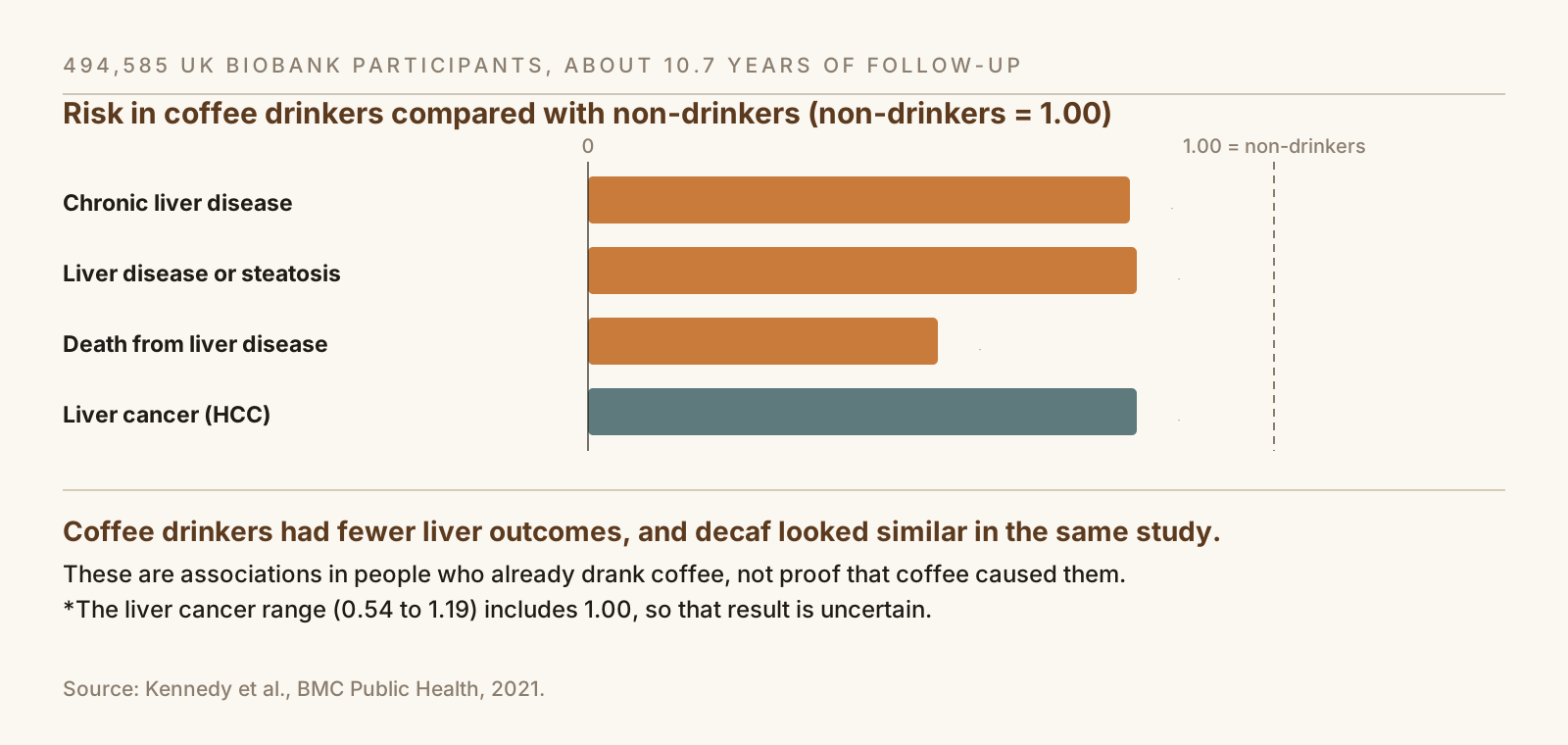
The authors also split coffee by type. Per the abstract, the associations for decaffeinated, instant and ground coffee individually were similar to all types combined.
Cirrhosis: the meta-analysis
An earlier systematic review in Alimentary Pharmacology & Therapeutics (opens in a new tab) pooled five cohort studies and four case-control studies, covering 1,990 cases and 432,133 participants. It reported a dose-response pattern: for every extra two cups a day, the pooled relative risk of cirrhosis was 0.56 (95% range 0.44 to 0.68).
Two cautions apply. The studies disagreed a good deal on size of effect (the authors report an I² of 83.3%, a measure of how much results varied beyond chance). And “two more cups” is a statistical comparison, not advice about how much to drink.
Liver cancer: what decaf shows
A meta-analysis in BMJ Open (opens in a new tab) pooled 18 cohorts and 8 case-control studies. An extra two cups a day went with a 35% lower risk of liver cancer (RR 0.65, 95% range 0.59 to 0.72).
Here is where caffeine comes in. For caffeinated coffee the reduction was 27% (RR 0.73), and for decaf 14% (RR 0.86, range 0.74 to 1.00), but only two or three cohort studies sat behind each of those. So decaf looks associated with a smaller benefit, and with less certainty. The authors rated the overall quality of the evidence as “very low” under the GRADE system, citing no randomized trials, possible publication bias and no accepted definition of “coffee”.
What these studies can’t tell you
- They compare groups, not cause and effect. People who drink coffee may differ from those who don’t in diet, income, alcohol use or health before the study began. The researchers adjust for what they measured, not for everything.
- People with liver trouble may already avoid coffee. That could make non-drinkers look worse for reasons unrelated to coffee.
- Nobody tested a dose. There are no randomized trials of coffee for liver disease in what we read, which is why the cancer evidence was graded very low.
- It tells you nothing about herbal coffees. We found no research on chicory, dandelion or carob blends and the liver, so we can’t say whether they would show anything similar.
The same cautions apply to our pieces on coffee and kidney stones and coffee and gout, which found a similar “large studies, not proof” pattern.
If you’re cutting back or quitting
This evidence shouldn’t change a decision to cut caffeine for sleep, anxiety, reflux or any other reason. The data show an association in drinkers, and they don’t show that stopping harms your liver.
A few practical points:
- If you want the coffee taste without the caffeine, our guide to decaf covers what it is, and how much caffeine is in decaf covers the small amount left in.
- If you’re considering herbal coffee instead of decaf, remember the liver research above was about coffee, not about those blends.
- If you have liver disease, or drink heavily, ask your doctor before changing anything. Coffee is not a treatment, and nothing here replaces medical advice.
The bottom line
Coffee drinkers, including decaf drinkers, had lower rates of liver disease in several large datasets. That is interesting and worth knowing, and it comes from observation, not trials. If you already enjoy coffee, it isn’t a worry for your liver on this evidence. If you’ve moved on from it, there’s no case here for going back. For more options, start with our caffeine-free coffee roundup.
Sources & further reading
- All coffee types decrease the risk of adverse clinical outcomes in chronic liver disease: a UK Biobank study (opens in a new tab) — Kennedy OJ and colleagues, BMC Public Health, 2021
- Systematic review with meta-analysis: coffee consumption and the risk of cirrhosis (opens in a new tab) — Kennedy OJ and colleagues, Alimentary Pharmacology & Therapeutics, 2016
- Coffee, including caffeinated and decaffeinated coffee, and the risk of hepatocellular carcinoma: a systematic review and dose-response meta-analysis (opens in a new tab) — Kennedy OJ and colleagues, BMJ Open, 2017
Reader conversation (4)
We read every response. Selected reader notes below.
My doctor mentioned coffee and the liver at my last checkup and I wondered how solid it was. Good to see the word “association” used properly.
Thanks, Raymond. The consistency across studies is real, and so is the gap between association and cause. Your doctor is the right person to put it in context for you.
I switched to decaf a few years ago for my sleep. The section on decaf was the part I came for.
Helpful that you said plainly there is no research on chicory or other herbal blends. I have been wondering about that.
I quit coffee in August and was a little worried after reading headlines about this. Your note that it shouldn’t change the decision settled me.
Have something to add? Email us and we may include it in a future update.