The chicory swap's fourth physics: what a curry's browning stage changes, and the curry that already uses coffee
A curry base does something chili, a dry rub and mole never do -- it browns for the better part of an hour with no liquid at all before anything wet goes in. Here's what that changes for the roasted-chicory swap, and the one curry tradition that already answers half the question.

Owen Baptiste, in Port of Spain, read the savoury-cooking piece and noticed the gap in it immediately. That piece worked out three physics – chili stays mostly liquid, a dry rub only ever browns at the surface, a mole-style sauce genuinely reduces – and never once mentioned a curry. His point: a curry base doesn’t start like any of those three. It starts by browning onion, garlic and whole spices in fat, with no liquid anywhere in the pan, before it becomes a pot of anything wet at all. That’s a step none of the other three dishes have, and the piece he was replying to had no answer for it, because it hadn’t gone looking.
We said as much back to him rather than guess, and put it on the list as its own piece. Here’s the answer – what a curry base actually does before it ever adds liquid, whether that changes the roasted-root swap, and a real precedent for it that turned up in a curry tradition an American test-kitchen search almost never reaches.
The question the last piece couldn’t answer
The three-format piece drew its line at “does the heat concentrate the flavour over time,” and answered it structurally: chili stays a large, mostly-liquid pot; a dry rub only ever forms a crust; a mole-style sauce is a real reduction. Owen’s question adds a fourth case that doesn’t fit any of the three, because a curry isn’t one process – it’s two, run one after the other in the same pot, and the first one happens dry.
That distinction matters for exactly the reason the savoury piece cared about timing at all: if you’re going to stir a roasted-chicory or grain powder into a curry, you need to know which stage it’s going into, because the two stages are almost nothing alike.
Curry is two stages, not one
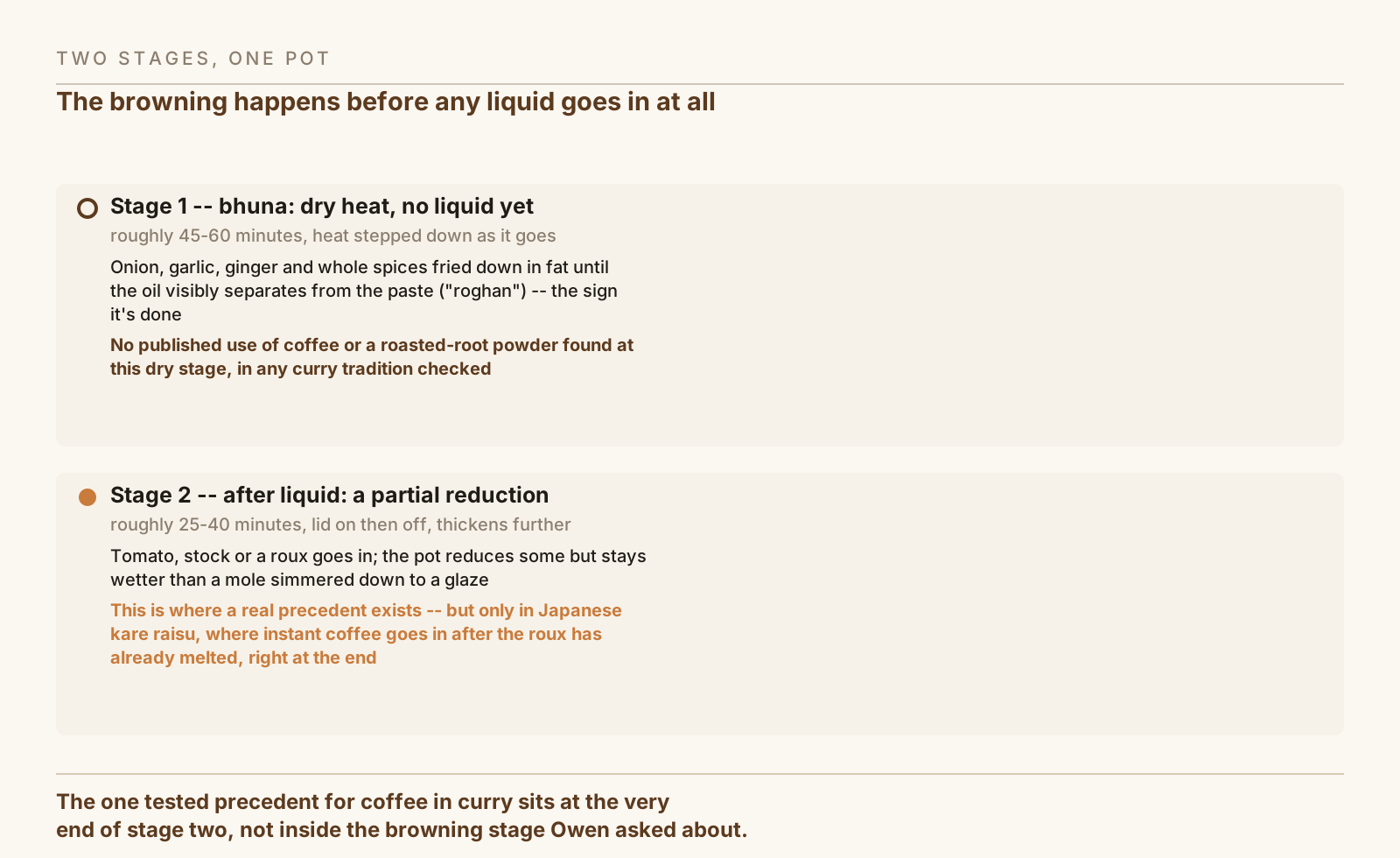
Stage one is the bhuna: onion, garlic, ginger and whole spices, fried down in fat with the lid off, no liquid at all, for something like 45 to 60 minutes as the heat steps down from high to low. Stage two starts the moment tomato, stock or a thickener goes in, and runs another 25 to 40 minutes as the pot reduces further – genuinely, but not all the way to a glaze the way a mole is. A chili never has a dry stage like the first one. A dry rub never gets wet at all. A mole starts wet and just keeps reducing. Curry alone does both, in that order, and the swap for a roasted-root powder has to answer to each stage separately rather than to “curry” as one thing.
Stage one: bhuna, and why no liquid changes everything
The Culinary Gene describes bhuna (opens in a new tab) as the browning stage that gives a curry its depth: frying the onion-garlic-ginger paste and whole spices in oil until they brown, releasing the essential oils that carry through the rest of the dish. My Food Story’s bhuna masala recipe (opens in a new tab) gives this an actual timeline rather than a vibe: onions browned on high heat for 7 minutes, then medium for 8, then low for 40 to 45 minutes more – the better part of an hour, entirely dry, before any tomato or liquid touches the pan. The sign it’s finished isn’t a colour or a smell; it’s that the oil visibly separates and pools at the edges of the paste, a state Indian cooking calls roghan, and which Wikipedia’s entry on bhuna (opens in a new tab) confirms as the defining trait of the technique – a dry, concentrated curry style rather than a saucy one.
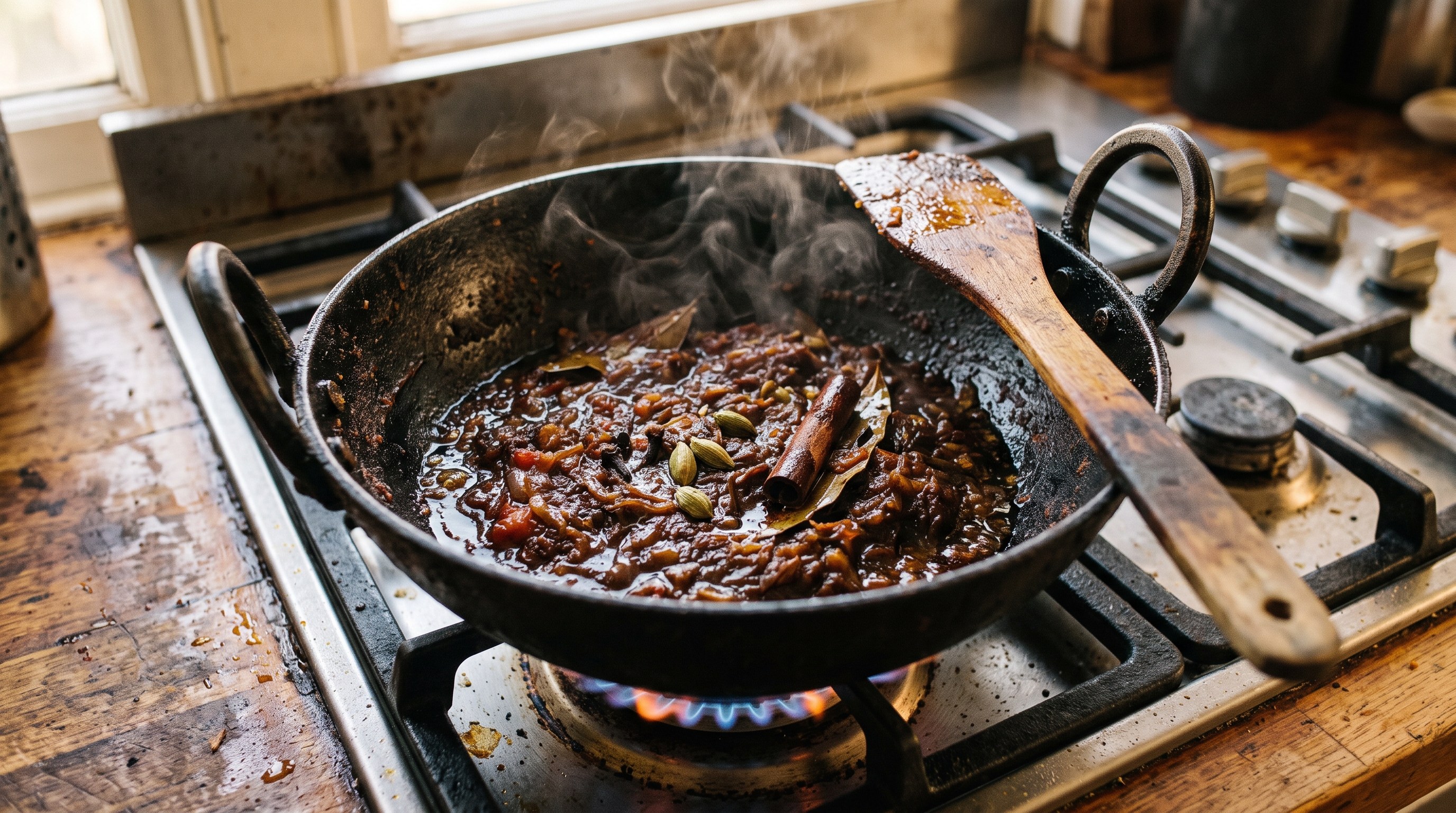
Nothing about that hour is comparable to any of the three formats the last piece worked out. It isn’t the “add it early with the other dry spices” case, because there are no other dry spices going in loose – everything is already frying, wet with fat rather than with water, moving toward a thick paste rather than a thin liquid. It also isn’t the dry-rub case, because a rub never heats past the meat’s surface and this stage heats an entire pan of aromatics all the way through. We went looking for a published recipe, a technique writeup, or even a single forum thread that put a coffee or roasted-root powder into a bhuna stage specifically, across both the South Asian sources above and the wider search this piece ran. There isn’t one. That absence is itself the honest first half of the answer: whatever the swap looks like in a curry, it doesn’t have a bhuna-stage precedent to borrow from, ours or coffee’s.
Two curry traditions, two different answers
The second half of the search turned up something the backlog note for this piece didn’t expect: the honest answer to “does coffee go in curry” depends entirely on which curry you mean, the same way the mole finding in the savoury piece turned “does coffee go in mole” into “not traditionally, but yes in modern shortcut versions.”
South Asian bhuna-style curry: no precedent found. Searching specifically for coffee or roasted chicory in curry recipes and technique writeups turned up plenty of roasted-chicory content – but all of it European, side-dish preparations (braised chicory with honey and thyme, roasted chicory with pomegranate), never a curry. Nothing in the bhuna sources above mentions it either. If it’s out there, it’s obscure enough that this search, run specifically to find it, didn’t.
Japanese kare raisu (curry rice): a real, documented precedent. This is the one SoraNews24’s coverage of a Kufura-portal survey (opens in a new tab) surfaced: asked what secret ingredient they add to curry, 437 Japanese women put instant coffee in first place, ahead of Worcestershire sauce, dark chocolate, garlic and soy sauce. It isn’t just a survey answer, either – Sudachi’s guide to Japanese curry from roux cubes (opens in a new tab) lists instant coffee as one of the author’s own regular additions, specifying 2 teaspoons, added after the roux has melted, for a richer taste, with dark roast recommended. This is a real, citable, specific use of coffee in a real curry tradition – it’s just a different curry tradition than the one Owen’s bhuna question was about, and it enters at a completely different point in the cooking process.
That’s a genuinely useful distinction, not a technicality. Japanese curry is roux-thickened rather than bhuna-browned – there’s no hour-long dry frying stage in most home versions of it at all. The coffee goes in at the very end, once the sauce is already built and thickened, which lines up with stage two above far more than stage one. Nobody in either tradition, as far as this search could establish, adds it during the dry browning stage bhuna curries actually have.
So when do you add it, and how much
Putting the two-stage physics together with the one real precedent gives an honest, specific answer rather than a shrug.
| Stage | What’s happening | Roasted-root powder here? |
|---|---|---|
| Stage 1 – bhuna (dry, ~45-60 min) | Onions and whole spices fry down to a paste; oil separates | No precedent found, ours or coffee’s. Treat as untested rather than assuming it works like a dry spice would. |
| Stage 2, early – liquid goes in (tomato, stock) | Sauce forms and starts reducing | No direct precedent, but structurally closer to the mole-style “add early, taste before the final reduction” case from the savoury piece |
| Stage 2, late – after a roux or thickener has melted | Sauce is built and close to done | The tested case. Japanese kare raisu adds 2 teaspoons instant coffee here, in a roux-cube batch sized for about 4-6 servings |
If you want to try the swap with something the closest real precedent supports, that’s the third row: stir instant chicory or another extract-based instant powder in near the end, after any roux or thickener has already done its job, starting at the same 2-teaspoon mark the Japanese recipe uses for a similarly sized batch, and taste before adding more. That’s a real number borrowed from a real recipe, not a multiplier reasoned from nothing the way the bhuna-stage question would have to be answered.
Two honest limits on that number. First, it’s calibrated to instant coffee’s flavour strength, not to any specific brand of instant chicory – extract-based powders vary, so “2 teaspoons” is a start, not a rule. Second, nobody has published a version of this with a roasted-root powder standing in for the coffee, in either curry tradition – we said the same thing about chili and mole in the savoury piece, and it’s just as true here.
What dissolves here, revisited again
The baking piece’s dissolve rule holds in a curry exactly the way it held in chili and mole: an extract-based instant powder – instant chicory, Dandy Blend, Pero, plain instant coffee-substitute granules – dissolves cleanly into a hot, wet sauce, the same way it dissolves into a batter or a pot of chili. Plain ground herbal coffee will settle out as grit at the bottom of a curry the same way it would in either of those, since a curry sauce is smooth and wet, not textured the way a dry rub is. If a roasted-root powder is going into stage two, it needs to be the instant, extract-based kind – the same format rule as everywhere else this swap has been tested, with no new exception for curry.
The gluten note, once more
Worth repeating here for a reason specific to this dish: a Japanese curry roux itself is traditionally a flour-and-fat roux, so most boxed roux blocks aren’t gluten-free to begin with, regardless of what goes in afterward. On the powder side, barley and rye contain gluten (opens in a new tab), and most instant coffee-substitute blends – Pero among them – are built on one or both. If gluten is a real constraint for whoever’s eating the curry rather than a preference, that’s two separate things to check, not one: the roux and the powder, both.
Where to find an extract-based powder
The same extract-based instant powders that worked in the baking and savoury pieces work here, since the property this dish needs – clean dissolving into a hot, wet sauce – is the same one those pieces needed. Dandy Blend, Pero and plain instant chicory are all straightforward choices. Among the blended instants, Teeccino’s instant French Roast (opens in a new tab) – roasted chicory and barley extract with a microground carob, ramón seed and date component – would dissolve into a curry sauce the same way it dissolves into a cup, at the same late, stage-two point this piece landed on. It’s built on barley, so the gluten note above applies to it the same way it applies to the roux.
What’s worked out, and what’s still a guess
The two-stage physics is sourced, not reasoned from Owen’s kitchen alone: the bhuna timeline and the oil-separation marker both come from a real recipe writeup, and the Japanese-coffee precedent comes from an actual survey and an actual published recipe with an actual measured amount. What isn’t tested is the substitution itself – nobody has published a version of either curry tradition with a roasted-root powder standing in for the coffee, at any stage, and this piece doesn’t pretend otherwise.
What we can say with more confidence, because it wasn’t the thing we went looking for, is the shape of the finding itself: “does coffee go in curry” doesn’t have one answer. It has two, and they point in different directions depending on which curry you’re asking about – exactly the kind of finding a single search for “coffee in curry” would have missed by stopping at the first no.
Thank you, Owen, for naming the actual gap instead of letting a three-format piece pass as a complete one. For the two formats this piece sits beside, the savoury-cooking piece has the full sugar-and-salt bitterness math for chili, rubs and mole, and the baking piece still has the dissolve rules and the caffeine arithmetic the swap started from.
Sources & further reading
- What Is 'Bhuna'? The Browning Stage Behind Deep Curry Flavor (opens in a new tab) — The Culinary Gene
- Bhuna Masala | Master Curry Paste (opens in a new tab) — My Food Story
- Bhuna (opens in a new tab) — Wikipedia
- You put WHAT in your curry? Japanese netizens reveal their favourite secret ingredients (opens in a new tab) — SoraNews24
- Japanese Curry Using Roux Cubes (including lots of secret tips) (opens in a new tab) — Sudachi Recipes
- Mole Mastery -- A First Recipe (Beginner's Mole Poblano) (opens in a new tab) — Rick Bayless
- Sources of Gluten -- barley and rye are not gluten-free (opens in a new tab) — Celiac Disease Foundation
Reader conversation (5)
We read every response. Selected reader notes below.
There’s a step you didn’t cover that might be an even earlier “stage zero” — a lot of South Indian and Bengali dishes temper whole spices in hot oil or ghee for just a few seconds at the very start, before the onions even go in (tadka, phoron, depending on the region). It’s dry heat like bhuna, but seconds instead of an hour. Does a powder behave any differently there?
Good catch, and you’re right that it’s a genuinely different case from bhuna rather than a variation on it — a few seconds in oil is closer to blooming a spice than browning a paste, there’s no time for anything to reduce or concentrate. I didn’t find a published use of a roasted-root powder there either, and I’d guess it doesn’t belong in that stage at all — a few seconds isn’t enough time for a powder to do anything except sit on top of hot oil — but that’s reasoning, not a tested answer, so I’m not going to state it as one in the piece itself.
Can confirm the coffee thing is real and not some internet myth — my mother has stirred a spoonful of instant coffee into her curry roux for as long as I can remember, and it’s common enough that it turns up in Japanese home-cooking columns as an ordinary tip, not a novelty. Nice to see it treated as a real curry tradition instead of a footnote.
Isn’t counting one country’s survey answer as “precedent” a bit of a stretch for an article about herbal coffee substitutes? Feels like you needed a yes and found the nearest thing to one.
Fair challenge, so let me be precise about the narrow claim I’m actually making. I’m not claiming coffee is a curry-wide tradition — the South Asian search came back empty, and the piece says so plainly rather than smoothing over it. What the Japanese survey and the Sudachi recipe support is a much smaller claim: that in one specific, real curry tradition, instant coffee is a documented, named, measured addition, not an invented one. If I’d stretched that into “coffee belongs in curry,” that would be the reach you’re describing. Keeping it to “true for kare raisu, not established for bhuna curry” is the whole point of splitting the two traditions apart instead of averaging them into one answer.
Thank you for actually running this down. One more for the list, if you’re taking them: Trinidadian curry goat doesn’t start with bhuna at all — it starts with “browning,” which is burnt sugar caramelized dark in oil before the meat goes in, a completely different chemistry from onions frying down. Caribbean curry might be a genuine fifth physics rather than a variation on the fourth.
What I appreciate most here is that you let “no precedent found” be the actual answer for the bhuna stage instead of padding it out with a guess dressed up as a finding. Most recipe content would have just asserted an amount and moved on.
Have something to add? Email us and we may include it in a future update.