What to use instead of coffee in chili, rubs and mole: the savoury side of the espresso-powder swap
Espresso powder isn't just a brownie trick — it's in chili, dry rubs and mole too, doing the same deepening job with no sugar to round it off. Here's whether roasted chicory holds up there, in real quantities, and why the honest amount is often more than instinct says.

Hal Brennan, in Portland, Maine, left a comment on the espresso-powder baking piece that we couldn’t answer honestly in the reply box. Most of his espresso powder, he wrote, never sees a dessert. It goes into chili, into a dry rub for pork shoulder, and into a red mole, doing the same job that article describes — making everything else taste more like itself. We’d given savoury cooking one line in a “works well” list and moved on. His question was simple and we didn’t have the answer: does the chicory swap hold up where there’s no sugar to balance against, and where the pot sits on heat for hours instead of thirty minutes in an oven?
We said “probably yes, at a lighter hand, but we haven’t tested it,” which is an article-shaped gap rather than a comment-shaped one. Here’s the article — what actually changes between a brownie and a braise, what real published recipes do with coffee in these three dishes, and where the honest quantities land.
Why roast powder works in savoury food at all
The baking piece’s central point was that espresso powder in a brownie isn’t there for coffee flavour — it’s there for roast character and bitterness, which deepen chocolate rather than compete with it. The same logic, it turns out, transfers cleanly to savoury cooking, just against a different set of things to deepen.
Food Republic (opens in a new tab) describes espresso powder’s bitterness as boosting the heat of a chili pepper while cutting some of the fattiness of the protein, and balancing the more familiar chili spices — cumin, cayenne — rather than standing apart from them. That’s the same mechanism as the brownie, restated for a different dish: a small amount of dark roast character makes the other flavours read as more themselves, not as “coffee.” Published recipes bear this out at a specific, checkable quantity — around a tablespoon of espresso powder per pot, stirred in at the same step as the other dry spices.
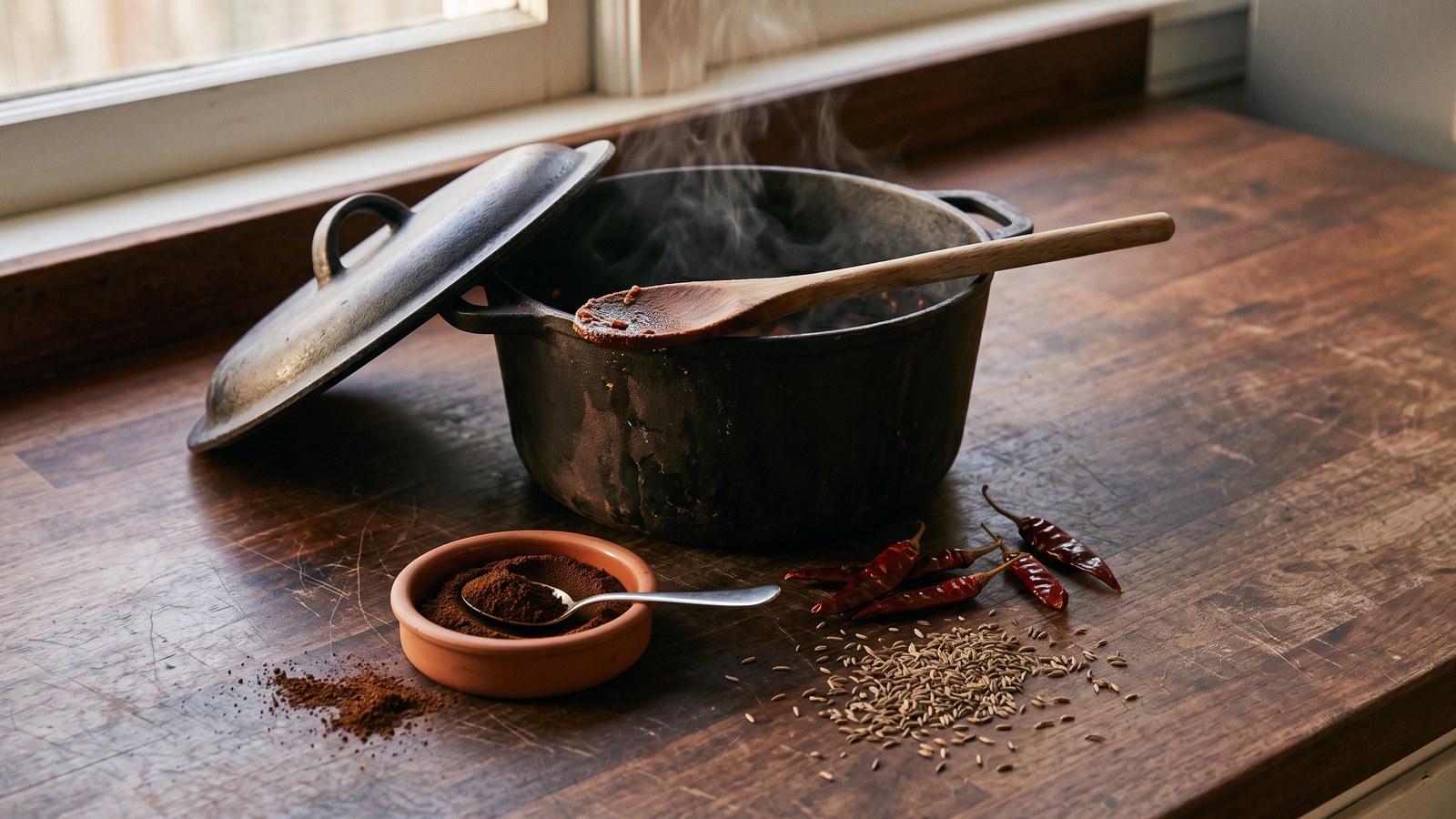
Roasted chicory sits in the same chemical family for the same reason it did in the baking piece: the flavour-formulator guide we cited there describes chicory’s roast profile (opens in a new tab) in terms of pyrazines (roasted, nutty) and furans (caramel), and lists savoury applications among its standard uses at similar concentration levels to sweet ones. Nothing about the chemistry stops working outside dessert. What changes is what it has to work against.
The premise we have to test first
The comment we replied to assumed something specific: that savoury applications have no sugar, so the bitterness lands harder, so you need less. We went looking for whether that’s actually true of published coffee-in-savoury recipes, rather than reasoning it through from Hal’s kitchen alone — and it’s only true about half the time.
Two real dry-rub recipes turned up in the research, and both include a genuine amount of sugar. A coffee-rubbed pork roast (opens in a new tab) calls for an ounce of ground coffee — about 3 tablespoons — against half a cup of brown sugar, plus salt, cayenne and paprika, for a roast cooked low for eight hours. DeLallo’s espresso-chili dry rub (opens in a new tab) puts a quarter cup of instant espresso on exactly equal footing with a quarter cup of chili powder and a quarter cup of brown sugar. Neither recipe treats “no sugar” as the default. The sugar has just moved from granulated, as in a brownie, to brown or molasses-forward, which does the same job while reading as savoury rather than sweet.
Where “no sugar” genuinely is the case — a straightforward chili with no cocoa or brown sugar in it, or a plain savoury rub built from salt, pepper and roasted powder alone — there’s a real, different mechanism doing the muting instead: salt. A taste-research paper in Chemical Senses (opens in a new tab) found that sodium salts directly suppress the perception of bitterness, through the taste receptors themselves rather than by masking or diluting it the way sugar does. Salt is already in almost every savoury application at hand — it doesn’t need to be added on purpose to do this job, the way sugar does in a brownie recipe that would otherwise have none.
So the honest correction to Hal’s premise isn’t “you need less because there’s no sugar.” It’s “check what’s actually muting the bitterness in your specific dish, because it’s very often still there — just as brown sugar or as salt, not as the white sugar a brownie assumes.”
Three dishes, three different physics
The second half of Hal’s question — does the answer change over hours on the heat — turns out to depend entirely on which of the three dishes we’re talking about, because a chili, a dry rub and a mole-style sauce concentrate flavour by three genuinely different mechanisms.
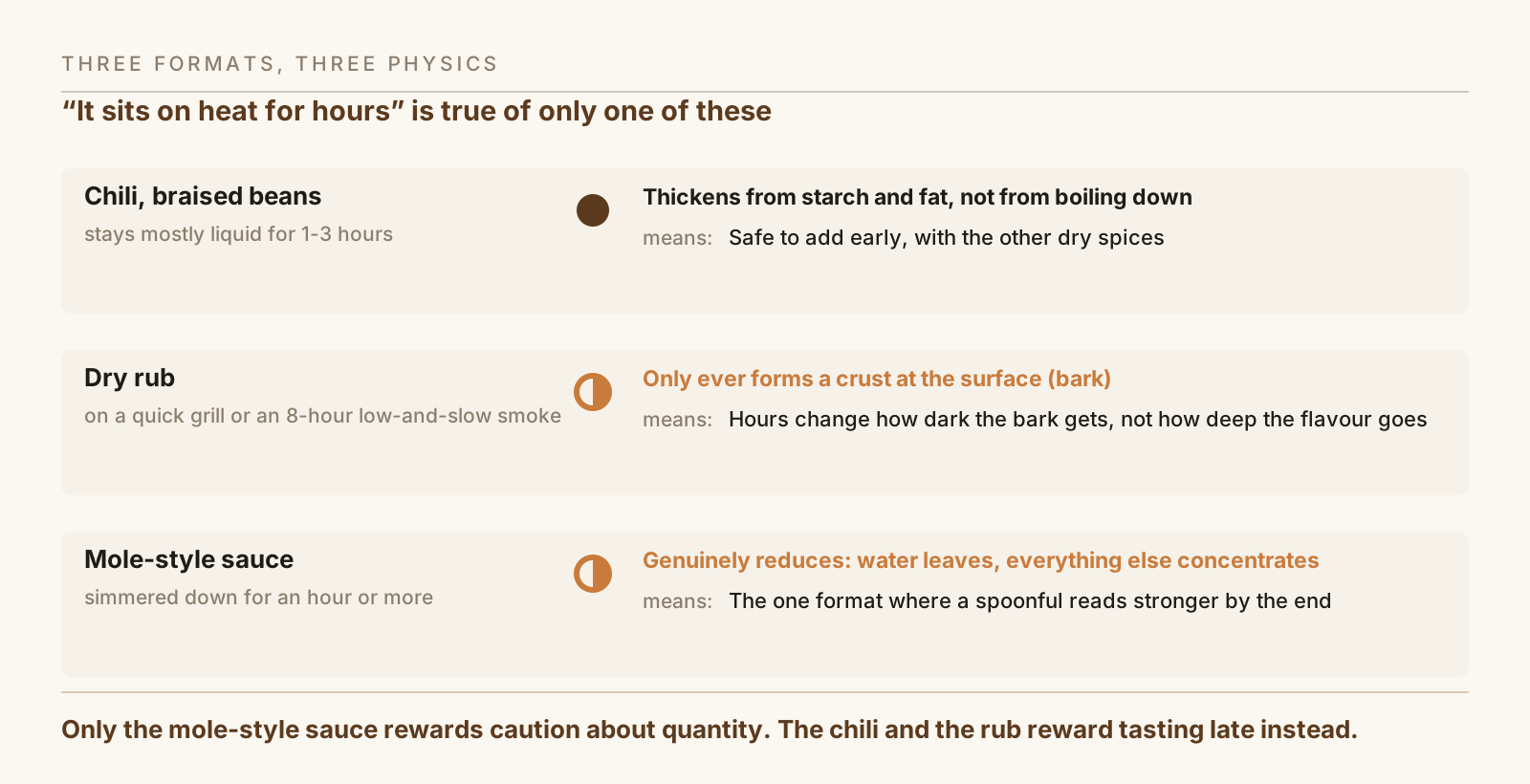
Chili and braised beans stay mostly liquid. A pot of chili thickens as it simmers, but from starch, fat emulsification and reduced-but-not-gone liquid, not from boiling down to a glaze. That’s why published recipes add espresso powder at the start, with the other dry spices, and simmer for one to three hours without treating it as a timing hazard — the powder disperses through a large, still-mostly-liquid volume rather than concentrating hard.
A dry rub only ever touches the surface. AmazingRibs’ science-of-rubs (opens in a new tab) piece makes the point plainly: spices in a rub don’t penetrate the meat to any meaningful depth, whatever the marketing on a rub jar implies. What actually happens, per their explanation of bark (opens in a new tab), is that surface moisture dissolves the rub into a slurry, which then dries and melds with fat and juices into a crust as the meat cooks — the Maillard reaction, running at the surface only. Eight hours at low heat and a twenty-minute sear both produce bark from the same rub; the difference is how dark and thick that crust gets, not how much roast flavour makes it past the surface into the meat itself. This is the one place Hal’s “hours on the heat” instinct doesn’t apply the way it sounds like it should.
A mole-style sauce is the one dish that genuinely concentrates. Reduction is real evaporative physics: water leaves as steam, and everything that isn’t water — sugars, fats, flavour compounds — becomes more concentrated in what’s left, over however long the pot spends uncovered on the heat. A mole is usually simmered for the better part of an hour or more and often finished quite thick, so a spoonful of roast powder stirred in at the start reads meaningfully stronger by the time the sauce is done than it did going in. This is the one format where Hal’s caution was pointed at the right target.
The actual method, by format
Putting the sugar-and-salt finding together with the three-physics finding gives a real starting point for each dish, stated as a multiplier over whatever quantity of espresso powder or brewed coffee a recipe calls for — the same kind of multiplier the baking piece established at 1.5–2×, adjusted here for what’s actually different about each format.
| Format | What’s muting the bitterness | Starting multiplier | Add it |
|---|---|---|---|
| Chili, braised beans, dry rub without added sugar | Salt only, usually | 1–1.5× | With the other dry ingredients, early |
| Dry rub with brown sugar (the more common recipe) | Brown sugar plus salt | 1.5–2×, same as baking | Mixed into the dry rub before it touches the meat |
| Mole-style sauce, with chocolate or dried fruit | Chocolate and fruit sugars | 1.5–2× going in, taste before the final reduction | Early, with the purée, before the long simmer-down |
Two practical notes that hold across all three. First, taste near the end, not at the start — for chili and mole because the flavour is still developing as it cooks, and for a rub because raw seasoning tastes nothing like cooked bark, a point AmazingRibs makes about rubs generally: what’s on your finger before the meat goes on is not a preview of what you’ll get off the grill. Second, this table is a reasoned starting point, not a measured one. Nobody has published a controlled test of instant chicory specifically in a pot of chili, so treat the multiplier the way the baking piece treated its own: a place to start, and a reason to taste before you commit the whole batch.
What dissolves, revisited for a rub
The baking piece’s format rule was strict: extract-based instant powder dissolves cleanly into a batter, a microground blend leaves its solids behind, and plain ground herbal coffee is grit unless it’s brewed and reduced to a syrup first. That rule holds unchanged for chili and for a mole-style sauce — both are wet, both want a smooth result, and ground roast will settle out at the bottom of the bowl exactly the way it would in a brownie.
A dry rub is the one place that rule relaxes. A rub is already a mixture of ground spices with real texture — cracked pepper, coarse salt, whole fennel or cumin seed in some recipes. Plain ground herbal coffee, the kind that’s grit in a batter, is unremarkable grit in a rub, because a rub is never meant to dissolve; it’s meant to coat. Extract-based instant powder works too, dissolving into the surface slurry as the meat’s own moisture wets the rub down — either format gets you to the same bark. This is the one savoury use where you have a genuinely free choice of format, which the baking piece never offered.
The gluten note, again
This matters more here than it did in a brownie, for the same reason it mattered in baking: you’re putting this on food that other people are going to eat, and a dry rub sits directly on the surface rather than being diluted through a whole pan.
Barley and rye contain gluten (opens in a new tab), and most of the instant coffee-substitute blends on the shelf — Pero among them — are built on one or both. If you’re cooking for someone with a real gluten constraint rather than a preference, plain instant chicory root or instant dandelion root are the reliable routes, since neither is a cereal grain, or a blend explicitly labelled gluten free. Read the current label rather than carry over what a bag said last time you bought it.
Where to find an extract-based powder
Any of the extract-based instant powders from the baking piece work here too, since the “dissolves cleanly” property is the same one this piece needs for chili and mole. Dandy Blend, Pero and plain instant chicory are all straightforward choices, and among the blended instants, Teeccino’s instant French Roast (opens in a new tab) — roasted chicory and barley extract with a microground carob, ramón seed and date component — would work in a chili or a mole the same way it works in a batter, and the small amount of microground texture it carries is, per the section above, no defect at all in a dry rub. It’s built on barley, so the gluten note above applies to it directly.
What’s worked out, and what’s still a guess
The multiplier table above is arithmetic, built honestly from the baking piece’s own established ratio and adjusted for real, sourced differences between formats — it isn’t a guess pulled from nowhere. What it isn’t is a taste test. Nobody on this team has made a pot of chili with instant chicory standing in for espresso powder and reported back on it, and we said as much to Hal rather than let the reply imply otherwise.
What we can say with more confidence is the mole finding, because it wasn’t the thing we went looking for: coffee isn’t actually traditional in mole at all. Rick Bayless’s own beginner’s mole poblano (opens in a new tab) — as foundational an English-language source on the dish as exists — uses no coffee whatsoever; the roundness comes from chocolate, dried fruit, bread and nuts. Coffee shows up only in modern shortcut versions of mole, doing the brownie job of quiet depth rather than any classical one. If a roasted-root powder belongs in a mole-style sauce, it belongs there the same way espresso powder does when it shows up at all: as a background note in a dish that already has its sweetness built, not as a stand-in for the chocolate.
Thank you, Hal, for the actual shove. The next time someone tells us a swap “probably works, but we haven’t tested it,” that’s the sentence that should turn into an article instead of a hedge.
For the format this all started from, the baking piece still has the fuller solubility rules and the caffeine arithmetic behind the swap. For the chocolate register these dishes both lean on, carob vs cocoa covers a related but different swap — carob doesn’t behave like a roast powder at all, sweeter and without the bitterness this piece depends on. And if the format you actually have on hand is a ground herbal-coffee roast rather than an instant, how it behaves in a French press or pour-over is worth reading before you decide whether to brew and reduce it for a syrup, or buy an instant powder instead.
Sources & further reading
- A Dash Of Espresso Is The Key Ingredient For Elevating Chili (opens in a new tab) — Food Republic
- The Science Of Rubs (opens in a new tab) — Meathead's AmazingRibs.com
- What is Bark, and Why It Makes Us Howl for More (opens in a new tab) — Meathead's AmazingRibs.com
- Suppression of bitterness by sodium: variation among bitter taste stimuli (opens in a new tab) — Chemical Senses, via PubMed
- Mole Mastery — A First Recipe (Beginner's Mole Poblano) (opens in a new tab) — Rick Bayless
- Chicory as a natural flavoring: roast chemistry, solubility, and use levels in baked goods (opens in a new tab) — Perfumer & Flavorist
- Sources of Gluten — barley and rye are not gluten-free (opens in a new tab) — Celiac Disease Foundation
Reader conversation (5)
We read every response. Selected reader notes below.
This is a better answer than I expected to get from a comment about chili. The sugar-versus-salt point actually explains something I’d never connected: my dry rub has always had brown sugar in it, so I’ve apparently been doing the “rub with sugar” version all along without knowing there was a “without” version that behaves differently. Going to try the mole note next — I had genuinely assumed coffee was traditional in there and never questioned it.
That’s exactly the gap we didn’t expect going in either — we started out ready to write “use less in savoury food” and the actual recipes talked us out of it. Report back on the mole if you make it; that’s the one format where we’d genuinely adjust the amount down rather than up, and it’s the part of this we’re least certain about.
Growing up we never had coffee anywhere near the mole, and reading that Bayless’s own recipe doesn’t use it either is validating in a way I didn’t expect to feel about a coffee-alternatives website. The version with coffee always tasted like someone was trying to shortcut the chocolate toasting step to me, not like an ingredient that belonged there on its own terms.
Pitmaster, for what it’s worth on the rub section: the “hours don’t change how deep it goes, only how dark the bark gets” point matches what I see on a 14-hour brisket versus a 90-minute rack of ribs with the same rub. I’d never had a clean explanation for why the interior tastes basically the same either way. Filing this away.
Useful gluten reminder, and I’d push it one step further for anyone cooking for a mixed table: a rub touches every piece of meat it goes on, so if even one guest can’t have barley or rye, the whole rub has to be the gluten-free version, not just their portion. Learned that one the hard way at a cookout.
What I actually want next is the curry side of this. Roasted, ground spice going into a long-simmered curry is a completely different heat and time profile from a chili or a rub, and a lot of curry bases are built on browning something first the same way a dark roast is already “browned.” Does the chicory swap change again once you’re talking hours in a curry pot rather than a chili pot?
Good instinct, and we don’t think the answer is “same as chili” without checking — a curry base usually starts by browning onions, garlic and whole spices in fat before any liquid goes in, which is a different mechanism again from either a braise or a rub. That’s genuinely a fourth physics, not a restatement of the first three, so it’s going on the list as its own piece rather than an assumption we bolt on here.
Have something to add? Email us and we may include it in a future update.