What a cafe can actually make you caffeine-free: the drinks that aren't on the board
Steamers, hot chocolate, and a herbal tea poured as a latte — the caffeine-free drinks most espresso bars can already build, even when none of them are printed on the menu. Plus the one cocoa-based trap that quietly isn't caffeine-free at all.

Danny Okonkwo, six years a barista in Leeds, left a comment on a piece about ordering caffeine-free abroad that pointed out something closer to home: the caffeine-free/decaf mix-up isn’t a customer problem. It happens behind the counter too, staff included, and it happens because most menu boards were never built to answer the question a genuinely caffeine-avoiding customer is actually asking. His other point was sharper still — a steamer ordered unsweetened or at half syrup fixes the biggest complaint about it (cloyingly sweet), and there’s a whole category of drink a standard espresso bar can build that never makes it onto the board at all.
That’s the gap this piece fills. Not a home recipe — an order. What a cafe with a steam wand, a syrup rack and a tea drawer can already assemble, whether or not it’s printed anywhere, and the one place on a typical menu where “sounds caffeine-free” and “actually is” quietly part ways.
The question the board doesn’t answer
Every coffee shop menu is organized around coffee. Decaf gets a line. Tea gets a section. “I don’t want either of those, and I don’t want a cup of hot water either” doesn’t get a category — even though the machine sitting behind the counter can build exactly that drink in under a minute. The four things below aren’t secret menu tricks in the gimmicky sense. They’re standard builds at most chains, just filed under names that don’t advertise what they leave out.
The steamer: the drink that’s already on the machine
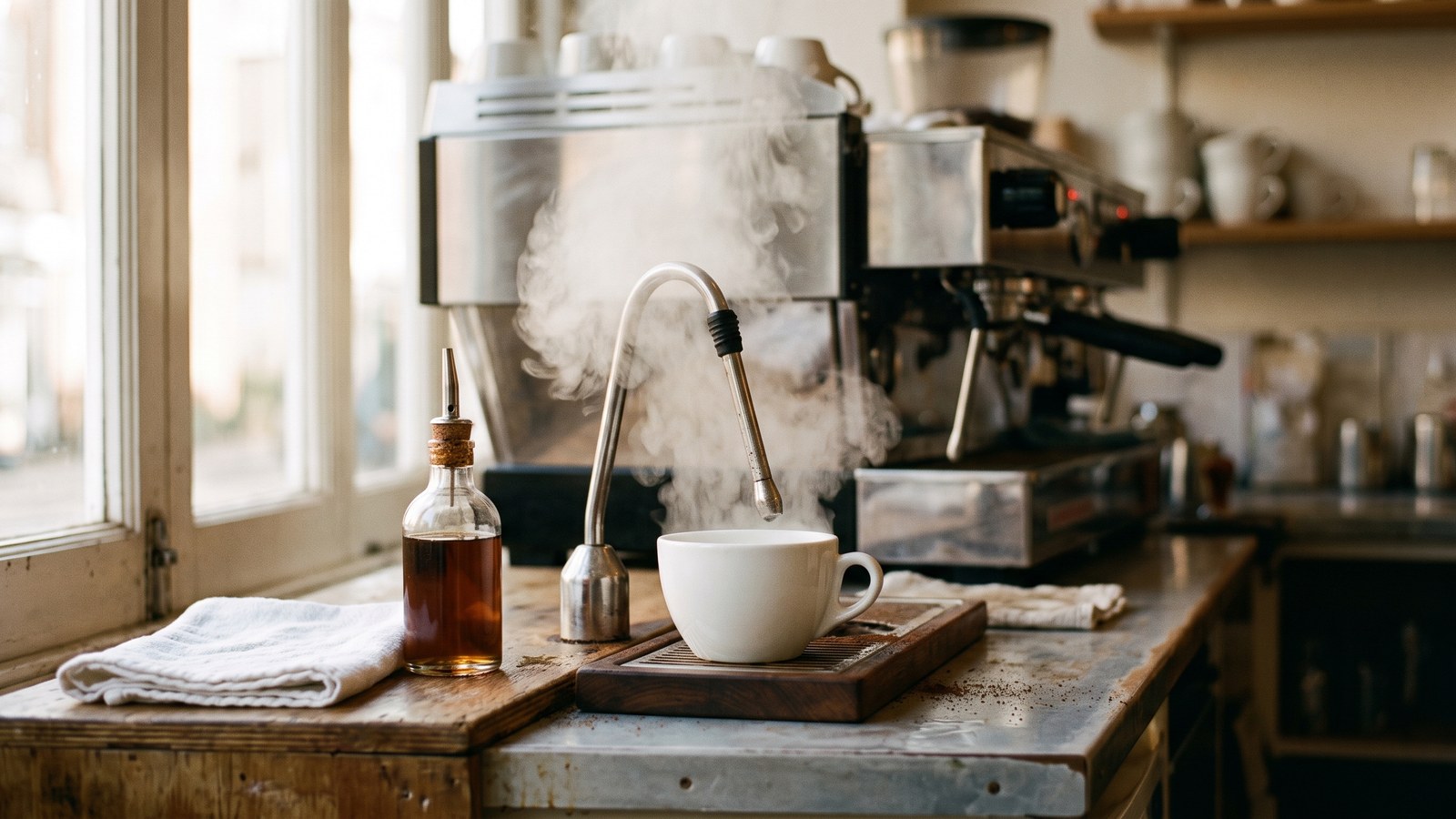
A steamer is steamed milk and a flavored syrup — nothing else. No espresso shot, no tea bag, no coffee anywhere near the cup. It’s an actual named item at most chains rather than an insider trick: Starbucks lists plain Steamed Milk and a Vanilla Crème steamer on its regular hot menu, and any other pump syrup behind the counter — caramel, hazelnut, cinnamon dolce, seasonal flavors like pumpkin spice in the fall — can usually be substituted in on request, since it’s the same syrup used to flavor coffee drinks. Danny’s fix is worth repeating here because it’s the single biggest complaint about the drink: ask for it unsweetened or at half syrup. A full-syrup steamer is built to taste like a dessert, not a coffee substitute, and most cafes will happily cut the pump count if you ask.
This is the drink to lead with if you’re new to going caffeine-free at a counter, because it needs no explanation — “a steamer, please, half the usual syrup” is a complete, ordinary-sounding order that doesn’t require anyone behind the counter to think twice.
The hot chocolate trap
This is the one honest complication in this piece, and it’s worth knowing before you order on autopilot. Hot chocolate sounds like the obvious caffeine-free fallback — no coffee, no tea, just cocoa — and most of the time that’s roughly true. But “roughly” is doing real work in that sentence, and one popular version of the drink isn’t caffeine-free at all.
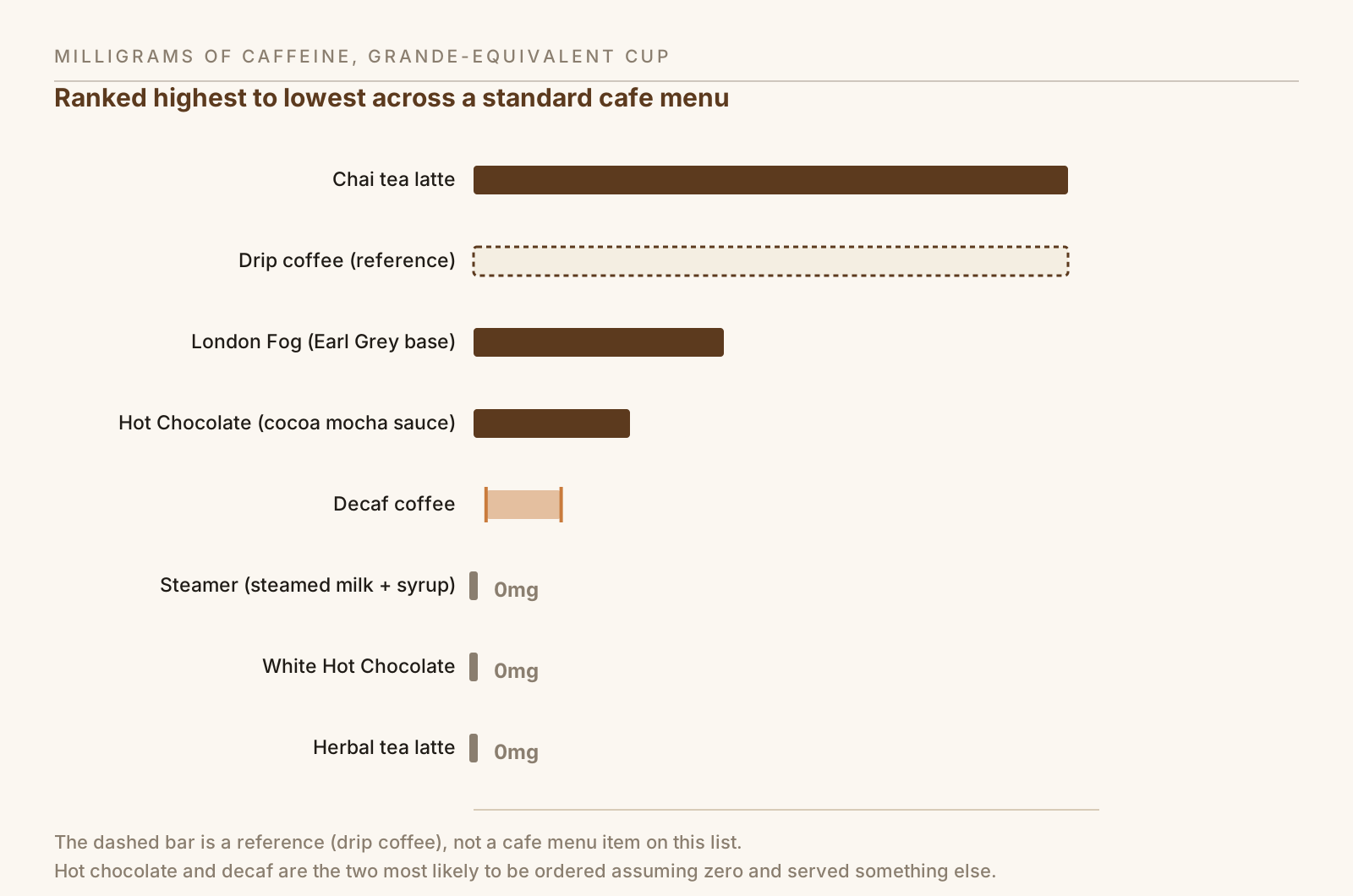
The caffeine in a standard hot chocolate comes from the cocoa itself, not from coffee — cocoa solids naturally carry a small amount, the same fact behind how much caffeine is actually in a bar of chocolate. At Starbucks specifically, a grande Hot Chocolate is built from the same mocha sauce used in a Caffè Mocha — real cocoa solids cooked down with sugar — and lands at roughly 25mg of caffeine, according to Healthline’s review of the chain’s own nutrition figures. A grande White Hot Chocolate, by contrast, is built from a separate white mocha sauce made from cocoa butter and sugar with no cocoa solids at all, and comes in at 0mg. Two drinks that sound like flavor variants of each other — regular versus white — actually split on the one axis that matters if you’re avoiding caffeine entirely, not just avoiding coffee.
The practical version of this: if zero caffeine actually matters to you (pregnancy, a medical reason, a strict withdrawal taper), a white hot chocolate or a plain vanilla steamer is the safer default, not a “regular” hot chocolate assumed caffeine-free by name alone.
Ask for the herbal tea as a latte, not a tea
Chai lattes and London Fog lattes are genuinely caffeinated — chai concentrate is brewed on black tea (roughly 95mg per grande at Starbucks, in the same range as drip coffee), and a London Fog is built on Earl Grey, also a black tea (roughly 40mg per grande). Neither is a caffeine-free order despite sounding gentler than a straight coffee.
But the format both drinks use — a brewed tea, steamed milk poured over it, vanilla syrup if you want the London Fog flavor — isn’t locked to black tea. Most espresso bars stock at least one caffeine-free herbal tea behind the counter for their plain hot-tea menu (Starbucks carries Peach Tranquility, Mint Majesty and Passion Tango as standing options), and a barista can build the exact same latte format around any of them: half brewed tea, half steamed milk, syrup to taste. It won’t be called a “London Fog” on the receipt, because that name is tied to the Earl Grey version specifically, but it’s the same drink with the caffeine swapped out at the source. Ordering it is just naming the parts: “a Peach Tranquility tea latte, steamed milk, vanilla syrup.”
This is the trick worth remembering above the others, because it turns a specific caffeinated drink you already know how to order into a caffeine-free one, rather than asking you to learn a new drink from scratch.
Why “decaf” isn’t the answer you asked for
This is Danny’s other point, and it deserves to be said as plainly as he said it: decaf and caffeine-free are not the same request, and treating them as interchangeable — at the register or in your own head — is where most confusion at the counter actually starts. Decaf coffee still carries real caffeine — a wide range depending on the batch, averaging around 2mg per 8oz cup by USDA figures, with independently tested samples occasionally running into the low teens. That’s a small amount next to a regular cup, but it isn’t zero, and “isn’t zero” matters if the reason you’re avoiding caffeine is medical rather than a taste preference.
If a customer says “decaf” at the register, they get coffee beans that have been through a decaffeination process — not a promise of zero. If what you actually mean is no caffeine, none, from any source, the clearer ask is one of the four drinks above: a steamer, a white hot chocolate, or a herbal tea latte. None of them run through a decaffeination process at all, because none of them started with caffeine to begin with — which is the same underlying distinction this site has drawn before between herbal coffee and decaf as two different products solving two different problems.
The iced version of all three
Every drink above works cold, and the build barely changes. A steamer becomes milk over ice with syrup, shaken or stirred rather than steamed — some counters call this exact drink a “chiller” and it needs no coffee or tea reference at all to order. A white hot chocolate is milk, white mocha sauce and ice, the same ratio as the hot version. A herbal tea latte iced is the standard “iced tea latte” build most chains already offer for their black-tea version — brewed tea over ice, milk poured over the top — just asked for with the caffeine-free herbal option named specifically instead of left to default. The one thing worth double-checking on an iced order: some default iced tea lattes are built from a pre-brewed tea concentrate rather than a fresh bag, and that concentrate is more likely to default to a caffeinated tea unless you ask for the herbal option by name.
What this is built on, and what varies by cafe
Everything above is documented against one chain specifically — Starbucks — because it’s the most thoroughly published menu and nutrition data available, not because it’s the only cafe where these builds work. The underlying pieces (a steam wand, a syrup rack, a tea drawer with at least one herbal option, a mocha sauce and a separate white version) are standard equipment at most espresso bars, chain or independent, which is why the principle generalizes even where the exact names and caffeine figures won’t. A small independent cafe may not carry a white mocha sauce at all, may only stock one herbal tea instead of three, or may build its hot chocolate from a powder mix rather than a cocoa sauce — all of which changes the specific numbers without changing the underlying move: ask what’s actually in the cup, not what the drink is called.
That’s also the honest limit of this piece. It’s built from each chain’s own published nutrition data and menu documentation, not from a survey of independent cafes — Danny’s original comment came from six years behind a UK counter, and if you work a bar and something here doesn’t match what you can actually build, we’d genuinely like to know.
What to actually say at the counter
The four drinks above collapse into one script, adjusted for what you want:
- For something plain and warm: “A steamer, please — half the usual syrup.” No coffee, no tea, in the name and in the cup.
- For something chocolatey: “A white hot chocolate.” Not the regular one — the white version is the one that’s actually zero.
- For something that tastes like a tea-shop drink: “Do you have a caffeine-free herbal tea? Can I get that as a latte, like a London Fog, with steamed milk?”
- If the reason is medical, not preference: don’t say “decaf” — say “no caffeine at all, is there anything with genuinely zero?” and let the barista match you to what’s actually on hand.
None of this requires a special menu, a loyalty app trick, or a barista who’s seen a viral TikTok about it. It requires knowing which three words to put in a normal-sounding sentence — which is exactly what a six-year barista’s comment on this site handed us for free.
Thank you, Danny, for the correction and the fix in the same comment. If you’ve found other cafe builds that solve this from behind the counter rather than from a home kitchen, the ordering caffeine-free abroad piece your comment sat on, and the camping and travel roundup, are the other two places on this site built the same way — from what a reader who’s actually done the thing told us, not from guessing.
Sources & further reading
- The 15 Best Caffeine-Free Starbucks Drinks, Chosen by a Former Starbucks Barista (opens in a new tab) — PureWow
- Starbucks Steamers (Including Flavors & Ordering Options) (opens in a new tab) — Sweet Steep
- Does Hot Chocolate Have Caffeine? Versus Coffee, Tea, and More (opens in a new tab) — Healthline
- What Is Mocha Sauce At Starbucks? (opens in a new tab) — We Want The Sauce
- Every Starbucks Tea Drink Ranked by Caffeine Content (opens in a new tab) — Oh, How Civilized
- A Barista's Guide to Starbucks Tea Latte Menu (opens in a new tab) — Sweet Steep
- Quick Guide to Starbucks Caffeine-free Tea Drinks (opens in a new tab) — Sweet Steep
Reader conversation (5)
We read every response. Selected reader notes below.
Glad this turned into a proper piece — the decaf mix-up is the thing I still catch myself doing on a busy Saturday, six years in. One more from behind the bar: on machines with a manual steam valve rather than an auto-steam button, ask for it “not too hot” if it’s for a kid or someone with a sensitive mouth. Full steam pressure gets that milk hotter than most people expect from something with no coffee in it.
That’s a genuinely useful addition — thank you. Added it to my own mental script even though it didn’t make the final word count. “Not too hot” is exactly the kind of two-word add that costs nothing to ask for.
The hot chocolate vs white hot chocolate thing genuinely surprised me. I’ve been ordering regular hot chocolate for my daughter for years assuming it was the same as decaf-adjacent, basically nothing. Twenty-five milligrams isn’t huge but it isn’t the zero I thought I was getting her either.
Tried the “herbal tea as a latte” ask at my local place yesterday and the barista didn’t even blink — just asked which tea. Felt like I was asking for something complicated and it turned out to be a completely normal request on their end. Wish I’d known this years ago.
Small addition from an independent shop I frequent here: they don’t carry a white mocha sauce at all, but they’ll make a “hot cocoa” from straight cocoa powder and steamed milk on request, no sauce base — worth asking specifically since it sidesteps the whole sauce question entirely at a place that doesn’t stock the fancier version.
That’s a good example of the “ask what’s actually in the cup” principle doing real work — a from-powder cocoa isn’t built from either mocha sauce, so it plays by different rules than the Starbucks-specific numbers in the piece. Exactly the kind of independent-cafe variation the piece flagged as the honest limit of what we could document.
The “say no caffeine at all, not decaf” line is worth printing on a card. I have a heart condition and have said “decaf” at counters for years assuming it meant what I needed it to mean. Going to change how I order starting tomorrow.
Have something to add? Email us and we may include it in a future update.