The caffeine nap, explained: why coffee-then-a-20-minute-nap beats either alone
A short nap taken right after a cup of coffee outperforms either one alone in the best-controlled test we have: driving incidents during a monotonous afternoon drive fell to 9% of placebo with the combination, versus 34% for caffeine by itself. The adenosine mechanism, the real window to time it in, and who this genuinely isn't for. This still uses caffeine — it's a timing piece, not an alternatives pitch.

Someone told me about this years ago like it was a magic trick — drink your coffee, then go straight to sleep for twenty minutes, and you wake up hit twice as hard. It sounded like the kind of thing that gets repeated at parties and falls apart the moment anyone checks a source.
I checked. It mostly holds up, and it holds up for a specific, unglamorous reason: it isn’t a trick at all. It’s two separate mechanisms that happen to land on the same clock.
I want to be honest about what this piece is before you’re three paragraphs in. This is still a caffeine strategy. It is not a coffee-alternative pitch, and if you’re here because you’re trying to use less caffeine rather than time it better, skip ahead to the section for you. What follows is for the much larger group of people who are keeping caffeine in their life and want to know if this particular habit is real.
What a caffeine nap actually is
The mechanics are almost insultingly simple: you drink a caffeinated drink, and instead of going about your afternoon while it kicks in, you immediately lie down for a short nap — most of the research lands somewhere between 15 and 20 minutes. You set an alarm. You wake up roughly when the caffeine is starting to take effect.
That’s it. There’s no special brewing method, no particular type of coffee, no ritual beyond the timing. The entire intervention is sequence — coffee first, sleep second, both within the same short window — rather than the more common pattern of coffee instead of a nap, or a nap and then coffee afterward to shake off the grogginess.
The adenosine mechanism, in plain terms
Two things are happening on two different clocks, and the useful trick is just lining them up.
Sleep pressure builds up as a molecule called adenosine accumulates in your brain while you’re awake. The longer you’ve been awake, the more adenosine is sitting around, and the sleepier you feel. Sleep — even a short bout of it — clears some of that adenosine out. That’s a real, physical decrease in the thing making you drowsy, not just a subjective sense of having rested.
Caffeine doesn’t clear adenosine. It blocks the receptors adenosine would otherwise bind to. Caffeine is what pharmacologists call an adenosine receptor antagonist — it occupies the same docking sites adenosine uses, without triggering the drowsy signal itself, so the buildup can’t do its job as effectively. That’s the whole reason coffee makes you feel more awake: not energy from nowhere, but a chemical blockade on your brain’s built-in sleepiness alarm.
Put those together and the nap stops being a coincidence. A short nap physically clears some adenosine. Caffeine, arriving a little while later, blocks the receptors so the adenosine that’s left has less to grab onto. You get a real reduction in sleep pressure and a blockade against what remains, rather than one or the other. Caffeine also takes a stretch of time — commonly cited as somewhere in the neighborhood of 20 to 45 minutes — to reach meaningful levels in the blood after you drink it, which is a large part of why a roughly-20-minute nap lines up so well: you’re waking up right around when the caffeine is starting to bite.
What the research actually found
The most-cited study behind this isn’t a lifestyle blog — it’s a 1997 driving-simulator experiment, and it’s worth walking through because the numbers are more dramatic than the “wakes you up a bit more” reputation this idea has.
Reyner and Horne, at Loughborough University, put 12 chronically sleep-restricted drivers through a monotonous two-hour drive on a car simulator in the early afternoon — the exact window most people associate with the post-lunch slump. Before each drive, the drivers got a 30-minute break with one of three conditions: 200mg of caffeine (roughly the amount in a strong cup of coffee), 200mg of caffeine immediately followed by a short nap opportunity of well under 15 minutes, or a placebo.
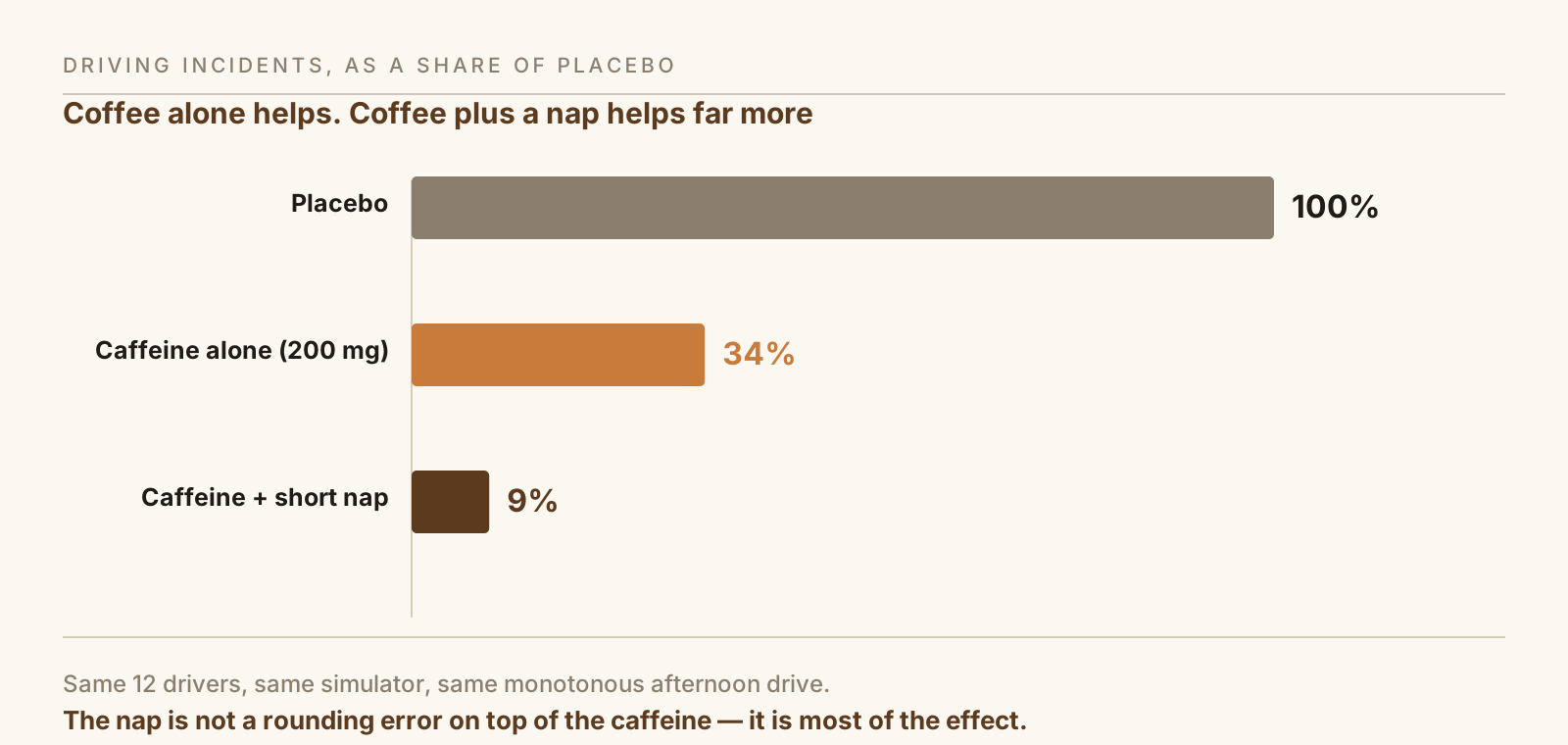
Caffeine alone cut driving incidents to about 34% of the placebo level. That’s a real, useful effect on its own — nobody should read this piece as “coffee doesn’t help.” But caffeine plus the short nap cut incidents to about 9% of placebo, a considerably larger reduction than caffeine achieved by itself. The same pattern showed up in subjective sleepiness ratings and in EEG measures of drowsiness, not just in the incident count.
A separate 2003 lab study by Hayashi and colleagues tested the caffeine-nap combination against four other conditions — a nap alone, a nap followed by bright light, a nap followed by face-washing, and no nap at all — using a 20-minute nap opportunity and the same 200mg caffeine dose. The caffeine-nap combination came out ahead on both subjective sleepiness and objective performance measures, and unlike the other combinations, its benefit was still measurable a full hour after napping.
There’s also a smaller, more recent pilot study worth knowing about if you work nights: Centofanti and colleagues tested a caffeine-nap against a decaf placebo-nap in six night-shift workers taking a 30-minute nap opportunity at 3:30am, and found improved vigilant attention and lower subjective fatigue in the 45 minutes afterward. It’s a small pilot — six people is six people — but it points the same direction as the larger daytime studies, in a population that actually needs this the most.
How to actually do one
Based on what the studies above actually did, rather than what internet folklore has added to it:
- Drink a caffeinated drink with somewhere around 150–200mg of caffeine — roughly one strong cup of drip coffee, or check a label if you’re using something more concentrated. Do this in the early-to-mid afternoon, during the window when sleepiness is naturally highest for most people.
- Lie down immediately, rather than finishing the cup slowly or checking your phone first. The clock on both the caffeine and the nap starts as soon as you’re done drinking.
- Set an alarm for 15–20 minutes. This is the range the underlying research actually used, and it’s short enough that most people won’t drop into deep sleep, which is the thing that causes grogginess on waking.
- Get up when the alarm goes off, even if you don’t feel like you slept much. Reyner and Horne’s own drivers dozed for well under 15 minutes and still showed the effect — you don’t need to have fallen properly asleep for a real reduction in sleepiness to register.
A dark room isn’t required by anything in the research, though it may help you fall asleep faster inside a short window. If you nap regularly as part of shift work, our piece on day-sleep that actually works covers the room-darkening and temperature basics in more depth.
What it doesn’t do
A few honest limits, because this idea tends to get oversold:
It’s still caffeine. Nothing about napping first changes caffeine’s pharmacology afterward — it still has the same roughly five-hour half-life we’ve written about in detail in why caffeine wrecks your afternoon, and a caffeine nap taken too late in the day carries the same risk of a caffeine tail eating into that night’s sleep. If you’re in bed by 11pm, a caffeine nap after about 4–5pm is working against your sleep, not for your afternoon.
It doesn’t fix accumulated sleep debt. These studies were run on acutely sleep-restricted or chronically fatigued subjects to demonstrate a real physiological effect, not to suggest a 20-minute nap substitutes for a full night’s sleep. Our piece on caffeine and sleep architecture covers what caffeine does to the sleep you do get, even the sleep you think is unaffected by it.
Tolerance is real and understudied here specifically. Regular heavy caffeine users may get less benefit from any single caffeine dose, nap-paired or not, because their adenosine receptor system has partly adapted to chronic blockade. None of the studies above controlled tightly for participants’ baseline caffeine habits, so treat the size of the effect as demonstrated in the populations tested, not guaranteed to be identical for you.
One nap isn’t a substitute for fixing the schedule that’s making you need it. If the 3pm wall shows up every single day, that’s frequently a signal worth looking at on its own terms — see our piece on the caffeine half-life math for the more common underlying cause.
Who should skip this
This isn’t medical advice, and none of what follows is a diagnosis — it’s a list of reasons to talk to your own clinician before making a caffeine nap a habit, drawn from the same caution any caffeine dose warrants:
- Anyone advised to limit or avoid caffeine for anxiety, insomnia, high blood pressure, heart rhythm issues, acid reflux, or during pregnancy or breastfeeding. A caffeine nap is a caffeine dose; none of the usual reasons to avoid caffeine go away because it’s paired with a nap.
- Shift workers trying to sleep during the day afterward. The Centofanti pilot above used caffeine specifically to stay alert during a shift — it wasn’t testing whether the same dose interferes with the sleep a night-shift worker needs when they get home. Timing this away from your own main sleep period matters as much as timing it toward your slump.
- Anyone who already struggles to fall asleep within 15–20 minutes. If a short nap opportunity routinely turns into 40 minutes of lying there or a full hour of unplanned sleep, the mechanism this piece describes doesn’t have anything to work with, and you’re better off addressing the sleep debt directly.
- People who are already caffeine-sensitive at much smaller doses than 150–200mg. There’s no rule that says the dose has to match the research exactly — a smaller dose in the same sequence may still help, though it hasn’t been separately tested at scale.
If you’re trying to cut caffeine, not time it
If you read this far and realized the honest answer for you is “I don’t actually want more caffeine, timed well or otherwise” — that’s a completely reasonable place to land, and it’s most of what the rest of this site is about.
A plain 15–20 minute nap, without the coffee, still clears real sleep pressure on its own; you simply lose the receptor-blockade half of the effect described above. If you want a warm ritual in the same slot without the caffeine, our roundup of the best herbal coffee covers roasted-chicory and grain-based blends — Teeccino among them — that give you something to hold and sip without adding a stimulant to a nap you’re trying to use as actual rest. And if mornings without caffeine are the harder problem than afternoons, how to wake up without coffee is the piece to read next.
The bottom line
A short nap taken right after a cup of coffee is a real, mechanistically sound combination, not folklore — a 1997 driving-simulator study found it cut incidents to about 9% of placebo versus 34% for caffeine alone, and later lab and pilot work points the same direction. The mechanism is straightforward: a short nap clears some of the adenosine that’s making you sleepy, and caffeine blocks the receptors so what’s left has less to bind to, and the two effects arrive on roughly the same clock if you keep the nap to 15–20 minutes.
It is still a caffeine habit, with the same half-life, the same evening risk, and the same reasons some people should avoid it in the first place. If that describes you, the honest next step isn’t a bigger dose or a better-timed one — it’s a nap on its own, and a caffeine-free cup for the ritual around it.
This article is educational and is not medical advice. If you have a health condition affected by caffeine, or you’re pregnant or breastfeeding, talk to your own clinician before making a caffeine nap a regular habit.
Sources & further reading
- Suppression of sleepiness in drivers: combination of caffeine with a short nap (Reyner & Horne) (opens in a new tab) — Psychophysiology, 1997
- The alerting effects of caffeine, bright light and face washing after a short daytime nap (Hayashi, Masuda & Hori) (opens in a new tab) — Clinical Neurophysiology, 2003
- A pilot study investigating the impact of a caffeine-nap on alertness during a simulated night shift (Centofanti et al.) (opens in a new tab) — Chronobiology International, 2020
- Actions of caffeine in the brain with special reference to factors that contribute to its widespread use (Fredholm et al.) (opens in a new tab) — Pharmacological Reviews, 1999
- What Is a Coffee Nap? (opens in a new tab) — Sleep Foundation
Reader conversation (4)
We read every response. Selected reader notes below.
I’ve done a version of this for years on night shifts in the ICU without ever knowing there was research behind it — one of the senior nurses taught it to me as “coffee then close your eyes for one round of obs,” which works out to almost exactly twenty minutes on our unit. I always assumed it was folk wisdom. Nice to find out it’s closer to actual pharmacology.
That’s a good, specific version of the timing — “one round of obs” is a better instruction than “twenty minutes” because it’s anchored to something you’re already doing rather than a number you have to watch. The night-shift pilot study in this piece is small, but it was testing more or less exactly your situation, and it found the same direction of effect.
Isn’t this just a fancy justification for drinking more coffee? Feels like the kind of thing that gets shared because it sounds clever, not because anyone needed permission to nap.
Fair pushback, and I’d rather answer it than dodge it. It isn’t giving anyone permission to drink more caffeine than they otherwise would — the dose in the driving study was one cup’s worth, the same 200mg a lot of people already have in the afternoon. The only thing that changes is the order you do two things in, which is why I found it worth writing up: the effect size in that study is bigger than I expected from a pure sequencing change, and it cost the drivers nothing extra to try.
Does it matter what the caffeine comes in? I mostly drink strong black tea rather than coffee in the afternoon and I’m wondering if the same twenty-minute trick applies, or if there’s something coffee-specific about the studies you’re citing.
The mechanism is about caffeine specifically, not about coffee as a beverage, so a strong black tea carrying a comparable dose should work on the same logic. I’ll say plainly that I don’t know of a trial that used tea in place of coffee for this exact nap protocol, so I can’t point you to a study that tested it directly — but there’s nothing in the adenosine-receptor mechanism that’s coffee-specific, and the caffeine dose is the variable that matters.
Tried this on a long drive back from the coast last month after reading about it somewhere else, timed against my phone. Twenty minutes in a service-station car park, alarm set, and I genuinely did feel sharper for the rest of the drive than the usual just-coffee stops I normally make. Anecdote, not data, but it matched what you’re describing here closely enough that I wanted to say so.
Have something to add? Email us and we may include it in a future update.