Day-sleep that actually works: the blackout, the cold room, and the setup for sleeping when the sun's up
Sleeping during the day is a different sport than sleeping at night — you're fighting daylight, a warm body, and a loud world. Here's the bedroom setup that actually closes the gap: sealing out light, getting the room cold, masking noise, and a wind-down ritual that travels — plus where caffeine timing quietly wrecks all of it.

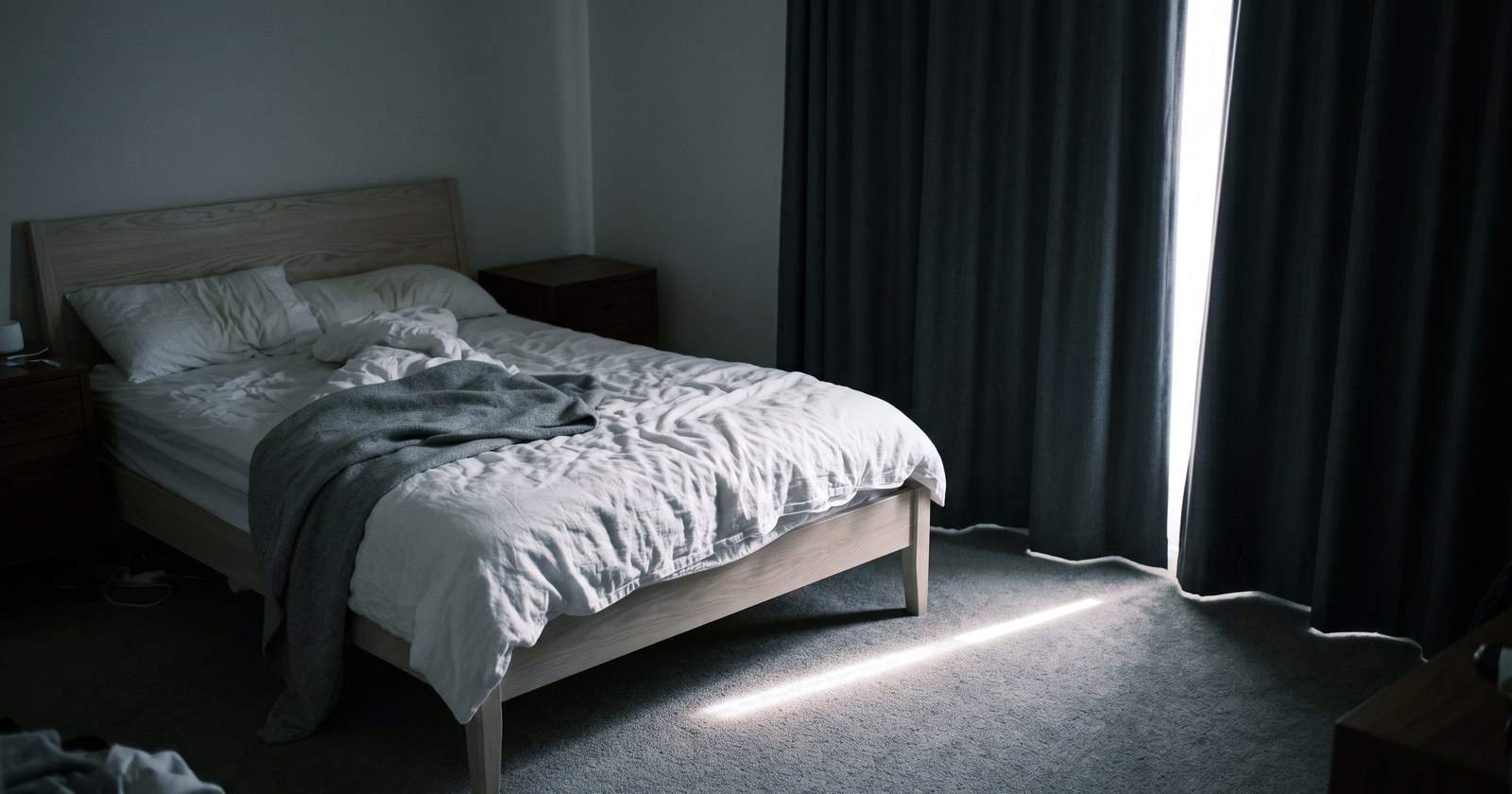
I am not a shift worker, but I’ve spent a strange amount of my life trying to sleep when the sun was up. Red-eye recovery. The summer I worked a 4am bakery prep shift and crawled into bed at noon. The newborn stretch where “sleep when the baby sleeps” meant 1pm in a room full of July light. Every time, I made the same discovery: lying down in a bright, warm, awake-sounding house at midday is nothing like lying down in the dark at 11pm. It’s a different sport, and the rules you learned for night-sleep barely transfer.
So this is the companion piece I kept meaning to write to the shift-worker morning routine. That one was about manufacturing a morning when your morning doesn’t line up with the sun. This one is about the harder half — manufacturing a night when it’s the middle of the afternoon. A reader named Priya, an ICU nurse, put it bluntly in the comments there: the morning stuff is fine, it’s the day-sleep that’s killing me. Fair. Here’s what actually moves the needle, in the order I’d fix it.
One caveat first, the same one as always: I write about this from experience, not a clinic. If you’re genuinely not sleeping, nodding off driving home, or you suspect shift work disorder, that’s a doctor conversation, not a blog post.
Why day-sleep is a different sport
It helps to know what you’re actually fighting, because once you see it you stop blaming yourself for finding day-sleep hard.
Three things are working against you at noon that quietly work for you at midnight. The first is light. Daylight hitting your eyes suppresses melatonin, the hormone that builds your drowsiness — so the exact moment you’re trying to wind down, your brain is getting the strongest possible “stay awake” signal. The second is temperature. To fall and stay asleep, your core body temperature has to dip slightly, and researchers have shown that daytime light and melatonin levels each independently shift alertness and body temperature (opens in a new tab) — during the day your temperature is riding its natural upswing, so it’s working against the dip sleep needs. The third is simply the world: deliveries, traffic, lawnmowers, a phone that assumes you’re awake because it’s 2pm.
None of that makes day-sleep unhealthy. It just means the room has to do the job that darkness and a quiet night would otherwise do for free. Everything below is a way of handing those jobs to your environment instead of your willpower.
Seal out the light — all of it
If you fix exactly one thing, fix light, because it’s both the strongest lever and the one most people get 80% right and stop. Eighty percent isn’t enough here.
Blackout curtains are the obvious move and they’re worth it — but nearly every blackout curtain leaks a bright rim of daylight around the edges, and that escaped light is more than a cosmetic annoyance. The fix isn’t a fancier curtain so much as covering the gap: mount the rod wider and higher than the window so the fabric overlaps the frame, or run a cheap blackout liner right up against the glass. The Sleep Foundation’s shift-work guidance (opens in a new tab) keeps coming back to the same word — dark — because your clock reads even modest light as daytime.
Then add a contoured eye mask anyway. It covers the rim the curtains miss, and just as importantly it travels — to a hotel, a couch, a relative’s spare room that’s never going to be blacked out. The day-sleepers I know who’ve actually stuck with it almost all land on the belt-and-suspenders version: curtains for the room, mask for the face.
The part people forget is the commute home. If you walk out of a night shift into morning sun and let it hit your eyes the whole drive, you’ve just sent your clock a sunrise signal right before you ask it to sleep. The Working Time Society’s consensus on light for shift workers (opens in a new tab) is explicit about this: dark sunglasses on the way home aren’t an affectation, they’re protecting the sleep you’re about to attempt. Light at the wrong time undoes the dark you’ve worked to build at home. This is the same cortisol-and-light machinery underneath how to wake up without coffee — just run in reverse, because now you’re trying to convince your body it’s night.
Get the room genuinely cold
This is the lever I underrated for years. I treated temperature as a comfort preference and it’s actually mechanical.
Because sleep onset rides on that small drop in core body temperature, a cool room isn’t about feeling cozy — it’s about giving your body somewhere to shed heat to. During the day, when your temperature’s running higher anyway, the room has to help more than it would at night. Most guidance points to roughly 65–68°F (about 18–20°C), and for day-sleep specifically I’d push toward the cold end of that and let bedding do the adjusting. A cool shower before bed helps too — counterintuitively, it triggers a rebound where your core temperature drops afterward, which is exactly the direction you want.
Practical stack: crank the AC or a fan before you get in rather than after, use breathable bedding instead of a duvet built for January, and keep the room you sleep in on the shaded side of the home if you get any choice in it. If you’re rotating between day-sleep and night-sleep, it’s worth setting a thermostat schedule so the room is already cold when your “night” begins, whatever the clock says.
Mask the noise instead of chasing silence
You will not get a quiet house at 1pm. The trick is to stop chasing silence — which is impossible during the day — and start masking, which is achievable.
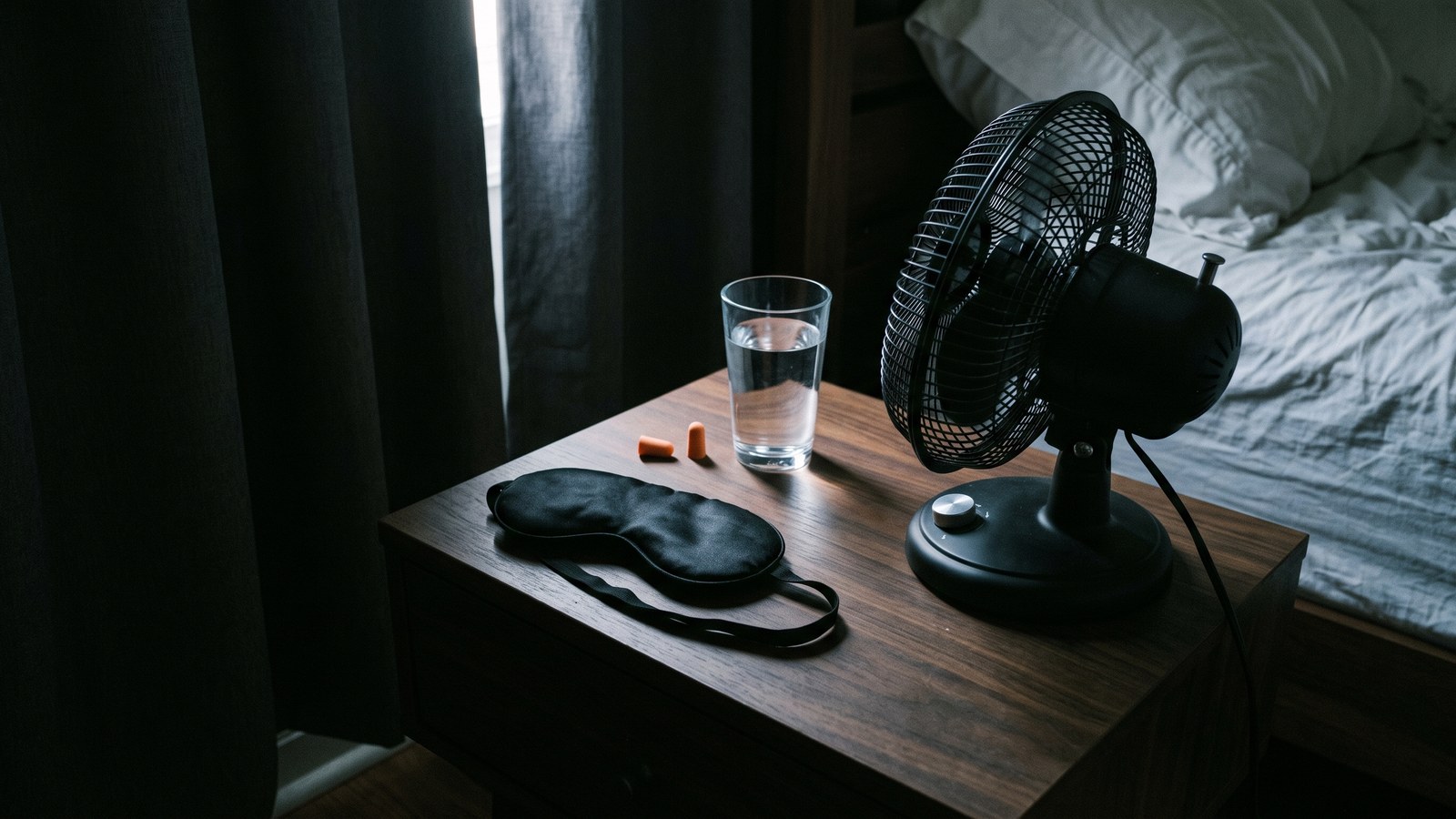
A steady wall of neutral sound covers the variable noises that actually wake you: the delivery truck, the doorbell, a conversation drifting up from the street. That’s what a white-noise machine, a fan, or even a long looping rain track does — it doesn’t make the room silent, it raises the floor so individual sounds don’t spike above it. Constant and boring beats intermittent and interesting; your brain startles at change, not volume. Earplugs are the other half if you’re a light sleeper, and the two together — plugs plus a masking layer — handle most of what a daytime neighborhood throws at you.
The phone is its own noise source, and the fix is non-negotiable: it goes somewhere other than the nightstand, on do-not-disturb, with whatever “let my partner through in an emergency” exception you need configured so you can actually let go of it. A phone buzzing at 2pm because the world assumes you’re awake is the single most avoidable day-sleep wrecker.
Build a wind-down that travels
Here’s the thing about day-sleep that took me longest to learn: your body can’t rely on the time as a cue, so the ritual has to become the cue instead. At night, the late hour itself tells your body what’s coming. At 1pm it tells your body the opposite, so you have to supply the signal yourself — the same sequence, in the same order, every time you’re about to sleep, until your nervous system learns that this means down, regardless of what the clock says.
Mine is boring on purpose: lights low, screens off, a cool shower, and a warm caffeine-free drink while the room finishes cooling. The drink matters more than it looks like it should. A warm mug is a strong “the day is over” gesture, and after a night shift it’s the cleaner replacement for the worst habit in the category — one more coffee on the way home. That last coffee is genuinely destructive, because caffeine’s roughly five-hour half-life means a 4am cup is still circulating when your 9am sleep begins; the AASM’s shift-work guidance (opens in a new tab) is specific that the back half of a shift is exactly when to stop. Swap that cup for a caffeine-free roast and you keep the entire ritual — the warmth, the bitterness, the signal that work is done — and spend none of it against your sleep.
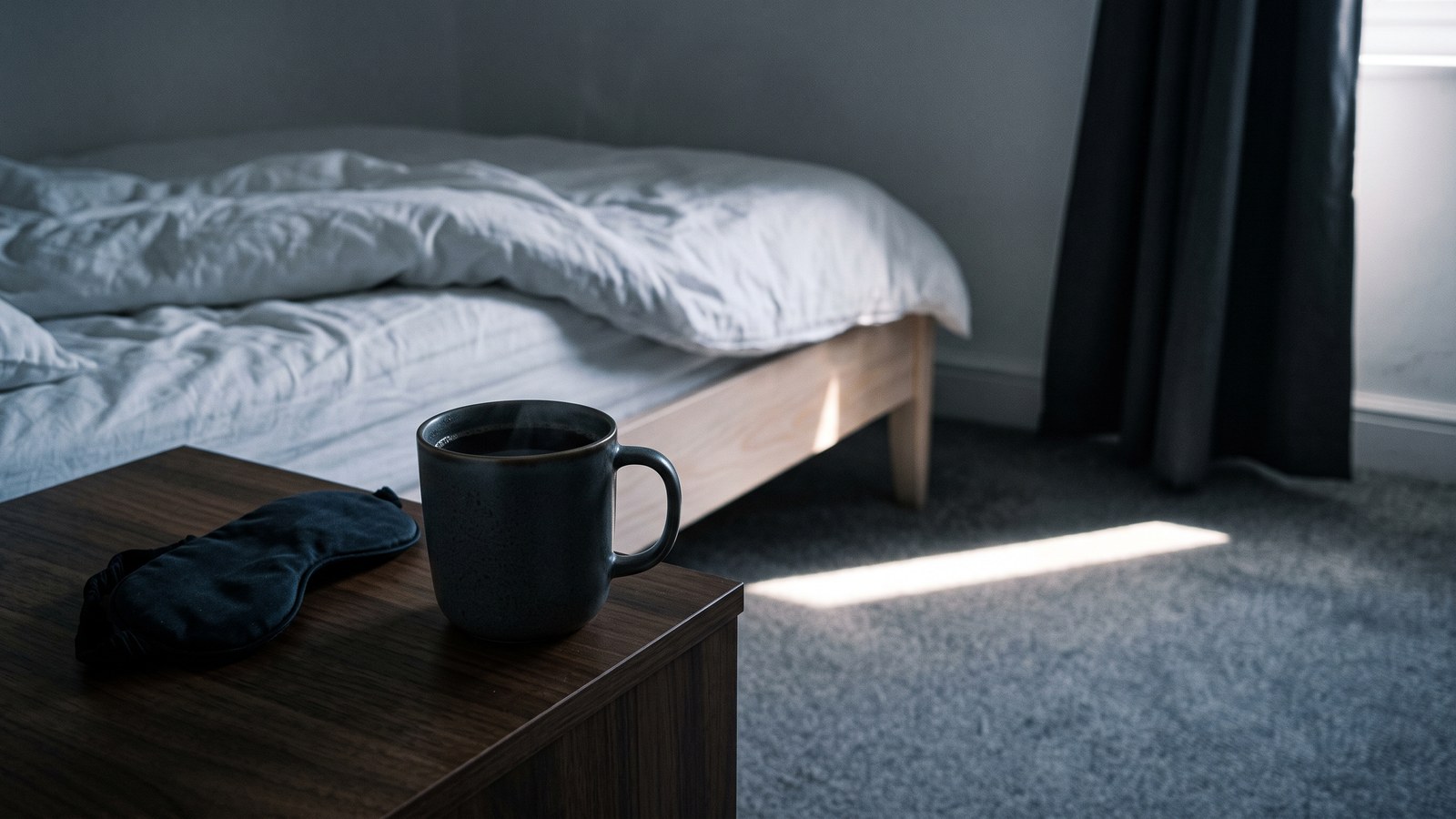
Among the herbal “coffee” roasts I’ve used for this end-of-shift slot, a dark chicory-and-carob blend like Teeccino’s French Roast (opens in a new tab) gets closest to the roasted bitterness that makes the gesture feel like coffee — but it’s one of several that work, and the point is the zero-caffeine part, not the label. If you want options, I’ve gone through the contenders in the best caffeine-free coffee alternatives and the best morning drink instead of coffee, most of which work just as well at the end of a night as the start of a day. And if you’ve been leaning on caffeine to paper over short day-sleep, dropping it is often the thing that finally lets the sleep deepen — which is the whole arc behind what happens at day 30 off caffeine.
The schedule stuff you only half control
I want to be honest that the biggest lever here isn’t a curtain or a mug — it’s the schedule, and you don’t fully own it.
What you can do: protect a single consolidated block of 7–8 hours rather than grabbing sleep in scattered fragments, and keep your sleep timing as consistent as your life allows so the ritual has something to anchor to. What’s often out of your hands: the number of consecutive nights you work, how fast the rota rotates, whether you can keep any stable timing across days off. Both the AASM fact sheet and the Sleep Foundation guidance flag the schedule itself — fewer consecutive nights, predictable rotations, real recovery days — as a lever that no bedroom setup fully replaces.
If your rotation is fast and irregular, the hardest pattern of all, the realistic goal stops being “adapt” and becomes “damage control”: nail the dark, the cold, and the noise every single time, because when the schedule won’t give you consistency, the environment is the only stable cue you’ve got left. I dug into the broader version of riding an unpredictable schedule without caffeine in the shift-worker routine piece, and the honest throughline is the same: control what you can reach.
The honest limits
I won’t oversell this. Day-sleep done perfectly is still, on average, a little shorter and a little lighter than the night-sleep it’s standing in for — that’s a real finding, not a motivation problem, and the research on sleeping out of phase with your clock is consistent about it. A blacked-out, cold, quiet room narrows that gap a lot. It doesn’t erase it.
What the setup does buy you is the difference between fighting your environment and being helped by it — and across a stretch of nights, that difference compounds into whether you’re functional or fried. So: seal out the light, including the rim the curtains miss and the sun on your commute home. Get the room genuinely cold. Mask the noise rather than chasing a silence you can’t have. Build a wind-down ritual that travels, and end it with something warm that isn’t going to keep you up. None of it is glamorous. All of it works better than willpower, which is the only thing day-sleep reliably burns through.
If your “morning” lands at 4pm, pair this with a morning routine for shift workers, without caffeine. For the wake-up science underneath it all, see how to wake up without coffee.
Sources & further reading
- Tips for Shift Workers: How To Get Better Sleep (opens in a new tab) — Sleep Foundation
- Daytime melatonin and light independently affect human alertness and body temperature (opens in a new tab) — Journal of Pineal Research (PMC)
- Working Time Society consensus statements: evidence-based interventions using light to improve circadian adaptation to working hours (opens in a new tab) — Industrial Health (PMC)
- Shift Work Disorder — Provider Fact Sheet (opens in a new tab) — American Academy of Sleep Medicine
Reader conversation (5)
We read every response. Selected reader notes below.
I’m the ICU nurse who said the day-sleep was the part killing me — so seeing a whole piece on it kind of made my week. The commute-home sunglasses thing is what I never took seriously. I’d black out the bedroom perfectly and then drive home squinting into the sunrise for 25 minutes and wonder why I couldn’t drop off. Wore dark wraparounds on the drive this week and it genuinely helped. Small thing, big difference.
That made my week back, honestly — your comment is half the reason I finally wrote it. The commute is the blind spot nobody warns you about; you do all the work at home and then undo it on the road. Glad the sunglasses landed.
The temperature section is so right and so underrated. I bought a cheap window AC just for the bedroom and started running it an hour before I get home from nights. Walking into an already-cold room instead of cooling it down while I lie there sweating was the single biggest upgrade I’ve made. Wish I’d done it years ago.
Not a shift worker — new mom here — but this is the most useful day-sleep advice I’ve found and none of it was baby-specific, which is exactly why it worked. The “mask the noise instead of chasing silence” line reframed the whole thing for me. I was tiptoeing around trying to make the house silent. Bought a fan, gave up on silent, slept better.
Question — I rotate days and nights every week and I genuinely can’t keep a consistent sleep time no matter what I do. You mention “damage control” for fast rotations but is there anything more specific for people whose schedule is just chaos?
Honestly, for true chaos rotations the most useful shift is to stop optimizing for a consistent time (you can’t) and make the ritual itself the constant — same wind-down sequence, same cold dark room, same caffeine-free mug, every single time you sleep, whatever the clock says. When timing won’t hold still, the environment and the routine become the only stable cue your body gets. Protect those ferociously and let the clock be the mess it’s going to be.
The point about that last coffee on the drive home hit me. I’d grab a cup “to get home safely” and then lie awake until noon and blame the daylight. Switched to a caffeine-free roast for the after-shift mug and it turns out the daylight was only half the problem. Funny how the fix was the thing I thought was helping.
Have something to add? Email us and we may include it in a future update.