Coffee and ADHD medication: the label never mentions caffeine, but the pharmacology still adds up
Neither Adderall's nor Ritalin's own FDA label names caffeine as an interacting substance — despite what a hundred blog posts imply. Here's what the labels actually warn about, what the two stimulants have in common anyway, and what that means for your morning cup.

A reader wrote in last month after a genuinely unsettling appointment: her son’s psychiatrist asked, almost in passing, whether he’d had any caffeine that morning before his Concerta. She hadn’t thought to mention the can of soda at breakfast. Nobody had ever told her it might matter.
I went looking for the actual rule behind that question, expecting to find it spelled out somewhere official. It isn’t, not quite — and the gap between what’s officially written down and what’s pharmacologically true turns out to be the most useful thing I found.
The short answer
Caffeine and prescription ADHD stimulants — amphetamines like Adderall and Vyvanse, methylphenidate like Ritalin and Concerta — are not officially listed as a drug interaction on either medication’s FDA label. I checked both directly rather than relying on a secondhand summary, and neither document names caffeine.
That is not the same as “fine to ignore.” Caffeine and prescription stimulants work on overlapping systems in the brain and the cardiovascular system, even though they aren’t the same molecule and don’t share a label warning. Combining them adds stimulant load on top of stimulant load, and the people closest to this — CHADD, the largest ADHD patient organization in the US — describe real cases of it going badly, in language plainer than most clinical writing: “dangerously acute jitteriness or out-of-control impulsivity.”
So: not a labeled contraindication, but not nothing either. The rest of this piece is about the size of that gap and what to actually do with it.

What actually happens when you combine them
Amphetamine and methylphenidate both work primarily by increasing dopamine and norepinephrine activity in the brain — that’s the mechanism behind the medication actually helping someone focus. Caffeine works differently at the receptor level (it blocks adenosine, the molecule that makes you feel drowsy, rather than boosting dopamine directly), but the downstream effect overlaps heavily: more alertness, more arousal, a faster heart rate, in some people more anxiety.
Two different keys opening two different locks on the same door is still two things going through that door at once. That’s the plain-language version of what several sources converge on: prescription stimulants act specifically and predictably in the targeted brain regions; caffeine, taken as a beverage, circulates through the whole body and adds a second, less targeted stimulant signal on top.
Nobody has run a controlled clinical trial that puts real ADHD patients on their actual prescribed dose of Adderall or Ritalin and then dosed them with coffee to measure what happens — I looked, and that specific study doesn’t appear to exist. What we have instead is pharmacology (both act as CNS stimulants, both raise heart rate and blood pressure to some degree), clinical caution from the organizations closest to ADHD care, and a scattering of patient reports. That’s a real basis for caution. It is not the same as a measured, quantified risk.
What the drug labels actually say (and don’t)
This is the part that changed how I’d write this article. I expected to find caffeine named somewhere in the official prescribing information for at least one of these medications. It isn’t — not in Adderall XR’s label, not in Ritalin’s.
Here’s what each label actually says instead:
Adderall XR (amphetamine). The label warns against combining amphetamine with other sympathomimetic drugs and with tricyclic antidepressants specifically, citing the risk of “striking and sustained increases in the concentration of d-amphetamine in the brain” with cardiovascular effects potentiated. Separately, it carries a serotonin-syndrome warning that names SSRIs, SNRIs, triptans, tricyclic antidepressants, fentanyl, lithium, tramadol, tryptophan, buspirone, and St. John’s Wort, and an outright contraindication with MAOIs — combining a CNS stimulant with an MAOI can cause a hypertensive crisis. Caffeine appears in none of these lists.
Ritalin (methylphenidate). The label is even more general: “Because of possible effects on blood pressure, Ritalin should be used cautiously with pressor agents.” It doesn’t name which pressor agents. Caffeine has a mild pressor (blood-pressure-raising) effect of its own, so a reasonable pharmacologist would probably read caffeine as falling under that umbrella — but the label doesn’t say so explicitly, and I’m not going to present my own inference as the label’s finding.
What both labels document clearly, independent of caffeine entirely, is that these medications already carry meaningful cardiovascular effects on their own:
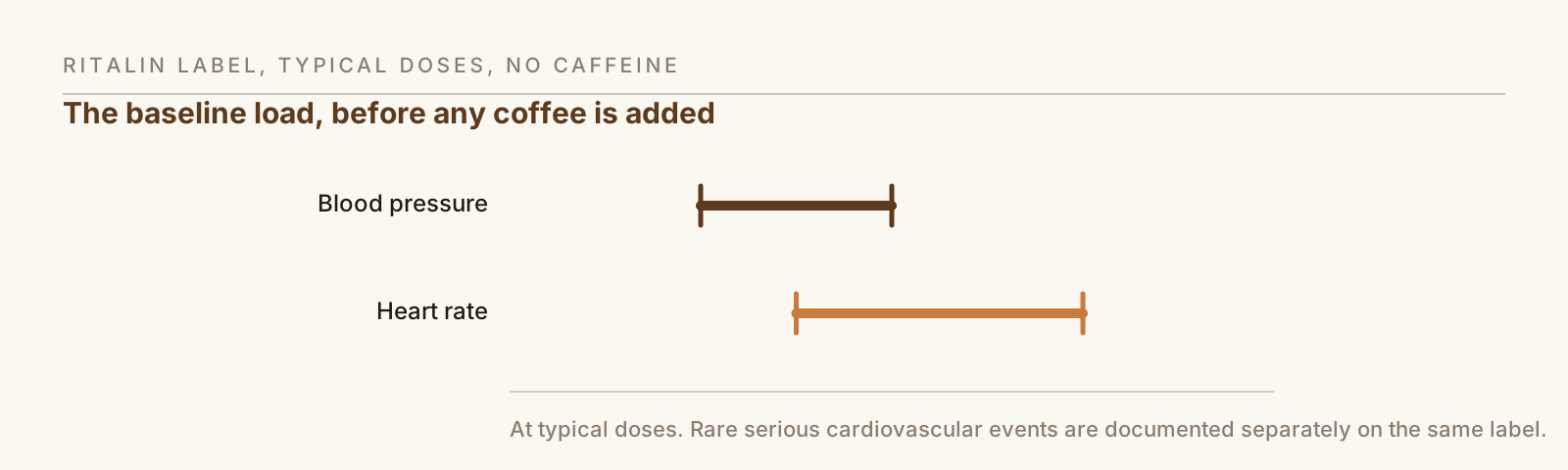
That’s the number worth sitting with. The medication is already nudging blood pressure and heart rate upward in the average patient, as an expected and monitored part of how it works. A second stimulant on top of that isn’t crossing into some previously safe zone — it’s adding to a load that was never zero to begin with. The FDA’s own 2023 safety communication updated the boxed warning across every prescription stimulant in this class specifically because of cardiovascular and psychiatric risk, misuse, and overdose — again, without singling out caffeine, but as a reminder that regulators already treat this drug class as one that deserves real caution on its own terms.
Does caffeine help ADHD symptoms on its own?
A separate but related question worth answering honestly: if caffeine and stimulant medication work on overlapping systems, does caffeine do anything useful for ADHD symptoms by itself?
CHADD’s own review of the research says yes, a little, in adults — low to moderate caffeine doses have shown modest improvement in concentration in some studies — but adds an important asterisk: higher doses actually produced a decline in working memory in the same body of research, and CHADD’s own conclusion questions “whether caffeine deserves a place in the arsenal of pharmacological agents for ADHD” at all. The Child Mind Institute’s read is blunter still: a dose small enough to be genuinely low-risk “might not hurt, but it’s not likely to have much impact,” and a dose large enough to move the needle brings the same side effects — sleep disruption, tremors, appetite suppression — that make caffeine a worse trade than the medication it’s being compared to. ADDitude Magazine frames the core difference simply: prescription stimulants work specifically in the targeted brain regions, while caffeine in a beverage travels through the whole body.
None of that makes caffeine useless or forbidden. It does mean caffeine is not a substitute for stimulant medication, and “I’ll just have coffee instead of taking my pill” is a worse plan than either source suggests on its own.
Kids are a different question
Everything above is written with an adult in mind. For a child on stimulant medication, the caution tightens considerably, for reasons that stack rather than cancel out:
- Appetite. Stimulant medication already suppresses appetite in a lot of kids — it’s one of the most commonly reported side effects, and it’s part of why some children on long-term stimulant treatment show temporary growth deceleration that can compound if caloric intake stays low for years. Caffeine is its own appetite suppressant. Layering the two doesn’t add mildly; it adds on top of an effect that’s already being watched by the prescriber.
- Sleep. Both the medication and caffeine can interfere with sleep, and sleep is doing more developmental work for a child’s brain than for an adult’s.
- Cardiovascular sensitivity. Children’s cardiovascular systems respond more reactively to stimulant stacking than adult systems do, and kids can develop caffeine dependence faster than adults.
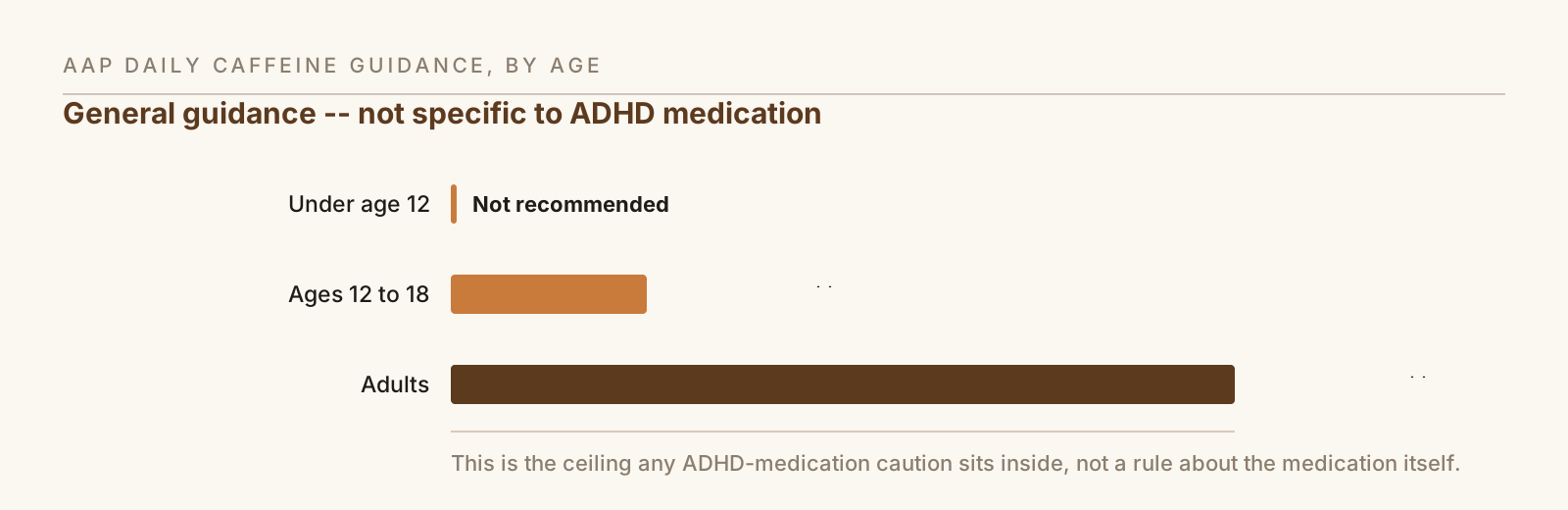
The American Academy of Pediatrics’ standing caffeine guidance — no caffeine recommended under age 12, up to 100 mg a day for ages 12 to 18 — predates and applies independently of any ADHD diagnosis or medication. CHADD’s specific read for children already on stimulant medication is more direct than its read for adults: the risks generally outweigh the benefits, full stop. That’s a pediatrician conversation, not a household rule to work out by trial and error.
Does switching to a caffeine-free herbal coffee change anything?
This is the question I most wanted to answer honestly rather than conveniently, given what this site is.
A genuinely caffeine-free herbal coffee — roasted chicory, carob, barley, dandelion root, the base of most herbal coffee blends — removes the caffeine input entirely if the product is actually 0 mg, which is a real, checkable difference from decaf. Decaf coffee still carries a small residual amount of caffeine per cup; a chicory-based herbal coffee like Teeccino’s French Roast (opens in a new tab) or Dandelion Dark Roast (opens in a new tab) doesn’t, and neither do comparable blends like Dandy Blend or Pero. For someone whose actual goal is “stop adding a second stimulant on top of my medication, but keep the ritual of a hot mug in the morning,” that’s a real and useful swap — not a marginal one.
What it does not do is anything about the medication side of the picture. Nothing about a caffeine-free cup addresses whether Adderall or Ritalin is dosed correctly, or whether residual symptoms in the afternoon are a sign the current prescription needs adjusting rather than a gap to fill with more caffeine. If coffee has been doing real work managing symptoms the medication isn’t fully covering, switching what’s in the mug treats the caffeine question and leaves the medication question exactly where it was — a conversation for a prescriber, not a beverage aisle.
One more honest limit worth naming: Teeccino’s Miraculous Mushrooms line is not uniformly caffeine-free the way its herbal-coffee line is — Adapt & Protect is 0 mg, but Cacao + 5 and the Matcha Latte both contain caffeine despite the shared family name. If the whole point of switching is getting caffeine out of the picture for someone on stimulant medication, that’s worth checking on the specific product, not assumed from the line.
What I actually tell people
When someone brings me this exact question, the list is short:
- This isn’t an emergency, and it isn’t nothing. Neither Adderall’s nor Ritalin’s label names caffeine, so you haven’t been secretly breaking a rule if nobody’s mentioned it before. The pharmacology still overlaps enough to be worth a real answer, not a shrug.
- Mention it at your next appointment, specifically. Not “I drink coffee” in the abstract — how much, what time relative to your dose, and whether you’ve noticed anything (racing heart, jitteriness, trouble sleeping) that’s worse than what the medication alone explains.
- If you have any cardiovascular risk factors — high blood pressure, an arrhythmia, a family history of early heart disease — that conversation moves from “worth having” to “have it before your next dose, not after.”
- A caffeine-free swap is a real option, not a placebo, if the goal is specifically reducing stimulant load while keeping a hot-drink habit. It’s not a fix for anything about how the medication itself is working.
- For a child on stimulant medication, treat caffeine as its own decision requiring your pediatrician’s input — not an extension of what’s fine for an adult, and not something to figure out from a can of soda at breakfast without anyone knowing.
The bottom line
Caffeine isn’t named on Adderall’s or Ritalin’s FDA label, and that surprised me enough to check it twice. That absence is real, and it’s also not the same as a clean bill of health — both drugs are CNS stimulants that already move blood pressure and heart rate on their own, documented on their own labels, before caffeine enters anywhere. Stacking a second stimulant on top of that isn’t crossing some bright line the label drew; it’s adding load to a system the label already asks prescribers to monitor.
For most healthy adults, that means “worth a conversation and some attention,” not “forbidden.” For a child on stimulant medication, the calculus is genuinely different, and the organizations closest to pediatric ADHD care are more direct about it. Either way, the honest starting point is the one the label itself gives you: this isn’t spelled out as a rule, so it’s on you and your prescriber to actually talk about it, rather than assuming silence means it’s settled.
We’ve looked at related medication-and-caffeine questions from a few other angles — what actually happens to your heart rate when researchers hand people real coffee, how coffee interacts with thyroid medication specifically, and the honest math on decaf versus genuinely caffeine-free — if any of those are the next question on your mind.
This article is educational and is not medical advice. Questions about your own ADHD medication, dosing, or caffeine intake belong with the prescriber managing your treatment, not a beverage swap.
Sources & further reading
- Q&A: What about caffeine for ADHD? (opens in a new tab) — CHADD (Children and Adults with Attention-Deficit/Hyperactivity Disorder)
- My son has a very mild case of ADHD combined. Would coffee help him? (opens in a new tab) — Child Mind Institute
- Caffeine Is Not a Good Alternative to ADHD Medication (opens in a new tab) — ADDitude Magazine
- ADDERALL XR (dextroamphetamine and amphetamine) prescribing information (opens in a new tab) — DailyMed, U.S. National Library of Medicine
- RITALIN (methylphenidate hydrochloride) prescribing information (opens in a new tab) — DailyMed, U.S. National Library of Medicine
- FDA updating warnings to improve safe use of prescription stimulants used to treat ADHD and other conditions (opens in a new tab) — U.S. Food and Drug Administration, May 2023
Reader conversation (5)
We read every response. Selected reader notes below.
My son’s psychiatrist asked us the exact same question at his last check-up and I genuinely had no idea it was a real thing to track. Going to start actually paying attention to what he’s drinking before his Concerta instead of assuming it doesn’t matter.
Been on Vyvanse for six years and drink two cups of coffee most mornings with zero issues, so my instinct was to roll my eyes at this headline. But the label breakdown actually changed my mind a little — I didn’t know the medication alone was already nudging my heart rate up before the coffee even enters the picture. Not stopping my coffee, but I did mention it at my last refill appointment.
That’s exactly the right takeaway, and honestly a more useful one than “stop drinking coffee.” Six years of no issues is real information your prescriber should have on file — it just shouldn’t be assumed to stay true forever without anyone checking.
The bit about neither label actually naming caffeine surprised me too. I’d absorbed the “double stimulant, never combine” line from about five different ADHD forums as if it were an official rule, and it turns out nobody who wrote that ever checked the actual prescribing information either.
Appreciate that you didn’t just say “ask your doctor” and stop there — the actual specific numbers (2-4 mmHg, 3-6 bpm) give me something concrete to bring up instead of a vague “is caffeine bad with my meds” question that usually gets a vague answer back.
Question: does any of this change once you’re on a stable dose for years versus just starting titration? Feels like the risk window would be different.
Good instinct, and I’d agree directionally even though I didn’t find a source that quantifies it — the titration window is when dose and response are both still moving, so an unrecognized caffeine interaction is harder to spot against that noise. Once you’re stable, a consistent caffeine habit is at least a known, steady variable rather than a second moving one. That’s a reasonable inference, not a finding I can cite, so it’s worth raising directly with your prescriber rather than assuming it.
Have something to add? Email us and we may include it in a future update.