Caffeine-free cafecito: the sugar-foam trick works on a strong herbal brew, and the first spoonful is the part that matters
A Cuban-style cafecito gets its sweetness from sugar whipped with the first drops of the brew. How to adapt the espumita method to roasted chicory or other caffeine-free grounds, and what we can't promise.


A cafecito is a tiny cup with a big idea in it: the sugar is not stirred in at the end, it is whipped up at the start. If you miss the sweet, concentrated, small-cup ritual of Cuban coffee, the technique travels better than you might expect.
Sugar first, then coffee
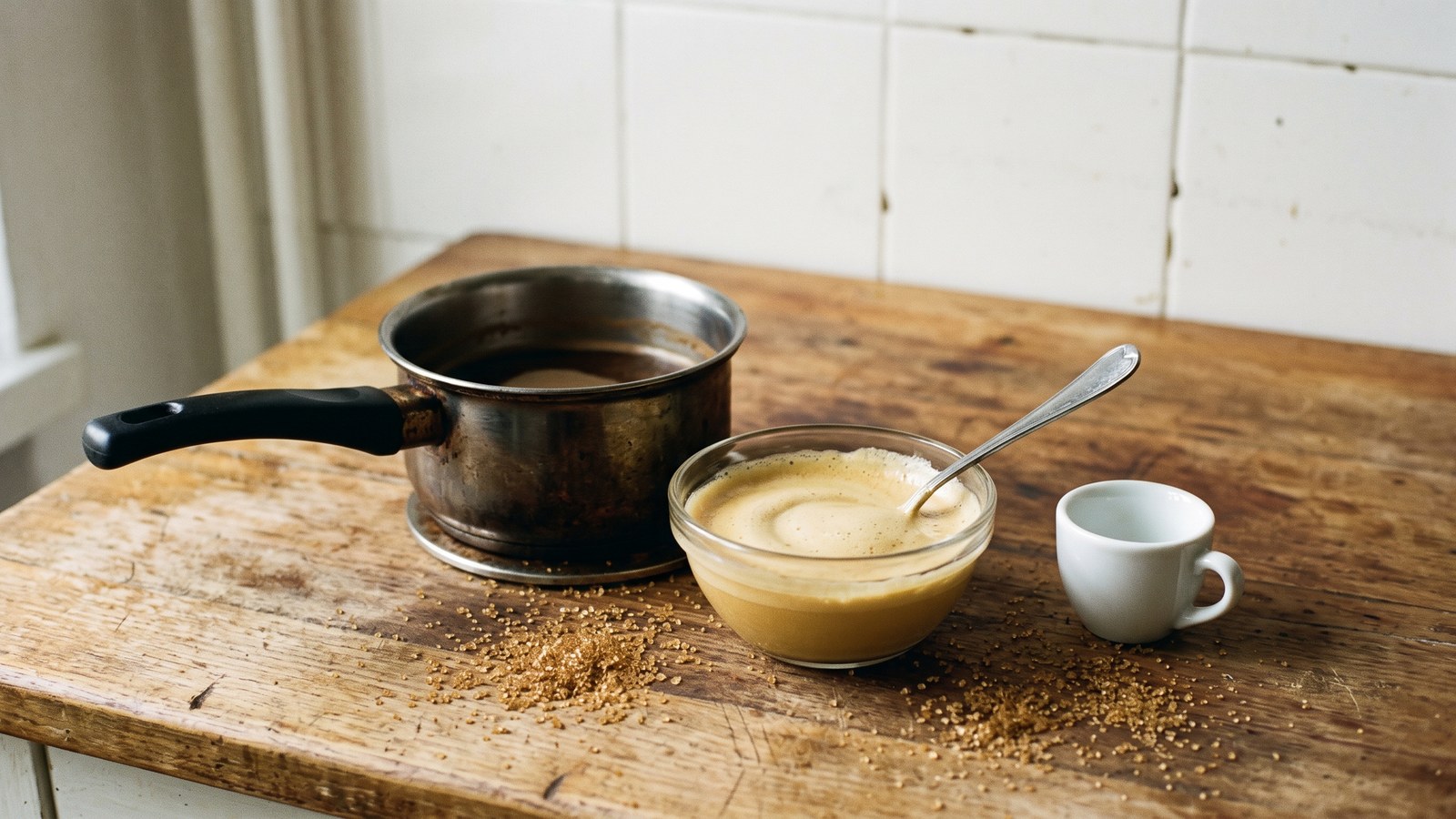
According to Wikipedia’s entry on Cuban espresso (opens in a new tab), the drink is an espresso shot sweetened with sugar, traditionally brown sugar, and often made in a moka pot. The signature step is to take a small amount of the first coffee out of the pot, add it to the sugar, and stir hard with a spoon until it becomes a creamy foam called espuma or espumita. The rest of the coffee goes in on top.
The University of Miami’s “Cafecito 101” (opens in a new tab) describes the same step, using the first teaspoon of brewed coffee, and says it gives a sweeter, more viscous result than adding sugar at the table. Wikipedia’s explanation is that hot coffee dissolves more sugar than cold sugar added later does. We’d treat that as the practical reason and not go further than that.
What changes without coffee
We haven’t tested this on a range of herbal grounds, so this is reasoning from the method, not test results.
- The foam may behave differently. The sources describe the foam as sugar and the first drops of brew, with no special ingredient, so a very strong chicory brew should get you part of the way. We can’t promise it will hold its shape as long as it does with espresso.
- Strength matters more than anything. The first spoonfuls need to be dark and concentrated. A weak brew just makes wet sugar. Our piece on why iced herbal coffee tastes watery explains why more grounds, not more time, is the fix.
- Roasted chicory is a good fit because it’s naturally caffeine-free and bitter enough to stand up to a lot of sugar. See our chicory brewing guide for the basics.
Caffeine-free cafecito, step by step
Makes two small cups, about two to three fluid ounces each, the size the University of Miami article gives for a cafecito.
You’ll need:
- 1 cup of water
- 3 heaping tablespoons of roasted chicory or other caffeine-free herbal grounds, medium to coarse grind
- 1 tablespoon of brown sugar, or demerara if you have it
Steps:
- Bring the water to a boil in a small saucepan, add the grounds, and turn the heat to low. Simmer gently for about 5 minutes, then let it stand for 2 minutes so the grounds settle.
- Put the sugar in a small bowl or a measuring jug.
- Spoon about a teaspoon of the hot brew from the top over the sugar.
- Stir hard and fast with a teaspoon for a minute or two. You want a thick, pale, creamy paste. If it’s gritty, add another few drops of brew.
- Strain the rest of the brew through a fine strainer into the foam, stirring gently to combine.
- Pour into two small cups, making sure each gets some foam on top. Serve right away.
The timings and amounts are our starting point, not a tradition. If it’s too sweet, cut the sugar. Brown sugar is a stand-in for the traditional kind, not a match.
If you want the other small-pot approach, our Turkish-style cezve method uses the same idea of a short, strong brew. And if you like a whipped sugar top on a cold drink, see the caffeine-free dalgona.
Colada, cortadito and café con leche
Cuban coffee comes in a few sizes. Per the Wikipedia entry, a colada is three to six shots in one cup with small plastic cups for sharing, a cortadito is espresso with steamed milk at roughly half and half to three quarters coffee, and café con leche is espresso served with hot milk. The Miami article adds that sharing a colada is part of the social ritual.
To scale up, multiply the recipe and keep the foam step in a larger bowl. For a cortadito, warm some milk and pour it over the foam in place of some of the brew. We haven’t tested non-dairy milks here, so use whichever you already like in coffee.
If the foam won’t come
- Gritty, no foam. The brew wasn’t concentrated enough, or there’s too much sugar for the amount of liquid. Add a few more drops and keep stirring.
- Thin and runny. Too much brew went in at once. Start with a teaspoon and add by the drop.
- Too bitter. It simmered too long, or the heat was too high. Stop at 5 minutes.
- Muddy cup. Use a finer strainer and leave the last bit in the pot, as chicory leaves sediment.
Before you buy anything
Read the ingredient list on whatever grounds you choose. Plain roasted chicory is a root, but many herbal coffees include barley or rye, which contain gluten, and some include nuts. If you have celiac disease or a tree nut allergy, confirm on the packaging itself, since formulas and labels change.
If you’re still choosing a base, our roundup of caffeine-free coffee alternatives is the place to start. The result won’t be a true Cuban cafecito, but it will be small, sweet and made with care, which is most of what people miss.
Sources & further reading
- Cuban espresso (opens in a new tab) — Wikipedia
- Cafecito 101 (opens in a new tab) — University of Miami News
Reader conversation (4)
We read every response. Selected reader notes below.
I tried this with chicory and the foam came together once I used less liquid. Starting with a teaspoon is the right advice.
That is useful to hear, Yaneisy. A very small amount of brew at the start seems to be the whole trick.
I quit coffee in the spring and miss the little cup more than the caffeine. Glad someone wrote for that.
Good that you said plainly that the foam might not hold like it does with espresso. I would rather know.
I grabbed a barley-based blend by mistake and only then read your note about gluten. Checking labels from now on.
Have something to add? Email us and we may include it in a future update.