Curry goat's real browning: burnt sugar in oil, not onions — a fifth curry physics
Trinidadian curry goat doesn't start with a bhuna. It starts by caramelizing sugar in hot oil until it's nearly black. Here's what that actually is, whether a roasted-root powder has any business near it, and the one real coffee precedent that turned up in a different Caribbean dish entirely.

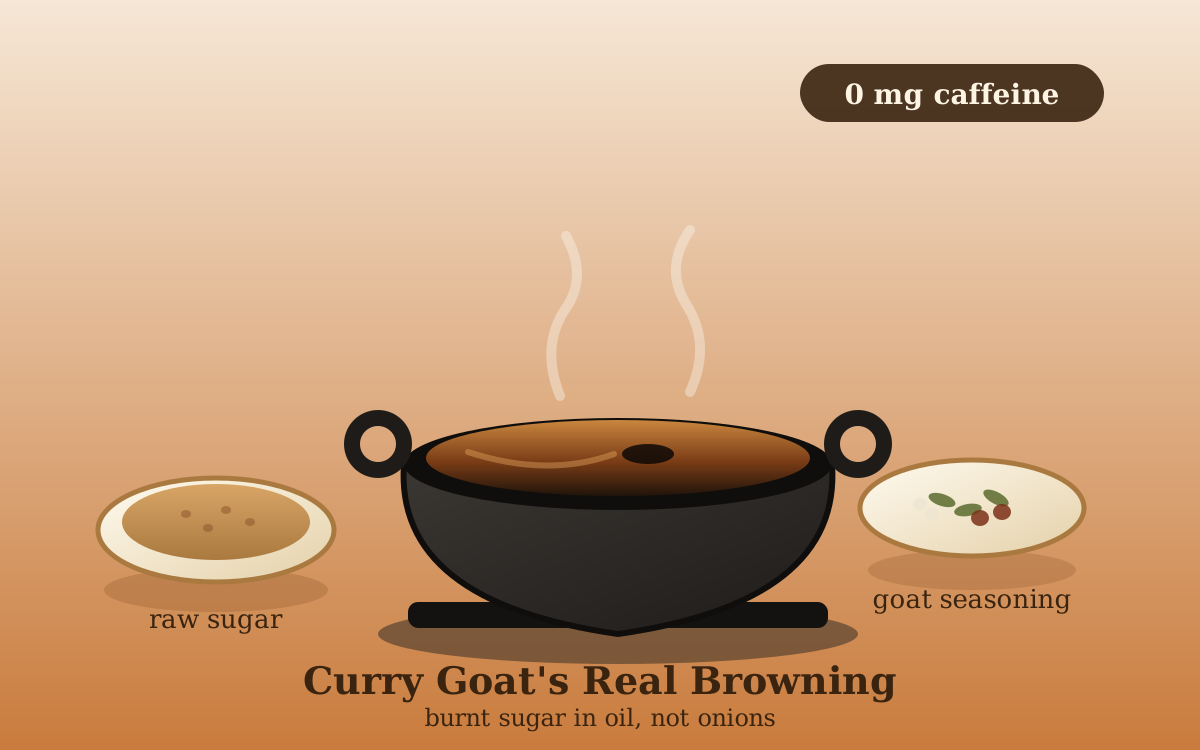
Owen Baptiste, in Port of Spain, has now sent us two ideas in a row, and this one landed the same day the curry-base piece went up. That piece worked out what a South Asian bhuna-style curry does before any liquid goes in — an hour of onion, garlic and whole spices frying down to a paste — and it said plainly that it was scoping itself to bhuna and to Japanese kare raisu, not to every curry tradition there is. Owen’s point: it left out the curry he actually grew up eating. Trinidadian curry goat doesn’t start with a bhuna at all. It starts with something else entirely, and calling it “browning” undersells how different the chemistry is.
Here’s the piece that gap earned — what curry goat’s browning stage actually is, why it isn’t the same reaction as bhuna’s onion-browning even though both dishes use the word, whether a roasted-root powder has any published business near either one, and the one real coffee precedent that turned up in Caribbean cooking, in a dish that isn’t curry goat at all.
The gap in the last piece
The curry-base piece drew a clean two-stage picture: a dry bhuna stage with no liquid, then a wetter stage once tomato or stock goes in, with the one documented coffee precedent — instant coffee in Japanese kare raisu — sitting at the very end of stage two. That structure doesn’t describe curry goat as it’s actually cooked across Trinidad, Jamaica, Guyana and the wider English-speaking Caribbean. Those recipes open with a step some call “browning” or “stewing down” the sugar, and it isn’t a variant of bhuna’s onion fry. It’s a different starting material, cooked to a different endpoint, by a different reaction, and it deserved its own piece rather than a footnote grafted onto the bhuna one.
What “browning” actually is in a pot of curry goat
CaribbeanPot’s ultimate curry goat recipe (opens in a new tab) — from Chris De La Rosa, who has documented Trinidadian home cooking for over fifteen years — describes the step plainly: heat oil in a deep, heavy pot on medium-high, add sugar, and let it melt, go frothy, and darken to a deep amber. No onion, no garlic, no meat yet — just sugar and oil, cooked until color says it’s ready. Go past amber toward black and the batch is ruined: the recipe’s own instruction is to stop, let the pot cool completely, wash it, and start over, because burnt sugar reads as straightforwardly bitter rather than richly dark. Cooking with Ria’s curry goat recipe (opens in a new tab), also rooted in Trinidadian home cooking, confirms the same sequence: sugar browned in oil first, seasoned goat added and coated in it next, and only then does anything wet touch the pot.
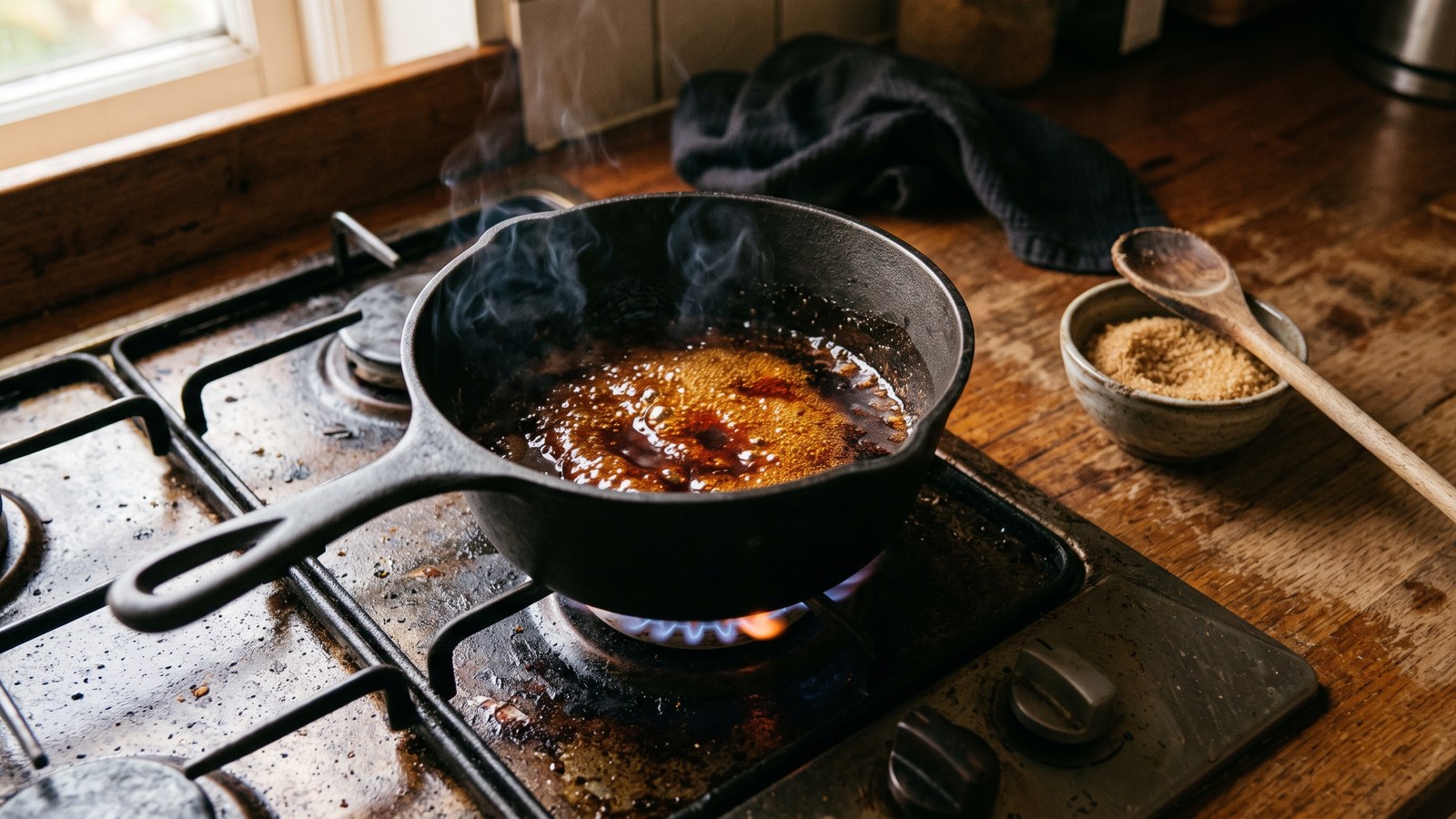
That’s the entire step. No onion is present to fry, no protein is present to brown, and there’s no dry-spice stage the way bhuna has one. It’s a single ingredient — sugar — undergoing a single, purely thermal change, and it’s done in a matter of minutes rather than the better part of an hour bhuna takes.
Caramelization and Maillard are not the same reaction
It’s tempting to file curry goat’s browning under the same heading as bhuna’s onion-browning, since both dishes call the step “browning” and both produce a dark, savory base. Food Republic’s explainer on the difference (opens in a new tab) is direct about why that’s wrong: caramelization is a reaction between sugar molecules alone, with no protein involved, while the Maillard reaction — the one responsible for bhuna’s onion browning, and for a seared steak’s crust — requires both an amino acid and a reducing sugar together. They aren’t two names for the same thing; they’re two different reactions that happen to both produce brown color and toasty flavor, which is exactly why the word “browning” hides the distinction instead of naming it.
The temperatures back that up. Formul.io’s comparison (opens in a new tab) puts sucrose caramelization’s onset at roughly 320–338°F (160–170°C), while the Maillard reaction generally gets going lower, around 285–300°F (141–149°C) — which tracks with bhuna needing a long, patient fry at stepped-down heat rather than a hard, fast melt. Neither Caribbean source above states a thermometer reading for curry goat’s browning step — like bhuna’s oil-separation marker in the last piece, the doneness signal here is color, not a number, and this is context for what’s actually happening in the pan rather than a claim about what any specific recipe writer measured.
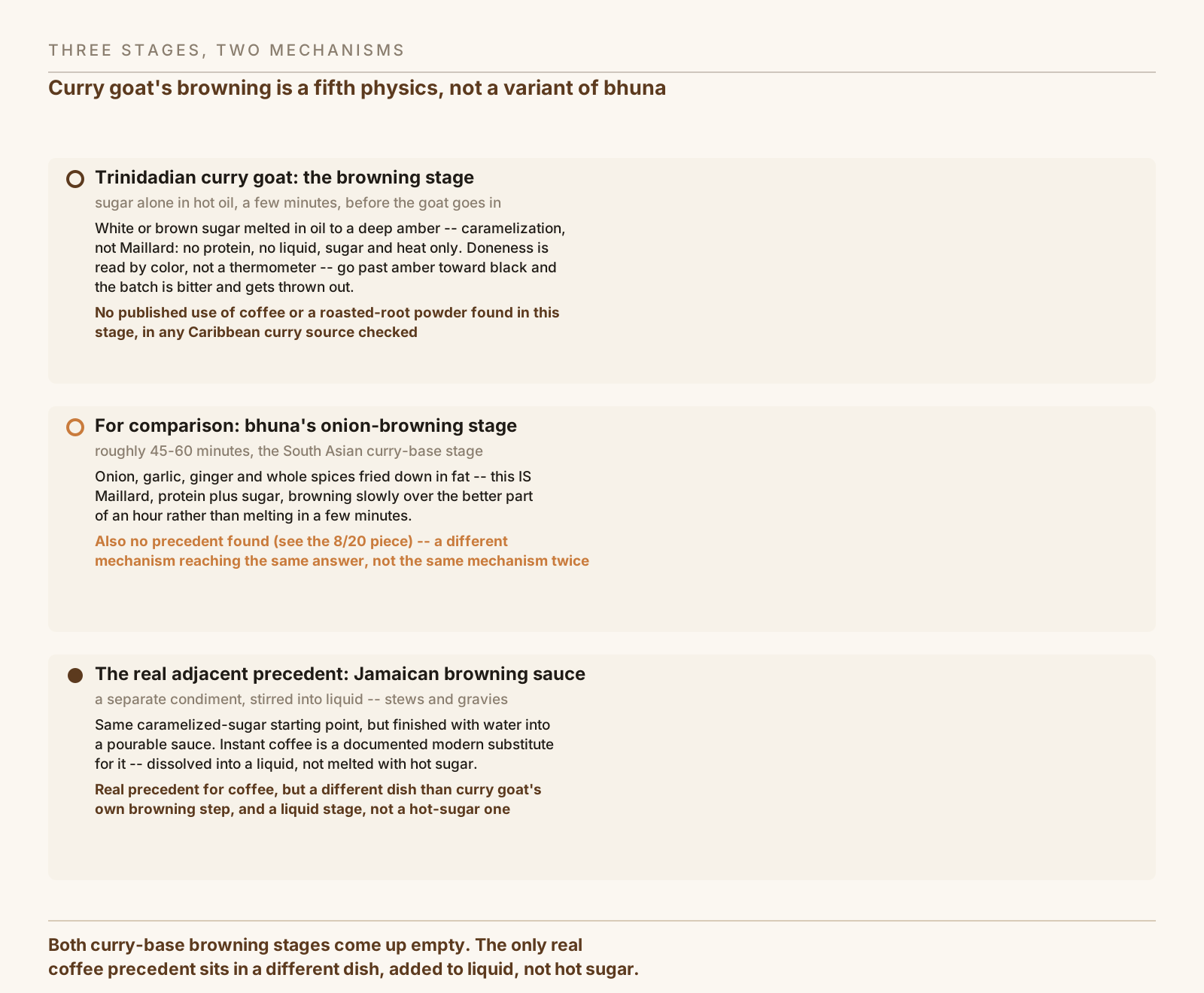
That’s a genuinely different answer than “curry goat is just Caribbean bhuna.” It’s a fifth physics this site has now documented for the roasted-root swap, alongside chili’s mostly-liquid pot, a dry rub’s surface-only crust, mole’s real reduction, and bhuna’s hour-long dry Maillard fry — and it doesn’t collapse into any of the other four.
Does coffee or a roasted-root powder go in Caribbean curry?
Searching specifically for coffee, chicory, or a roasted-root powder as an ingredient in Trinidadian, Jamaican, Guyanese or wider Caribbean curry — recipes, technique writeups, forum threads — turned up nothing. Caribbean curry powders themselves are built from coriander, cumin, allspice, fenugreek, turmeric and scotch bonnet, with no roasted-root component in any blend checked for this piece. That’s a genuine, checked absence, not an assumption carried over from the bhuna piece — the same honest outcome as the South Asian side of that search, reached independently and for an entirely different dish.
The real precedent — in a different dish
The search wasn’t a dead end everywhere, though — it’s just not where Owen’s question pointed. Tasting Table’s roundup of browning sauce substitutes (opens in a new tab) names instant coffee as a real, documented stand-in for Jamaican browning sauce — the bottled or homemade condiment made by cooking sugar down further with water into a pourable dark liquid, used to color and deepen stews, gravies, oxtail and soups. The substitute works two ways: dissolved into a small amount of hot water and whisked into a finished sauce, or massaged onto raw meat as a dry rub that turns into a glaze as it cooks.
This is a real precedent for coffee in Caribbean cooking — it’s just not the precedent Owen asked about. Browning sauce is a separate condiment from curry goat’s browning stage, made and used differently: it’s finished with water rather than left as hot melted sugar, and it’s stirred into a dish after the fact rather than being the pot’s first cooking step. The two share a starting point — caramelized sugar — and a name, and that’s exactly the kind of overlap that makes it easy to assume they’re the same thing when they aren’t.
So if you want to try it, where does it go
Putting the chemistry and the one real precedent together gives an honest answer, not a shrug.
| Stage | What’s happening | Roasted-root powder here? |
|---|---|---|
| The browning step (sugar alone, hot oil, a few minutes) | Pure caramelization, no protein, no liquid, judged by color | Not recommended. A dry powder in oil this hot is more likely to scorch than caramelize — reasoned from the chemistry, not tested |
| Meat goes in, coated in the browned sugar | Maillard now starts too, as the goat’s surface meets the hot pan | No precedent, and the powder would be competing with the meat’s own browning rather than adding anything distinct |
| Stock or water added, pot covered and stewed | A genuine liquid stage, closer to the “add and taste” case from the savoury and curry-base pieces | The closest real precedent — this is structurally where browning sauce and its coffee substitute actually get used: stirred into a liquid, not into hot sugar |
If you want to try the swap at all, the third row is the one with something real behind it: dissolve instant chicory or another extract-based instant powder into a small amount of hot water, the same way the browning-sauce substitute is used, and stir it in once the stock has gone into the pot — not during the sugar step. Start small and taste, the same caution every piece in this series has given, because nobody has published this specific substitution with a roasted-root powder standing in for the coffee.
What dissolves here, once more
The rule holds unchanged from the baking and savoury cooking pieces: an extract-based instant powder — instant chicory, Dandy Blend, Pero — dissolves cleanly into a hot liquid the way it dissolves into a batter or a pot of chili. Plain ground herbal coffee will settle as grit at the bottom of a curry stew, the same way it would anywhere else this swap has been tested. If a roasted-root powder is going into the liquid stage of curry goat, it needs to be the instant, extract-based kind.
The gluten note, again
Curry goat’s base — meat, sugar, oil, curry powder, garlic, thyme, scotch bonnet — is naturally gluten-free, unlike the roux-thickened Japanese curry the last piece covered. The risk is entirely in what gets added afterward: barley and rye contain gluten (opens in a new tab), and most instant coffee-substitute blends, Pero among them, are built on one or both. Plain instant chicory root or instant dandelion root are the reliable routes if that matters for who’s eating it.
Where to find an extract-based powder
The same extract-based instants that worked in the earlier pieces in this series apply here, since “dissolves cleanly into a hot liquid” is the property this stage needs. Dandy Blend, Pero and plain instant chicory are all straightforward choices. Among the blended instants, Teeccino’s instant French Roast (opens in a new tab) — roasted chicory and barley extract with a microground carob, ramón seed and date component — would dissolve into a curry goat’s stewing liquid the same way it dissolves into a cup, added at the same late, stock-stage point this piece landed on. It’s built on barley, so the gluten note above applies to it directly.
What’s sourced, and what’s reasoned
Two things in this piece are sourced, not guessed: the browning method itself, from two independent Trinidadian home-cooking sources that agree on the sequence and the color-based doneness test, and the caramelization-versus-Maillard chemistry, from a food-science explainer and a direct temperature comparison. The absence — no coffee or roasted-root precedent in Caribbean curry itself — is a real, checked finding, the same kind of honest gap the curry-base piece reported for bhuna.
What isn’t sourced is the recommendation against putting a roasted-root powder into the hot-sugar stage. That’s reasoned from the temperatures and the chemistry — a dry powder scorching rather than caramelizing — not from anyone having actually tried it and reported a burnt pan back to us. If you try it anyway, in either stage, we’d genuinely like to know what happened, the same offer this series has made every time.
Thank you, Owen, for pointing out that “curry” was doing a lot of unexamined work in the last piece’s title. For the two pieces this one sits beside, the curry-base piece has the full bhuna timeline and the Japanese kare raisu precedent, and the savoury cooking piece has the sugar-and-salt bitterness math for chili, rubs and mole that this one leaned on for the “taste before you commit” caution.
Sources & further reading
- The Ultimate Curry Goat Recipe (opens in a new tab) — CaribbeanPot.com
- Authentic Curry Goat Recipe (Trinidad) (opens in a new tab) — Cooking with Ria
- 14 Best Browning Sauce Substitutes To Use Instead (opens in a new tab) — Tasting Table
- The Real Difference Between The Maillard Reaction And Caramelization (opens in a new tab) — Food Republic
- Maillard Reaction vs Caramelization: Temperatures Compared (opens in a new tab) — Formul.io
- What Is 'Bhuna'? The Browning Stage Behind Deep Curry Flavor (opens in a new tab) — The Culinary Gene
- Sources of Gluten — barley and rye are not gluten-free (opens in a new tab) — Celiac Disease Foundation
Reader conversation (5)
We read every response. Selected reader notes below.
This is exactly the piece I was hoping for, and you kept the two dishes properly separated instead of collapsing them into one “browning” story, which I half expected. One small thing from my own kitchen: some households use white sugar instead of brown for this step, and it goes a shade lighter at the same doneness point — still the same reaction, just a slightly different starting color to judge against.
Good addition, and worth saying plainly since neither source I used specified which sugar: CaribbeanPot’s and Cooking with Ria’s recipes don’t call out white versus brown explicitly, so if the color cue is the only doneness marker either way, that’s one more reason a home cook needs to watch their own pot rather than match a photo exactly.
Can confirm the browning-sauce distinction is real and not a technicality — Grace browning is a bottled product on basically every Jamaican pantry shelf, sold separately from anything you’d use to start a curry, and it goes into brown stew chicken, oxtail and gravy more than it goes into curry specifically. I have used instant coffee as a stand-in when I ran out, dissolved in a spoon of hot water first. Works fine for color and a little bitterness. Never once occurred to me to try it in the curry-goat pot itself.
Isn’t “probably not, but I haven’t tested it” doing a lot of work here? Feels like you’re hedging a guess as caution.
Fair to push on, so let me separate the two things I’m actually claiming. The temperature gap is sourced: caramelization runs a good 30-40 degrees Fahrenheit hotter than where Maillard even starts, and a dry powder has none of sucrose’s chemistry to actually caramelize with. What I don’t have is anyone’s burnt pan to point to, which is why the piece calls it reasoned rather than tested and says so in those words, instead of stating it as a finding the way the sourced sections are stated. If someone tries it and it goes fine, I’d genuinely want to know and would correct the piece.
My grandmother called it “burning the sugar” rather than “browning,” which I think is actually the more honest name for what’s happening in that pot — you’re not far from burnt at any point in the process, and the whole skill of it is stopping at the right second. Good piece.
The Maillard-versus-caramelization distinction is one of those things that seems obvious once it’s stated and that I’d never actually had explained for a real dish before. Appreciate that you gave both a temperature range instead of just asserting “different reaction” and leaving it there.
Have something to add? Email us and we may include it in a future update.