Caffeine-free Turkish-style coffee: the cezve method works without coffee, and the foam is the part to watch
Turkish coffee is a method before it is a bean: powder-fine grounds, cold water, a small pot and low heat. How to run that method with roasted chicory or other herbal grounds, what carries over, and the one result you shouldn't count on.

Most caffeine-free coffee advice assumes a mug and a filter. Turkish coffee is a different thing: a tiny pot, a flame and a cup you drink from the top. If you’ve missed that ritual, or you’re curious about it, almost everything that defines it is technique, not coffee.
A method, not a bean
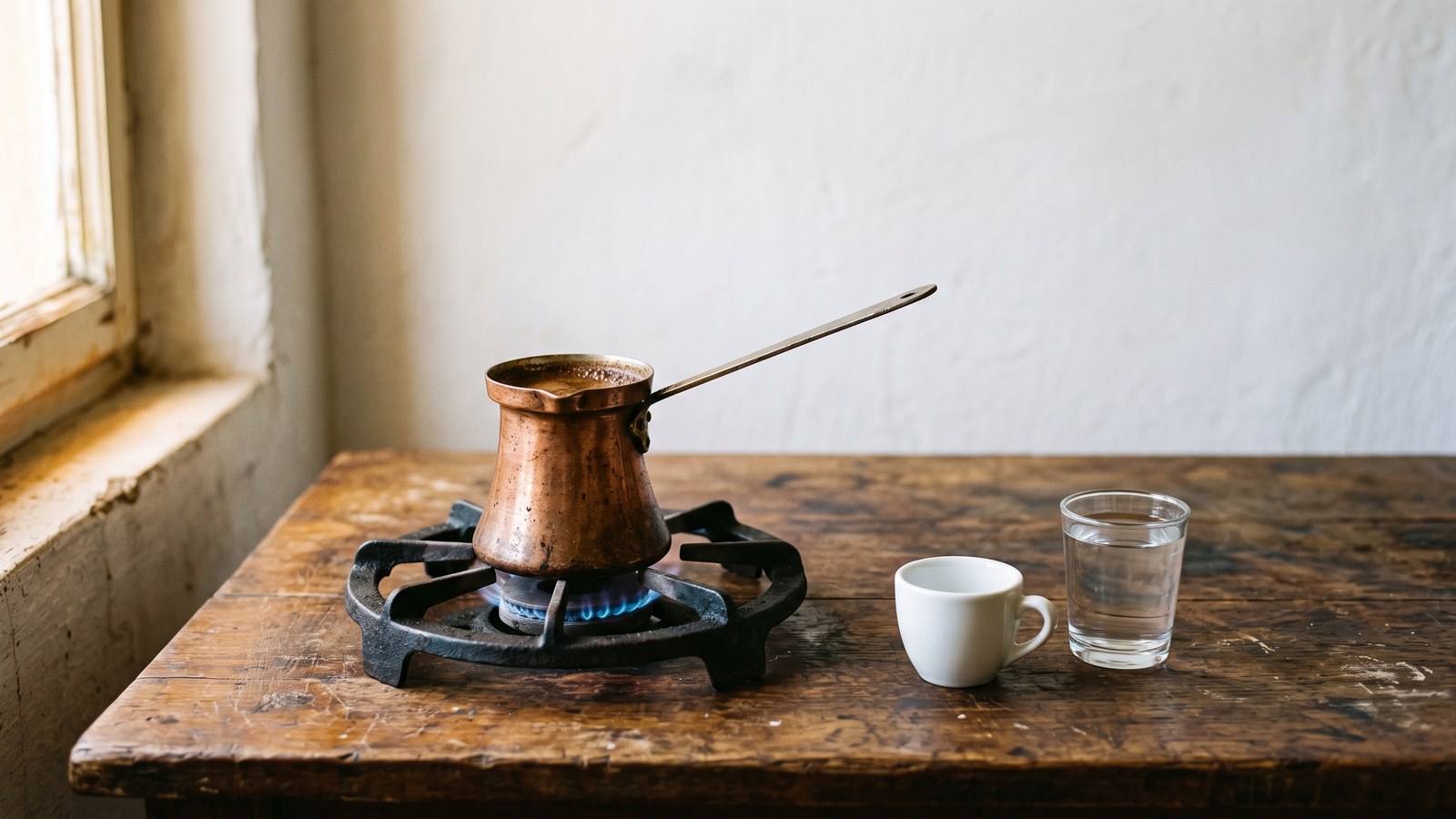
UNESCO’s entry for Turkish coffee (opens in a new tab), inscribed in 2013, describes freshly roasted beans ground to a fine powder, then ground coffee, cold water and sugar added to a coffee pot and brewed slowly on a stove, served in small cups with a glass of water. What it protects is the practice and the social setting around it, not a particular recipe or ingredient.
That’s useful to us. Strictly speaking, a version made with chicory isn’t Turkish coffee, and we won’t call it that. But the method, the one that makes the drink so different from drip, doesn’t care what the grounds are. For how the drink shows up in cafes, our guide to ordering caffeine-free in Turkey, the Balkans and North Africa covers that side.
What carries over, and what doesn’t
We haven’t tested every herbal grounds on the market, so treat the split below as reasoning from how the method works, not as test results.
Likely to carry over
- Strength and body. Because the grounds stay in the cup, you drink everything the water pulled out, plus the fine solids. That gives a thick, heavy cup, which suits roasted chicory’s bitter edge. It’s the same logic as the brew-strong advice in our chicory brewing guide.
- The slow ramp. Starting from cold water and heating gently is a method choice, not a coffee property.
- The ritual. A small cup, a glass of water and a slower pace need no beans at all.
Not guaranteed
- The foam. The rise in the pot depends on how the grounds behave in heating water. We haven’t verified that a chicory or herbal grind rises the way coffee does. Expect a thinner layer, or none. If you want a dependable foam, our dalgona and egg coffee pieces build it separately.
- Fine enough grounds. See the grind section below.
Caffeine-free Turkish-style coffee, step by step
This follows the standard approach described by Food Türkiye (opens in a new tab): about one heaping teaspoon of grounds per cup, low heat throughout, sugar added at the start rather than stirred in later, and two rises. We’ve swapped in caffeine-free grounds.
You’ll need (one small cup):
- 1 small cup of cold water, measured using the serving cup
- 1 heaping teaspoon of roasted chicory or other caffeine-free herbal grounds, ground to a fine powder
- Sugar, optional, to taste
- A cezve or very small saucepan, and a small cup
Steps:
- Put the water, grounds and any sugar in the pot together. Stir once to wet the grounds.
- Heat on low. Don’t walk away.
- When the surface starts to rise, take the pot off the heat just as it climbs.
- Spoon a little of whatever foam formed into the cup. If nothing formed, skip this.
- Return to the heat for a few seconds to let it rise once more, then pour slowly into the cup.
- Let it settle for a minute so the grounds sink, and serve with a glass of water.
Drink it without milk, from the top, and leave the sludge. The same advice as in our piece on why iced herbal coffee tastes watery applies: if the cup tastes thin, use more grounds rather than heating it longer.
The grind problem
The real limitation is the grind. The method calls for a powder finer than espresso. Most packaged chicory and herbal coffees are sold as a coarse or medium grind meant for a filter, and those are likely to give a gritty cup in a cezve. Options:
- Look for grounds sold as extra-fine or Turkish grind, and check that the ingredient list is a plain roasted root.
- Regrind what you have in a grinder that can reach powder-fine. We haven’t tested how chicory behaves in different grinders, so start with a small amount.
- Try an instant herbal coffee powder in the pot. It’s already fine, though it won’t behave like roasted grounds. Treat it as an experiment.
If it’s gritty, flat or bitter
- Gritty. The grind is probably too coarse. Regrind finer, or let the cup settle longer before sipping.
- Thin or flat. Add more grounds, not more time.
- Too bitter. The heat may have been too high or the pot may have sat too long. Start again on lower heat and take it off the flame at the first rise.
- No foam. Possible with some grounds. It doesn’t mean you did anything wrong.
Before you buy anything
Check the label before you grind. If you have celiac disease, remember that many herbal coffees use barley or rye, which contain gluten, and plain roasted chicory is a root, not a grain. For allergen details on any specific brand, confirm on the packaging, since labels change.
If you’d like help choosing a base, our roundup of caffeine-free coffee alternatives is the place to start. The cup you end up with won’t be traditional Turkish coffee, but it will be small, dark and slow, which is most of what people miss.
Sources & further reading
- Turkish coffee culture and tradition (opens in a new tab) — UNESCO Intangible Cultural Heritage
- Turkish Coffee: What It Is and How to Make It (opens in a new tab) — Food Türkiye
Reader conversation (4)
We read every response. Selected reader notes below.
I grew up with this ritual and gave up caffeine last year. The glass of water on the side is something people forget. I’ll try it with chicory and see what the foam does.
Please do. The foam is the part we couldn’t promise, so what you see is useful to everyone reading.
My grinder doesn’t go fine enough for this. Is the instant powder route worth trying or will it just taste like instant?
It will behave differently from roasted grounds, so treat it as an experiment. Use a small amount first and see how you like the body.
Helpful that you flagged barley and rye. My daughter has celiac and I’d have assumed all herbal coffee was safe.
I like that the piece admits the foam isn’t guaranteed. Most recipe posts promise things they haven’t checked.
Have something to add? Email us and we may include it in a future update.